Aquaculture


Share
抄録
Biophysical impacts of aquaculture, with consequences for biodiversity, vary with species and culture systems and include issues such as: nutrient enrichment/removal, chemicals, land use, species introductions, genetic flow to wild populations, disturbance of balance or introduction of pathogen/parasites, consumption of capture fishery resources, energy, and greenhouse gas emissions. Guiding principles, labeling schemes and various tools are needed to analyze performance and conformance. Ecological footprints and life-cycle analysis aim to capture biophysical performance, including up- and downstream effects of policy decisions. Aquaculture provides a range of services but also makes demands and impacts on ecosystem functions, services, and thus biodiversity.
記述
This article is a revision of the previous edition article by Kautsky, N., Folke, C., Rönnbäck, P., Troell, M., Beveridge, M., Primavera, J., Volume 1, pp. 185-198, © 2001, Elsevier Inc.
Suggested Citation
Troell, M., Kautsky, N., Beveridge, M., Henriksson, P., Primavera, J., Rönnbäck, P., & Folke, C. (2013). Aquaculture. In S. A. Levin (Ed.), Encyclopedia of Biodiversity (2nd ed., Vol. 1, pp. 189-201). Waltham: Academic Press.
Type
Book chapterCollections
- Books and Book Chapters [123]
Related items
Showing items related by title, author, creator and subject.
-
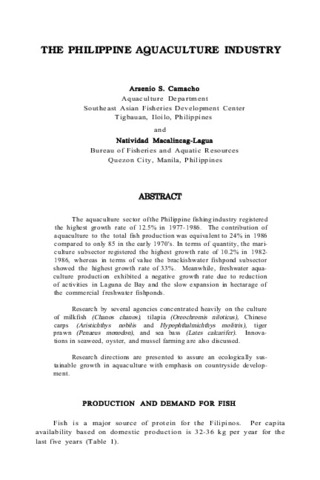
The Philippine aquaculture industry
(Aquaculture Department, Southeast Asian Fisheries Development Center, 1988)The aquaculture sector of the Philippine fishing industry registered the highest growth rate of 12.5% in 1977-1986. The contribution of aquaculture to the total fish production was equivalent to 24% in 1986 compared to only 85 in the early 1970's. In terms of quantity, the mariculture subsector registered the highest growth rate of 10.2% in 1982-1986, whereas in terms of value the brackishwater fishpond subsector showed the highest growth rate of 33%. Meanwhile, freshwater aquaculture production exhibited a negative growth rate due to reduction of activities in Laguna de Bay and the slow expansion in hectarage of the commercial freshwater fishponds. Research by several agencies concentrated heavily on the culture of milkfish (Chanos chanos), tilapia (Oreochromis niloticus), Chinese carps (Aristichthys nobilis and Hypophthalmichthys molitrix), tiger prawn (Penaeus monodon), and sea bass (Lates calcarifer). Innovations in seaweed, oyster, and mussel farming are also discussed. Research directions are presented to assure an ecologically sustainable growth in aquaculture with emphasis on countryside development. -
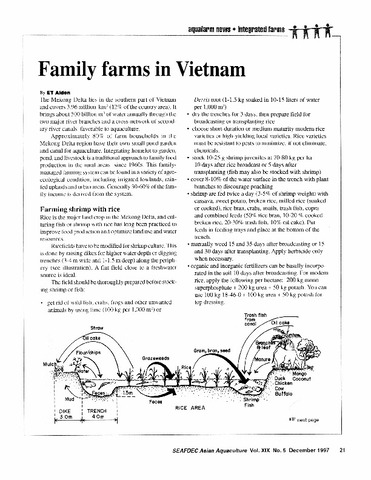
Family farms in Vietnam
(Aquaculture Department, Southeast Asian Fisheries Development Center, 1997) -
Nursery and grow-out operation and management of Penaeus monodon (Fabricius)
(Aquaculture Department, Southeast Asian Fisheries Development Center, 1988)The results of research on nursery and grow-out rearing of prawn conducted by the SEAFDEC Aquaculture Department for over a decade are reviewed. Different rearing facilities designed to accommodate hatchery-produced prawn fry are presented with corresponding data on growth, survival and production. Studies on stocking density, fertilization/natural food production, water management, feeds and feeding schemes and harvest/post-harvest handling are evaluated and viable technology identified. Diseases, pests and predators and other factors considered as production constraints are also mentioned. The success in hatchery operation for prawn coupled by the gradual emergence of nursery and grow-out rearing technology have triggered off a technology-dependent prawn industry. When SEAFDEC AQD was established in 1973, there were very few commercial prawn monoculture ventures in the country. Prawn pond production was mostly an incidental crop in milkfish culture. At present, various prawn grow-out techniques ranging from extensive, semi-intensive and intensive culture systems are in practice. SEAFDEC AQD focused its research on the extensive and semi-intensive culture systems which are within the reach of most farmers in contrast to the intensive system that is highly capital-intensive. There have been much work done in nursery and grow-out operations, but much remains to be done in research, among which are the development of nutritionally-efficient and low-cost feed, control of diseases, etc.