Quarterly Research Reports: Recent submissions
Now showing items 1-20 of 125
-
Preliminary studies on predicting the setting season of oysters for the benefit of shellfish farmers
(Aquaculture Department, Southeast Asian Fisheries Development Center, 1981)Preliminary findings from a spatfall forecasting programme initiated in April 1981 at Himamaylan River, Negros Occidental are presented. Two main activities are involved: 1) monitoring of daily counts of oyster larvae in the plankton; and 2) monitoring of actual setting of oysters on standardized collectors put in the vicinity of oyster farm sites. Findings indicate that when the count of mature larvae exceeds 5 per 100 ml sample and persists for at least 3 days, spat may be expected to occur shortly afterwards. -
Acute toxicity of un ionized ammonia to milkfish (Chanos chanos) fingerlings
(Aquaculture Department, Southeast Asian Fisheries Development Center, 1981)The acute toxicity of un-ionized ammonia to milkfish (Chanos chanos) fingerlings was determined using a static bioassay system. Median lethal concentrations found show that milkfish fingerlings have a high tolerance to ammonia and it is unlikely that levels as high as those employed for the acute exposure would be found to occur under natural conditions. Although the threat of acute toxicological effects induced by ammonia are remote, such conditions might be encountered in stressed natural environments or in heavily loaded aquaculture systems. -
Gum arabic, carrageenan of various types and sago palm starch as binders in prawn diets
(Aquaculture Department, Southeast Asian Fisheries Development Center, 1981)An experiment was undertaken in order to investigate the use of sago palm starch, gum arabic and carrageenans as binders in prawn diets. Water stability data are presented; EPT-2 carrageenan was found to be the best binder for both steamed and unsteamed pellets. -
Effect of varying crude protein levels on spawning frequency and growth of Sarotherodon niloticus breeders
(Aquaculture Department, Southeast Asian Fisheries Development Center, 1981)Four-month-old S. niloticus breeders were fed with dry pellets containing 20-50% crude protein and the frequency of spawning involving removal of egg from the mouthbrooding females and growth were determined. When the diets contain high quality proteins from fish meal and soybean oil meal and the amounts of daily food allowance are at satiation level, the influence of increasing dietary crude protein on spawning frequency involving egg removal from the brooder and growth may not be significant. -
Effects of exogenous hormone injections on milt consistency in newly caught, wild milkfish
(Aquaculture Department, Southeast Asian Fisheries Development Center, 1981)A study was conducted to determine the effects of single injections of human chorionic gonadotropin (HCG) and Durandron Forte 250 on sperm motility, vitality and density and also on the consistency of milt in newly caught, wild, mature milkfish (Chanos chanos). In contrast to HCG, single injections of Durandron Forte 250 were effective not only in inducing spermiation but also in maintaining newly caught mature males in good running condition for a maximum of 7 days, despite daily handling and collection of approximately 3ml milt. -
Effects of 2-phenoxy ethanol and MS-222 on milkfish fingerlings (Chanos chanos) as anaesthetic agents
(Aquaculture Department, Southeast Asian Fisheries Development Center, 1981)An experiment was undertaken in order to determine an adequate anaesthetic and optimum concentrations for use in the handling of fingerling milkfish (Chanos chanos). The compounds 2-phenoxy ethanol and MS-222 were investigated. Results show the latter to be adequate with optimum concentrations between 100 and 200 ppm. -
Survival and changes in the fine structure of selected tissues of Penaeus monodon Fabricius juveniles fed various carbohydrates
(Aquaculture Department, Southeast Asian Fisheries Development Center, 1981)Penaeus monodon juveniles were reared on semipurified diets containing various carbohydrates (maltose, sucrose, dextrin, molasses, cassava starch, corn starch or sago palm starch). Significant differences were observed between the type as well as the level of carbohydrate in the diet on the survival of the juveniles. Results indicate that there does not seem to be any correlation between survival and the complexity of the carbohydrates. -
Dietary crude protein requirement of Tilapia nilotica fry
(Aquaculture Department, Southeast Asian Fisheries Development Center, 1981)To determine growth and survival of Tilapia nilotica fry fed formulated practical dry diets with varying crude protein levels, fish were subjected to 3 seperate feeding trials. Isocaloric practical diets containing 20, 25, 30 and 35% crude protein were fed to fry at 15% fish biomass daily for 7 weeks in 2 trials and another set containing 20, 25, 30, 35, 40, 45 and 50% was given for 8 weeks. On the basis of growth, survival and feed conversion, T. nilotica fry required 35% crude protein in the practical diets given at 15% fish biomass. -
Gill lesions associated with acute exposure to ammonia
(Aquaculture Department, Southeast Asian Fisheries Development Center, 1981)Histopathological effects of ammonia on the gills of milkfish (Chanos chanos) fingerlings were examined qualitatively. -
Effects of temperature on behavior, growth, development and survival of young milkfish, Chanos chanos Forsskal
(Aquaculture Department, Southeast Asian Fisheries Development Center, 1981)The effects of 3 temperature treatments on activity, feeding, growth, development and survival of young milkfish (Chanos chanos) were investigated under laboratory conditions. It is believed that the results may be applied to develop a land-based mass production technology in rearing milkfish fry to fingerlings. -
The water stability of shrimp diets with various polysaccharides as a binding agent
(Aquaculture Department, Southeast Asian Fisheries Development Center, 1981)The water stability of shrimp (Penaeus monodon) diets with various polysaccharides as binding agents were tested without steaming. The diet with alginate showed the best water stability and did not completely disintegrate in 24 hours. However, the use of alginate is dependent on cost and availability, so alternate choices may be a combination of sago palm starch and wheat flour or glutinous rice flour. -
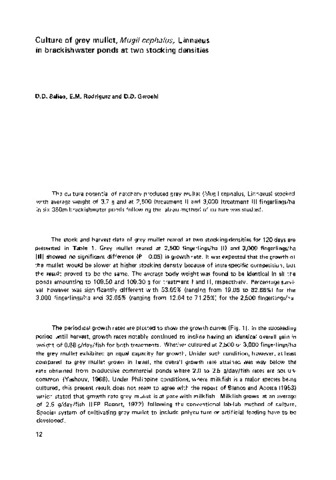
Culture of grey mullet, Mugil cephalus, Linnaeus in brackishwater ponds at two stocking densities
(Aquaculture Department, Southeast Asian Fisheries Development Center, 1981)The culture potential of hatchery-produced grey mullet (Mugil cephalus , Linnaeus) stocked with average weight of 3.7 g and at 2,500 (treatment I) and 3,000 (treatment II) fingerlings/ha in six 350m brackishwater ponds following the lab-ab method of culture was studied. -
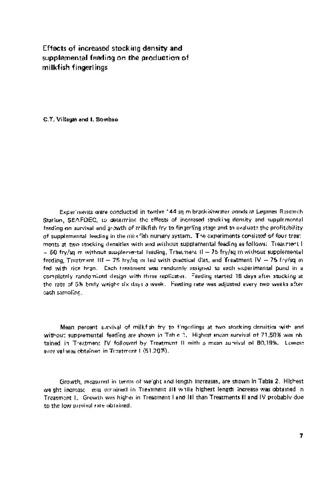
Effects of increased stocking density and supplemental feeding on the production of milkfish fingerlings
(Aquaculture Department, Southeast Asian Fisheries Development Center, 1981)Experiments were conducted to determine the effects of increased stocking density and supplemental feeding on survival and growth of milkfish (Chanos chanos) fry to fingerling stage and also to evaluate the profitability of supplemental feeding in the milkfish fry nursery. Results showed that increased stocking density from 50 to 75 fry/m2 increased net income and is profitable. Survival was further increased through supplemental feeding with rice bran, which is cheap and easily obtainable. -
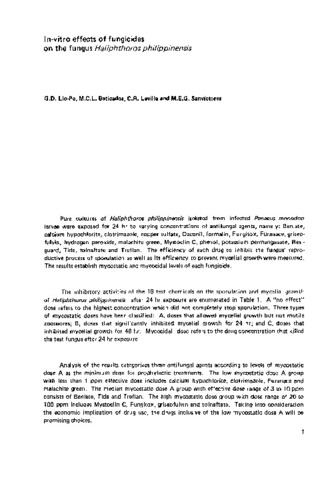
In vitro effects of fungicides on the fungus Haliphthoros philippinensis
(Aquaculture Department, Southeast Asian Fisheries Development Center, 1981)Pure cultures of Haliphthoros philippinensis, isolated from infected Penaeus monodon larvae, were exposed for 24 hours to varying concentrations of antifungal agents. The efficiency of each agent to inhibit sporulation and mycelial growth was measured. Effects on P. monodon eggs and larvae were also investigated. It is concluded that preliminary bioassay of larval tolerance to the suggested effective doses should always be made prior to prophylaxix or therapeutic applications. -
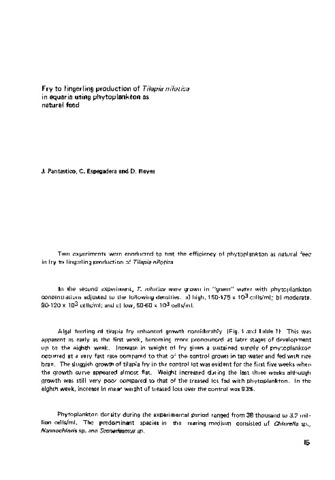
Fry to fingerling production of Tilapia nilotica in aquaria using phytoplankton as natural feed
(Aquaculture Department, Southeast Asian Fisheries Development Center, 1981)Overall results of the study indicate that the availability of high concentrations of phyloplankton in the rearing medium favoured growth of T. nilotica fry to fingerling. -
Culture of the mud crab, Scylla serrata (Forskal) at different stocking densities in brackishwater ponds
(Aquaculture Department, Southeast Asian Fisheries Development Center, 1981)The mean weight percentage survival, relative growth increment, net production and feed conversion value of S. serrata stocked in monoculture at different stocking densities are presented. -
Survival, growth and production of Penaeus monodon and P. indicus at different density combinations with milkfish
(Aquaculture Department, Southeast Asian Fisheries Development Center, 1981)Penaeus monodon and P. indicus juveniles were stocked and reared for about 3 months in earthen ponds at different density combinations with Chanos chanos. The presence of either Penaeus species at any density ratio did not affect significantly the C. chanos survival. Survival rates of the penaeids indicated that intraspecific and interspecific competition occurred and were reduced with the reduction in stocking rate. It is concluded that further studies on higher density ratios and feeding and economic consideration would be of help to the development of this kind of fishpond management system. -
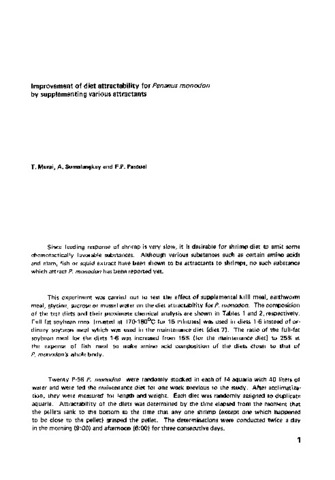
Improvement of diet attractability for Penaeus monodon by supplementing various attractants
(Aquaculture Department, Southeast Asian Fisheries Development Center, 1981)An experiment was undertaken to test the effect of supplemental krill meal, earthworm meal, glycine, sucrose or mussel water on diet attractibility of Penaeus monodon. Only glycine or mussel water significantly improved diet attractibility. -
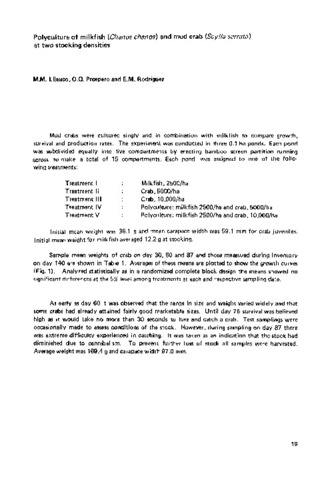
Polyculture of milkfish (Chanos chanos) and mud crab (Scylla serrata) at two stocking densities
(Aquaculture Department, Southeast Asian Fisheries Development Center, 1980)Mud crabs (Scylla serrata) were cultured singly and in combination with milkfish (Chanos chanos) to compare growth, survival and production rates. Net production of crab was higher in polyculture than monoculture, but the reverse was observed for milkfish. -
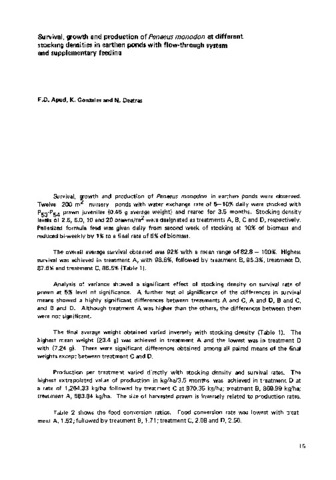
Survival, growth and production of Penaeus monodon at different stocking densities in earthen ponds with flow-through system and supplementary feeding
(Aquaculture Department, Southeast Asian Fisheries Development Center, 1980)The survival, growth and production of Penaeus monodon in earthen ponds were observed. A significant effect of stocking density on the survival rate of prawns was observed. The final average weight obtained varied inversly with the stocking density and the production varied directly with stocking density and survival rates. The maintenance of a clear water environment is recommended as a preventive measure against Vorticella attack.