Books and Book Chapters: Recent submissions
61-80 / 123
-
Series: ACIAR Monograph 110
Localisation of enzymes in the digestive system during early development of the grouper (Epinephelus coioides)
(Australian Centre for International Agricultural Research, 2004)This study was undertaken to investigate the occurrence of some digestive enzymes in the gastrointestinal tract during early development in the grouper. This work was conducted to provide information on formulating an appropriate feeding scheme and an artificial diet for the early development of the grouper, Epinephelus coioides. Larvae of E. coioides were reared in 5 tonne rectangular concrete tanks. The digestive enzymes localized were acid phosphatase (ACP), alkaline phosphatase (ALP), nonspecific esterase (NSE), aminopeptidase (AMP), trypsin (TRP), maltase (MAL) and lipase (LIP). Weak enzyme activity occurred during the yolk sac stage. High AMP activity started at day 14 prior to Artemia feeding at day 16. Fluctuations in TRP activity might be related to stomach formation. Occurrence of MAL during early development demonstrated a capacity to digest carbohydrates. An increase in LIP activity coincided with the occurrence of gastric glands. Insignificant changes in digestive enzymes were observed in the metamorphosing grouper larvae from day 40 to 60. -
Series: ACIAR Monograph 110
Changes in the gastrointestinal tract and associated organs during early development of the grouper (Epinephelus coioides)
(Australian Centre for International Agricultural Research, 2004)The histomorphological changes in the gastrointestinal tract of Epinephelus coioides and associated organs during its early development were studied. Larvae of E. coioides were reared in 5-tonne tanks using the semi-intensive culture system. Larval samples were collected at days 0, 2, 4, 6, 8, 10, 12, 14, 16, 20, 25, 30, 35, 40, 45 and 60. The total length (TL) of about 10-20 larvae per sampling was measured. At least 3 samples were examined from each stage for longitudinal sections using light microscopy. The digestive tract of day 0 larvae was a straight, undifferentiated tube composed of simple cuboidal cells. At day 2, cellular differentiation was observed in the pharynx, oesophagus, primordial stomach and intestine. The primordial stomach broadened into a voluminous pouch at day 10. The gastric gland was observed in the stomach from day 20. Day 35 seemed to be the proper time to feed larvae with minced fish when using the semi-intensive rearing system. Insignificant histomorphological changes in the metamorphosing grouper larvae were observed from days 40-60. -
Series: ACIAR Monograph 110
Environmental factors affecting embryonic development, hatching and survival of early stage larvae of the grouper (Epinephelus coioides)
(Australian Centre for International Agricultural Research, 2004)These series of experiments were conducted to determine the effects of density (200, 400, 800 and 1600 eggs/litre), salinity (8, 16, 24, 32 and 40 ppt), aeration (0, 0.62, 1.25, 2.50 and 3.75 ml/min/litre) and light intensity (0, 120, 230, 500 and 700 lx) on the survival of fertilized eggs and early stage larvae of Epinephelus coioides. Under statice incubation conditions, the highest egg viability, hatching rate and percentage of normal larvae were obtained at a stocking density of 400 eggs/litre with moderate aeration (100 ml/min) and salinity of 32-42 ppt. Gentle aeration at 0.62 to 1.25 ml/min/litre, rearing water of 16 to 24 ppt and a light intensity of 500 to 700 lx maximized the survival of early stage E. coioides larvae in the hatchery. -
Infectious diseases of warmwater fish in fresh water
(CABI Publishing, 2014)This chapter presents the viral, bacterial, pseudofungal and parasitic diseases in cultured warm freshwater fish. Focus is given on the distribution, causative agent, pathology, diagnosis, prevention and control of these diseases. -
Market and fisheries development issues in coastal resources management
(Department of Agriculture - Bureau of Agricultural Research, 2013)This chapter suggests that the market, as an economic and social institution, has important roles and a multitude of opportunities to contribute to the strategies for managing the crisis, in fisheries. The crisis apparently was an outcome of the complex interplay of variables such as increasing fishing pressure, depleting fish stocks, low income among small-scale fishers, social inequity in the fishery sector and inadequate management of the fishery and related resources. -
Nursery and grow-out culture of Asian seabass, Lates calcarifer, in selected countries in Southeast Asia
(CRC Press, 2014)In this chapter, the practices of growing Asian seabass in nursery and grow-out culture systems in selected Southeast Asian countries like the Philippines, Thailand and Indonesia are described. -
Reproductive biology of the Asian seabass, Lates calcarifer
(CRC Press, 2014) -
Early development and seed production of Asian seabass, Lates calcarifer
(CRC Press, 2014)This Chapter outlines the characteristics of L. calcarifer eggs and larvae, the changes during embryonic and larval development, advances in seed production and at the same time highlights the relative ease in its mass production. -
Aquaculture
; ; ; ; Primavera, Jurgenne ; ; (Academic Press, 2013)
Biophysical impacts of aquaculture, with consequences for biodiversity, vary with species and culture systems and include issues such as: nutrient enrichment/removal, chemicals, land use, species introductions, genetic flow to wild populations, disturbance of balance or introduction of pathogen/parasites, consumption of capture fishery resources, energy, and greenhouse gas emissions. Guiding principles, labeling schemes and various tools are needed to analyze performance and conformance. Ecological footprints and life-cycle analysis aim to capture biophysical performance, including up- and downstream effects of policy decisions. Aquaculture provides a range of services but also makes demands and impacts on ecosystem functions, services, and thus biodiversity.
; ; (Academic Press, 2013)
Biophysical impacts of aquaculture, with consequences for biodiversity, vary with species and culture systems and include issues such as: nutrient enrichment/removal, chemicals, land use, species introductions, genetic flow to wild populations, disturbance of balance or introduction of pathogen/parasites, consumption of capture fishery resources, energy, and greenhouse gas emissions. Guiding principles, labeling schemes and various tools are needed to analyze performance and conformance. Ecological footprints and life-cycle analysis aim to capture biophysical performance, including up- and downstream effects of policy decisions. Aquaculture provides a range of services but also makes demands and impacts on ecosystem functions, services, and thus biodiversity. -
Series: JIRCAS Working Report; No. 75
The relationship between nutritional stress and digestive enzyme activities in sea cucumber Holothuria scabra
(Japan International Research Center for Agricultural Sciences, 2012)The sea cucumber Holothuria scabra (sandfish) was studied to determine what digestive enzymes are present, to perform a basic characterization of their activity, and to attempt to correlate enzyme activity with nutritional status of the animal. Enzymes alpha amylase, protease (as well as chymotrypsin), cellulase, mannanase, agarase, and xylanase were detected. The enzymes trypsin, alginate lyase and laminarinase were also tested for, but the presence of trypsin was inconclusive, and no alginate lyase or laminarinase was detected. The pH optimum of protease was pH 5 and that of alpha amylase pH 7. Alpha amylase, protease, chymotrypsin, cellulase and mannanase continued to digest their substrates over time. A 2-week starvation experiment showed changes in alpha amylase and protease levels. No differences in cellulase, mannanase, agarose or xylanase activity were detected as a result of the starvation experiment. Another starvation experiment wherein sandfish intestines were sampled every 3 days for 15 days showed that only alpha amylase levels changed with starvation. All samples had lower alpha amylase activity after the withdrawal of feed compared to the day 0 samples. These results suggest the possibility of the use of alpha amylase activity as an indicator of nutritional status, particularly feed deprivation, in sandfish. -
Series: JIRCAS Working Report; No. 75
Utilization of organic waste from black tiger shrimp, Penaeus monodon, by sandfish, Holothuria scabra
; ; Lebata-Ramos, Ma. Junemie Hazel; ; (Japan International Research Center for Agricultural Sciences, 2012)
In Southeast Asian countries, a large proportion of shrimp aquaculture has switched its target species from native black tiger shrimp, Penaeus monodon, to exotic P. vannamei because of frequent viral disease outbreaks. One of the causes of disease outbreaks is thought to be poor water and sediment conditions in the shrimp pond, which aggravate disease symptoms. To establish co-culture methods of black tiger shrimp and sandfish, Holothuria scabra, for possible mitigation of shrimp pond eutrophication and prevention of disease outbreaks, laboratory experiments were conducted at the Aquaculture Department, Southeast Asian Fisheries Development Center (SEAFDEC/AQD) in Iloilo, Philippines. A feeding trial of juvenile H. scabra using benthic diatom, Navicula ramossisima, and powdered P. monodon feed showed that H. scabra do not grow with fresh shrimp feed on a hard substrate. A feeding trial with and without sand substrate with shrimp feed as food showed that the substrates enhance the growth of H. scabra. H. scabra juveniles were found to grow with detritus and P. monodon feces as food sources in tanks. It was also shown that addition of ground oyster shell to the sand substrate enhances the growth of H. scabra when fed with N. ramossisima. Thus, these results suggest that H. scabra can grow by feeding on organic matter present in a P. monodon pond and may be used to mitigate organic load in P. monodon ponds. -
Series: Lessons Learned Brief; 2012-10
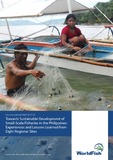
Towards sustainable development of small-scale fisheries in the Philippines: Experience and lessons learned from eight regional sites
(WorldFish, 2012)The focus of this paper is on the governance of small-scale or municipal fisheries in the Philippines in light of the critical role they play in the livelihoods of coastal communities and in the nation as a whole. Annually, some 1.3 million metric tons of fish are harvested from the country’s 17,460 km coastline and 496,000 ha of inland water bodies. This sub-sector contributes significantly to the Philippine economy, supplies the bulk of the dietary fish requirement for over 90 million Filipinos who consume around 38 kg/capita/year, and provides direct employment to 1.4 million fishers. Despite eight national fisheries plans from 1972 to 2010, four major externally funded fisheries programs and thousands of local initiatives, the failures and inadequacies in governance of small-scale fisheries are conspicuous. They are made evident by depleted fishery resources, degraded fish habitats, intensified resource use competition and conflict, post-harvest losses, limited institutional capabilities, inadequate and inconsistent fisheries policies, and weak institutional partnerships. Although there are suitable governance arrangements in place, there needs to be better clarification of management functions between and among the various bodies at different administrative levels. Up-scaling small-scale fisheries management and expanding institutional partnerships would be beneficial. Six ‘core’ strategies are proposed to help promote the sustainability of small-scale fisheries: (1) sustain—conservation and rational use of fishery resources; (2) protect—preventive steps to manage threats to habitats and/or ecosystems that support fisheries; (3) develop—development of small-scale fisheries in geographically-appropriate areas, including promotion of livelihoods; (4) capacitate—enhancing the capacity of municipal fishers and relevant stakeholders; (5) institutionalize—organizational integration including scaling-up of fisheries management; and (6) communicate—generation of pertinent information and translation into appropriate formats for practical transmission. In pursuit of multiple objectives, the governance of small-scale fisheries will continue to be a delicate balancing act. However, it will be the more judicious allocation of administrative resources by local government units to small-scale fisheries, as well as the continuing support of national government agencies and civil society groups, that will be most critical over the longer term. -
The pressing challenges of mangrove rehabilitation: Pond reversion and coastal protection
Primavera, Jurgenne; ; (Academic Press, 2011)
The 2004 Indonesia tsunami as well as the increasing storm frequency and intensity associated with climate change–sea-level rise have highlighted the coastal protection function, among the many goods and services that mangrove forests provide. This wider awareness of mangroves has increased national and international rehabilitation efforts, given only 15 million ha remaining and yearly rates of 1–3% loss. Rehabilitation programs employ two strategies: seafront planting and pond reversion. Seafront planting is necessary because coastal populations will not move to safer ground by choice, or cannot move due to poverty, and is also preferred because the sites are open access with no tenurial conflicts. However, former sites of fringing mangroves are difficult to rehabilitate as their lower intertidal–subtidal levels are not optimal for mangroves (due to frequent inundation and wave action). Planting in tidal flats and seagrass beds is also ecologically misguided. This chapter evaluates the relevant mainstream and gray literature (on site and species selection, propagule sources, nursery protocols, outplanting techniques, biophysical/anthropogenic threats, and novel interventions, e.g., integrated approaches using barriers) to improve the low survival rates of seafront planting. However, this strategy should not preclude the long-term relocation of coastal communities to safer ground and the politically difficult option of pond reversion. Given thousands of hectares of underutilized and abandoned brackish water ponds in Southeast Asia, this option holds greater potential for rehabilitation of wide areas of mangroves and greater species diversity. It is ecologically easier as it merely requires restoring hydrology (by breaking pond dikes); mangrove recruitment and succession naturally follow (if propagule sources are present) in these ponds located at mid-upper intertidal levels where mangroves naturally occur. The Philippines, with its long history of mangrove–pond conversion and problematic enforcement of laws that mandate mangrove reversion of idle ponds, is examined as a case study. The chapter assesses the Fishpond Lease Agreement (FLA) system by which vast expanses of mangroves were transferred from the public domain (government-leased ponds) to private ownership and recommends ways to improve the FLA system. -
Series: Cellular Origin, Life in Extreme Habitats and Astrobiology; 15
A review of Kappaphycus farming: prospects and constraints
(Springer Netherlands, 2010)A review of Kappaphycus (broadly including Eucheuma) farming is presented, including the current possibilities and challenges with the goal of contributing to sustainable mariculture management practices. -
Milkfish marketing in the Philippines
(National Taiwan University; The Fisheries Society of Taiwan; Asian Fisheries Society; World Aquaculture Society, 2010)Milkfish produced from aquaculture is one of the most traded fish in local markets and it also provides export earnings for the Philippines. Annual per capita consumption of milkfish among Filipinos is 4 kg which comprise the major portion of the 25 kg annual intake of all types of fresh fish. Increasing milkfish production from aquaculture constitutes the strategies for securing fish food supply, especially for the growing middle- and low-income households. However, there are diverging analyses and criticisms on the effectiveness and performance of the milkfish industry in improving access to fish and protein sources among the poor in the Philippines. The generally increasing volumes of milkfish production due to improved technologies are indeed desirable. But higher levels of production does not guaranty the availability and access to fish food supply, especially in geographically dispersed production and consumption centers around the archipelago. Efficiency in marketing perishable fishery products is a crucial factor to ensure availability of safe and fresh milkfish in deficit areas. This review of milkfish marketing literature showed that meeting the milkfish demand-supply gaps, in geographic and temporal sense, is an immediate market objective for the Philippines. The spatial and inter-temporal variations in production volumes influence investment decisions on infrastructures and other public support systems. There is enormous challenge for the industry in view of the declining productivity of capture fisheries, the emerging preference for organic food and value-added forms arising from socio-cultural transformations and lifestyle changes among consumers. This chapter elaborates on the potentials of the milkfish industry by presenting the challenges for traders who should deal with the issues on the demand side of the market; and the challenges for milkfish farmers and processors who should act on the supply side. The constraints and corresponding strategies to meet potentials are also discussed. -
Milkfish aquaculture in the Philippines: An overview
(National Taiwan University; The Fisheries Society of Taiwan; Asian Fisheries Society; World Aquaculture Society, 2010)Milkfish farming has been, and will remain the backbone of Philippine aquaculture. To date, over 260,000 ha of brackishwater ponds, 6, 700 ha of freshwater pens and about 500 ha of marine pens and cages are used to culture this fish. Average milkfish annual production since 1990 is 206,840 mt valued at over ten billion pesos. Annual per capita consumption of milkfish is about 2 kg or 7. 5 % of the total fish (26. 8 kg/per capita) consumed by every Filipino. By the year 2020, the population is predicted to reach 112 million and will require 224,000 mt of milkfish. If production growth rate is maintained at 2.3%, an estimated 400,000 mt will be produced by the year 2020 generating surplus production of close to 200,000 mt. The development of value-added products from the surplus produce will be needed to enhance acceptability of milkfish in the export market and the changing food preference of younger generations. This paper presents a brief overview of the current status of the milkfish industry in the Philippines. Details of, breeding and hatchery technologies, farming systems, marketing, value-added products and research and development are in the various chapters of this book. -
Milkfish hatchery and nursery production in the Philippines
(National Taiwan University; The Fisheries Society of Taiwan; Asian Fisheries Society; World Aquaculture Society, 2010)Milkfish is the most important farmed fish species in the Philippines. In the last 5 years, milkfish production has been increasing. Culture of milkfish in brackishwater ponds still contributes most to milkfish production, although production from marine cages has been on the rise, recently. To sustain milkfish production, a reliable supply of good quality seeds is imperative. Following the spontaneous spawning of milkfish in floating net cages in 1979, protocols for broodstock management, breeding and seed production were developed and these have been continuously refined over the years. Compared to Indonesia and Taiwan, however, commercialization of milkfish seed production in the Philippines, took a long time to take off. Currently, there are a number of government-run and private milkfish hatcheries in operation. In contrast, milkfish fingerling production in brackishwater ponds has long been practiced in the Philippines and is an industry in itself. Traditionally, milkfish fry were from catch from the wild. Recently, more and more come from local hatcheries as well as fry imported from neighboring countries like Indonesia and Taiwan. Prospects for the milkfish hatchery and nursery industries are discussed in light of the Philippine government initiatives to increase fish production, including milkfish, through mariculture as well as by improving production efficiency in other traditional culture systems. -
Milkfish R&D in the Philippines
(National Taiwan University; The Fisheries Society of Taiwan; Asian Fisheries Society; World Aquaculture Society, 2010)Culture of milkfish in brackish water ponds has been practiced for many years in the Philippines and recently its culture has expanded to fish cages in marine waters. Following the spontaneous spawning of milkfish in floating net cages in 1979, protocols for its seed production were developed. Studies to determine sustainable culture techniques in ponds and cages were conducted. Studies on nutritional requirements of milkfish at different developmental stages were done to reduce dependence on live prey organisms during hatchery operations and optimize feed formulations for nursery and grow-out cultures. In recent years, research geared towards the environmental impact of milkfish culture and ways to mitigate the negative effects of intensive farming practices. Prospects for the milkfish industry are discussed in light of the recent advances in milkfish R&D and Philippine government initiatives to increase fish production by mariculture. -
Early ossification and development of the cranium and paired girdles of Chanos chanos (Teleostei, Gonorynchiformes)
; Bagarinao, Teodora (Science Publishers, 2010)
In this chapter, we provide new data on the timing of ossification of cranial and paired girdle elements, and compare our results, when it is possible, with previous work on early ossification development of Chanos chanos. This is particularly important because of the basal phylogenetic position of Chanos among living ostariophysans and among extant gonorynchiforms as well (see Fig. 3.1). We describe the normal cranial and girdle patterns of ossification in Chanos chanos and evaluate to what extent the cranial development is consistent, or whether some intraspecific differences occur in comparison to previous results by Taki et al. (1987) and Kohno et al. (1996a) based on ontogenetic series grown in the same Aquaculture Department as the specimens used in this study. We assess previously published developmental work in a few ostariophysans and test some previous hypotheses on heretochrony and patterns of diversification. [A study of chondrification versus ossification processes in Chanos chanos is outside the scope of this paper, but it is the subject of a separate paper (Arratia and Grande, in preparation).] -
Grouper aquaculture R&D in the Philippines
(Asian Fisheries Society; World Aquaculture Society; The Fisheries Society of Taiwan; National Taiwan Ocean University, 2008)Culture of groupers in ponds and floating net cages has been practiced for many years in the Philippines. Unsustainable culture practices such as dependence on wild caught seeds, use of trash fish, use of high stocking densities, and unregulated expansion and proliferation of fish cages, have led to the "boom and bust" cycle of grouper aquaculture in the Philippines. The drastic decrease in grouper aquaculture production in the late 90's was mainly attributed to environmental deterioration and diseases outbreaks. To sustain grouper production, research on the breeding, seed production and culture of groupers started in the mid 1980s. As a regional inter-government R&D organization, the Aquaculture Department of the Southeast Asian Fisheries Development Center (SEAFDEC/AQD) followed the recommendations of the 1987 Seminar-Workshop on Aquaculture Development in Southeast Asia on grouper R&D. Research activities initially focused on market survey of grouper species in the Philippines and Southeast Asia, assessment of fry and availability in traditional fishing grounds, and development of broodstock management techniques. Following the spontaneous spawning of Epinephelus coioides in concrete tanks and floating net cages in 1990's, protocols for the seed production of milkfish and sea bass were adapted and modified. Parallel studies to determine sustainable culture techniques in ponds and net cages were conducted. Studies on the nutritional requirements of grouper at various developmental stages were done to reduce dependence on live prey organisms and trash fish as feeds. Research geared towards health management started in the in late 90's to early 2000's. Prospects for grouper aquaculture are discussed in the light of recent advances in grouper R&D and the Government of the Philippines initiatives to increase fish production by mariculture.