Conference Proceedings: Recent submissions
Now showing items 1-20 of 300
-
Series: ICLARM Conf. Proc. 64
Genetic research at the Southeast Asian Fisheries Development Center/Aquaculture Department
Basiao, Zubaida (ICLARM - The World Fish Center, 2001)
Southeast Asia is endowed with a variety of species that can be cultured as food fish. Since 1973, the Southeast Asian Fisheries Development Center/Aquaculture Department (SEAFDEC/AQD) has devoted research efforts to establish broodstock for the tiger prawn (Penaeus monodon), milkfish (Chanos chanos), and other economically important fish and crustaceans in the region. The objective is to ensure the availability and reliability of seed supply for fish culture. SEAFDEC’s pioneering effort on genetics was a collaborative study with the University of the Philippines Marine Science Institute on the genetic variation of milkfish populations in the Philippines. Towards the end of the 1980s, genetic activities, co-funded by the International Development Research Centre (IDRC) of Canada in collaboration with Dalhousie University of Canada, were focused on tilapia.
(ICLARM - The World Fish Center, 2001)
Southeast Asia is endowed with a variety of species that can be cultured as food fish. Since 1973, the Southeast Asian Fisheries Development Center/Aquaculture Department (SEAFDEC/AQD) has devoted research efforts to establish broodstock for the tiger prawn (Penaeus monodon), milkfish (Chanos chanos), and other economically important fish and crustaceans in the region. The objective is to ensure the availability and reliability of seed supply for fish culture. SEAFDEC’s pioneering effort on genetics was a collaborative study with the University of the Philippines Marine Science Institute on the genetic variation of milkfish populations in the Philippines. Towards the end of the 1980s, genetic activities, co-funded by the International Development Research Centre (IDRC) of Canada in collaboration with Dalhousie University of Canada, were focused on tilapia. -
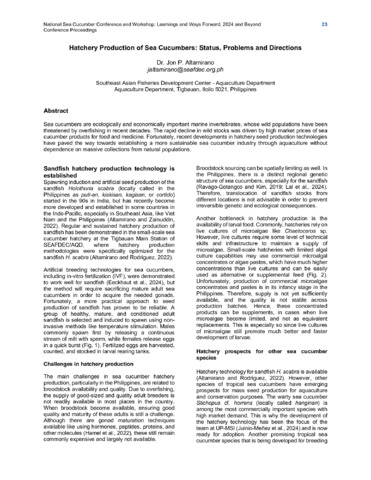
Hatchery production of sea cucumbers: Status, problems and directions
Altamirano, Jon (Mindanao State University at Naawan, 2025)
Sea cucumbers are ecologically and economically important marine invertebrates, whose wild populations have been threatened by overfishing in recent decades. The rapid decline in wild stocks was driven by high market prices of sea cucumber products for food and medicine. Fortunately, recent developments in hatchery seed production technologies have paved the way towards establishing a more sustainable sea cucumber industry through aquaculture without dependence on massive collections from natural populations. -
Development and sustainability of Philippine aquaculture
Primavera, Jurgenne (Royal Academy of Overseas Sciences, 2006)
Aquaculture plays a predominant role in the Philippines, an archipelago of 7,150 islands with 36,300 km of coastline, 26.6 million ha of coastal waters, and 250,000 ha of lakes, rivers and reservoirs over which are spread 239,000 ha of brackish-water ponds and 14,500 ha of freshwater ponds. From a mere 25,500 mt valued at P33.1 million in 1950, aquaculture production has increased to 38.2 million mt valued at P35.4 billion in 2002, and employs some 258,500 persons. Aquaculture contribution to total fisheries’ production in the 1950-2002 period has similarly increased from 11.6 % to 38.2 % by volume, and from 15.4 % to 31.3 % by value. Next to yields of 894,858 mt of seaweeds and bivalves from mariculture, Philippine aquaculture was dominated in 2002 by brackish-water pond production of 246,937 mt, followed by 94,697 mt from marine and freshwater pens/cages and 70,425 mt from freshwater ponds. Notwithstanding its major contribution to the Philippine economy, aquaculture development has come with many environmental and social costs. Foremost among these is mangrove conversion to culture ponds, mainly for milkfish — around half of the 279,000 ha of mangroves lost from 1951 to 1988 were developed into culture ponds. Ninety-five percent of Philippine brackish-water ponds in 1952-1987 were derived from mangroves. Mangroves have contributed significantly to the well-being of coastal communities for centuries through products used for fuel, construction, fishing, agriculture, forage, and food items mainly fish, crustaceans and mollusks. Mangroves also provide a variety of ecosystem services such as coastal protection provided by a buffer zone during typhoons and storm surges, reduction of shoreline and riverbank erosion, stabilizing sediments, control of flooding and recycling of nutrients. Other environmental impacts are pollution of lake and coastal waters from intensive pond, pen and cage culture; dependence on fish meal and fish oil for feeds; use of chemicals and antibiotics; spread of parasites and diseases; excessive harvesting of wild seed and adults and loss of bycatch. Socioeconomic consequences have the greatest effect on rural communities — loss of mangrove goods and services, blocked access to coastal resources, navigational hazards, privatization of lands and waterways, fishery decline, food insecurity, rural unemployment and urban migration, social disruption and conflicts. The future sustainability of Philippine aquaculture depends not only on farm level practices but also on the integrated management of the coastal zone and government action to prevent or redress environmental and socioeconomic damage. Pond, pen and cage systems for growout need to reduce and mitigate negative impacts and become more environmentally responsible through the development and/or wider dissemination of available onfarm technologies. These cover water management (closed/semiclosed cycles with low to zero water exchange, reservoir/treatment-settling ponds, greenwater techniques), feed management (reduced fishmeal/fish oil levels, lower N, P in effluents), effluent management (biofilters using seaweed, oysters and external filters such as mangroves, sludge processing and disposal, fallowing), and reduced use of antibiotics and chemicals. Aquaculture needs greater integration, e.g. the polyculture of more than one species in the same pond, or aquasilviculture where fish/shrimp/crab culture is integrated with mangroves. Only one among the many uses of the coastal zone, aquaculture should develop within the framework of Integrated Coastal Zone Management (ICZM). For example, siting of aquaculture farms should be based on the ecological footprint of the farming technology, and farm density should not exceed environmental capacity of a given area. ICZM features coastal zonation based on carrying or assimilative capacity of the environment; valuation of alternative resource uses; buffer zones between aquafarms and villages, rice paddies, rehabilitation of mangroves and other degraded habitats; participation of various stakeholders, e.g. fishers, aquafarmers; protection of communal resources, rights and access of marginalized groups; and mechanisms for conflict resolution. The government should enforce existing laws; institute a clear national aquaculture policy with corresponding institutional arrangements such as resource use fees for land, groundwater use, and penalties to fund environmental rehabilitation and compensate socioeconomic damage and become mangrovefriendly by adopting silvofisheries (or aquasilviculture where crabs/fish/shrimp are reared at low density in mangrove ponds and pens) or integrating mangroves filter adjacent to intensive fish/shrimp ponds. All these require a paradigm shift from the short-sighted common exploitation of water, mangroves and other resources to the ecological footprint approach incorporating not only inputs such as feed and seed, but also outputs, e.g. effluent treatment facilities. -
For the record: The fate of libraries and records offices in the Visayas, Philippines devastated by the typhoon Haiyan
Alayon, Stephen; Superio, Daryl ; Alenzuela, Reysa ; ; ; ; Bunyaphiphat, Tunchira ; Enomae, Toshiharu ; ; ; (National Library of Thailand, 2015)
A year after Typhoon Haiyan (local name: Yolanda) hit central Philippines, traces of destruction are still evident. Libraries and records offices were not spared from the damage. Recovery efforts on lives and properties have been attended to but the salvage of records that establish the existence of lives and properties have earned little attention. This paper described the result of the survey, assessment and documentation on the extent of damage to selected academic libraries and government offices in Eastern and Western Visayas, Philippines conducted five and nine months respectively after the disaster. It also identified the recovery, restoration and conservation initiatives done by librarians, archivists, records officers, office managers and volunteers. It further documented innovative ways done to recover flood-damaged documents. The study also determined the disaster preparedness and the level of knowledge of the library staff on disaster management. Despite the delay in the recovery efforts and assessment of the damages, the findings of the study are useful in sharing the lessons learned and identifying common areas in need of improvement. The findings can serve as baseline data for disaster preparedness projects and researches, document recovery initiatives, capacity building of records officers and librarians on disaster management, and in building back better libraries and records offices. -
Fatty acid composition of Nile tilapia Orechromis niloticus muscles: A comparative study with commercially important tropical freshwater fish in Philippines
; ; ; ; El-Haroun, Ehab (AquaFish Collaborative Research Support Program, 2008)
Six tropical freshwater species were collected from Philippines in order to study the characteristic of polyunsaturated fatty acids distributions. 16:0 and 18: l n-9 were the predominant saturated fatty acid (SFA) and monounsaturated fatty acid (MUFA) in both neutral lipids (NL) and polar lipids (PL). There was an absence or very low values of n3 highly unsaturated fatty acid (HUFA) in NL of all species. However these fatty acids found in PL of all species studied with higher levels. The high proportions of docosahexaenoic acid (DHA) in PL were found with catfish Arius (20.71%), ayungin (17.64%), and snakehead (17.09%) whereas anabas (4.21%) gave lower DHA content. In PL, arachidonic acids (ARA) was found in high proportions, and also is superior to eicosapentaenoic acid (EPA) (ranged from 3.35 to 10.67% and from 0.42 to 4.74%, respectively). Tilapia lipid appears to be intermediate in nutritional quality between all species studied; the proportions of DHA, EPA and ARA in PL were 16.27%, 4.52% and 9.36%, respectively. According to the n-3/n-6 ratio in both fractions, only ayungin is in the range typical of freshwater fish. Our results indicate that the wild tropical freshwater fish studied here are not good sources of n-3 HUFA fatty acids. Therefore, aquatic nutritionists and farmers should combine their efforts in order to manipulate the nutritional quality of these species to enhance their n-3 HUFAs concentrations especially when these species are reared in captivity system. The wash-out strategy may provide an adequate description of the changes in the fillet lipid fatty acid profiles of fatty fish. -
Susceptibility of Macrobachium rosenbergii to local white spot syndrome virus isolate using immersion assay
; Logronio, Dan Joseph; Romana-Eguia, Maria Rowena R. (De La Salle University, 2017)
White spot syndrome virus (WSSV) continue to be one of the leading causes of serious epizootic in cultured shrimp. Macrobrachium rosenbergii or giant freshwater prawns are found to be resistant in White spot syndrome virus (WSSV). However, conflicting studies have shown that pathogenicity of WSSV to M.rosenbergii may vary according to the life cycle of prawn, strain of WSSV and the source of the virus during passaging. On this preliminary study, the susceptibility of M. rosenbergii stocks to local strain of WSSV as exposed via immersion assay will be determined. Likewise, the pathogenicity of WSSV will be identified using the median lethal dose (LD50). The confirmation for the presence of WSSV on giant freshwater prawns will be done using nested PCR. The preliminary study will provide valuable data for the succeeding experiments. -
Evaluation of community-based livelihood development initiatives: The sustainable livelihood approach
(University of the Philippines Visayas, 2022)The sustainable livelihood approach (SLA) is a tool for evaluating livelihood strategies that utilize assets categorized as environmental, human, physical, financial and social assets. In this study, the SLA was applied to determine the main factors that influence the adoption of integrated multi-trophic aquaculture (IMTA) in milkfish (Chanos chanos Forsskål) farming among fisherfolks. The community-based field trials conducted in Nueva Valencia in Guimaras province for 4 years since 2015 revealed that stakeholders were receptive to IMTA and were able to situate its effects on livelihood assets. The assessment of 52 stakeholders showed small but significant improvements in most livelihood assets during the 3-phased evaluation period. Using the 5-scale Likert rating, the environmental livelihood assets were rated highest but showed slight significant decline due to perceived weather and water level changes that may have negatively affected fish production and income. Financial livelihood assets were initially rated low but significantly improved due to supplemental income derived from wages and harvest. The human livelihood assets significantly improved due to sustained hands-on aquaculture experience. Social livelihood assets also improved due to cohesive interaction during projects implementation. In contrast, the acquisition of physical livelihood assets did not significantly improve because these assets were not commensurate with the many stakeholders who would like to have access to these shared assets. Overall, stakeholders expect IMTA’s potential environmental and economic benefits to overcome additional adoption costs. These include the cost of physical and financial investments in seeds of co-culture species and modified enclosures. Stakeholders expect institutional and government support on further studies on the technical details of IMTA. Fisheries and aquaculture regulations should embed the necessary support systems for the adoption of IMTA and ensure a positive public perception of aquaculture. -
Innofloc: Innovative biofloc technology for the nursery production of shrimp, Litopenaeus vannamei in tanks
Caipang, Christopher Marlowe; ; ; ; Pakingking, Rolando V., Jr. ; ; (University of the Philippines Visayas, 2022)
Nursery systems are valuable production tools in shrimp aquaculture and are effective biosecurity facilities for the high-density culture of shrimp postlarvae (PL), resulting in healthy and uniform-sized juveniles. The nursery production of shrimp is usually carried out in small ponds; however, the use of small and circular tanks with plastic liners is gaining popularity. From an industry standpoint, there is a need to assess how nursery systems can improve the productivity of the shrimp production cycle. Hence, the use of small circular tanks coupled with the incorporation of biofloc technology was assessed in terms of its viability during the nursery production of the Pacific whiteleg shrimp, Litopenaeus vannamei. A 450m2 plastic-lined circular tank was installed and prepared for the stocking of L. vannamei postlarvae (PLs) at a density of 500 PLs per m2. Biofloc was produced and maintained throughout the nursery phase by adding brown sugar as a carbon source at carbon to nitrogen (C:N) ratio of 10. Daily monitoring of the various water quality parameters was carried out, while presumptive Vibrios were enumerated weekly. The shrimp juveniles were sampled for their body weight on the 14th day post-stocking and weekly until harvest on the 30th day of culture. The different water quality parameters were within optimum levels required for shrimp growth. Presumptive Vibrios were dominated by the yellow colonies. The shrimp attained 100% survival with an average body weight of 1.26 g and a feed conversion ratio (FCR) of 0.43 at the end of the nursery production phase. Our results indicate that the use of small circular tanks with biofloc during the nursery production phase of whiteleg shrimp is feasible and can be incorporated during the grow-out culture for improved and continuous production of this shrimp species. -
Bacterial microbiota of hatchery-reared freshwater prawn Macrobrachium rosenbergii (De Man, 1879) and their pathogenicity
Monghit-Camarin, Ma-ann; ; Pakingking, Rolando V., Jr. ; Cuvin-Aralar, Maria Lourdes ; Traifalgar, Rex Ferdinand ; ; ; (University of the Philippines Visayas, 2022)
Quantitative and qualitative analyses of bacterial microbiota associated with hatchery of Macrobrachium rosenbergii (de Man, 1879) were conducted over three larval cycles, along with important water quality parameters. Physicochemical parameters (temperature, DO, salinity, pH, and total ammonia) of culture water were within the optimum level required for the hatchery phase of M. rosenbergii. Significant differences in aerobic plate count (APC) among larval stages were observed. Ten genera and 17 species were identified with the predominance of Gram-negative bacteria constituting 63 % of all isolates (n = 706). A total of 17 dominant bacterial isolates randomly selected from freshwater prawn larvae were screened for in vitro hemolysin activity using blood agar plate (BAP) medium with 5% sheep blood. Pathogenicity of the isolated bacterial strains was assessed through in vivo infection bioassay. Out of the 17 isolates tested, six isolates showed α – β zone of hemolysis on the BAP, i.e., Aeromonas caviae, Bacillus cereus, Plesiomonas shigelloides, Staphylococcus warneri, Vibrio cholerae non-01, and Vibrio furnissii, were used in the infection bioassay. The current data indicate that the six bacterial isolates tested, particularly B. cereus and V. cholerae non-01, are opportunistic pathogens capable of inducing disease epizootics, particularly in freshwater prawn hatcheries with suboptimal rearing water conditions. Thus, control measures to reduce the influx of pathogenic microbes in the system by maintaining good water quality and good farm management practices through disinfection of culture facilities, rearing water, and Artemia cysts, the practice of good hygiene of personnel, regular water exchange, and feed regulation, among others, and cautionary use of antibiotics, can be adopted. -
Characterization of wild eucheumatoids from Visayas, Philippines as inferred from the mitochondrial cox2-3 spacer sequence
Sibonga, Rema; Brakel, Janina ; Gachon, Claire ; Faisan, Joseph P., Jr. ; Brodie, Juliet ; Ward, Georgia ; Ferriols, Victor Marco Emmanuel ; Luhan, Maria Rovilla ; (University of the Philippines Visayas, 2022)
Eucheumatoids are the major seaweed species cultivated in most coastal areas in the Philippines, being a major source of income for many families. Seaweed farmers face issues such as lack of good quality cultivars and the presence of diseases and epiphytes in the cultivated stocks. This study characterizes the wild eucheumatoids, which are potential sources of cultivars that might be resistant to diseases and epiphytes. Wild eucheumatoids were collected from Iloilo (N=18), Guimaras (N=10), and Bohol (N=20), Philippines. Gross morphology was described, and a 10-mm apical tip was excised for DNA extraction. PCR amplification and sequencing using cox2-3 spacer genetic markers were done. Based on sequence data, 5 species can be identified from the Visayas region: the commercially cultivated Kappaphycus alvarezii (Iloilo, Bohol), K. striatus (Iloilo, Guimaras), and Eucheuma denticulatum (Iloilo, Bohol) and the currently uncultivated K. cottonii (Iloilo) and Kappaphycus sp. (Iloilo, Bohol). Haplotype network analysis identifies individuals of K alvarezii and E. denticulatum as haplotype E3 and E13, respectively, which are haplotypes previously reported from seaweed farms and globally distributed for cultivation purposes. The K. striatus from Iloilo and Guimaras are identified as haplotype E89, and the K. cottonii from Iloilo is haplotype E108 which has been described previously from seaweed farms and wild populations, respectively. Interestingly, Kappaphycus sp. from Iloilo and Bohol are identified as haplotype GUI1 initially described in 2014 and yet to be identified up to the species level. Our study shows that purely morphological identification is not sufficient to reliably identify species, thus highlighting the need to employ molecular techniques supporting strain selection. In summary, it reveals a rich diversity of wild eucheumatoids in the Visayas region of the Philippines. In-vitro studies need to reveal the performance of individuals from these wild populations but highlight a great potential for the development of new cultivars. -
Improving artisanal fisheries through community-based prawn stock enhancement in a mangrove estuary
Altamirano, Jon (Japan International Research Center for Agricultural Sciences, 2022)
Tropical seafood, especially prawns, have always been in high demand with high market prices. Because of this, wild prawn resources are often overfished as indicated by the increasing number of fishers, but with overall declining catch volume and sizes through the years. Prawn aquaculture has, as of course, significantly contributed to the total yield in the past decades. However, the expansion of farms and ponds has often negatively affected the natural nursery grounds in the estuaries and mangroves. The economic gains from aquaculture are limited only to those who invested. However, local communities and artisanal fishers are often deprived of such gains. They are still reliant upon the dwindling natural stocks of fisheries resources. This is where the concept of stock enhancement comes in, wherein hatchery-produced juveniles are released into the water body in order to increase capture fisheries yield for local fishers. In this talk, I will present the case of the tiger prawn Penaeus monodon stock enhancement in the New Washington Estuary (NWE), in Aklan, central Philippines. The NWE was a productive fishing ground providing >24 kg/gear/day of catch in the 1970s but steadily declined to <0.7 kg/gear/day in 2010s. Prawn catches declined both in quality and quantity. Meanwhile, mangrove cover was reduced from 4800 ha in 1950s to only <800 ha in 2010s. Site-specific studies were conducted in NWE on prawn nursery rearing, small-scale release and monitoring experiments, as well as social assessments. Our studies produced essential scientific data to guide future stock enhancement activities in NWE. Even at an experimental scale, our releases showed significant increases in catch by at least 8% but can potentially increase daily income by >400%. However, in order to sustain the prawn fisheries and optimize the benefits, long-term management plans by all stakeholders are needed, especially between the communities and the local government. -
Proceedings of the National Seaweed Symposium, September 3-4, 2002, Cebu City
(Seaweed Industry Association of the Philippines, 2003)The Proceedings of the National Seaweed Symposium is published by the Seaweed industry association of the Philippines (SIAP). The 109-page book is edited by SEAFDEC/AQD researchers Dr. AQ Hurtado and Ms. Ma. RJ Luhan. It ... -
User acceptance of IAMSLIC digital fisheries library
Alayon, Stephen; (International Association of Aquatic and Marine Science Libraries and Information Centers (IAMSLIC), 2018)
The International Association of Aquatic and Marine Science Libraries and Information Centers (IAMSLIC) through the Aquatic Commons Board approved the deployment of IAMSLIC Digital Fisheries Library in the Philippines during the 2015 Conference. The digital library utilized the LibraryBox, a portable, open source distribution tool. This standalone wireless access is ideal for fisheries schools in the area due to limited or no Internet access and intermittent electrical power conditions. With the aim of providing access to SEAFDEC Aquaculture Department (AQD) publications in these schools, more than a thousand publications that were already made available in SEAFDEC/AQD institutional repository were also added in the box. The box contained over 26,000 publications, reports, articles and documents on all aspects of fisheries that are freely available. SEAFDEC/AQD is the first institution in the country to launch t he project in July 2016 using LibraryBox. Five boxes were distributed in Philippine fisheries libraries devastated by Typhoon Yolanda or hazed by fire. This study examined the factors that influence student’s acceptance and attitude towards the IAMSLIC Digital Fisheries Library. A survey was distributed to selected fisheries and marine biology undergraduate students in the Philippines. Relevance, perceived usefulness, perceived ease of use, screen design and behavioral intention to use the digital library were determined. -
Development of brackish water aquaculture emphasizing sustainability in Western Visayas, central Philippines
(International Institute of Fisheries Economics & Trade, 2004)Western Visayas is located in central Philippines and consists of Guimaras Island, Panay Island and Negros Occidental. This region is advanced in aquaculture. Interviews were conducted at Ivisan and Carles municipalities, located at the northeastern part of Panay Island, in November 2003 to investigate the state of aquaculture start-ups by local people. Many small-scale aquafarmers had started in the business after 1997. Most (93%) respondents currently engaged in aquaculture wanted to continue in their business. In this paper, marine fishcage culture, marine fishpen culture, oyster culture, mussel culture and seaweed culture are collectively termed "small-scale aquaculture". Brackish water aquaculture in Western Visayas originally started by digging ponds in mangrove forests, but the growth in the number of ponds resulted in the degradation of water quality and outbreaks of prawn disease. Today, tiger prawn culture has declined and milkfish culture remains stagnant because of low price induced by a glut of milkfish. Both municipalities, however, are active in planting mangrove trees with the help of the central government, and coastal fishermen aggressively engage in small-scale aquaculture. The investigation revealed that both pond culture and small-scale aquaculture are leading towards practicing sustainable production systems and for some reasons it was noted that their production was lower than before. -
Series: GL Conference Series; No. 23
Burning grey: The worldwide influence of a locally published grey literature
Palcullo, Vince Ervin; ; ; Peleña, Ma Cynthia Tolones ; Geromiano, Joy F. ; Superio, Daryl (TextRelease, 2022)
Rice is a major staple crop in the Philippines, which produces a large amount of rice each year. On the other hand, rice production generates biomass waste in the form of rice husks. In consideration of the rice husks’ potential as a biomass energy source and support the development of the rice husk gas stove technology in the Philippines, Engineer Alexis T. Belonio had published a grey literature (GL) entitled “Rice Husk Gas Stove Handbook.” Hence, to fully understand the impact of the technology, a citation analysis was conducted. The works that cited the GL were retrieved from Google Scholar using Harzing’s Publish or Perish software. The complete title of the GL was used as keywords for the search string. Results revealed that the GL was cited by 155 literatures written by 398 authors from 31 countries. Seventy-five (48.4%) of the 155 literatures were cited 797 times. The results showed the wide utilization and the impact of locally-published GL, thereby confirming GL’s value in research and development. -
Hi-density tank culture of Nile tilapia (Oreochromis niloticus) using lake water with effluent management
(Southeast Asian Regional Center for Graduate Study and Research in Agriculture (SEARCA), 2005)Nine concrete tanks (2 x 2 x 1 m) were stocked with tilapia fingerlings (abw = 3.3±0.9 g) and three stocking rates (50 fish/m2, 100/m2, and 150/m2) were tried. The rearing period lasted for 120 days. Fingerlings were fed commercial diet containing approximately 27% crude protein. The amount of feed was adjusted based on monthly weight samplings. Pre-filtered lake water pumped through gravity aerators into the tanks was used throughout the culture period. Although production was intensified, water agitators and similar mechanical implements were not employed to cut production costs. Results show that tilapia stocked at 50/m3 grew significantly heavier at 109.2 ± 8.0 g. This was significantly better (P<0.05) than fish stocked at 100 and 150/m3, which had basically the same final weight of 82.4 ± 1.8 g and 83.4 ± 8.7 g, respectively. Likewise, survival or recovery at harvest was highest at 92.8% for the stocking rate of 50 fish/m3. The results suggest that stocking at lower densities would result to bigger fish but a lower total yield per tank, or higher stocking densities would mean higher yield but smaller individual fish size at harvest. The rate of water flow through at harvest time was equivalent to 0.30 L/min/kg biomass at the highest stocking density of 150/m3, 0.40 L/min/kg biomass at 100/m3, and 0.60 L/min/kg biomass at the lowest density of 50/m3. Siddiqui et al. (1991) suggested a minimum of 0.50 L/min/kg biomass flow rate for intensive culture of tilapia, but this was generally for clean culture water, not like lake water whose quality varies naturally. After determining the optimum stocking density, a second experiment using bigger fingerlings (57.5±12.6 g) was conducted for 101 days to determine the ideal water flow rate in the system. Varying flow rates (10 liters per minute (Lpm), 15 Lpm and 20 Lpm) were evaluated at a fixed stocking density of 50 fish/m3. Feed ration was 5% during the first two months, 4% on the third month, and 3% thereafter. Tilapia size at harvest increased with increasing flow rate when stocked at 50 fish/m3. From an initial stocking size of 57.5 ± 12.6 g, biggest fish harvests were obtained in tanks with a flow through rate of 20 Lpm (152.2 ± 15.1 g) after 101 days of culture. However, this was not significantly different to fish grown in tanks at 15 Lpm (139.9 ± 7.6 g). Smallest fish harvests were obtained at 10 Lpm at 111.20 ± 8.3 mm. A similar trend was observed with fish length at 157.7 ± 15.5 mm, 150.8 ± 11.0 mm, and 142.1±17.6 mm for 20 Lpm, 15 Lpm, and 10 Lpm, respectively. Feed conversion ratio (FCR) ranged from 1.7 to 2.5 in all treatments. The rate of water flow through at harvest time was equivalent to 1.2 L/min/kg biomass at 20 Lpm, 0.6 L/min/kg at 15 Lpm (sufficient for Laguna de Bay water), and 0.4 L/min/kg at 10 Lpm flowrate. Except for a slight increase in ammonia levels (maximum 1.1 mg/L total ammonia nitrogen) towards the final two weeks of the rearing period, water quality in the culture tanks was generally within tolerable levels throughout the run. Thus, the quality of water from Laguna de Bay can safely support the stocking density used in the experiment. However, if stocking density is further increased, aeration may need to be provided because very low early morning dissolved oxygen levels (DO) were observed, especially in tanks with high stocking density. The significant amount of sludge, mainly fish feces and uneaten feeds, effectively trapped and collected from the settling apparatus, clearly demonstrated the apparatus efficiency. Effluent water was practically rid of solid wastes, and gravity aeration oxygenated the water before it was discharged back to the lake. Ammonia, pH and DO levels of the effluent water were similar to those recorded from the water in the header tank. -
Aquaculture practices in Laguna de Bay, Philippines
(Southeast Asian Regional Center for Graduate Study and Research in Agriculture (SEARCA), 2005)A survey was conducted to obtain information on the fish culture practices of the fish farmers in Laguna de Bay, Philippines. Fish farms vary greatly in size. Nile tilapia and bighead carp are the two fish species cultured in cages. Milkfish as well as tilapia and bighead carp are cultured in pens. The fish in cages and pens in the lake are grown in monoculture and polyculture systems. About one-half of the cage operators and two-thirds of the pen operators do not use artificial feeds in growing fish. Estimates of N load in the lake due to feeding indicated that the contribution of feeds to N in the water is low in relation to the N present in the water. The fish farmers vary in their practices in terms of stocking rate, culture period, and feeding. Production per unit area also varies. However, fish farmers have common concerns and problems. -
Microcystins from the cyanobacteria Microcystis aeruginosa in Laguna de Bay, Philippines
(Southeast Asian Regional Center for Graduate Study and Research in Agriculture (SEARCA), 2005)Laguna de Bay, the largest freshwater lake in the Philippines, experiences periodic blooms of the cyanobacteria Microcystis aeruginosa. The results of analysis for the presence of the hepatotoxin microcystins in bloom samples of this cyanobacteria from 1996, 1998, 1999 and laboratory cultures from 1997 isolates, based on the studies conducted at Binangonan Freshwater Station of SEAFDEC/AQD are presented. Twenty structural variants of the toxin have been isolated with microcystin LR (MC-LR) being the most abundant form. MC-LR contribution ranged from 22% to almost 100% of the total microcystins in the samples. Microcystis bloom in 1998 had MC-RR as the most dominant form of the toxin with almost 38% followed closely by MC-WR (23%) and MC-LR (22%). The harvest from 1996 had the highest total toxin concentration (4048 µg g-1). Laboratory-cultured M. aeruginosa had even higher total toxin concentrations ranging from 11,472 to 12,160 µg g-1. The presence of high microcystins concentrations in M. aeruginosa from Laguna de Bay has far reaching implications in terms of the use of this resource for fishery and domestic water supply. -
Series: SCS/GEN/77/15
Engineering aspects and problems in the design and construction of fishpens and fish cages in Laguna Lake, Philippines
(South China Sea Fisheries Development and Coordinating Programme, 1977)The profitability of the fishpen industry in Laguna de Bay cannot be over-emphasized. However, a good engineering design must be prepared, in addition to the feasibility study in production and marketing. The destructive effect of the past typhoons which hit the Philippines especially in 1974 has shown the susceptibility of these fishpens to failures. To protect the industry from collapsing due to these calamities, better enclosure designs have to be developed. It is therefore hoped that the two design models presented will stimulate a more rigorous investigation of the present system. The SEAFDEC Freshwater Aquaculture Station will be putting up some experiments on the design models herein discussed. It is also recommended that studies be made on the wave characteristics of the lake water and water hyacinth movements all year round. The extensive use of floating cages for fish culture in other countries has proved to be successful. In the Philippines, this kind of fish culture was introduced in the culture of Tilapia in the lakes of San Pablo City, Laguna, notably in the Bunot Lake. Because of this, the Freshwater Station has included in its projects a study of the design and construction of floating cages with emphasis on the kinds of materials for floatation and support system. -
Series: SCS/GEN/77/15
Plans and programmes of the SEAFDEC Leganes Station with emphasis on varied layouts and design of ponds
(South China Sea Fisheries Development and Coordinating Programme, 1977)As the importance of engineering to aquaculture becomes more apparent it is also realized that the physical properties of a pond have a strong influence on its productivity. This article reports the plans and programmes of the SEAFDEC Leganes station on pond design with reference to site location, ponds and supportive facilities, their general layout, design and specifications and construction. Shrimp and milkfish culture is mentioned. Problems are considered and finally recommendations are made.