Conference Proceedings: Recent submissions
Now showing items 21-40 of 300
-
Series: SCS/GEN/77/15
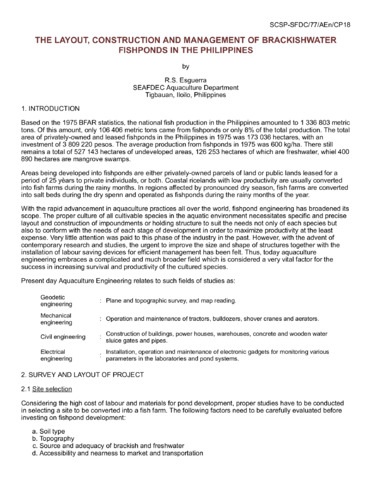
The layout, construction and management of brackishwater fishponds in the Philippines
(South China Sea Fisheries Development and Coordinating Programme, 1977)With the advent of new research and studies into aquaculture practices there is a need to improve the size and shape of brackishwater ponds in the Philippines and to make their management more efficient. This article discusses the survey and layout of the project and the engineering aspects of pond management. Milkfish pond management is also considered. -
Series: GL Conference Series; No. 22
Increasing the availability of West African Grey Literature to improve marine fisheries management
; ; Superio, Daryl ; (TextRelease, 2021-02)
The Fishery Committee for the Eastern Central Atlantic (CECAF) seeks to promote the sustainable utilization of the living marine resources across the Eastern Central Atlantic between Cape Spartel and the Congo river through informed development of fisheries management actions. Aquatic Sciences and Fisheries Abstracts (ASFA) is contributing to the CECAF-PESCAO project “Improved Regional Fisheries Governance in Western Africa”, by developing a comprehensive inventory of marine fisheries research covering both primary literature (available online on both commercial and free to use platforms) and grey literature available at institutions holdings and not always accessible online. This assessment of fisheries management research in the region will enable CECAF, ASFA and, critically, member countries the means to access relevant contextual and discernible science-based materials and publications. Cataloguing and subsequent bibliometric analysis of large amounts of information specific to regional fisheries management will encourage solid research-based fisheries management recommendations at the national level by highlighting areas of fisheries management to investigate. This paper presents the preliminary results of the research inventory and bibliometric analysis, comparing the amount and type of information available in primary and grey literature collections for the region and at individual country level.
; (TextRelease, 2021-02)
The Fishery Committee for the Eastern Central Atlantic (CECAF) seeks to promote the sustainable utilization of the living marine resources across the Eastern Central Atlantic between Cape Spartel and the Congo river through informed development of fisheries management actions. Aquatic Sciences and Fisheries Abstracts (ASFA) is contributing to the CECAF-PESCAO project “Improved Regional Fisheries Governance in Western Africa”, by developing a comprehensive inventory of marine fisheries research covering both primary literature (available online on both commercial and free to use platforms) and grey literature available at institutions holdings and not always accessible online. This assessment of fisheries management research in the region will enable CECAF, ASFA and, critically, member countries the means to access relevant contextual and discernible science-based materials and publications. Cataloguing and subsequent bibliometric analysis of large amounts of information specific to regional fisheries management will encourage solid research-based fisheries management recommendations at the national level by highlighting areas of fisheries management to investigate. This paper presents the preliminary results of the research inventory and bibliometric analysis, comparing the amount and type of information available in primary and grey literature collections for the region and at individual country level. -
Small-scale freshwater aquaculture development: Experiences from the Philippines on giant freshwater prawn, milkfish and tilapia
Aya, Frolan (Japan International Cooperation Agency, 2013-12)
The Aquaculture Department of the Southeast Asian Fisheries Development Center (SEAFDEC/AQD) has been promoting a number of programs towards effective dissemination and adoption of science-based aquaculture technologies for rural aquaculture development. This is in line with the national government development program on sustainable aquaculture, which is implemented in agreement with the country’s Fisheries Code of 1998 and Local Government Code of 1991. SEAFDEC AQD, through its Binangonan Freshwater Station (BFS), offers extension services and training courses on freshwater aquaculture. Also, AQD has been providing technical support to other countries through a series of regional trainings on freshwater aquaculture to facilitate the dissemination of aquaculture technologies and to capacitate the various stakeholders on this aspect. Aside from training activities, AQD established the Agree-Build-Operate-Transfer (ABOT) AquaNegosyo program which caters to private investors. In this program, AQD assists fish farmers from site selection, design and construction of facilities and monitoring of production run until harvest. Another program is called the Institutional Capacity Development for Sustainable Aquaculture (ICDSA) which aims to establish partnerships and build the capacities of local government units (LGUs), community-based organization and non-government organizations (NGOs), fishery schools and other local institutions. This is through training and information dissemination, on-farm demonstration and on-site consultations on fish culture. AQD continues to carry out research and development (R&D) activities on various commodities and disciplines. One of the R&D programs developed by AQD is the “Meeting Social and Economic Challenges in Aquaculture Program” or MSECAP. This program aims to develop and implement social and economic strategies in aquaculture and resource management for food security and poverty alleviation in rural communities (Salayo et al. 2012). The five-year targets (2012-2016) of the MSECAP are directed on the implementation of R&D activities which include the (1) promotion of aquaculture technologies in inland and coastal communities through verification and on-site demonstration activities and (2) the development of appropriate technology adoption pathways for aquaculture technologies, among others (Salayo et al., 2012). -
Digestibility and effective level of meat and bone meal in formulated diet for milkfish, Chanos chanos Forsskal, grown in fresh and seawater
(Masyarakat Akuakultur Indonesia (MAI), 2015)The efficient level of MBM for good growth and survival of milkfish, Chanos chanos Forsskal, without histological changes in tissues (liver, intestine, muscle, kidney and brain) was determined in both freshwater (FW) and seawater (SW) culture conditions. To determine this level, growth and digestibility experiments were conducted in FW and SW together with observations on histology of tissues. In the growth experiments, fish (wet weight less <5g) in triplicate groups were fed for three months with either of the six test diets formulated to be isonitrogenous at 36% with varying dietary levels of MBM at 0%, 7.5%, 15%, 22.5%, 30% and 37.5%. The apparent digestibility coefficients of crude protein and crude fat in diets were determined using a dietary indicator (Chromic Oxide). Intestinal content of fed fish (wet weight, 85g – 65g) were collected by stripping the last posterior third of the intestine. Milkfish survival was 100% in all treatments in FW. Protein of MBM was more digestible to milkfish in SW (93.64%) than in FW (67.34%). Based on growth efficiencies, survival data, and histology of tissues examined, milkfish was able to utilize dietary level of MBM at 30% in FW and at 22.5% in SW. Assimilation of organic matter in test diets that contained MBM at 7.5% to 30% were high (88% - 93%) in both FW and SW. -
Series: NOAA technical memorandum; NMFS-F/SPO-168
Development of integrated multi-trophic aquaculture using sea cucumber
; ; ; Lebata-Ramos, Ma. Junemie Hazel (United States Department of Commerce, National Oceanic and Atmospheric Administration, National Marine Fisheries Service, 2017)
In Southeast Asian countries, aquaculture production continues to increase. Environmental deterioration associated with water and sediment eutrophication by aquaculture effluent has been problematic, sometimes resulting in disease outbreaks and fish kills due to hypoxia and hydrogen sulfide poisoning. Integrated multi-trophic aquaculture (IMTA) is one of the promising measures for sustainable aquaculture. In this study, a box model estimation of nitrogen (N) budget based on experimental data and values from literature was made for a system of sandfish (Holothuria scabra) in sea cage IMTA with milkfish (Chanos chanos) and Elkhorn sea moss (Kappaphycus alvarezii). Information on stocking density, stocking size, mortality, growth, feed ration, feed assimilation, NH4-N production and NH4-N absorption of these species was obtained from a series of experiments and existing literature. In the production system 26 g milkfish were cultured in a 5 x 5 x 4 m cage at the stocking density of 36.7 ind/m3 with the initial feeding ration of 10% of body weight which was gradually decreased to 4% over time; 10 g sandfish were cultured in a cage with the same bottom area as milkfish cage hanged under the milkfish cage to trap particulate N waste (i.e. feces and leftover feed) at the stocking density of 35 ind/m2; the stocking weight of Elkhorn sea moss line culture was 10 kg; culturing period was 200 days. It was estimated that milkfish culture cumulatively produced 145 kg of particulate N, and milkfish and sandfish together produced 60 kg of NH4-N in 200 days of culture. Daily assimilation rate of the particulate N by sandfish ranged 3.4 - 12.4%, and 4.3% of the particulate N was estimated to be removed by sandfish in 200 days of culture. Daily absorption rate of NH4-N by Elkhorn sea moss increased exponentially with time and reached 100% after 125 days of culture. Cumulative NH4-N was estimated to be depleted after 162 days of culture. For complete utilization of particulate N by the end of culture, sandfish stocking density should be 805 ind/m2, which is 200 times as high as that in existing sandfish aquaculture operations. -
Expressions of molt-inhibiting hormone (MIH) and extracellular signal-regulated kinase (ERK) during the molting stages of the giant mud crab, Scylla serrata
; ; Eguia, Maria Rowena; (De La Salle University, 2017)
Survival and growth of mud crabs and any other crustaceans depend on molting. Molting is influenced by several hormones, two of which are Molt-Inhibiting Hormone {MIH} and a molt promoting hormone, the Extracellular Signal-regulated Kinase (ERK). Controlling and synchronizing the molting of the crabs would be a big boost to the mud crab industry, especially in the production of soft shell crabs. The best way to control molting would be to stock juvenile crabs of the same molting stage together. In this study, hormone expressions were analyzed using quantitative Real-Time Polymerase Chain Reaction (1RT-PCR). Molt stages of 36 juvenile S. serrata were established based on MIH and ERK expression levels that was analyzed using Principal Component Analysis (PCA). One group of six individuals had MIH value equal to zero and presumed to be in the PR stage. The rest of the crabs had values for MIH and were presumed to be in the PM-IM stage. The value of ERK for the PM-IM stage was higher at 24.79 than in the PR stage at 21.67. Based on the data gathered, morphological markers may now be identified to standardize hormone expression. This would be the first study concerning the comparison of hormones during molting. -
Morphological development and survival of Philippine silver therapon larvae, Leiopotherapon plumbeus (Kner, 1864) reared under different feeding schemes
; Eguia, Maria Rowena R. (De La Salle University, 2016)
Philippine silver therapon, Leiopotherapon plumbeus, locally known as ayungin, is an endemic fish species in the country. The demand for silver therapon remained high despite the decline of its population and commercial catches. Taking into account the potential of this species for stock enhancement, this study focused on developing an initial feeding strategy necessary to provide potential L. plumbeus juveniles for aquaculture. The experiment conducted was a short duration 10-day feeding experiment which used different feeding schemes utilizing live food organisms [Brachionus (B), Moina (M), co-fed with BM, Chlorella (C) and filtered lake water (L)]. Morphometric measurements were evaluated to assess growth performance of larvae among different feeding schemes. Survival rate was determined at the end of feeding experiment at 9 DAH (days after hatching). Growth parameters of L. plumbeus larvae reared under different feeding schemes showed significant differences starting at 5 DAH (P < 0.05) onward. After a total of 10 days, a significant decline in fish larval samples was observed under two feeding schemes (C and L). BM has a significant higher rate of survival (18.07 ± 7.09%) compared to other treatments. B. rotundiformis (15-20 mL-1) can be considered as a starter food for silver therapon larviculture and M. micrura (5-10 mL-1) can be utilized during an assumed co-feeding phase at 6 DAH. -
Series: ACIAR Proceedings; No. 90
Review of recommendations from recent SEAFDEC workshops: SICCPPS and AQUACHEM
(Australian Centre for International Agricultural Research, 1999)The Second International Conference on the Culture of Penaeid Prawns and Shrimps (SICCPPS) was convened in Iloilo City by the Southeast Asian Fisheries Development Center (SEAFDEC) on May 14-17 1996 to bring together scientists, researchers and industry practitioners to discuss developments and constraints in shrimp culture. Two simultaneous workshops were held after the presentation of scientific papers: the Workshop on Seed Production and the Workshop on Pond Grow-out Culture of Shrimp. -
Series: ACIAR Proceedings; No. 90
Shrimp aquaculture: The Philippine experience
(Australian Centre for International Agricultural Research, 1999)An overview is presented of the shrimp farming industry in the Philippines, noting that it was established as brackish-water aquaculture as early as 1521, although it took until the 1970s to take off, blooming during the 1980s, and then stagnating and even declining during the 1990s. Issues discussed are: a brief status of the shrimp aquaculture industry (farm production and exports; hatcheries, processors and feed mills); current key constraints (technical constraints to fry production; technical constraints to the grow-out operation; environmental constraints; social constraints; economic constraints; and political and administrative constraints); and research activities and priorities for future research. -
Paradigm shifts in mangrove rehabilitation in Southeast Asia: Focus on the Philippines
Primavera, Jurgenne; ; ; ; ; (Department of Environment and Natural Resources - Ecosystems Research and Development Bureau (DENR-ERDB), 2014)
Mangrove rehabilitation has a long history in the Philippines dating back to the 1930s. The standard practice is the planting of bakhaw Rhizophora propagules by paid community members (or volunteers) in seafront sites selected during spring low tides. In 2009, the Community-based Mangrove Rehabilitation Project (CMRP) of the Zoological Society of London was established to: (a) rehabilitate abandoned government-leased fi shponds into healthy mangroves; (b) increase coastal protection, food resources, and livelihood income through sustainable management of mangroves; and (c) re-establish the legally mandated mangrove ‘greenbelt’ along the coast. Over four years, the CMRP has planted the following in various partner sites in Panay and Guimaras: (a) 58,000 seeds or wildings bagged in nurseries by 3,000 participants, and (b) 99,000 seedlings/wildings outplanted by 4,000 planters in ~20 ha of greenbelts and abandoned ponds. The species are mainly bungalon/piapi Avicennia marina, pagatpat Sonneratia alba, and to a lesser extent, bakhaw Rhizophora. The planters include high school/college students and teachers, members of people’s organizations, barangay and municipal government employees, BFAR and DENR staff , and civil society organizations. The extensive CMRP trials have yielded signifi cant learnings, many of them paradigm shifts from present protocols, as included in the 20 Golden Rules of Mangrove Rehabilitation. A manual that documents these learnings with concrete examples based on CMRP monitoring of fi xed quadrats and other standardized protocols, is currently in press. Some of these protocols are the following: (a) planting site: shift from seafront sites to abandoned ponds (whenever possible); (b) time of site selection: during (low tide of) Neap Tide rather than Spring Tide; (c) species selection for seafront sites: the ecologically correct bungalon/piapi and pagatpat, rather than the easy-to-plant but unsuitable bakhaw; (d) sources of planting materials: use of available wildings is harvesting nature’s excess (equivalent to withdrawing from ‘seedling banks’), which also saves time; (e) labor: “No Pay” planting is based on the premise that labor contributed by the community provides the basis for ownership, thereby obligating them to nurture the plants to maturity and validating their role as de facto managers of mangrove resources. Similar mangrove initiatives have been observed elsewhere in Southeast Asia, as follows: (a) barriers/breakwater in MaIaysia, Vietnam, and Thailand; (b) use of wildings in Malaysia; and (c) mangrove ecoparks/reserves in Singapore, Thailand, Vietnam and Brunei. -
Salt tolerant Nile tilapia production: Prospects in aquaculture
; Romana-Eguia, Maria Rowena R. (Rajiv Gandhi Centre for Aquaculture (MPEDA), 2016)
In the Philippines, salt tolerant Nile tilapia strains have been developed and promoted for culture to increase tilapia production in brackishwater pond systems previously dedicated for milkfish and/or penaeid shrimp culture. This was mainly done to address the decline in the production of such major commodities in ponds and/or cages brought about by diseases and mass fish kills caused by intensified culture methods. The present paper focuses on the different salt tolerant Nile tilapia stocks that have been developed and disseminated in the Philippines, the culture practices involved, as well as the prospects for profitable production of Nile tilapia in saline conditions. -
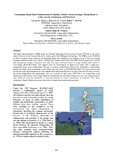
Aquaculture-based restoration and stock enhancement of tiger shrimps in the Philippines
(Training Department, Southeast Asian Fisheries Development Center, 2016)In central Philippines, the Aquaculture Department of the Southeast Asian Fisheries Development Center (SEAFDEC/AQD), with strong collaboration and support from the Research Institute for Humanity and Nature (RIHN) of Kyoto, Japan, has been looking into the stock enhancement of tiger shrimp Penaeus monodon in the New Washington Estuary (NWE), province of Aklan, central Philippines. The NWE was a productive fishing ground that has been suffering from degenerating brackishwater fisheries and estuarine environment. Average daily catch declined from 24 kg in 1970s to only 0.7 kg at present. Shrimp fisheries, the most important livelihood, declined in quality and quantity. Tiger shrimps were abundant in catch until the early 1990s when these were observed to decline in volume, replaced by smaller and cheaper species. This was coincidental with the rapid decline in mangrove cover for ponds and huge increase in fishing pressure. It is clear that crucial interventions are required to restore the tiger shrimp fisheries in the NWE in order to increase income of local fishers, while promoting reduction of fishing gears and restoration of mangroves. Stock enhancement of tiger shrimps shows good potential in answering these needs. Site-specific assessments were conducted to evaluate prospects of shrimp stock enhancement in NWE. Conservative simulations of capture of released stocks showed that fishers can increase income by 300%. To decrease fishing pressure in the area, number of gears per fisher may have to be reduced but shrimp catches will be relatively high-priced. Comparative experiments using aquaculture techniques were done to identify strategies especially in the delicate intermediate acclimation rearing. Aquaculture protocols like those for pond preparation were also adapted to be used in a mangrove pen nursery rearing system for shrimps. Supplemental feeding with formulated feeds increased carrying capacity of the culture area, while enhancing growth and survival of stocks. Culture experiments showed that shrimps grow to 0.5 g within 1 mo and >1g in 2 mo. High stocking density of 40-60 shrimps m-2 can be used for <2 mo rearing in a mangrove pen. Release experiments showed that 60-d old shrimps have higher chances of survival when released in the estuaries. With strong support from local communities, government and other sectors, together with effective management and law enforcement, aquaculture-based stock enhancement of tiger shrimps can be a viable intervention to restore livelihood and promote estuarine rehabilitation in the NWE. -
Fishery resource enhancement: An overview of the current situation and issues in the southeast Asian region
Lebata-Ramos, Ma. Junemie Hazel; (Training Department, Southeast Asian Fisheries Development Center, 2016)
The total global production from capture fisheries has plateaued since the mid 90s. This stagnation in production or reduced productivity of the world’s coastal and marine wild fisheries is caused by overfishing and degradation of habitats through coastal development and destructive fishing methods. Reports have shown that if the current fishing trends continue, all of the commercial fisheries will have collapsed by 2050. To boost production, scientists, fisheries managers, government agencies, and NGOs have been looking at ways of enhancing fish stocks. Replenishing depleted stocks may be done by regulating fishing effort, restoring degraded nursery and spawning habitats or through resource enhancement. Resource enhancement using individuals reared in aquaculture facilities or seed stocks abundant in the wild is becoming a popular method of supplementing depleted stocks. It is one of the many strategies that could help address the decreasing fisheries production in the wild. A brief history of resource enhancement, the aquatic species released in the different countries in the region, the reasons for releasing stocks, and the issues involved, are discussed briefly in this paper. Among the main reasons for resource enhancement are to increase production or enhance stocks and increase food supply and/or family income. Other reasons include protection of endemic and maintenance of endangered species, rehabilitation of degraded natural habitats and for recreation fisheries, among others. Age or size of seeds, seed quality, genetics, governance, economics, biodiversity conservation, politics, and the introduction of exotics are among the resource enhancement issues identified in the region. -
SEAFDEC/AQD stock enhancement initiatives: Release strategies established
Lebata-Ramos, Ma. Junemie Hazel; ; Sibonga, Rema ; ; ; (Training Department, Southeast Asian Fisheries Development Center, 2016)
SEAFDEC/AQD’s Stock Enhancement Program started in 2001 with the first stock enhancement initiative on mud crab Scylla spp. funded by the European Commission. This was followed by another stock enhancement program in 2005 supported by the Government of Japan Trust Fund with seahorses Hippocampus spp., giant clam Tridacna gigas, abalone Haliotis asinina, and sea cucumbers Holothuria spp. as priority species. This paper discusses the release strategies that have been established for giant clam, abalone and mud crab. -
Community-based stock enhancement of abalone, Haliotis asinina in Sagay marine reserve: Achievements, limitations and directions
(Training Department, Southeast Asian Fisheries Development Center, 2016)The Sagay Marine Reserve (SMR) under the National Integrated Protected Area System (NIPAS) is one of the many reef areas in the Visayan Sea in the central part of the Philippine archipelago. The SMR covers 32,000 ha or 59% of coastal waters north of the mainland Sagay City. Donkey’s ear abalone is one of the most sought mollusks traded by small-scale fishers in Molocaboc Island located within the SMR. High buying prices in local and international markets compared with other fish catch motivated fishers to target abalone and caused its overfishing. SEAFDEC/AQD, with support from the Government of Japan Trust Fund (JTF), conducted a community-based stock enhancement through a tri-party collaboration between the fisherfolks of Molocaboc Island, the Sagay local government at the village and city levels, and SEAFDEC/AQD. The study showed that the decision and implementation of stock enhancement and the definition of its objectives and relevance involves the strong engagement with stakeholders. For over a period of eight years (2007-2014), we learned that stock enhancement necessarily involve high financial investments and enormous transaction cost over a long period of time which are often not affordable to local governments of coastal communities in Southeast Asia. Thus, community-based collaborations may help achieve enhancement and restocking goals. -
Series: ACIAR Working Paper;No. 54
Mud crab hatchery and grow-out status in the Philippines
Quinitio, Emilia T. (Australian Centre for International Agricultural Research, 2004)
Interest in mud crab aquaculture is increasing throughout the Philippines because of its demand both in local and export markets. Mud crab culture started as low-density polyculture with fish or shrimp using wild crab juveniles and developed to monoculture in ponds and cages. Recently, an integrated mangrove-crab culture system has been practiced. Mud crab species commonly cultured are Scylla serrata, S. tranquebarica, and S. olivacea. The yearly increase in production from 1996 to 2000 (Table 1) may indicate a corresponding increase in the seed collection activity due to greater demand of seeds for stocking. According to many gatherers in the country, there has been a declining volume of all size-classes, from juveniles to adult crabs, gathered from the wild over the last decade. Hence, the development of a commercially viable hatchery technology can play an important role in promoting sustainable crab aquaculture and fisheries management. -
Requirements of juvenile sea bass, Lates calcarifer Bloch, for lysine and arginine
(International Foundation for Science, 1993)The dietary requirements of juvenile sea bass for the essential amino acids, lysine and arginine, were studied. Fish (Initial average weight in Lysine (Study 1) and Arginine (Study 2) experiments were 13.1 g and 2.5 g, respectively) were given amino acid test diets that contained fish meal, zein, squid meal, and crystalline amino acids (about 46% dietary protein) for 12 weeks. Each set of nitrogenous and isocaloric test diets contained graded levels of lysine or arginine. Fish were fed twice a day at 0800 and 1600 h: in Study 1, feeding rate was 4-2.5% of body weight per day throughout the experiment, while in Study 2, fish were fed at a rate of 10% body wt per day during the first four weeks and at 4% body wt per day from 5 to 12 weeks thereafter. The fish were reared in 500 li (Study 1) or 250 li (Study 2) fiberglass tanks provided with flowthrough seawater at 28°C and salinity of 30 ppt. At the end of the feeding experiment, growth, survival, and feed efficiency were determined. Survival was high in fish given adequate lysine or arginine. Mean weight gains were significantly different in fish fed varying levels of lysine or arginine but no significant different in fish fed varying levels of lysine or arginine but no significant differences were found in the hepatosomatic index (HSI), survival, and feed efficiently ratio. From the breakpoint analysis of the growth response curves, the dietary requirements of sea bass juveniles for lysine and arginine are 4.5 and 3.6% of dietary protein, respectively. This information is important in developing research diets and practical feeds for sea bass. -
Seafarming and community development in the Philippines
(Network of Aquaculture Centres in Asia-Pacific, 2002)This paper provides information on the seafarming activities in the Philippines, which includes milkfish, seabass and grouper cage and pen culture. It also provides some other seafarming alternatives including mud crab, seaweed, mussels and oysters. The paper gives information on community-based coastal resource management as a strategy for community development. The Philippines Government Fishery Resources Management project was outlined. The problems and issues associated with seafarming in the Philippines are described. -
Qualitative and quantitative comparison of bacterial flora associated with hatchery-reared and wild-caught shrimp postlarvae
(ASIARESIST, 2005)Because of high mortality recorded in pond-reared shrimps due to luminescent vibriosis infection, a study was conducted to determine if postlarvae (PLs) could be major sources of luminescent bacteria (LB). Batches of hatchery-reared (PL12 to 18) and wild-caught Penaeus monodon PLs were examined to determine their bacterial load. Results show that although all PLs have associated Vibrio spp., not all of them harbored detectable levels of LB. Fifty eight percent of wild-caught postlarval batches did not have associated LB compared with only 23-44% of hatchery-reared postlarvae. A significant difference in quantitative LB load was noted between hatchery reared and wild-caught PLs with the former harboring up to 3.0 x 10⁵ cfu LB/postlarva. Wildcaught PLs had only up to 3.5 x 10² cfu LB/postlarva. Antimicrobial sensitivity tests using disc diffusion method show significant resistance to Chloramphenicol and Oxytetracycline among isolates from hatchery-reared PLs (33 and 44%) compared with bacteria from wild-caught PLs (3 and 6%) and near shore seawater (0 and 12%). The differences between the quantitative and qualitative bacterial flora of hatchery-reared and wild-caught PLs may have contributed to the occurrence of luminescent vibriosis in grow-out ponds, which generally make use of hatchery-reared postlarvae. -
Antimicrobial resistance in bacteria isolated from aquaculture environments in the Philippines
Tendencia, Eleonor; (ASIARESIST, 2005)
Antibiotics have been used in aquaculture as feed additives to promote growth and added in water to prevent disease occurrence. Therapeutic doses are used to treat diseases. Long-term use and misuse of antibiotics may result to drug resistant bacterial strains and accumulation of unwanted residues in the cultured commodity upon slaughter and harvest. Some of the antibiotics that have been used in shrimp hatcheries and grow-out ponds are tetracycline, rifampicin, chloramphenicol, nitrofurans, erythromycin, oxolinic acid and furazolidone. Oxytetracycline, furanace, terramycin, Ektecin, chloramphenicol and sulfa drugs have been used to treat fish bacterial infections. Antibiotic resistant bacteria have been isolated from shrimp rearing water, natural bodies of water that received effluents from aquaculture, and from cultured apecies in the Philippines. Resistance to oxytetracycline and furaltadon were reported in bacteria isolated from crab and nearshore sediments. Bacteria from shrimp ponds have been reported to be resistant to oxytetracycline, furazolidone, oxolinic acid and chloramphenicol. Luminous vibrios from shrimp larvae and ponds were resistant to erythromycin, kanamycin, oxytetracycline, Penicillin, streptomycin, sulfadiazine and triple sulfa. Aeromonas sp. from fish, shrimp, and their rearing water were resistant to streptomycin, oxytetracycline and trimethoprim/sulphamethoxazole. Multiple antibiotic resistance has also been reported in bacteria isolated from shrimp, shrimp ponds, luminous bacteria from shrimp post larvae, and Aeromonas hydrophila from fish. Despite the recorded usage, antibiotic residues in cultured food fish have not yet been a problem of the Philippine aquaculture industry as far as trade is concerned. However, chloramphenicol and nitrofurazolidone residues have been detected in shrimp for export using the enzyme link immunoassay (ELISA) technique. To minimize the use of antibiotics, different alternative methods to prevent diseases in aquaculture have evolved. Government agencies also issued regulations on the use of antibiotics.