LakeCon2003: Recent submissions
21-40 / 49
-
Revisiting the Ligawasan marshland in Mindanao: An indigenous resource management system study towards sustainability
(Southeast Asian Regional Center for Graduate Study and Research in Agriculture (SEARCA), 2005)The Ligawasan Marshland covering an area of 288,000 ha is important to hundreds of thousands of Magindanawan Bangsamoro fisher-farmers whose basic means of livelihood are wild fishing and traditional rice farming. This study evaluates the indigenous resource management system and indigenous laws in fishing and rice farming and the effects to the sustainability of the marshland. Most of the fisher-farmers practiced traditional fishing and farming beliefs/rituals which promoted sustainability since giving respect to the marshland as a sacred place deters overexploitation. In terms of indigenous laws, bans on electric and chemical fishing, and fry catching are strictly enforced. A peaceful coexistence is preserved among the heads of barangays, traditional religious leaders, and the Bangsamoro mujahideen leaders to enable them to work in unity amidst some diversity. An exclusive open access and rights to control only among Magindanawan Bangsamoro is observed which show their control over accessibility and utilization of the marshland. Aquatic wildlife remains abundant in the marshland to include species of fish, crustaceans, mollusks, and other aquatic organisms with economic value. Values obtained on the physico-chemical properties [dissolved oxygen (DO) - 4.67 g/L; pH - 6.99; water turbidity - 53.30 cm; dissolved solids (DS) - 136.04 mg/L) of the marshland were within the normal range indicating that the area remains an ideal habitat for fish and other aquatic resources. The overall sustainability level (using ecological soundness, cultural acceptability, social justice, economic viability and technological appropriateness dimensions) of the marshland was rated moderate with a mean rating of 75.06. This indicates that the marshland has gained some degree of degradation due to the occurrence of natural calamities and centuries of utilization of the area by the fishers-farmers. Based on the findings, a sustainability framework is put forward to strike a balance between the socioeconomic and biophysical environment, and the indigenous resource management system and laws to enhance sustainability of the Ligawasan Marshland. -
Hi-density tank culture of Nile tilapia (Oreochromis niloticus) using lake water with effluent management
(Southeast Asian Regional Center for Graduate Study and Research in Agriculture (SEARCA), 2005)Nine concrete tanks (2 x 2 x 1 m) were stocked with tilapia fingerlings (abw = 3.3±0.9 g) and three stocking rates (50 fish/m2, 100/m2, and 150/m2) were tried. The rearing period lasted for 120 days. Fingerlings were fed commercial diet containing approximately 27% crude protein. The amount of feed was adjusted based on monthly weight samplings. Pre-filtered lake water pumped through gravity aerators into the tanks was used throughout the culture period. Although production was intensified, water agitators and similar mechanical implements were not employed to cut production costs. Results show that tilapia stocked at 50/m3 grew significantly heavier at 109.2 ± 8.0 g. This was significantly better (P<0.05) than fish stocked at 100 and 150/m3, which had basically the same final weight of 82.4 ± 1.8 g and 83.4 ± 8.7 g, respectively. Likewise, survival or recovery at harvest was highest at 92.8% for the stocking rate of 50 fish/m3. The results suggest that stocking at lower densities would result to bigger fish but a lower total yield per tank, or higher stocking densities would mean higher yield but smaller individual fish size at harvest. The rate of water flow through at harvest time was equivalent to 0.30 L/min/kg biomass at the highest stocking density of 150/m3, 0.40 L/min/kg biomass at 100/m3, and 0.60 L/min/kg biomass at the lowest density of 50/m3. Siddiqui et al. (1991) suggested a minimum of 0.50 L/min/kg biomass flow rate for intensive culture of tilapia, but this was generally for clean culture water, not like lake water whose quality varies naturally. After determining the optimum stocking density, a second experiment using bigger fingerlings (57.5±12.6 g) was conducted for 101 days to determine the ideal water flow rate in the system. Varying flow rates (10 liters per minute (Lpm), 15 Lpm and 20 Lpm) were evaluated at a fixed stocking density of 50 fish/m3. Feed ration was 5% during the first two months, 4% on the third month, and 3% thereafter. Tilapia size at harvest increased with increasing flow rate when stocked at 50 fish/m3. From an initial stocking size of 57.5 ± 12.6 g, biggest fish harvests were obtained in tanks with a flow through rate of 20 Lpm (152.2 ± 15.1 g) after 101 days of culture. However, this was not significantly different to fish grown in tanks at 15 Lpm (139.9 ± 7.6 g). Smallest fish harvests were obtained at 10 Lpm at 111.20 ± 8.3 mm. A similar trend was observed with fish length at 157.7 ± 15.5 mm, 150.8 ± 11.0 mm, and 142.1±17.6 mm for 20 Lpm, 15 Lpm, and 10 Lpm, respectively. Feed conversion ratio (FCR) ranged from 1.7 to 2.5 in all treatments. The rate of water flow through at harvest time was equivalent to 1.2 L/min/kg biomass at 20 Lpm, 0.6 L/min/kg at 15 Lpm (sufficient for Laguna de Bay water), and 0.4 L/min/kg at 10 Lpm flowrate. Except for a slight increase in ammonia levels (maximum 1.1 mg/L total ammonia nitrogen) towards the final two weeks of the rearing period, water quality in the culture tanks was generally within tolerable levels throughout the run. Thus, the quality of water from Laguna de Bay can safely support the stocking density used in the experiment. However, if stocking density is further increased, aeration may need to be provided because very low early morning dissolved oxygen levels (DO) were observed, especially in tanks with high stocking density. The significant amount of sludge, mainly fish feces and uneaten feeds, effectively trapped and collected from the settling apparatus, clearly demonstrated the apparatus efficiency. Effluent water was practically rid of solid wastes, and gravity aeration oxygenated the water before it was discharged back to the lake. Ammonia, pH and DO levels of the effluent water were similar to those recorded from the water in the header tank. -
Aquaculture practices in Laguna de Bay, Philippines
(Southeast Asian Regional Center for Graduate Study and Research in Agriculture (SEARCA), 2005)A survey was conducted to obtain information on the fish culture practices of the fish farmers in Laguna de Bay, Philippines. Fish farms vary greatly in size. Nile tilapia and bighead carp are the two fish species cultured in cages. Milkfish as well as tilapia and bighead carp are cultured in pens. The fish in cages and pens in the lake are grown in monoculture and polyculture systems. About one-half of the cage operators and two-thirds of the pen operators do not use artificial feeds in growing fish. Estimates of N load in the lake due to feeding indicated that the contribution of feeds to N in the water is low in relation to the N present in the water. The fish farmers vary in their practices in terms of stocking rate, culture period, and feeding. Production per unit area also varies. However, fish farmers have common concerns and problems. -
Status and impacts of tilapia fish cage farming in Lake Bato: Some policy and management options for sustainable development
(Southeast Asian Regional Center for Graduate Study and Research in Agriculture (SEARCA), 2005)An assessment and impact analysis of the fish cage arming in Lake Bato was conducted from October 1999 to January 2000 through a field survey and personal interviews with fish cage farmers, operators and key informants in 10 lakeside communities bordering Lake Bato. Tilapia fish cage farming was the most dominant activity undertaken in the lake owing to its economic contribution and performance. It is sad to note, however, that the management and protection of the lake has been neglected. Results showed that the lake is experiencing serious stress and degradation as a result of fish cage congestion numbering to more than 21,820 units indiscriminately installed all over the lake. The same is also the cause of conflicts (i.e., marginalized small-scale fishers, obstruction of navigational route, and proliferation of dummy fish cage operators) among lake users. As a consequence of expanded technology application, slow fish growth, algal bloom, fish kill, and the apparent shallowing of the lake have become alarming concerns among resource users. It is also worth noting that the industry s sustainability is now under serious threat if not properly planned, managed, and protected. It is therefore recommended that alternative policy and management options be institutionalized. This would include formulation of a lake-wide inter-Local Government Unit (LGU) fisheries ordinance, implementation of Lake Bato Resource Management Plan, organization of a lake-wide fish cage farmers and operators, conduct of collaborative and interdisciplinary research and development initiatives, conduct of technical and management training for Best Fish Cage Practice, and massive information-education-communication (IEC) for concerned municipalities. -
Sustaining the resource use and management of Sampaloc Lake, San Pablo City, Philippines: A potable source of water
(Southeast Asian Regional Center for Graduate Study and Research in Agriculture (SEARCA), 2005)Water is the most basic and indispensable commodity. In the past, nobody realized the value of water until the wells and rivers started to dry. Of the numerous natural lakes of the Philippines (about 59), all are potential sources of surface water. The existing natural lakes are one of the best solutions to meet the water shortage of the different users and stakeholders. But human activities interfere with the natural life of these lakes, depleting its life-giving support characteristics, its productivity and usefulness. San Pablo City, situated in the apex of the heart-shaped Province of Laguna, is known as the City of Seven Lakes . Sampaloc Lake is the biggest, having a surface area of 104 ha. It is one of the ecotourism spots of the city and used to have an abundant supply of clear springs in the lakeshore area. This policy research study sought to address the question: What policies should be pursued to sustain the natural resources of Sampaloc Lake? There were several policy issues identified related to the sustainability, conservation and protection of the lake and its natural resources: (1) the capacity of the people in the lakeshore area to sustain the benefits and ecological balance; (2) enforcement of the regulations and laws to sustain the initiatives of the city government to rehabilitate, protect and conserve the natural resources of the lake; and (3) policy support for a relocation plan of the settlers within the lakeshore area. Major issues and concerns related to the lake were evaluated. First was the community-based approach in resource management and development. Second was the efficient delivery of services by the government, non-government organizations (NGOs), and other entities. Third was the synergy and complementation in the integration of policy interventions and initiatives of the city government and private sectors. Effectiveness, equity and distribution, and financial and institutional sustainability were the criteria used for the analysis in the policy research. Effectiveness was evaluated in terms of impact to poverty alleviation and lakeshore rehabilitation and protection, while equity and distribution were evaluated in terms of the quality of life of lakeshore-beneficiaries and settlers. Financial sustainability was measured in terms of the adequacy of funds to meet the financing obligations while institutional sustainability was evaluated in terms of whether the existing policy environment is favorable to supporting the proposed alternatives in response to Republic Act 7160, Local Government Code, Republic Act (RA) 8041, National Water Crisis Act of 1995, and RA 8550 and Fishery Code of 1998. -
Prawn fisheries of Lake Bato
(Southeast Asian Regional Center for Graduate Study and Research in Agriculture (SEARCA), 2005)Lake Bato is one of the most important lakes in the Bicol Region in terms of economic benefits to lakeshore communities. It is considered a commercial fishing ground of endemic and indigenous fish species. However, fish production in the lake is declining and now under serious threat. This paper is the result of a preliminary survey on freshwater prawns conducted in July 2001 which could serve as a basis in policy formulation for management and conservation measures to attain sustainability. The fishing gears used in catching prawns in Lake Bato are prawn pot bubo , seine net, and prawn shelter. Two species of Palaemonid prawns were noted in the area but the dominant species was Macrobrachium idella, locally known as buyod . It was reported that M. idella is caught year-round but peak season is observed during summer. Based on samples measured, males of M. idella were larger than females. Fisherfolks reported that berried prawns are observed throughout the year but peak season is noted in March to April. The average prawn catch during the survey is 13 kg/fisherfolk/day with an estimated production of about 0.646 MT/day is sold in local and export markets. The average gross income is about P520.00 to P780.00/fisherfolk/day and an estimated total gross income of P26,000.00 to P32,000.00/day. Major issues/ problems related to capture fisheries in the lake are the following: deteriorating habitat, overfishing, and the absence of a management plan. -
Socio-ecological case study of Lake Danao, Ormoc City, Philippines: Implications to management and policy
(Southeast Asian Regional Center for Graduate Study and Research in Agriculture (SEARCA), 2005)This paper discusses some of the social, political, and economic pressures impinging upon the ecosystem components of Lake Danao in Ormoc City, Philippines. Conflicting objectives among individual residents and various stakeholders regarding the exploitation and utilization vis-a-vis the preservation and/or conservation of the lake s resources have led to a seeming lack of coherence in the approaches for the sustainable management of the ecosystem. There is also a need to review existing policies and examine the feasibility of accomodating a multiple-use framework in the management of Lake Danao. -
Documenting the presence and impact of introduced freshwater fishes for aquaculture in the Philippines
(Southeast Asian Regional Center for Graduate Study and Research in Agriculture (SEARCA), 2005)The demand for fish protein in the Philippines cannot be met by capture fisheries alone so the Philippine government has turned to aquaculture as an alternative source of fish protein. Aquaculture has promoted the introduction of aquaculture species where, although contributing significantly to aquaculture production, has also led to the introduction and establishment of species in local ecosystems through their escape to the wildlife. In the Philippines, freshwater ecosystems with relatively high endemism have become a significant problem. There have been 157 species introduced into the Philippines, 36 of which have been established in the wild. Although most were introduced by the ornamental industry, 79% (23 of 29) of those introduced for aquaculture purposes have established in the wild. After habitat destruction, introduced species are considered the greatest cause of the loss of biological diversity, posing as a major threat to native fishes. Introduced species, however, are also responsible for contributing much to world aquaculture production where over 2.35 million MT (13% of total) were contributed by introduced finfish species to freshwater aquaculture production in 2000. The Philippines is the 8th freshwater aquaculture producer in the world with 111,764 MT produced in 2000, approximately 75% of which were contributed by introduced species. Documenting the introduction (man-made or otherwise) of exotic fishes provides a general view of the magnitude of these movements, their existence in the wild and the existing and potential threat faced by the ecosystems to which they have been introduced. Tracking the impact of the introduced fishes into ecosystems should be treated with very high importance. Currently, this kind of information is either not available, very limited, or scattered in different journals and agency/project reports. FishBase provides a shell to document and consolidate specific information on the occurrence and impact of species in the ecosystems where the species are now found. A registry like this provides information about the status of the introduced and native species as well as current or potential threats to the ecosystems. Together and through links to other related information sources on the web, information can thus be accessed easily. The fusion of all these information sources would allow students, researchers, decision- and lawmakers to access updated and reliable information for programs, projects and aquatic resources conservation and management. -
Back to basics: Institutional and behavioral perspectives on the Taal Lake fish cage industry
(Southeast Asian Regional Center for Graduate Study and Research in Agriculture (SEARCA), 2005)The practice of fish cage culture existed in Taal Lake in the 1970s but it only flourished in the late 1990s, degrading water quality and increasing fish kill incidences in cage areas. This paper analyzes the Taal Lake fish cage industry using the situation, structure, and performance (SSP) framework. The following interrelated goods were identified: (1) water quality as an incompatible use and common pool resource; (2) lake resource use as high exclusion cost (HEC) good; and (3) fish cage technology and labor as high transaction cost goods. Relevant stakeholders were identified and for each situation, the current institutions were described and alternative institutional structures were suggested, shifting externalities and costs from one group to another. The key to solving problems confronting stakeholders of Taal Lake s fish cage industry lies with the understanding of the sources of interdependence among the different goods and the industry s relationships with existing policy structures. Theoretical analyses showed the differences in income distribution among stakeholders, diminishing biodiversity, fish kill incidences, and the apparent ineffectiveness of the current institutional support system. Therefore, it is important to interpret and modify existing laws and regulations, determining who pays for fixed costs and whose preferences count. Development in the institutional structures may lead to future technological changes in the fish production system and improvement of water quality in cage areas. -
Fisheries in the floodplain lakes of Agusan marsh and its implications for sound management
(Southeast Asian Regional Center for Graduate Study and Research in Agriculture (SEARCA), 2005)Yearlong assessment of the artisanal fishery from the three floodplain lakes of Ticgon, Dinagat, and Mihaba in Agusan Marsh, a declared national priority protected area, was done using length-weight frequency analyses. Results showed that the catch on economically-important fishes such as Cyprinus carpio and Trichogaster pectoralis in Lakes Ticgon and Mihaba did not suggest growth overfishing. The regulated mesh size allowed in the area is, to some extent, effective. However, Oreochromis niloticus and Trichogaster pectoralis caught from Lake Dinagat were found to have sizes below the optimum and with size less than its length at first maturity. This assessment has a very profound implication to the conservation efforts in the area considering that fishery in the marsh is a cheap source of protein for the local communities. Yet, the continuity of the said regulations remains a formidable challenge for some reasons: community in the marsh is dispersed; the area is so vast with lots of entry and exit points making monitoring a tedious and expensive job; and unabated electrofishing, although declared an illegal activity, is still more profitable than mere use of fishing gears. -
Policy issues on lake management in the Philippines
(Southeast Asian Regional Center for Graduate Study and Research in Agriculture (SEARCA), 2005) -
Bathymetry and vertical temperature profile of Lake Mainit
(Southeast Asian Regional Center for Graduate Study and Research in Agriculture (SEARCA), 2005)The bottom topography and vertical temperature profile of Lake Mainit was assessed to provide baseline data to understand the dynamic behavior of the lake as an ecosystem. Many limnological phenomena, distribution of biota, and productivity were directly related to the morphological features of the lake basin. The bottom topography was assessed using echo sounding method. Vertical temperature profile of the lake was evaluated using reversing thermometers mounted on Nansen reversing samplers. All data points were marked by geographic positioning system. Results indicated that the maximum recorded depth was 218.75 m based on current surface elevation of Lake Mainit. The deep portions of the lake with steep shoreline profile were observed in the vicinity along the Malimono ridge. Areas in the lake with more than 200 m depth were observed between Bonga and the islets of Kitcharao. Coasts along Mainit and the eastern part of the lake, except the Kitcharao Park which is rocky, have sloping shoreline. The vertical temperature profile of Lake Mainit ranged between 26.55° - 30°C. The thermocline layer was observed between 10 m to 40 m. The variation in vertical temperature was observed at the surface and at levels down to a depth of 30 m. Beyond 30 m, there was a minute variation of temperature that ranged between 0.03° - 0.15°C. -
Transformation of Laguna Lake from a marine arm of Manila Bay to a freshwater system
(Southeast Asian Regional Center for Graduate Study and Research in Agriculture (SEARCA), 2005)Evolution of Laguna Lake during the past 6,000 years is established using paleontologic, sedimentologic, and geochemical profiles of a 10.5-meter long sediment core from the western lobe. Marine molluscan and diatom assemblages reveal a lagoonal environment with depths initially greater than 10 m, 5,700 radiocarbon years ago (yBP), then it consistently shallowed to intertidal depths until 3,700 yBP. Tellina sp., Leptaxinus sp., and Anomalocardia sp. predominated the molluscan fauna. The marine Cyclotella stylorum, Thalassiosira eccentrica, and Thalassiosira lineata, comprise 80% of the diatom fauna. Brackish water condition was short-lived and it was succeeded by freshwater conditions set at the appearance of Vivipara burroughiana 3,000 yBP. The XRF-derived sulfur, strontium, and calcium concentrations and their aluminum-normalized trends used as geochemical proxy records, corroborate the changing salinity levels and the age boundaries set from the molluscs. Lowering of sea level from the mid Holocene high and vertical movements across the West Marikina Valley Fault, which presently bound the western edge of Laguna Lake, led to the emergence of the Muntinlupa-Paranaque stretch, isolating the proto-Laguna Lake from Manila Bay. Pulsed decreases of salinity to freshwater levels at 250-year intervals and the associated emergence of a 30 m-high barrier reveal a large tectonic influence as opposed to small climatic and sea level shifts within this period. In the last few decades, a new phase of environmental shift has been occurring in the lake. Global warming and land subsidence elevated the saltwater backflow into the lake, enough to leave an increasing salinity trend in the sediment record. -
Catastrophic flood hazards from crater lakes: Parker and Pinatubo volcanoes, Philippines
(Southeast Asian Regional Center for Graduate Study and Research in Agriculture (SEARCA), 2005)In a span of seven years, three catastrophic flood events ensued from the breakout of two crater lakes: two from Maughan Lake, the crater lake of Parker volcano, and one from Pinatubo volcano. The mechanisms of the three lake-breakouts differ significantly from each other. In September 1995, about 30 million m3 of water was suddenly released from Maughan Lake, resulting in large life and property losses. The breakout, which lowered the lake level by 10 m, was caused by the sudden removal of the material that had been damming the lake at its outlet along the Gao Creek. How the dam material was removed remains the subject of a criminal investigation. A result of the 1995 breakout was the destabilization of the slopes along the Gao Creek, which resulted in several large landslides that dammed the lake outlet anew. By January 1997, Maughan Lake had risen by more than 8 m, equivalent to an additional 24 million m3 of water. Maughan Lake broke out again in March 2002, hours after a M6.8 earthquake occurred offshore southwest of Cotabato City. The lake level was lowered by more than 9 m, and the total volume of water released was about 27 million m3. The debris flows and floods resulting from the breakout emplaced deposits that could be traced to at least 80 km along the Gao-Alah River. The breakout is believed to have been caused by the progressive weakening of the landslide dam due to the earthquakes, and/or to seiches that may have been produced along the blocked Gao Creek. The lake-breakout scenario at Pinatubo was anticipated as early as 1998, with the lake rising at ~10 m per year. Judging from the loose emplacement and low density of the uppermost layers of the deposits at the Maraunot Notch (the lowest part of the crater rim), Philippine Institute of Volcanology and Seismology (PHIVOLCS) and United States Geological Service (USGS) scientists predicted a potentially large lake-breakout lahar event that might inundate the town of Botolan, Zambales. In September 2001, while the lake was still 5 m below spilling level, the government decided to excavate a trench that would drain the lake at a scheduled time and prevent the accumulation of an additional 15 million m3 of water. However, miscommunication between scientists and engineers resulted in a trench that favored slow drainage of the crater lake. It was only in July 2002, during heavy typhoon rains, that the lake actually broke out, releasing about 65 million m3 of water and lowering the lake by 23 m. The floodwaters bulked up with sediments downstream to form lahars with a total volume of 165 million m3, reaching the Bucao Bridge but sparing the Botolan town proper. Without the 2001 trenching, the lahar volume could have been more than 200 million m3, perhaps enough to adversely affect Botolan. The 2002 Pinatubo crater-lake breakout was probably generated by channel-bed erosion at the Maraunot Notch, as predicted by commonly used dam-breach models. With the lake now draining through the Maraunot Notch over erosion-resistant dacitic bedrock, a catastrophic breakout by such mechanism is no longer expected. Lake-breakout, however, may be triggered by unpredictable events such as an eruption from the crater. -
Microcystins from the cyanobacteria Microcystis aeruginosa in Laguna de Bay, Philippines
(Southeast Asian Regional Center for Graduate Study and Research in Agriculture (SEARCA), 2005)Laguna de Bay, the largest freshwater lake in the Philippines, experiences periodic blooms of the cyanobacteria Microcystis aeruginosa. The results of analysis for the presence of the hepatotoxin microcystins in bloom samples of this cyanobacteria from 1996, 1998, 1999 and laboratory cultures from 1997 isolates, based on the studies conducted at Binangonan Freshwater Station of SEAFDEC/AQD are presented. Twenty structural variants of the toxin have been isolated with microcystin LR (MC-LR) being the most abundant form. MC-LR contribution ranged from 22% to almost 100% of the total microcystins in the samples. Microcystis bloom in 1998 had MC-RR as the most dominant form of the toxin with almost 38% followed closely by MC-WR (23%) and MC-LR (22%). The harvest from 1996 had the highest total toxin concentration (4048 µg g-1). Laboratory-cultured M. aeruginosa had even higher total toxin concentrations ranging from 11,472 to 12,160 µg g-1. The presence of high microcystins concentrations in M. aeruginosa from Laguna de Bay has far reaching implications in terms of the use of this resource for fishery and domestic water supply. -
Assessment of the Lumban River Delta in Laguna de Bay, Philippines for conservation
(Southeast Asian Regional Center for Graduate Study and Research in Agriculture (SEARCA), 2005) -
History of trace metal pollution in Laguna Lake, Laguna, Philippines
(Southeast Asian Regional Center for Graduate Study and Research in Agriculture (SEARCA), 2005) -
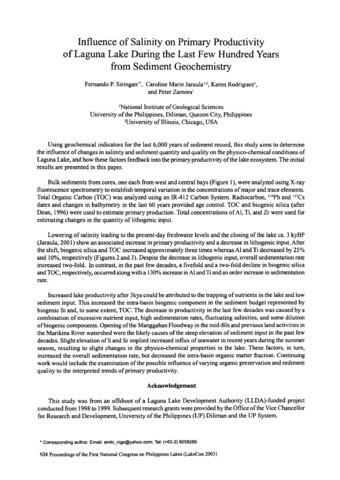
Influence of salinity on primary productivity of Laguna Lake during the last few hundred years from sediment geochemistry
(Southeast Asian Regional Center for Graduate Study and Research in Agriculture (SEARCA), 2005) -
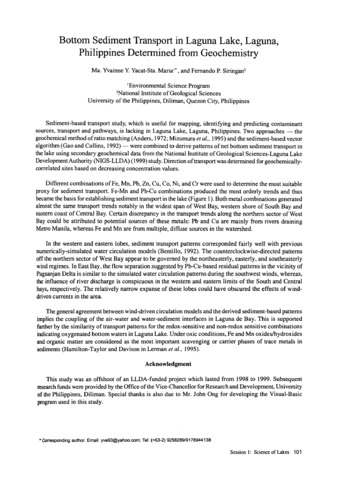
Bottom sediment transport in Laguna Lake, Laguna, Philippines determined from geochemistry
(Southeast Asian Regional Center for Graduate Study and Research in Agriculture (SEARCA), 2005) -
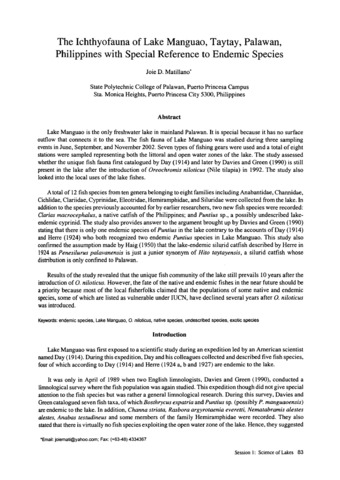
The ichthyofauna of Lake Manguao, Taytay, Palawan, Philippines with special reference to endemic species
(Southeast Asian Regional Center for Graduate Study and Research in Agriculture (SEARCA), 2005)Lake Manguao is the only freshwater lake in mainland Palawan. It is special because it has no surface outflow that connects it to the sea. The fish fauna of Lake Manguao was studied during three sampling events in June, September, and November 2002. Seven types of fishing gears were used and a total of eight stations were sampled representing both the littoral and open water zones of the lake. The study assessed whether the unique fish fauna first catalogued by Day (1914) and later by Davies and Green (1990) is still present in the lake after the introduction of Oreochromis niloticus (Nile tilapia) in 1992. The study also looked into the local uses of the lake fishes. A total of 12 fish species from ten genera belonging to eight families including Anabantidae, Channidae, Cichlidae, Clariidae, Cyprinidae, Eleotridae, Hemiramphidae, and Siluridae were collected from the lake. In addition to the species previously accounted for by earlier researchers, two new fish species were recorded: Clarias macrocephalus, a native catfish of the Philippines; and Puntius sp., a possibly undescribed lake-endemic cyprinid. The study also provides answer to the argument brought up by Davies and Green (1990) stating that there is only one endemic species of Puntius in the lake contrary to the accounts of Day (1914) and Herre (1924) who both recognized two endemic Puntius species in Lake Manguao. This study also confirmed the assumption made by Haig (1950) that the lake-endemic silurid catfish described by Herre in 1924 as Penesilurus palavanensis is just a junior synonym of Hito taytayensis, a silurid catfish whose distribution is only confined to Palawan. Results of the study revealed that the unique fish community of the lake still prevails 10 years after the introduction of O. niloticus. However, the fate of the native and endemic fishes in the near future should be a priority because most of the local fisherfolks claimed that the populations of some native and endemic species, some of which are listed as vulnerable under IUCN, have declined several years after O. niloticus was introduced.