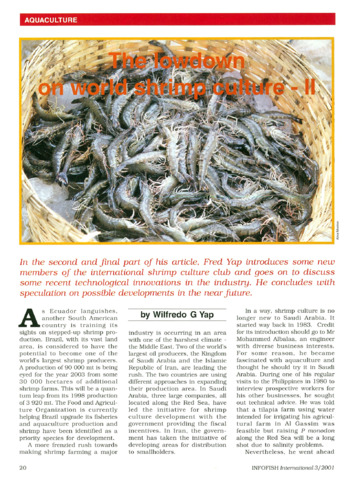
The lowdown on world shrimp culture - II
閲覧/開く
日付
2001Page views
1,790ASFA keyword

AGROVOC keyword
Taxonomic term

Geographic names

Metadata
アイテムの詳細レコードを表示するShare
抄録
This paper introduces some new members of the international shrimp culture club and goes on to discuss some recent technological innovations in the industry, particularly the polyculture of tilapia (mainly Oreochromis mossambicus) and shrimp.
Keywords
SEAFDEC/AQD記述
In the second and final part of his article, Fred Yap introduces some new members of the international shrimp culture club and goes on to discuss some recent technological innovations in the industry. He concludes with speculation on possible developments in the near future.
Suggested Citation
Yap, W. G. (2001). The lowdown on world shrimp culture - II. INFOFISH International , (3), 20-23, 26-27. http://hdl.handle.net/10862/6427
Type
magazineArticleISSN
1511-5976Collections
- Magazine Articles [20]
Related items
Showing items related by title, author, creator and subject.
-
Management of feeding aquaculture species
(Aquaculture Department, Southeast Asian Fisheries Development Center, 2002)This chapter teaches the reader to: differentiate the different feeding strategies in pond culture; learn feeding management methods such as stock sampling and record keeping, calculating daily feed ration, choosing appropriate feed size, and methods of applying feeds; understand the impact of feeding management on water quality and environment and on the cultured animal’s growth, survival, and feed conversion ratio; and describe the different feeding schemes used to culture fishes (milkfish, tilapia, rabbitfish, bighead carp, native catfish, sea bass, orange-spotted grouper, and mangrove red snapper; and crustaceans (tiger shrimp and mud crab). Other species for aquaculture stock enhancement (donkey’s ear abalone, seahorses, window-pane oyster) are also discussed. -
Effect of different sizes of saline red tilapia hybrid Oreochromis niloticus Linnaeus x O. mossambicus Peters on the growth of luminous bacteria Vibrio harveyi
Tendencia, Eleonor ; (College of Agriculture, University of the Philippines Los Baños, 2010)
Luminous bacterial disease caused by Vibrio harveyi has devasted the shrimp industry. The use of different strains of tilapia and other fish species polycultured with shrimp cultured at a salinity of 24 ppt to control luminous bacteria has been reported. These species, however, could not tolerate salinities higher than 24 ppt. Alternative species/strains that could be used to control luminous bacteria at high salinities need to be investigated. Likewise, the effect of fish size on the growth of luminous bacteria is worth studying. Shrimp (Penaeus monodon Fabricius) were stocked in concrete tanks filled with 34 ppt cartridge filtered seawater. Tanks were stocked with two sizes (16 pcs, average body weight (ABW) = 55 g and 6 pcs ABW=250 g) of the red tilapia hybrid Oreochromis mossambicus Peters x O. niloticus Linnaeus, except for the tanks that served as the control. Luminous bacteria (V. harveyi) were inoculated into the tank water to a density of 104 Cfu mL-1. Significantly lower luminous bacterial count was observed in tanks with either of the two sizes of red tilapia hybrid compared with the control, after 5-7 d. Bacteria isolated from the fish feces, mucus and rearing water; and the fish feces and mucus themselves demonstrated anti-V. harveyi activity. Results showed that the red tilapia hybrid could be used to control luminous bacteria at salinities as high as 34 ppt and that the size of the fish did not affect its efficiency. The ability of the red tilapia hybrid to control the growth of the luminous bacteria V. harveyi is attributed to different factors such as the mucus, the feces and the bacteria associated with tilapia culture. Bacteria associated with the fish mucus and feces also contributed to the anti-V. harveyi activity of these biological substances.
; (College of Agriculture, University of the Philippines Los Baños, 2010)
Luminous bacterial disease caused by Vibrio harveyi has devasted the shrimp industry. The use of different strains of tilapia and other fish species polycultured with shrimp cultured at a salinity of 24 ppt to control luminous bacteria has been reported. These species, however, could not tolerate salinities higher than 24 ppt. Alternative species/strains that could be used to control luminous bacteria at high salinities need to be investigated. Likewise, the effect of fish size on the growth of luminous bacteria is worth studying. Shrimp (Penaeus monodon Fabricius) were stocked in concrete tanks filled with 34 ppt cartridge filtered seawater. Tanks were stocked with two sizes (16 pcs, average body weight (ABW) = 55 g and 6 pcs ABW=250 g) of the red tilapia hybrid Oreochromis mossambicus Peters x O. niloticus Linnaeus, except for the tanks that served as the control. Luminous bacteria (V. harveyi) were inoculated into the tank water to a density of 104 Cfu mL-1. Significantly lower luminous bacterial count was observed in tanks with either of the two sizes of red tilapia hybrid compared with the control, after 5-7 d. Bacteria isolated from the fish feces, mucus and rearing water; and the fish feces and mucus themselves demonstrated anti-V. harveyi activity. Results showed that the red tilapia hybrid could be used to control luminous bacteria at salinities as high as 34 ppt and that the size of the fish did not affect its efficiency. The ability of the red tilapia hybrid to control the growth of the luminous bacteria V. harveyi is attributed to different factors such as the mucus, the feces and the bacteria associated with tilapia culture. Bacteria associated with the fish mucus and feces also contributed to the anti-V. harveyi activity of these biological substances. -
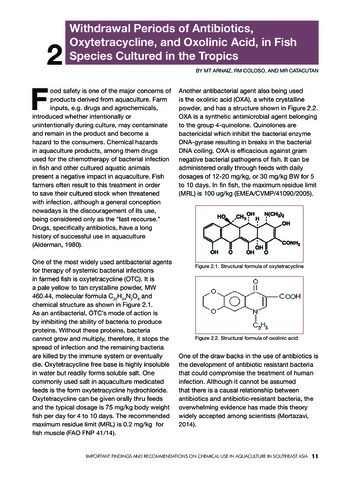
Withdrawal periods of antibiotics, oxytetracycline, and oxolinic acid, in fish species cultured in the tropics
(Aquaculture Department, Southeast Asian Fisheries Development Center, 2015)Food safety is one of the major concerns of products derived from aquaculture. Farm inputs, e.g. drugs and agrochemicals, introduced whether intentionally or unintentionally during culture, may contaminate and remain in the product and become a hazard to the consumers. Chemical hazards in aquaculture products, among them drugs used for the chemotherapy of bacterial infection in fish and other cultured aquatic animals present a negative impact in aquaculture. Fish farmers often result to this treatment in order to save their cultured stock when threatened with infection, although a general conception nowadays is the discouragement of its use, being considered only as the “last recourse.” Drugs, specifically antibiotics, have a long history of successful use in aquaculture (Alderman, 1980).