SEAFDEC/AQD Institutional Repository: Recent submissions
Now showing items 3481-3500 of 4221
-
Status of P. vannamei aquaculture in the Philippines.
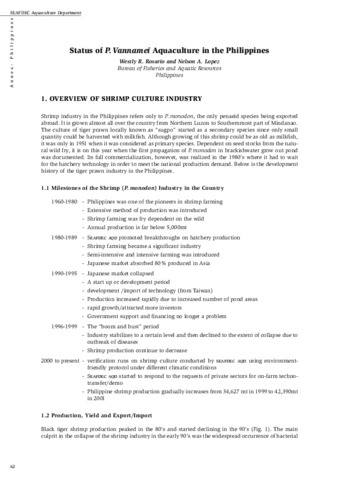
(Aquaculture Department, Southeast Asian Fisheries Development Center, 2005)Shrimp industry in the Philippines refers only to P. monodon, the only penaeid species being exported abroad. It is grown almost all over the country from Northern Luzon to Southernmost part of Mindanao. The culture of tiger prawn locally known as “sugpo” started as a secondary species since only small quantity could be harvested with milkfish. Although growing of this shrimp could be as old as milkfish, it was only in 1951 when it was considered as primary species. Dependent on seed stocks from the natural wild fry, it is on this year when the first propagation of P. monodon in brackishwater grow out pond was documented. Its full commercialization, however, was realized in the 1980’s where it had to wait for the hatchery technology in order to meet the national production demand. Below is the development history of the tiger prawn industry in the Philippines. -
Aquaculture of white shrimp Penaeus vannamei in Thailand.
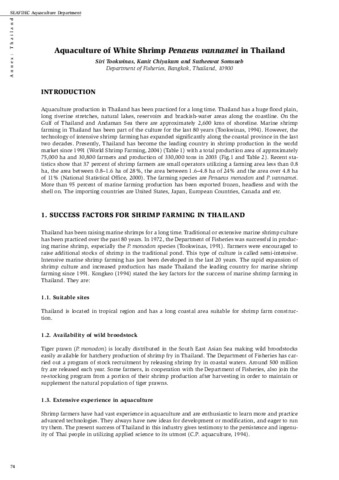
(Aquaculture Department, Southeast Asian Fisheries Development Center, 2005)Aquaculture production in Thailand has been practiced for a long time. Thailand has a huge flood plain, long riverine stretches, natural lakes, reservoirs and brackish-water areas along the coastline. On the Gulf of Thailand and Andaman Sea there are approximately 2,600 kms of shoreline. Marine shrimp farming in Thailand has been part of the culture for the last 80 years (Tookwinas, 1994). However, the technology of intensive shrimp farming has expanded significantly along the coastal province in the last two decades. Presently, Thailand has become the leading country in shrimp production in the world market since 1991 (World Shrimp Farming, 2004) with a total production area of approximately 75,000 ha and 30,800 farmers and production of 330,000 tons in 2003. Recent statistics show that 37 percent of shrimp farmers are small operators utilizing a farming area less than 0.8 ha, the area between 0.8–1.6 ha of 28%, the area between 1.6–4.8 ha of 24% and the area over 4.8 ha of 11% (National Statistical Office, 2000). The farming species are Penaeus monodon and P. vannamei. More than 95 percent of marine farming production has been exported frozen, headless and with the shell on. The importing countries are United States, Japan, European Countries, Canada and etc. -
The culture of Penaeus vannamei and other exotic shrimps in Singapore.
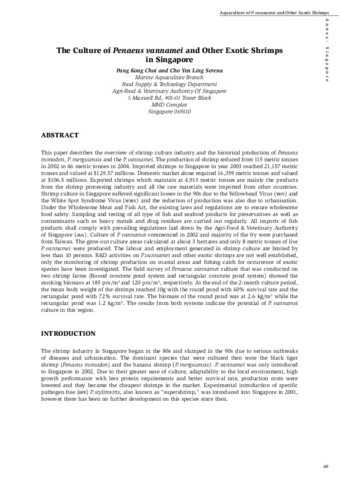
(Aquaculture Department, Southeast Asian Fisheries Development Center, 2005)This paper describes the overview of shrimp culture industry and the historical production of Penaeus monodon, P. merguiensis and the P. vannamei. The production of shrimp reduced from 115 metric tonnes in 2002 to 46 metric tonnes in 2004. Imported shrimps to Singapore in year 2003 reached 21,157 metric tonnes and valued at $129.57 millions. Domestic market alone required 16,359 metric tonnes and valued at $106.5 millions. Exported shrimps which maintain at 4,913 metric tonnes are mainly the products from the shrimp processing industry and all the raw materials were imported from other countries. Shrimp culture in Singapore suffered significant losses in the 90s due to the Yellowhead Virus (YHV) and the White Spot Syndrome Virus (WSSV) and the reduction of production was also due to urbanisation. Under the Wholesome Meat and Fish Act, the existing laws and regulations are to ensure wholesome food safety. Sampling and testing of all type of fish and seafood products for preservatives as well as contaminants such as heavy metals and drug residues are carried out regularly. All imports of fish products shall comply with prevailing regulations laid down by the Agri-Food & Veterinary Authority of Singapore (AVA). Culture of P. vannamei commenced in 2002 and majority of the fry were purchased from Taiwan. The grow-out culture areas calculated at about 3 hectares and only 8 metric tonnes of live P. vannamei were produced. The labour and employment generated in shrimp culture are limited by less than 10 persons. R&D activities on P.vannamei and other exotic shrimps are not well established, only the monitoring of shrimp production on coastal areas and fishing catch for occurrence of exotic species have been investigated. The field survey of Penaeus vannamei culture that was conducted on two shrimp farms (Round concrete pond system and rectangular concrete pond system) showed the stocking biomass at 185 pcs/m3 and 120 pcs/m3, respectively. At the end of the 2-month culture period, the mean body weight of the shrimps reached 10g with the round pond with 60% survival rate and the rectangular pond with 72% survival rate. The biomass of the round pond was at 2.6 kg/m3 while the rectangular pond was 1.2 kg/m3. The results from both systems indicate the potential of P. vannamei culture in this region. -
Shrimp farming in Malaysia
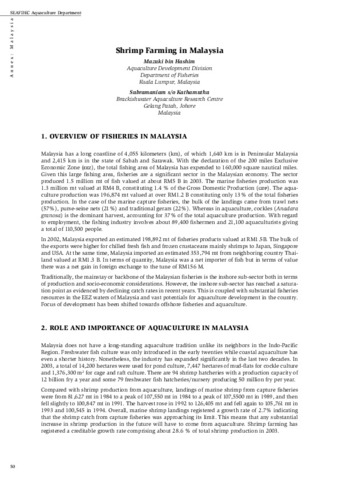
(Aquaculture Department, Southeast Asian Fisheries Development Center, 2005)Malaysia has a long coastline of 4,055 kilometers (km), of which 1,640 km is in Peninsular Malaysia and 2,415 km is in the state of Sabah and Sarawak. With the declaration of the 200 miles Exclusive Economic Zone (EEZ), the total fishing area of Malaysia has expended to 160,000 square nautical miles. Given this large fishing area, fisheries are a significant sector in the Malaysian economy. The sector produced 1.5 million mt of fish valued at about RM5 B in 2003. The marine fisheries production was 1.3 million mt valued at RM4 B, constituting 1.4 % of the Gross Domestic Production (GDP). The aquaculture production was 196,874 mt valued at over RM1.2 B constituting only 13% of the total fisheries production. In the case of the marine capture fisheries, the bulk of the landings came from trawl nets (57%), purse-seine nets (21%) and traditional gerars (22%). Whereas in aquaculture, cockles (Anadara granosa) is the dominant harvest, accounting for 37% of the total aquaculture production. With regard to employment, the fishing industry involves about 89,400 fishermen and 21,100 aquaculturists giving a total of 110,500 people. In 2002, Malaysia exported an estimated 198,892 mt of fisheries products valued at RM1.5B. The bulk of the exports were higher for chilled fresh fish and frozen crustaceans mainly shrimps to Japan, Singapore and USA. At the same time, Malaysia imported an estimated 353,794 mt from neighboring country Thailand valued at RM1.3 B. In terms of quantity, Malaysia was a net importer of fish but in terms of value there was a net gain in foreign exchange to the tune of RM156 M. Traditionally, the mainstay or backbone of the Malaysian fisheries is the inshore sub-sector both in terms of production and socio-economic considerations. However, the inshore sub-sector has reached a saturation point as evidenced by declining catch rates in recent years. This is coupled with substantial fisheries resources in the EEZ waters of Malaysia and vast potentials for aquaculture development in the country. Focus of development has been shifted towards offshore fisheries and aquaculture. -
Status of shrimp farming in Cambodia.
(Aquaculture Department, Southeast Asian Fisheries Development Center, 2005)In the South-Western part of the country, Cambodia has 435 km coastline in the Gulf of Thailand, which stretches between the Vietnamese borders in the South to the Thai border in the West. The fisheries sector plays a vital function in Cambodia's food supply, particularly the poor. It is also important for Cambodia's national economy that most national incomes come from this sector through exploitation and exportation. According to the latest official data recorded by the Department of Fisheries (DoF), the total commercial fisheries production in 2002 was 424,400 metric tons, which included the small scale and family scale freshwater fisheries and aquaculture production, except crocodile culture (DoF, 2003). In this case, freshwater fish capture dominates the production, which accounted for 85% of the total production in 2002, while marine capture fisheries was 11%. The total aquaculture production represented only more than 4%. Even fish production increased in fish capture fisheries. The increasing production trend of the capture fisheries indicates overexploitation of fishery resources, hence, there is a need to restore fishery resources. To address this, local fishers need alternative jobs in order to enhance their livelihood and encourage them to minimize over fishing and also from destructive fishing practices. One of the options also is to promote aquaculture. -
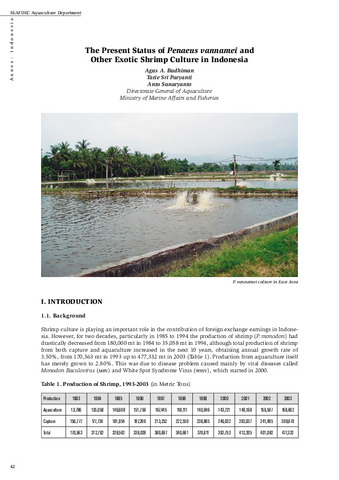
The present status of Penaeus vannamei and other exotic shrimp culture in Indonesia.
(Aquaculture Department, Southeast Asian Fisheries Development Center, 2005)Shrimp culture is playing an important role in the contribution of foreign exchange earnings in Indonesia. However, for two decades, particularly in 1985 to 1994 the production of shrimp (P. monodon) had drastically decreased from 180,000 mt in 1984 to 35,058 mt in 1994, although total production of shrimp from both capture and aquaculture increased in the next 10 years, obtaining annual growth rate of 3.50%, from 170,563 mt in 1993 up to 477,332 mt in 2003. Production from aquaculture itself has merely grown to 2.80%. This was due to disease problem caused mainly by viral diseases called Monodon Baculovirus (MBV) and White Spot Syndrome Virus (WSSV), which started in 2000. The total shrimp export showed a significant increase in ten years for both volume and value, with growth rate of 4.91% for volume and 0.78% for value, gaining 98.569 mt worth US $ 867,703 in 1993 to 137,636 metric tonnes worth US $ 850,222 in 2003. Taking into account that shrimp culture is one of the prime commodities, potential to increase foreign exchange earnings, the Government has made some efforts to cope with disease problems besetting the industry. In this regard, the Director General of Aquaculture, Ministry of Marine Affairs and Fisheries (DGA-MOMAF) is considering other shrimp culture species as alternative. In 2000, DGA made a business breakthrough by giving license to the private sectors to import broodstock and post larvae of P. vannamei into the country. Since then, the P. vannamei culture has been practiced in potential provinces in Indonesia. The success story of P. vannamei culture has encouraged many farmers who used to culture P. monodon, to try the new shrimp species. This increased shrimp aquaculture production, contributing 37.11 % to national production in 1999 and 41.2 % in 2003. -
Foreword.
(Aquaculture Department, Southeast Asian Fisheries Development Center, 2005) -
Series: Technical report / SEAFDEC Aquaculture Department; no. 11
A guide to the establishment and maintenance of milkfish broodstock
; ; Garcia, Luis Maria ; (Aquaculture Department, Southeast Asian Fisheries Development Center, 1984)
The manual describes methods used at the SEAFDEC Aquaculture Department in order to establish milkfish broodstock. It is presented under the following major section headings: Establishing broodstock farms; Farms for rearing bangus juveniles; Maturation cages for rearing broodstock to maturity; Gathering data; Spawning and egg collection; and Larval rearing.
; (Aquaculture Department, Southeast Asian Fisheries Development Center, 1984)
The manual describes methods used at the SEAFDEC Aquaculture Department in order to establish milkfish broodstock. It is presented under the following major section headings: Establishing broodstock farms; Farms for rearing bangus juveniles; Maturation cages for rearing broodstock to maturity; Gathering data; Spawning and egg collection; and Larval rearing. -
Series: Technical report / SEAFDEC Aquaculture Department; No. 10
A guide to induced spawning and larval rearing of milkfish Chanos chanos (Forsskal)
(Aquaculture Department, Southeast Asian Fisheries Development Center; International Development Research Centre, 1982)The techniques for the artificial propagation of milkfish (Chanos chanos ) developed at SEAFDEC are presented. These include: 1) capture and transport of spawners; 2) determination of sex and weight and maturity of fish; 3) induced spawning (preparation of injection, males, females); 4) fertilization and incubation; 5) larval rearing; and 6) mass production of larval food. -
Biological monitoring in west bay, Laguna Lake: Phytoplankton composition and water pollution
(Aquaculture Department, Southeast Asian Fisheries Development Center; Philippine Council for Aquatic and Marine Research and Development (PCAMRD), Department of Science and Technology; Bureau of Fisheries and Aquatic Resources, 2001)Phytoplankton composition and density were studied in three (3) stations in West Bay, Laguna Lake. Blue-green algae and diatoms were the most abundant in terms of cell density. Green algae had the most number of species. Diatoms predominated in the early parts of the year, under intense light conditions. Pulses of green algae were evident toward the end of the year, under high nitrogen concentrations. BIP (Biological Index of Pollution) values were very much affected by seasonal variations in the phytoplankton community. -
A freshwater red alga Compsopogon coeruleus (Balbis) Montagne from Bucal, Calamba, Laguna, Philippines
(Aquaculture Department, Southeast Asian Fisheries Development Center; Philippine Council for Aquatic and Marine Research and Development (PCAMRD), Department of Science and Technology; Bureau of Fisheries and Aquatic Resources, 2001)Compsopogon coeruleus (Balbis) Montagne was observed for the first time along the shallow, flowing portions of the spring that occurs naturally in Bucal, Calamba, Laguna. A year-round study of some habitat conditions in the sampling site was done. These conditions included air and water temperature (mean=28.5°C), pH (mean=6.5), orthophosphate (mean=0.26 ppm), ammonia-nitrogen (mean =0.52 ppm), depth of water (mean=12 cm), speed of current (mean=0.19 m/s) and light intensity (mean=770 foot candles). This alga seems to be a good indicator of organic pollution. A description of morpho-cytological characteristics in situ and in culture is given. Better growth was observed in a defined inorganic medium using different mixing waters (distilled, tap and filtered Bucal waters) over plain mixing waters. Germination of presumptive cortical cells into uniseriate filaments and monospore germination was observed after about 10 days of incubation in all media. -
Pasig River backflow and its effect on the water quality of Laguna de Bay, Philippines
(Aquaculture Department, Southeast Asian Fisheries Development Center; Philippine Council for Aquatic and Marine Research and Development (PCAMRD), Department of Science and Technology; Bureau of Fisheries and Aquatic Resources, 2001)The backflow of Pasig River into Laguna de Bay was closely monitored beginning April 28, 1997 based on the expected high tide in Manila Bay and the average low lake level of 2.5 m in Station W (N 14°27.7'; E 121°08.5') located at the west lobe of the lake. Saltwater intrusion was first detected during of the highest high tide (i.e., 1.5 m at 1430 h) on April 29. Water from Pasig River flowing into the lake was black and had a characteristic odor of hydrogen sulfide. With the light house (or 'Parola') at the mouth of Pasig River as the reference point, movement of saltwater in the lake was monitored and the area affected estimated with the use of GPS 38 Personal Navigator®. Up to mid May (Week 2), the movement of saltwater into Laguna de Bay was hampered by the intermittent calm weather conditions and moderately strong northeasterly wind ('hanging amihan'). When the wind direction shifted and the southwesterly wind ('hanging habagat') became strong on Week 3 (May 18 to 20), strong water movement and fast diffusion of saltwater into the other parts of the west lobe of the lake were observed. During this period of rapid change in the lake (May 21-24), a high frequency monitoring was conducted in Station W. Fluctuations in chloride ion concentration, conductivity and total dissolved solids, Secchi disc reading, turbidity, dissolved oxygen, and other parameters were noted in the station. Heavy rainfall in the area on May 24-26 and run-offs from the watershed and overflow from the river tributaries increased the lake level. The elevation of the water level resulted in draining out of the lake water into Pasig River to Manila Bay and this practically ended the year's saltwater intrusion into Laguna de Bay. Movement of saltwater reached almost the whole area of the west and central lobes of the lake on the first week of June (week 5) as evidenced by the clearing of water in those areas. It was estimated that clearing of the entire lake because of saltwater movement takes about 2-3 months. -
Species and proximate composition of Laguna de Bay phytoplankton cultured in three different nitrogen-phosphorus ratios and their utilization by Nile tilapia
(Aquaculture Department, Southeast Asian Fisheries Development Center; Philippine Council for Aquatic and Marine Research and Development (PCAMRD), Department of Science and Technology; Bureau of Fisheries and Aquatic Resources, 2001)Natural phytoplankton populations from Laguna de Bay were used in outdoor batch culture experiment in 1-ton capacity circular concrete tanks and 60-liter glass aquaria for a maximum duration of 72 days. The treatments consisted of the following nitrogen-phosphorus ratios: 2N: 1P, 6N: 1P, and 12N: 1P. The growth and species composition of phytoplankton were monitored in each of the three treatments. The phytoplankton were partially harvested at weekly intervals. The proximate composition of the freeze-dried harvest was also analyzed. The freeze-dried harvest was also used to feed Nile tilapia Oreochromis niloticus (L.) to determine effects of the different N-P ratios on the utilization of phytoplankton by fish. The fish were fed isonitrogenously and ration ranged from maintenance requirement for the first week to 3 times maintenance requirement for the succeeding weeks. Results showed that green algae, particularly the Chlorococcales group, dominated all the cultures. This was followed by diatoms. The blue-green algae consisted the third group in all treatments. Gross energy, crude protein, crude fat, neutral detergent fiber and crude ash content of the phytoplankton harvest did not vary significantly among treatments. However, crude protein expressed as percentage of organic matter was significantly higher in the treatment using 12N: 1P compared to those cultured in lower N-P ratios. Nile tilapia fed phytoplankton from 12N: 1P and 6N: 1P ratios showed significantly better growth than those fed with phytoplankton cultured in the lowest N-P ratio. -
Preliminary observations on the diel feeding patterns of Nile tilapia Oreochromis niloticus (L.) in Laguna de Bay, Philippines, with the aid of the computer model MAXIMS
(Aquaculture Department, Southeast Asian Fisheries Development Center; Philippine Council for Aquatic and Marine Research and Development (PCAMRD), Department of Science and Technology; Bureau of Fisheries and Aquatic Resources, 2001)Nile Tilapia, Oreochromis niloticus, cultured in cages in Laguna de Bay, were sampled on two occasions in 1995, each time over a 24-hour cycle. The weights of stomach content were averaged and analysed with the computer model MAXIMS. The model predicted that, in May, larger fish feeding on natural food alone fed continuously from dawn to dusk, ingesting 4.9 to 5.4% of their body weight (wet weight basis) whereas smaller fish had two feeding periods per day, from sunrise to mid-morning and again from mid-afternoon until after sunset, ingesting between 13.0 and 13.7%. In August, fish were given supplemental feed that ran out around mid-day, after which they continued to ingest natural food. The fish ingested 3.8 to 4.0% supplemental feed and 4.4 to 4.7% natural food per day. In May, most of the stomach contents consisted of the blue-green alga Anabaena spiroides, whereas in August, the natural food was made up principally of detritus. On the basis of these findings, it is recommended that supplemental feed be given in several doses spread throughout the day. -
Fish in a man-made lake: what is there to eat? (Ecological studies in La Mesa Reservoir)
(Aquaculture Department, Southeast Asian Fisheries Development Center; Philippine Council for Aquatic and Marine Research and Development (PCAMRD), Department of Science and Technology; Bureau of Fisheries and Aquatic Resources, 2001)Since 1975, a number of ecological studies have been done in La Mesa Reservoir (also known as La Mesa Dam or La Mesa Lake). Eight species of fish are known to occur in the lake; of these species, one is stocked to control the proliferation of algae. The plankton community of the reservoir has been found to be remarkably diverse, with at least 62 species of zooplankton and possibly 70 species of phytoplankton. The high biological diversity is due to this lake being a protected area as it is Metro Manila's main source of drinking water. A confluence of several factors that preserve this condition of high aquatic biodiversity is possible: (1) Little perturbation in its water quality and its watershed occurs. (2) During high water levels, numerous coves and embayments and the moderate depths create a myriad of ecological niches and refuges for the aquatic biota. (3) Plankton diversity is likely enhanced by abundance of edible algal species (for herbivorous zooplankton) and only occasional moderate algal blooms. (4) Low fish predation tolerates large-sized species in the plankton, i.e., Filipinodiaptomus insulanus, a copepod endemic to only a few large areas in Luzon. (5) Nuisance algae are controlled by stocking of tilapia fry and the occasional use of algicide (CuSO4). -
An ecological assessment of seven major lakes in the Philippines
(Aquaculture Department, Southeast Asian Fisheries Development Center; Philippine Council for Aquatic and Marine Research and Development (PCAMRD), Department of Science and Technology; Bureau of Fisheries and Aquatic Resources, 2001)An ecological assessment was done on the seven major lakes in the Philippines, namely; Laguna de Bay, Taal, Naujan, Lanao, Mainit, Buluan, and Bato. The assessment was based largely on secondary data and some primary data. The ecological parameters considered for each lake were focused on published information as well as those unpublished but were made accessible to the author by researchers and agencies of government. The different lakes are classified into three ecological categories, namely; critically degraded, degraded, threatened, and underdeveloped. Where adequate data on a lake is available, emphasis is also given on the examination of the nature of land use, lake development measures, climatic variations in terms of rainfall, and ecological conditions in the lake as they affect fish production. Finally, lake specific and general recommendations are forwarded for management purposes. -
An environmental assessment of the aquaculture potential of Lake Gawaan, Lake Lenneng and Lake Banao/Danum at the Mt. Province
(Aquaculture Department, Southeast Asian Fisheries Development Center; Philippine Council for Aquatic and Marine Research and Development (PCAMRD), Department of Science and Technology; Bureau of Fisheries and Aquatic Resources, 2001)This study reviews the existing conditions of the three Mt. Province lakes: Lake Gawaan, Lake Lenneng and Lake Banao/Danum. Three mechanisms were employed. First is the overview of the resource capabilities. This includes the geographical, physical and biological characteristics, as well as the identification of nearby communities and the possible market distribution channels. The physical characteristics are the watershed type, color of water, kind of shoreline, source of water, water fluctuation levels and transparency/turbidity. Biological and chemical characteristics comprise the primary productivity, dissolved oxygen, nitrate, pH, ammonia, and stock availability (catch composition, gear type, seasonal distribution and production rate). The second mechanism is the understanding of the limitations of the area and development prospects which could cater to the needs of the growing population. This tackles suitable aquaculture practices that may be adopted at the areas concerned in order to increase fish production at the Mt. Province. The last mechanism is to determine if the combined efforts of the non-government organizations, government agencies and other concerned groups could be improved to prevent a piece-rate resource development program. Results showed that favorable conditions for fish culture are present in the three lakes. Culture of fish in net cages and pens appears suitable for the lakes. -
The decline of native fishes and fisheries and the rise of aquaculture in lakes and rivers in the Philippines
Bagarinao, Teodora (Aquaculture Department, Southeast Asian Fisheries Development Center; Philippine Council for Aquatic and Marine Research and Development (PCAMRD), Department of Science and Technology; Bureau of Fisheries and Aquatic Resources, 2001)
This paper reviews historical and recent data on biodiversity, fisheries, exotic fishes, and aquaculture in Philippine lakes and rivers. The country's lakes and rivers are poor in primary freshwater fishes because the Philippines' only connection with the Asian mainland had been through land bridges between Borneo, the Sulu islands, Mindanao, Palawan and Mindoro - in which islands endemic carps have evolved. Philippine lakes and rivers instead have secondary freshwater fishes such as gobies, migratory marine fishes such as mullets, and some snails, clams, and prawns. Most lakes and rivers have been severely degraded and their biodiversity reduced by siltation, pollution, overfishing, and the establishment of exotic fishes from other countries or elsewhere in the country. Many fishes first described in the Philippines in 1910-1940 by Seale, Herre, and Filipino ichthyologists have not been collected in recent years. The Laguna de Bay fishery in the early 1960s was largely dependent on the 'ayungin' Therapon plumbeus, 'biyang puti' Glossogobius giurus, and the 'kanduli' Arius manilensis that together comprised 95% of the annual 83,000 mt; another 19,000 mt came from shrimps and 245,000 mt from snails. Fishing and snail-dredging were so intense that catches declined and the whole lake fishery collapsed around 1970. After the collapse, the primary production of the lake increased and milkfish and tilapia became natural choices for aquaculture. Lake Lanao became famous for its species flock of 18 endemic carps, but these are now extinct, except perhaps two species. In 1963, these carps contributed 981 mt to the fishery, other native fishes 269 mt, shrimps and snails 257 mt, and introduced fishes 479 mt. Twenty years later, endemic carps have made up only 92 mt, native fishes 141 mt, shrimps and snails 164 mt, and introduced fishes 312 mt of the harvest from the lake. The 'kadurog' G. giurus, probably stocked in the lake with milkfish larvae in 1955, proliferated in the 1960s and apparently drove the endemic carps to extinction. The 'katolong' Hypseleotris agilis was first seen in the lake in 1977 and has since outcompeted the 'kadurog'. In Lakes Taal and Naujan, migratory marine fishes have been caught by fish corrals set across the outlets, but the catch along Pansipit River has fallen since the turn of the century and that in Butas River fell from 62 mt in 1977 to 17 mt in 1983. Catches of the endemic sardine Harengula tawilis in Lake Taal fluctuated between 4,400 mt in 1983 to 11,300 mt in 1990 and 1,400 mt in 1994. Cage culture of tilapia and milkfish has been going on in Lake Taal for 10 years. In Lakes Buhi and Bato, the endemic 'sinarapan' Mistichthys luzonensis almost disappeared due to fine-net fishing and tilapia stocking; catches have been 50-90 mt in 1983-93 but zero in 1994. -
Impact assessment of cage culture in Lake Taal, Philippines
(Aquaculture Department, Southeast Asian Fisheries Development Center; Philippine Council for Aquatic and Marine Research and Development (PCAMRD), Department of Science and Technology; Bureau of Fisheries and Aquatic Resources, 2001)The environmental impact of cage culture on water quality of Lake Taal was assessed from March 1996 through February 1997. Three stations were considered namely: Balas, which serves as station 1 (non-cage area) and Sampaloc and Laurel, stations 2 and 3 (cage areas), respectively. Monthly water samples with two replicates were collected using a van Dorn sampler at 0, 5, 10 and 15-m depths in all stations. Below surface water from the inside of the cages was also collected. Water temperature, water transparency, pH, and conductivity were determined in situ. Dissolved oxygen, chloride, NO3, NH3, PO4, and total P were analyzed in the laboratory. Phytoplankton density and algal biomass (through cholorophyll a) and primary productivity indices were determined with the light-and-dark bottle method. Of the water quality parameters, conductivity and DO had significant differences between non-cage and cage areas. Conductivity gave significant difference (P<0.01) between control and cage area during the wet season. Highest conductivity value (2100 µ S/cm) was observed in station 3. Mean values of DO gave significant differences (P<0.05) in the different stations throughout the study period. A decrease of DO to 2.5 mg/1 was observed below 10-m depth around the cage areas. Analysis indicates that cage culture leads to oxygen depletion in the water column. The presence of cage structures decreased the flow rate resulting to weak circulation. The reduced water circulation in effect decreased the supply of oxygen and removal of toxic waste metabolites from the vicinity of the fish farm, and reduced the supply of plankton. These results suggest that the impact of cage culture in Lake Taal is minor but can alter the lake ecosystem if not properly managed. Zoning and continuous water quality monitoring are needed. -
Autoecology of an endemic calanoid copepod: The first step in biodiversity conservation in Lakes
(Aquaculture Department, Southeast Asian Fisheries Development Center; Philippine Council for Aquatic and Marine Research and Development (PCAMRD), Department of Science and Technology; Bureau of Fisheries and Aquatic Resources, 2001)Copepods, specifically calanoid copepods, play an important role in the productivity of aquatic ecosystems since they serve as a crucial link between primary producers and carnivores. In tropical reservoirs and lakes, they are not only a major source of food for many invertebrates and zooplanktivorous fish, but also good biological indicators. Calanoid/cyclopoid-cladoceran ratio is used in limnological studies as an indicator of water quality. In the past, studies in the Philippines on copepods and other freshwater zooplankton have dealt only on their taxonomy and distribution. Filipinodiaptomus insulanus is a calanoid copepod recognized as endemic to the country with its distribution restricted to the areas of Bulacan, Laguna and other parts of Rizal. Furthermore it is the only calanoid copepod found in the La Mesa Reservoir in Novaliches, Quezon City. This paper is a synthesis of three studies of F. insulanus obtained from La Mesa Reservoir. It aims to provide additional baseline information about the organism, particularly on its postembryonic development, feeding habits, and density fluctuations of its life history stage in the reservoir.