SEAFDEC/AQD Institutional Repository: Recent submissions
1241-1260 / 4221
-
Capacity building initiatives of Winrock International on mud crab culture in the Caraga Region
(Aquaculture Department, Southeast Asian Fisheries Development Center, 2017)The paper presents the output of the capacity building initiatives of Winrock International on Mud crab culture in the Caraga Region, Philippines. The capacity building seminar included lectures on the mud crab biology, pond preparation, nursery and grow-out culture, fattening, and soft-shell crab farming. Identification of the various crab body parts, actual pond preparation, nursery and grow-out culture of crab were demonstrated after the series of lectures. -
Mud crab fattening project of KAMAMANA in Del Carmen, Siargao Island
(Aquaculture Department, Southeast Asian Fisheries Development Center, 2017)The Kaanib ng mga Mangingisda at Magsasaka ng Numancia Aqua-Agrikultura (KAMAMANA), established in Del Carmen, Siargao Island in 2011 is a People's Organization active in promoting the advocacy in 1) protecting the environment and natural resources, 2) providing services for the family welfare, and 3) managing sustainable livelihood programs and community development. One of the major livelihood programs presently being implemented by KAMAMANA is the fattening of mud crab (mangrove crab), Scylla serrata, in plastic containers set up in a mangrove area. Tenurial rights to manage a 2-hectare mangrove area for 25 years was granted to KAMAMANA by the Department of Environmental and Natural Resources. Crabs obtained from the mangrove areas of Del Carmen and nearby municipalities are purchased and stocked in plastic containers. The crabs are fed trash fish and mollusks once every afternoon to satiation until they are fattened, usually for 1-2 weeks. The major problem encountered is mortality after molting. Four KAMAMANA members are involved in the crab fattening. When mortalities occur, the dead crabs are usually charged to members assigned in the operation. The fattened crabs are sold to local restaurants, hotels, resorts and walk-in buyers or brought to traders in Surigao City. The net income is divided into the following: members involved in the culture (50%), treasurer (10%), business manager (15%), organizational share (5%), savings (5%) and trust fund (15%). -
Polyculture of mud crab in Region 3
(Aquaculture Department, Southeast Asian Fisheries Development Center, 2017)The polyculture of mud crab with one to three other species (milkfish (Chanos chanos), tilapia (Oreochromis spp.) and shrimp or sugpo (Penaeus monodon)) is a common practice in Region 3. Pond preparation is given importance prior to stocking of various species. Removal of sludge in the pond and application of probiotics are included in the standard pond preparation. The size and stocking densities of each species vary depending on the season. The volume of water to be replaced is based on the transparency of the water. The various species are fed natural food grown in the pond in addition to mollusks and low value fish given specifically for mud crab and shrimp. When pond water becomes transparent (indicating the decrease in phytoplankton density), the water is agitated using a small boat. If water continues to be transparent, fertilizers are applied to enhance growth of natural food. The pond water and animals are closely monitored to prevent diseases. Some of the early signs of occurrence of disease include the presence of bubbles on the water surface, and presence of weak shrimp on the feeding trays and along the dikes. The presence of weak shrimp and crab on the pond bottom and continuous swimming of these animals from night to dawn indicate poor pond water quality which can be remedied by circulating and flushing of the pond water every other day. -
Trading of juvenile crabs and grow-out culture in Capiz
(Aquaculture Department, Southeast Asian Fisheries Development Center, 2017)The article presents the trade of juvenile crabs in the Province of Capiz, Philippines. Moreover grow-out culture was also presented. Likewise, common problems encountered in the trade, and culture of the crabs was discussed. -
Mangroves as mud crab habitats
Primavera, Jurgenne (Aquaculture Department, Southeast Asian Fisheries Development Center, 2017)
The paper reports the use of mangroves by Scylla species both as wild and culture habitats. Based on published literature, natural mangrove crab populations are described in terms of population density, dispersal and movement within and outside mangroves, crab burrows and associated mangrove species. Strategies for Scylla conservation depend on the kind of mangrove habitat - (mangrove) restoration for open fringing mangroves where crab recruitment and abundance are determined by habitat availability vs stock enhancement in closed basin mangroves with restricted recruitment and limited movement of crabs. Mangrove crabs are also reared in monoculture in mangrove cages and pens, or in polyculture with milkfish in extensive ponds (where mangroves used to thrive). The paper describes a SEAFDEC Aquaculture Department study to evaluate the effects of mud crab net pen systems on mangrove macroflora, and the replacement of dietary trash fish with low-cost pellets. Results showed that incomplete, low-cost pellets can replace fish biomass requirement in mud crab diets, but that crab presence resulted in fewer mangrove seedlings and saplings. Economic analysis showed the viability of crab culture in mangrove pens using a combination of fish biomass and pellets to reduce the requirement for (low-value) fish, which is a food item of poor coastal communities.
(Aquaculture Department, Southeast Asian Fisheries Development Center, 2017)
The paper reports the use of mangroves by Scylla species both as wild and culture habitats. Based on published literature, natural mangrove crab populations are described in terms of population density, dispersal and movement within and outside mangroves, crab burrows and associated mangrove species. Strategies for Scylla conservation depend on the kind of mangrove habitat - (mangrove) restoration for open fringing mangroves where crab recruitment and abundance are determined by habitat availability vs stock enhancement in closed basin mangroves with restricted recruitment and limited movement of crabs. Mangrove crabs are also reared in monoculture in mangrove cages and pens, or in polyculture with milkfish in extensive ponds (where mangroves used to thrive). The paper describes a SEAFDEC Aquaculture Department study to evaluate the effects of mud crab net pen systems on mangrove macroflora, and the replacement of dietary trash fish with low-cost pellets. Results showed that incomplete, low-cost pellets can replace fish biomass requirement in mud crab diets, but that crab presence resulted in fewer mangrove seedlings and saplings. Economic analysis showed the viability of crab culture in mangrove pens using a combination of fish biomass and pellets to reduce the requirement for (low-value) fish, which is a food item of poor coastal communities. -
Mangrove structure and mud crab population in northern Samar
Quinitio, Emilia T.; ; ; Lebata-Ramos, Ma. Junemie Hazel (Aquaculture Department, Southeast Asian Fisheries Development Center, 2017)
This study assessed the mangrove community structure, relative seasonal abundance of all size classes of crabs (catch per unit effort or CPUE) and percent composition of the catch in two collection grounds in Pambujan and Rosario, Northern Samar using cylindrical bamboo traps and lift nets. Mangroves in Pambujan was dominated by Avicennia marina and A. alba. The initial total count of mangrove trees (67 stems ha-1) was slightly higher compared with the final count (61 stems ha-1). On the other hand, mangroves in Rosario was dominated by Rhizophora apiculata and R. stylosa. The total count of mangrove trees was higher in the initial (108 stems ha-1) compared with the final (46 stems ha-1). However, saplings and seedlings increased in both sites after 18 months. Mean CPUE ranged from 0.04 to 0.4 crabs using cylindrical bamboo traps in the monthly spring tide sampling for 19 months in Pambujan. High mean CPUE was recorded in February and August 2008. Mean CPUE ranged from 0.04 to 0.41 crabs using lift nets in the monthly spring tide sampling. The highest mean CPUE was noted in August. The initial and final CPUE were comparable. In Rosario, mean CPUE ranged from 0.3 to 1.78 crabs monthly caught in cylindrical bamboo traps and from 0.04 to 0.77 crabs in lift nets. In general, the number of crabs caught in both traps was higher in Rosario than in Pambujan. Mud crab ranged from 2.02-72.2% of the monthly total catch in lift nets in Pambujan. Other species of crabs ranging from 27.78 to 86.36% were the dominant catch in several months. In Rosario, mud crab ranged from 12.5 to 82.35% of the monthly total catch. The catch composition of the cylindrical bamboo traps was more varied compared with lift nets in both sites. The decrease in the population of mud crabs may also be associated with the decrease in mangrove trees. With the continuous cutting of trees and regular extraction of all sizes of mud crabs, the industry may no longer become sustainable. This paper is the first to be done on the assessment of the mud crab population in Northern Samar and the information gathered can be used as basis for the development and improvement of the existing fisheries legislation for the conservation and management of the remaining wild resources. -
Diseases affecting wild and farmed mud crab in the Philippines
Tendencia, Eleonor; (Aquaculture Department, Southeast Asian Fisheries Development Center, 2017)
Mortalities due to cannibalism and diseases have been reported as major problems in the grow-out phase of mud crab production. This study aimed to identify and describe diseases affecting farmed and wild mud crab (mangrove crab) including predisposing, risk and protective factors, and possible prevention and control measures. A total of 767 wild and farmed mud crab samples were collected. External examination showed abnormalities such as short abdominal flap, discoloration of the abdominal region, darker carapace, lesions on carapace, claws and legs, and presence of epibionts like algae and the barnacles Balanus sp. on the carapace. Internally, necrotic, black and brown gills, and discolored gonads were observed. Stalked barnacles, Octolasmis spp., were observed in the gills. White spot syndrome virus (WSSV) was detected in 14 samples sourced from farms and Infectious hypodermal and haematopoietic necrosis virus (IHHNV) in 2 wild samples. WSSV was implicated in mortality cases. Low temperature and presence of WSSV positive shrimp were identified as risk factors for WSSV infection or outbreak. Pathogenicity tests for some isolated bacteria suggested that these may cause mortality in mud crab under stressful conditions. To prevent mortality due to WSSV infection, it is recommended to avoid polyculture of mud crab with shrimp and/or other crustaceans. -
Overview of the mud crab industry in the Philippines
Quinitio, Emilia T. (Aquaculture Department, Southeast Asian Fisheries Development Center, 2017)
Mud crab farming has long been established in the Philippines and the country is the second top producer in the world. Except for Scylla paramamosain, the three other species, S. serrata, S. tranquebarica and S. olivacea are commonly found in the country, but S. serrata is the preferred species for farming. Crab seeds for farming are mainly from the wild and in recent years, a small percentage from the hatchery. Due to the apparent decline of the wild crab stocks, provincial and municipal ordinances have been issued by a number of Local Government Units (LGUs) along with the Bureau of Fisheries and Aquatic Resources (BFAR) to conserve and manage the remaining resources. From the hatchery, megalopa or crab instars are grown in net cages installed in the nursery pond. Mud crab farming engages mostly in long-term grow-out culture of juvenile crabs to market size for 3-5 months, short-term fattening of lean crabs for 15-45 days, and recently, soft-shell crab production. Polyculture of juvenile crabs to market size with one to three other commodities in earthen brackishwater ponds is usually practiced. Mud crabs for soft-shell crab production are mainly from the wild, while SEAFDEC/AQD demonstrates the use of hatchery-produced juvenile mud crabs as seedstock. Refinement is continuously being done to improve the economic viability of producing crabs, although basic technologies have been developed for all phases of culture (hatchery, nursery, grow-out, fattening and soft shell crab production). The major issues facing the industry are the lack of seedstock, difficulty of zoea 5 to molt to megalopa stage, cannibalism particularly at the nursery phase, species identification at the juvenile stage, use of fish as aquafeed, diseases, effects of climate change and quality of crabs at postharvest. In 2012, the Philippine Council for Agriculture, Aquatic and Natural Resources Research and Development (PCAARRD) of the Department of Science and Technology (DOST) started funding projects under the National Mud Crab Science and Technology Program (NMCSTP) to address these issues. The major aim of the Program was to improve the production, profitability and sustainability of crab farming. SEAFDEC/AQD leads in capacity building with focus on the sustainability of the mud crab industry. Various collaborations and research studies on mud crab culture enabled SEAFDEC/AQD to package mud crab technologies, conduct local and international training courses and on-site technology demonstrations, and publish extension manuals and scientific publications since the mid1990s. Research and Development activities have been translated into improved production. With the recent developments and refinements of technologies, it is expected that the Philippines will increase its production by 25-50% in the next 5 years. -
A probiotic Bacillus strain containing amorphous poly-beta-hydroxybutyrate (PHB) stimulates the innate immune response of Penaeus monodon postlarvae
Laranja, Joseph Leopoldo; Amar, Edgar C. ; Ludevese-Pascual, Gladys ; ; ; ; (Elsevier, 2017)
In this study, the PHB-accumulating Bacillus sp. JL47 strain (capable of accumulating 55% PHB on cell dry weight) was investigated for its effects on the immune response of giant tiger shrimp (Penaeus monodon) postlarvae (PL) before and after the Vibrio campbellii challenge. Briefly, shrimp PL were cultured and fed with Artemia nauplii enriched with Bacillus sp. JL47. Shrimp receiving the Artemia nauplii without JL47 enrichment were used as control. After 15 days of feeding, the shrimp were challenged with pathogenic V. campbellii LMG 21363 at 106 cells mL-1 by immersion. Relative expression of the immune related genes encoding for prophenoloxidase (proPO), transglutaminase (TGase) and heat shock protein 70 (Hsp70) in the shrimp were measured before (0 h) and after (3, 6, 9, 12, 24 h) the Vibrio challenge by quantitative real-time PCR using β-actin as the reference gene. The expressions of TGase and proPO were significantly up-regulated (p < 0.05) within 9 h and 12 h, respectively after challenge in shrimp receiving the Bacillus sp. JL47 as compared to the challenged and non-challenged controls. Hsp70 expression was significantly increased (p < 0.05) at 3 h post-challenge in all challenged shrimp. Interestingly, proPO and TGase genes were significantly up-regulated (p < 0.05) in Bacillus sp. JL47 treated shrimp even before the Vibrio challenge was applied. No up-regulation in the Hsp70 gene, however, was observed under these conditions. The data suggest that the protective effect of the PHB-accumulating Bacillus sp. JL47 in shrimp was due to its capacity to stimulate the innate immune related genes of the shrimp, specifically the proPO and TGase genes. The application of probiotic Bacillus species, capable of accumulating a significant amount of PHB, is suggested as potential immunostimulatory strategy for aquaculture. -
Morphological deformities in mud crab Scylla serrata juveniles exposed to antibiotics during the larval stage
; Quinitio, Emilia T.; (Wiley, 2017)
The effects of antibiotics on the external deformities, growth and survival of mud crab Scylla serrata larvae and juveniles were determined. Zoeae were exposed to oxytetracycline (OTC) (0, 3.0, 6.0, 9.0, 12 mg L-1) and furazolidone (FZD) (0, 0.5, 1.0, 1.5, 2.0 mg L-1) in the first and second experiments, respectively, until the late megalopa. The crab instars were grown in nursery tanks for 1 month. Larvae survived until megalopa only at 3.0 and 6.0 mg L-1 OTC or 0.5 and 1.0 mg L-1 FZD. These four concentrations were run simultaneously in another experiment. Morphological deformities in zoea 5 were bent dorsal, rostral and furcal spines. There was no significant difference (P > 0.05) on the deformities of zoea 5 in 3.0 and 6.0 mg L-1 OTC and 0.5 and 1.0 mg L-1 FZD. Significantly (P < 0.05) higher survival and faster growth were attained in 3.0 mg L-1 OTC and 0.5 mg L-1 FZD. Deformities observed in juveniles were fused frontal and lateral spines, asymmetrical and depressed tip of abdominal flap and gap between sternites. High percentage occurrence of deformities was observed in the 6.0 mg L-1 OTC and 1.0 mg L-1 FZD in the first and third experiments, respectively. There was no significant difference (P > 0.05) observed in the survival of juveniles in OTC and FZD treatments. However, growth was significantly (P < 0.05) faster in lower concentrations of the two antibiotics. The study shows the effects of OTC and FZD in the morphology of mud crab. Therefore, there is a need to eliminate the use of antibiotics and find alternatives. -
Use of agar-bound microparticulate diet as alternative food for tropical abalone, Haliotis asinina (Linnaeus 1758) post-larvae in large-scale cultures
(Springer Verlag, 2017)The efficacy of using agar-bound microparticulate diet (A-MPD) as alternative food for abalone Haliotis asinina Linne post-larvae in large-scale culture was investigated. Larvae sourced from the hatchery-bred (HB) and wild-sourced (WS) broodstock were fed with either diatoms (TMT1-NF), agar-bound microparticulate diet (TMT2-A-MPD), or a combination of both feeds (TMT3-NF + A-MPD) in six 2-m3 tanks replicated over time. Three hundred thousand veliger larvae were stocked/tank containing 80 corrugated plates with mucus trails hanging on bamboo poles. Feeds were given at 0900 h starting at day 3 with seawater flow through introduced every 1400 h starting day 5. Two-way analysis of variance determined significant differences (p < 0.05) in survival and shell length between larval sources and feed types. Tukey’s post hoc test established differences among treatment means. At day 30, survival for HB- and WS-sourced larvae was significantly higher (42%) in TMT3 compared with TMT2 having 35% for HB and 38% for WS (p < 0.05). Larvae fed with TMT1 had significantly lowest survival among the three treatments. Survival at 60 and 90 days did not show significant difference for TMT2 and TMT3 regardless of broodstock source. Post-larval shell growth (90 days), from both sources fed with TMT2 and TMT3, was significantly higher than TMT1 (p < 0.05). Larval performance did not show any significant interactions between HB and WS broodstock. The use of A-MPD alone or in combination may elicit improvement in survival and shell length growth in abalone larvae regardless of larval sources. A-MPD may be used as full or partial replacements to diatoms as alternative food for abalone post-larvae in large-scale culture. -
Quality assessment of newly hatched mud crab, Scylla serrata, larvae
Quinitio, Emilia T.; ; (Wiley, 2018)
Starvation and exposure to formalin were investigated as possible stress tests for evaluating the quality of mud crab, Scylla serrata, larvae. For the starvation stress test, newly hatched zoeae stocked in 150-ml containers were either starved or fed rotifers. Similarly, newly hatched zoeae were stocked in containers with seawater of 0 (control), 20, 30 and 40 mg/L formalin for the formalin stress test. The zoeae from the same batches were used for seed production to monitor their performance and validate the results of stress tests. Starvation was found to be unsuitable for larval quality evaluation. However, the impact of initial food deprivation on the newly hatched larvae indicates that feeding immediately after hatching is necessary for mud crab larvae. Exposure of larvae to 40 mg/L formalin for 3 hr appeared to be a reliable and practical method for larval quality assessment as the survival of larvae in the mass production tanks validated the classification of good and poor quality batches in the stress tests. On this basis, a hatchery operator can decide which batch should be cultured further. Finally, there appears to be a link between the quality of larvae and the performance at the megalopa and early juvenile crabs. -
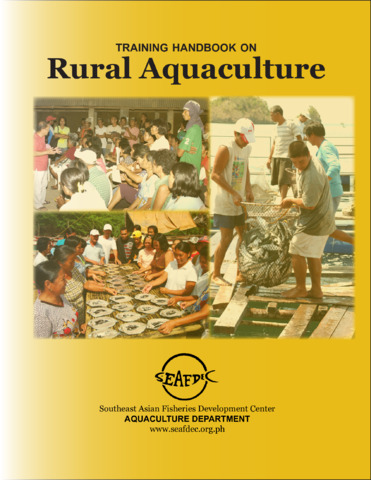
Training handbook on rural aquaculture
(Aquaculture Department, Southeast Asian Fisheries Development Center, 2009)This handbook covers four important factors in undertaking sustainable aquaculture livelihood namely: (1) aquatic resources and environment; (2) socioeconomic attributes of fishing communities; (3) appropriate and economically feasible aquaculture technologies; and, (4) policy issues and institutional arrangements related to a balanced fishery management and aquaculture livelihood. The long-term outcomes of these strategies shall be measured in terms of environmental sustainability, economic uplift of the community, and equitable distribution of benefits among different sectors of the community. -
Library and databanking services of SEAFDEC/AQD
(Aquaculture Department, Southeast Asian Fisheries Development Center, 2009)The Library of SEAFDEC Aquaculture Department (AQD) serves the information needs of scientists & researchers; AQD staff, trainees & interns; fish farmers; students; and other visitors. It is organized according to the ... -
Development communication work at SEAFDEC/AQD
(Aquaculture Department, Southeast Asian Fisheries Development Center, 2009) -
Training program of SEAFDEC/AQD
(Aquaculture Department, Southeast Asian Fisheries Development Center, 2009) -
Institutional capacity development for sustainable aquaculture
(Aquaculture Department, Southeast Asian Fisheries Development Center, 2009) -
Aquaculture marketing
(Aquaculture Department, Southeast Asian Fisheries Development Center, 2009) -
Financial analysis
(Aquaculture Department, Southeast Asian Fisheries Development Center, 2009) -
Business planning and management for sustainable small-scale rural aquaculture
(Aquaculture Department, Southeast Asian Fisheries Development Center, 2009)