Browsing Diseases of Cultured Groupers by Issue Date
Now showing items 1-7 of 7
-
Fungal diseases
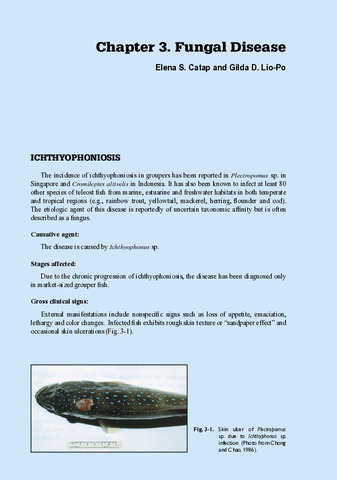
(Aquaculture Department, Southeast Asian Fisheries Development Center, 2004)The incidence of ichthyophoniosis in groupers (Epinephelus) has been reported in Plectropomus sp. in Singapore and Cromileptes altivelis in Indonesia. It has also been known to infect at least 80 other species of teleost fish from marine, estuarine and freshwater habitats in both temperate and tropical regions (e.g., rainbow trout, yellowtail, mackerel, herring, flounder and cod). The etiologic agent of this disease is reportedly of uncertain taxonomic affinity but is often described as a fungus. -
Parasitic diseases
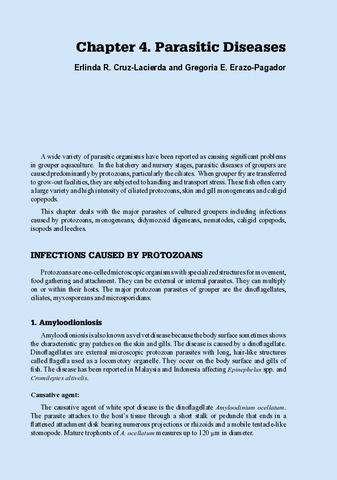
(Aquaculture Department, Southeast Asian Fisheries Development Center, 2004)A wide variety of parasitic organisms have been reported as causing significant problems in grouper aquaculture. In the hatchery and nursery stages, parasitic diseases of groupers are caused predominantly by protozoans, particularly the ciliates. When grouper fry are transferred to grow-out facilities, they are subjected to handling and transport stress. These fish often carry a large variety and high intensity of ciliated protozoans, skin and gill monogeneans and caligid copepods. This chapter deals with the major parasites of cultured groupers including infections caused by protozoans, monogeneans, didymozoid digeneans, nematodes, caligid copepods, isopods and leeches. -
Bacterial diseases
Tendencia, Eleonor ; (Aquaculture Department, Southeast Asian Fisheries Development Center, 2004)
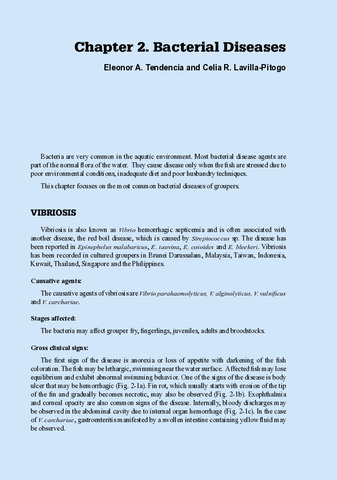
Bacteria are very common in the aquatic environment. Most bacterial disease agents are part of the normal flora of the water. They cause disease only when the fish are stressed due to poor environmental conditions, inadequate diet and poor husbandry techniques. This chapter focuses on the most common bacterial diseases of groupers.
; (Aquaculture Department, Southeast Asian Fisheries Development Center, 2004)
Bacteria are very common in the aquatic environment. Most bacterial disease agents are part of the normal flora of the water. They cause disease only when the fish are stressed due to poor environmental conditions, inadequate diet and poor husbandry techniques. This chapter focuses on the most common bacterial diseases of groupers. -
Nutritional diseases
Amar, Edgar C.; (Aquaculture Department, Southeast Asian Fisheries Development Center, 2004)
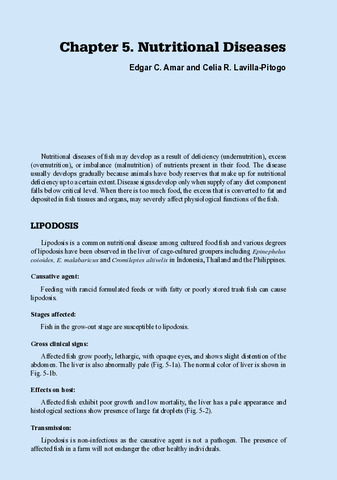
Nutritional diseases of fish may develop as a result of deficiency (undernutrition), excess (overnutrition), or imbalance (malnutrition) of nutrients present in their food. The disease usually develops gradually because animals have body reserves that make up for nutritional deficiency up to a certain extent. Disease signs develop only when supply of any diet component falls below critical level. When there is too much food, the excess that is converted to fat and deposited in fish tissues and organs, may severely affect physiological functions of the fish. -
Environmental diseases
(Aquaculture Department, Southeast Asian Fisheries Development Center, 2004)This chapter focuses on swimbladder stress syndrome and gas bubble disease, the two most common disorders due to adverse environmental conditions. -
Viral diseases
(Aquaculture Department, Southeast Asian Fisheries Development Center, 2004)Some viral infections are serious diseases of groupers causing heavy mortalities. In most cases, larval stages are the most susceptible stage. With the carnivorous nature of groupers, they can readily ingest viral pathogens from live fish food or trash fish that carry the viral pathogens. Moreover, viruses are able to effect vertical transmission from broodstocks that are likely carriers of the virus. Survivors of viral epizootics can be carriers of viral pathogens. This chapter focuses on current information on the major viral infections of groupers, i.e., viral nervous necrosis (VNN) and viral infections attributed to the family Iridoviridae. -
Diseases of cultured groupers
(Aquaculture Department, Southeast Asian Fisheries Development Center, 2004)Groupers (Epinephelus) are recognized as economically-important marine fish and abundantly cultured in Southeast Asia for domestic consumption and overseas export. Various diseases occur in grouper aquaculture and frequently create serious problems. This book compiles information on various diseases of groupers such as viral, bacterial, fungal, parasitic, nutritional, and environmental diseases. The chapters which are contained in this volume are indexed individually.