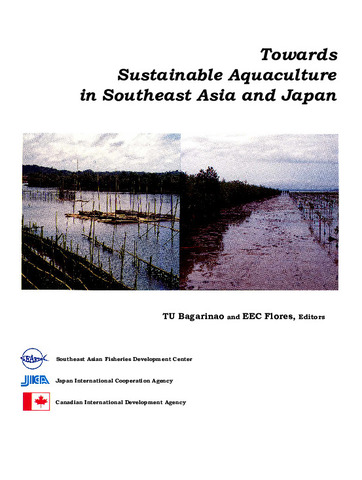
Towards sustainable aquaculture in Southeast Asia and Japan : proceedings of the Seminar-Workshop on Aquaculture Development in Southeast Asia, Iloilo City, Philippines, 26-28 July 1994


Share
นามธรรม
Documents the presentations at ADSEA '94, the 3rd Seminar-Workshop on Aquaculture Development in Southeast Asia. ADSEA '94 includes reviews of the status of aquaculture development in Southeast Asia and Japan and of the researches conducted by Southeast Asian Fisheries Development Center, Aquaculture Department (SEAFDEC/AQD) to contribute to this development. Topics on responsible aquaculture, mollusc and seaweed culture, integrated farming, shrimp culture, diseases, and health management, and transgenic fish were also discussed. It also lists the research areas of 20 or so commodities prioritized for research at AQD for 1995-1997.
การอ้างอิง
Bagarinao, T. U., & Flores, E. E. C. (Eds.). (1995). Towards Sustainable Aquaculture in Southeast Asia and Japan: Proceedings of the Seminar-Workshop on Aquaculture Development in Southeast Asia, Iloilo City, Philippines, 26-28 July, 1994. Tigbauan, Iloilo, Philippines: Aquaculture Department, Southeast Asian Fisheries Development Center.
Type
Book; Conference publicationISBN
971851127XFormat
viii, 254 p. : ill.
คอลเลกชัน
- ADSEA '94 [21]
- Monographs [34]
Related items
Showing items related by title, author, creator and subject.
-
Sustainable aquaculture development for food security in Southeast Asia towards 2020. Proceedings of the Regional Technical Consultation on Sustainable Aquaculture Development in Southeast Asia Towards 2020
(Aquaculture Department, Southeast Asian Fisheries Development Center, 2011)This publication represents the proceedings of the Regional Technical Consultation (RTC) on Aquaculture held in Bangkok, Thailand last 17-19 March 2010. The RTC was convened by the Southeast Asian Fisheries Development Center Aquaculture Department (SEAFDEC/AQD) as part of the preparatory undertakings for the ASEAN-SEAFDEC Conference on Fisheries held in June 2011. The main objectives of the RTC were to follow-up the developments of aquaculture in Southeast Asia after the 2001 ASEAN-SEAFDEC Millennium Conference on Fisheries and to define the strategic actions for the region s sustainable aquaculture development in the next decade. These proceedings contain 10 country papers and a summary status of implementation of the Resolution and Plan of Actions on six themes (supply of good quality seeds, environment-friendly aquaculture, getting out of the fish meal trap, healthy and wholesome aquaculture, biotechnology and rural aquaculture) which are the outcomes of the 2001 ASEAN-SEAFDEC Millennium Conference on Fisheries. It also presents the thematic papers and a synopsis of discussions on issues and recommendations on four thematic areas: (i) meeting social and economic challenges in aquaculture; (ii) quality seed production for sustainable aquaculture; (iii) healthy and wholesome aquaculture; and (iv) protecting the environment and adapting to climate change. These recommendations are expected to provide baseline information and directions in formulating the Resolution and Plan of Action (aquaculture component) for food security in Southeast Asia towards 2020. -
Recent developments in aquaculture in Japan
(Aquaculture Department, Southeast Asian Fisheries Development Center, 1995)Aquaculture production in Japan in 1993 was 1,351,000 tons, 15.6% of the total fisheries production. About 93.6% came from mariculture and 6.4% from freshwater aquaculture. The per cent contribution of aquaculture to total production has increased in recent years but partly because marine fisheries,especially of sardine and pollack, have decreased. Aquaculture has reached a plateau, and decreased slightly between 1992 and 1993. Diverse marine and freshwater species are cultured in Japan — various fishes, crustaceans, mollusks, seaweeds, sea squirt, sea urchin, and others. Research and development in mariculture focus on finding substitutes for animal protein in feeds, improvement of fish quality, protection of the culture environment, use of offshore floating culture systems, and protection from diseases. Research in freshwater aquaculture has expanded to include recreational fishing, the propagation and preservation of endangered species, and the construction of fish ladders for salmonids and other migratory species. -
Aquaculture development and sustainability in Southeast Asia
(Aquaculture Department, Southeast Asian Fisheries Development Center, 1995)Countries in Southeast Asia still display a vivid spectrum of developmental stages in aquaculture, the most and the least developed seen in contiguous areas despite geographic similarities. The Network of Aquaculture Centres in Asia-Pacific is actively involved in the development of aquaculture in the region, approaching it from a holistic viewpoint by integrating issues in environment, resource management, and socioeconomics into its program of work. Constraints related to site, inputs, and markets have assumed more importance in many countries, but transfer of technology is still the problem in about half the region. More intense culture systems, especially shrimp pond and fish cages, have resulted in serious problems of self-pollution, which affects the industry's own sustainability. A recent FAO-NACA regional study indicated that non-aquaculture sectors such as industries, agriculture, urbanization, and tourism have serious impacts on aquaculture, but there is little evidence that aquaculture is seriously affecting non-aquaculture sectors. Sustainability of aquaculture has to be considered along with economic and environmental sustainability. It appears from examples in the region that aquaculture that seriously damages the environment is economically unsustainable. Various constraints that impinge on the sustainability of aquaculture in the region are discussed.