Journal Articles, Conference Papers and Book Chapters by SEAFDEC Staff: Recent submissions
Now showing items 121-140 of 1694
-
Rapid screening of potential probionts from the gut microbiota of climbing perch, Anabas testudineus
Caipang, Christopher Marlowe ; ; Pakingking, Rolando V., Jr. ; ; (International Network for Natural Sciences, 2022-09-25)
The intestinal microbial community has crucial functions for their vertebrate host. Several studies in fish showed that their gastro-intestinal tract harbors a diverse population of bacteria that supplies exogenous nutrients, enzymes, fatty acids and vitamins to their host. Most studies on probiotics involved their practical use for aquaculture, but are limited for the ornamental fish industry. Hence, this study aimed to screen the gut microbiota of a freshwater fish, Anabas testudineus, for potential probiotic candidates for the ornamental fish industry. Gut bacteria were obtained from the gut of climbing perch by plating of serially-diluted samples of the gut contents onto Nutrient Agar (NA). In vitro antagonistic activities of these gut bacteria against a fish bacterial pathogen, Aeromonas hydrophila, were determined by spot-on-lawn method. Isolates that had strong antagonistic activities against A. hydrophila were further characterized using standard staining and biochemical techniques. Rapid screening of the gut microbiota of climbing perch resulted in the identification of a promising probiont, Kurthia gibsonii through sequencing of its 16S rRNA gene. This bacterium is a member of the Planococcaceae family and is a Gram-positive, non-spore forming and rod-like bacterium. The isolate is yellowish in appearance and has a filamentous colony on nutrient agar. It exhibited catalase and amylase activities. Immersion challenge of freshwater ornamental fish with the bacterial isolate showed no mortality at 15 days after exposure. Taken together, the present study demonstrated that the gut microbiota of fish is a rich source of probiotic candidates that can be utilized during the culture of freshwater ornamental fish.
; ; Pakingking, Rolando V., Jr. ; ; (International Network for Natural Sciences, 2022-09-25)
The intestinal microbial community has crucial functions for their vertebrate host. Several studies in fish showed that their gastro-intestinal tract harbors a diverse population of bacteria that supplies exogenous nutrients, enzymes, fatty acids and vitamins to their host. Most studies on probiotics involved their practical use for aquaculture, but are limited for the ornamental fish industry. Hence, this study aimed to screen the gut microbiota of a freshwater fish, Anabas testudineus, for potential probiotic candidates for the ornamental fish industry. Gut bacteria were obtained from the gut of climbing perch by plating of serially-diluted samples of the gut contents onto Nutrient Agar (NA). In vitro antagonistic activities of these gut bacteria against a fish bacterial pathogen, Aeromonas hydrophila, were determined by spot-on-lawn method. Isolates that had strong antagonistic activities against A. hydrophila were further characterized using standard staining and biochemical techniques. Rapid screening of the gut microbiota of climbing perch resulted in the identification of a promising probiont, Kurthia gibsonii through sequencing of its 16S rRNA gene. This bacterium is a member of the Planococcaceae family and is a Gram-positive, non-spore forming and rod-like bacterium. The isolate is yellowish in appearance and has a filamentous colony on nutrient agar. It exhibited catalase and amylase activities. Immersion challenge of freshwater ornamental fish with the bacterial isolate showed no mortality at 15 days after exposure. Taken together, the present study demonstrated that the gut microbiota of fish is a rich source of probiotic candidates that can be utilized during the culture of freshwater ornamental fish. -
Evaluation of dietary fermented tuna by-product meal as partial replacement for unprocessed tuna by-product meal in fishmeal-based diets for juvenile olive flounder Paralichthys olivaceus
Aya, Frolan; Moniruzzaman, Mohammad ; ; Won, Seonghun ; Hamidoghli, Ali ; ; (Springer, 2022-12-06)
This study examined the effects of feeding fermented tuna by-product (FTBP) on the growth, non-specific immune response, liver and intestinal morphology, and disease resistance of olive flounder Paralichthys olivaceus. Olive flounders (n = 20; 2 g) were randomly assigned into four dietary groups in triplicates. Fish were fed four test diets (50% crude protein; 10% crude lipid) for 10 weeks in which unprocessed tuna by-product (TBP) meal was replaced (on a protein basis) with 0% (FTBP0 as the control diet), 15% (FTBP15), 30% (FTBP30), and 60% (FTBP60) of FTBP protein. Results showed that growth performance, blood parameters, and proximate composition were not influenced by FTBP inclusion. Non-specific immune parameters such as superoxide dismutase activity in the FTBP30 and FTBP60 groups were significantly higher than in the FTBP15 and the control groups, whereas lysozyme and myeloperoxidase activities were not different. Liver histopathology revealed normal architecture in groups fed FTBP0 and FTBP15 diets although mild alterations were noted in the FTBP30- and FTBP60-fed groups. Intestinal villi height and muscular thickness were not significantly altered with FTBP inclusion. Moreover, higher cumulative survival rate was observed in the FTBP60-fed group than fish fed with the other diets following the 13-day challenge with E. tarda. Together, these results demonstrate that fermented tuna by-product meal could be included at 60% in olive flounder diets. -
Communicating science information to the fishing community in the Philippines
; ; Superio, Daryl (Taylor and Francis, 2022-11-10)
The world is currently experiencing an age of information overload, as information about anything and almost everything is easily obtainable. However, essential information that could help a community strive and survive is often left unread in scientific papers and grey literature, thus unable to reach its intended audience. Fishers, specifically in developing countries such as the Philippines, are still known to be information-poor despite the rich scientific knowledge produced by concerned agencies. This chapter describes and analyses the information needs and seeking behaviour among fishers in the coastal communities in Iloilo, Philippines. Taking the initiative and time to profile how specific groups consume information can help narrow the information gap and aid concerned agencies to create and conceptualise successful, sustainable, and effective information, education, and communication campaigns. -
Production, feeding and storage of Tetraselmis tetrathele paste by electrolytic flocculation
Villa-Franco, Annie; ; ; ; Usero, Roselyn ; de la Peña, Milagros R. (Springer, 2023-02)
An innovative microalgae harvesting technique using electroflocculation was carried out at different voltage treatments (4, 7, and 9 V) using a fabricated voltage regulator and compared with harvesting by electroflocculation at 12 V using a car battery to efficiently electroflocculate Tetraselmis tetrathele. This study was conducted to determine the ideal voltage settings that could improve the quality of harvested paste in terms of nutritional value and metal contamination for its later use in aquaculture. The use of 7 V achieved low Pb content producing the best harvest biomass (1.4 kg, 87 min) which is comparable to the harvest biomass (1.7 kg, 68 min) using a 12 V car battery. Storage of T. tetrathele paste is best done in a chiller (2 ± 1 °C) rather than a freezer (-20 ± -4 °C) for ease in reactivation and maintaining higher cell viability for later use as a starter in aquaculture. Storage in a chiller allows T. tetrathele paste to be resuspended after six months and used as a starter culture. -
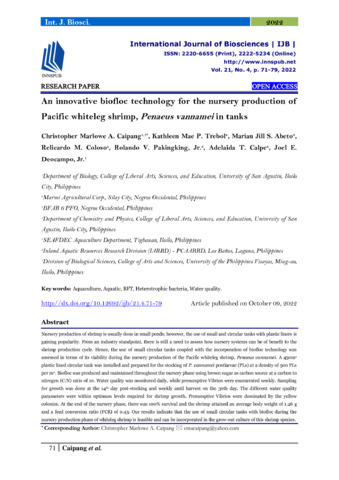
An innovative biofloc technology for the nursery production of Pacific whiteleg shrimp, Penaeus vannamei in tanks
Caipang, Christopher Marlowe; ; ; ; Pakingking, Rolando V., Jr. ; ; (International Network for Natural Sciences, 2022-10-09)
Nursery production of shrimp is usually done in small ponds; however, the use of small and circular tanks with plastic liners is gaining popularity. From an industry standpoint, there is still a need to assess how nursery systems can be of benefit to the shrimp production cycle. Hence, the use of small circular tanks coupled with the incorporation of biofloc technology was assessed in terms of its viability during the nursery production of the Pacific whiteleg shrimp, Penaeus vannamei. A 450m2 plastic lined circular tank was installed and prepared for the stocking of P. vannamei postlarvae (PLs) at a density of 500 PLs per m2. Biofloc was produced and maintained throughout the nursery phase using brown sugar as carbon source at a carbon to nitrogen (C:N) ratio of 10. Water quality was monitored daily, while presumptive Vibrios were enumerated weekly. Sampling for growth was done at the 14th day post-stocking and weekly until harvest on the 30th day. The different water quality parameters were within optimum levels required for shrimp growth. Presumptive Vibrios were dominated by the yellow colonies. At the end of the nursery phase, there was 100% survival and the shrimp attained an average body weight of 1.26 g and a feed conversion ratio (FCR) of 0.43. Our results indicate that the use of small circular tanks with biofloc during the nursery production phase of whiteleg shrimp is feasible and can be incorporated in the grow-out culture of this shrimp species. -
Vibrio load and percentage composition of sucrose‐fermenting vibrios in Nile tilapia (Oreochromis niloticus) cultured in brackish water earthen ponds and biocontrol potential of recycled tilapia‐conditioned greenwater against population growth of V. parahaemolyticus and non‐sucrose‐fermenting vibrios in the grow‐out culture of white leg shrimp (Litopenaeus vannamei)
Pakingking, Rolando V., Jr.; Palma, Peter ; ; Usero, Roselyn (Wiley, 2022-10-20)
Vibrio are known opportunistic pathogens of pond-cultured fish and shrimp. This study determined the presumptive Vibrio count (PVC) and percentage composition of “beneficial” sucrose-fermenting vibrios (SFVs) and “pathogenic” non-SFVs in the water, sediment, gills and intestines of healthy tilapia Oreochromis niloticus collected every 2 weeks from Days 30 to 120 post-stocking in brackish water earthen ponds. PVCs in water and sediment ranged from 102–104 CFU/ml/CFU/g while in tilapias' gills and intestines, PVCs ranged from 103–106 CFU/g and 102–106 CFU/g, respectively, with SFVs dominating in water, sediment, gills (≥50%), and intestines (≥80%) of tilapia. Because use of tilapia-conditioned green water (TCGW) for shrimp's grow-out culture has been reported effective against acute hepatopancreatic necrosis disease outbreaks caused by V. parahaemolyticus, PVC, SFVs/non-SFVs (%), and V. parahaemolyticus count (VPC) in the recycled TCGW and Litopenaeus vannamei's hepatopancreas were also examined from stocking until 105 days of culture (DOC) in earthen ponds. PVCs ranging from 102–103 CFU/ml and 103–104 CFU/g were noted in water and shrimp's hepatopancreas, respectively. While non-SFVs population in water varied, a downward trend typified by an abrupt 50% reduction was noted in hepatopancreas at DOC 42, and remained or further dropped until DOC 105. VPCs in water likewise varied (undetectable–102 CFU/ml) while in hepatopancreas, counts dropped to undetectable level from DOC 70 onwards. Current data illustrate that remarkable shift of SFVs' dominance in the water and concomitantly in shrimp's hepatopancreas, plays a pivotal role in regulating non-SFVs proliferation in shrimp's hepatopancreas via competitive exclusion. -
Acute lethal toxicity of dried garlic (Allium sativum) powder on orange-spotted grouper (Epinephelus coioides) juveniles under static exposure
(European Association of Fish Pathologists, 2022-10-05)The present study was carried out to assess the toxic effect and determine the lethal concentration of dried garlic (Allium sativum) powder on the orange-spotted grouper (Epinephelus coioides) juveniles. Laboratory static bioassays were conducted to determine the 96-h LC50 of different concentrations of garlic (0, 30, 60, 90, 120, 150 and 180 mg L-1) on grouper juveniles (mean weight, 35.4±6.18 g and mean length, 13.2±0.51 cm). The 96-h LC50 was 74.78 mg L-1 with lower and upper confidence limits of 62.8 and 89.06 mg L-1, respectively. All fish exposed to 30 to 180 mg L-1 exhibited rapid movement, faster opercular activity and erratic swimming whereas at higher concentrations (90 mg L-1 to 180 mg L-1) fish showed additional behavioral changes such as loss of balance, lethargy, gulping for air and respiratory distress. Water quality parameters were within the recommended acceptable limits. This LC50 value can be used as a baseline reference to generate an effective concentration of garlic for future prophylaxis and treatment for parasitic, viral and bacterial infection in grouper. -
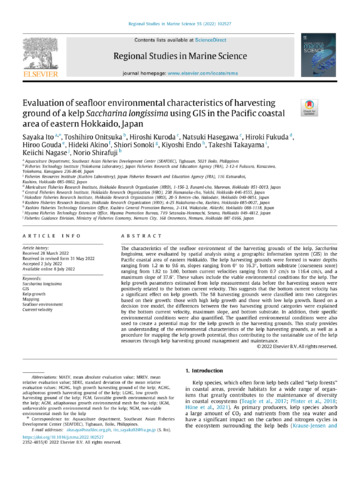
Evaluation of seafloor environmental characteristics of harvesting ground of a kelp Saccharina longissima using GIS in the Pacific coastal area of eastern Hokkaido, Japan
Ito, Sayaka; ; ; Hasegawa, Natsuki ; ; ; ; ; ; ; ; (Elsevier, 2022-09)
The characteristics of the seafloor environment of the harvesting grounds of the kelp, Saccharina longissima, were evaluated by spatial analysis using a geographic information system (GIS) in the Pacific coastal area of eastern Hokkaido. The kelp harvesting grounds were formed in water depths ranging from 1.2 m to 9.6 m, slopes ranging from 0° to 16.3°, bottom substrate (coarseness score) ranging from 1.82 to 3.00, bottom current velocities ranging from 0.7 cm/s to 116.4 cm/s, and a maximum slope of 37.6°. These values include the viable environmental conditions for the kelp. The kelp growth parameters estimated from kelp measurement data before the harvesting season were positively related to the bottom current velocity. This suggests that the bottom current velocity has a significant effect on kelp growth. The 58 harvesting grounds were classified into two categories based on their growth: those with high kelp growth and those with low kelp growth. Based on a decision tree model, the differences between the two harvesting ground categories were explained by the bottom current velocity, maximum slope, and bottom substrate. In addition, their specific environmental conditions were also quantified. The quantified environmental conditions were also used to create a potential map for the kelp growth in the harvesting grounds. This study provides an understanding of the environmental characteristics of the kelp harvesting grounds, as well as a procedure for mapping the kelp growth potential, thus contributing to the sustainable use of the kelp resources through kelp harvesting ground management and maintenance. -
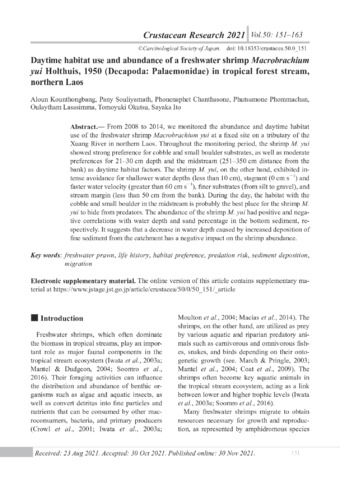
Daytime habitat use and abundance of a freshwater shrimp Macrobrachium yui Holthuis, 1950 (Decapoda: Palaemonidae) in tropical forest stream, northern Laos
; ; ; ; ; ; Ito, Sayaka (Carcinological Society of Japan, 2021-11-30)
From 2008 to 2014, we monitored the abundance and daytime habitat use of the freshwater shrimp Macrobrachium yui at a fixed site on a tributary of the Xuang River in northern Laos. Throughout the monitoring period, the shrimp M. yui showed strong preference for cobble and small boulder substrates, as well as moderate preferences for 21–30 cm depth and the midstream (251–350 cm distance from the bank) as daytime habitat factors. The shrimp M. yui, on the other hand, exhibited intense avoidance for shallower water depths (less than 10 cm), stagnant (0 cm s−1) and faster water velocity (greater than 60 cm s−1), finer substrates (from silt to gravel), and stream margin (less than 50 cm from the bank). During the day, the habitat with the cobble and small boulder in the midstream is probably the best place for the shrimp M. yui to hide from predators. The abundance of the shrimp M. yui had positive and negative correlations with water depth and sand percentage in the bottom sediment, respectively. It suggests that a decrease in water depth caused by increased deposition of fine sediment from the catchment has a negative impact on the shrimp abundance. -
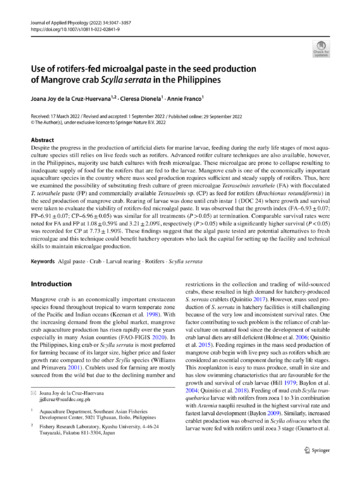
Use of rotifers-fed microalgal paste in the seed production of mangrove crab Scylla serrata in the Philippines
Huervana, Joana Joy; ; Villa-Franco, Annie (Springer, 2022-09-09)
Despite the progress in the production of artificial diets for marine larvae, feeding during the early life stages of most aquaculture species still relies on live feeds such as rotifers. Advanced rotifer culture techniques are also available, however, in the Philippines, majority use batch cultures with fresh microalgae. These microalgae are prone to collapse resulting to inadequate supply of food for the rotifers that are fed to the larvae. Mangrove crab is one of the economically important aquaculture species in the country where mass seed production requires sufficient and steady supply of rotifers. Thus, here we examined the possibility of substituting fresh culture of green microalgae Tetraselmis tetrathele (FA) with flocculated T. tetrathele paste (FP) and commercially available Tetraselmis sp. (CP) as feed for rotifers (Brachionus rotundiformis) in the seed production of mangrove crab. Rearing of larvae was done until crab instar 1 (DOC 24) where growth and survival were taken to evaluate the viability of rotifers-fed microalgal paste. It was observed that the growth index (FA–6.93 ± 0.07; FP–6.91 ± 0.07; CP–6.96 ± 0.05) was similar for all treatments (P > 0.05) at termination. Comparable survival rates were noted for FA and FP at 1.08 ± 0.59% and 3.21 ± 2.09%, respectively (P > 0.05) while a significantly higher survival (P < 0.05) was recorded for CP at 7.73 ± 1.90%. These findings suggest that the algal paste tested are potential alternatives to fresh microalgae and this technique could benefit hatchery operators who lack the capital for setting up the facility and technical skills to maintain microalgae production. -
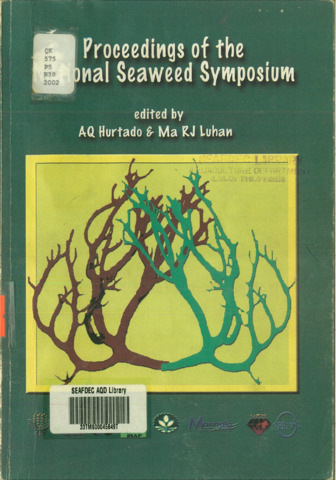
Proceedings of the National Seaweed Symposium, September 3-4, 2002, Cebu City
(Seaweed Industry Association of the Philippines, 2003)The Proceedings of the National Seaweed Symposium is published by the Seaweed industry association of the Philippines (SIAP). The 109-page book is edited by SEAFDEC/AQD researchers Dr. AQ Hurtado and Ms. Ma. RJ Luhan. It ... -
Cage culture of tropical eels, Anguilla bicolor pacifica and A. marmorata juveniles: Comparison of growth, feed utilization, biochemical composition and blood chemistry
Aya, Frolan; Garcia, Luis Maria (Wiley, 2022-11-02)
This study examined the performance and suitability of two tropical anguillid eels, Anguilla bicolor pacifica and A. marmorata, under cage culture conditions. Juvenile eels (1.73 ± 0.14 g body weight) of each species were stocked in triplicate hapa net cages (1 × 1 × 1.5 m; 30 eels/cage) suspended in outdoor tanks. Growth, feed utilization, biochemical composition and blood chemistry of the two species were compared after 210 days. Except for survival, mean final body weight (FBW), weight gain percentage (WG), specific growth rate (SGR) and yield of A. bicolor pacifica (64.51 ± 13.07 g, 3514 ± 690%, 2.14 ± 0.12%/day, 1534 ± 380 g/m3) were significantly higher than that of A. marmorata (7.77 ± 2.90 g, 356 ± 125%, 0.89 ± 0.16%/day, 178 ± 89 g/m3). In comparison with A. bicolor pacifica, significantly lower feed intake (FI), feed efficiency (FE) and protein efficiency ratio (PER) observed in A. marmorata suggest the need to develop eel diets with feeding stimulants to improve feed acceptance. Biometric indices, body proximate and amino acid composition were not significantly different between the two species. However, serum glutamic oxaloacetic transaminase (GOT), glutamic pyruvic transaminase (GPT) and total protein (TP) in A. bicolor pacifica were significantly higher than that in A. marmorata. These findings suggest that the differences in growth performance and feed utilization between the two anguillid eel species are related to feed palatability, and that A. bicolor pacifica appears to be a suitable species for cage culture because of its faster growth. -
User acceptance of IAMSLIC digital fisheries library
Alayon, Stephen; (International Association of Aquatic and Marine Science Libraries and Information Centers (IAMSLIC), 2018)
The International Association of Aquatic and Marine Science Libraries and Information Centers (IAMSLIC) through the Aquatic Commons Board approved the deployment of IAMSLIC Digital Fisheries Library in the Philippines during the 2015 Conference. The digital library utilized the LibraryBox, a portable, open source distribution tool. This standalone wireless access is ideal for fisheries schools in the area due to limited or no Internet access and intermittent electrical power conditions. With the aim of providing access to SEAFDEC Aquaculture Department (AQD) publications in these schools, more than a thousand publications that were already made available in SEAFDEC/AQD institutional repository were also added in the box. The box contained over 26,000 publications, reports, articles and documents on all aspects of fisheries that are freely available. SEAFDEC/AQD is the first institution in the country to launch t he project in July 2016 using LibraryBox. Five boxes were distributed in Philippine fisheries libraries devastated by Typhoon Yolanda or hazed by fire. This study examined the factors that influence student’s acceptance and attitude towards the IAMSLIC Digital Fisheries Library. A survey was distributed to selected fisheries and marine biology undergraduate students in the Philippines. Relevance, perceived usefulness, perceived ease of use, screen design and behavioral intention to use the digital library were determined. -
Edwardsiellosis
Pakingking, Rolando V., Jr.; Viet Nguyen, Vuong (Academic Press, 2022)
Edwardsiellosis is an acute to chronic systemic disease in fish characterized by exophthalmia, ascites, hernia, and severe lesions of the internal organs. It is caused by Edwardsiella tarda, a Gram-negative intracellular pathogen implicated in enormous economic losses of cultured seawater and freshwater fish species. E. tarda has a broad host range and geographic distribution, and possesses important virulence factors that enhance its survival and pathogenesis in hosts. This chapter discusses some of the recent research on edwardsiellosis in fish including the etiologic agent's identification, pathology, diagnosis, and virulence factors, and as well as novel strategies aimed at preventing and controlling the disease. -
Viral encephalopathy and retinopathy
; Pakingking, Rolando V., Jr. (Academic Press, 2022)
Viral nervous necrosis (VNN), also referred to as viral encephalopathy and retinopathy (VER), has been reported in at least 120 cultured or wild marine and freshwater fish species and has caused serious economic losses among farmed marine fish species in the past decades. Since the first description of this disease at the end of the 1980s, substantial amounts of researches have been instrumental in understanding the mechanisms involved in fish infection, development of reliable diagnostic methods, and disease prevention and control. This chapter presents some important aspects of the disease with particular emphasis on etiologic agent, clinical signs and gross pathology of the disease, histopathology, disease risk factors, virus propagation and identification, molecular diagnostics, and concomitant prevention and control methods. -
Accumulation and depletion of oxytetracycline (OTC) and oxolinic acid (OXA) in Pompano, Trachinotus blochii
Tendencia, Eleonor (European Association of Fish Pathologists, 2022-09-03)
Accumulation and depletion including withdrawal period for oxytetracycline (OTC) and oxolinic acid (OXA) in pompano (Trachinotus blochii) were determined following oral administration. Pompano were cultured in 250-L fiberglass tanks in a flow-through system provided with aeration. Observed average temperature was 30°C; salinity was 30 ppt. Fish were starved for 2 days then fed with OTC medicated diet (75mg/kg fish/day) or OXA medicated diet (30 mg/kg fish/day) 3 times a day for 10 successive days at 2% body weight and thereafter switched to regular diet for 45 days. Muscle and blood samples were taken at regular intervals during and after cessation of medication. OTC residues in the muscle and blood were analysed using the high performance liquid chromatography (HPLC). Peak OTC accumulation was observed at day 10 of treatment. Higher OTC accumulation was observed in the muscle (0.88+0.27 µg/g) than in the blood (0.3+0.09 µg/ml). OXA accumulation peaked on day 5 of treatment; higher OXA accumulation was observed in the muscle (0.11+0.06 µg/g) compared to blood (0.005+0.0001 ug/ml). Withdrawal period at 30°C for OTC in pompano muscle was 19 days (570 degree-days) and 17 days (510 degree-days) in the blood. For OXA, the withdrawal period in pompano muscle and blood at 30°C temperature was 3 days (90 degree-days). -
Effect of water mass mixing on phytoplankton dynamics in the scallop culture areas off Okhotsk Sea: A microcosm experiment
Aya, Frolan; Kudo, Isao (Elsevier, 2022-09)
The nearshore (Soya Warm Water (SWW)) and offshore (Intermediate Cold Water (ICW) and Okhostk Sea Low Salinity Water (OSLSW)) waters in the Okhotsk Sea differ substantially in their physico-chemical characteristics. Thus, the extent to which water mass mixing impacts phytoplankton dynamics in the Japanese scallop Patinopecten yessoensis culture areas needs to be assessed to properly manage scallop stocks. This study examined the phytoplankton dynamics in nearshore (SWW) and offshore (ICW and OSLSW) waters and phytoplankton response to water mass mixing (SWW + ICW, OSLSW + ICW) for 5 days in spring (2007) and summer (2007–2009) microcosm experiments. Increased chlorophyll a concentration in ICW was observed due to higher nutrients available for phytoplankton uptake than in OSLSW and SWW at the start of each microcosm experiment. In comparison to spring microcosm, mixing of SWW + ICW promoted higher chlorophyll a concentration and faster Si(OH)4 utilization than in OSLSW + ICW in summer. In addition, the size structure of chlorophyll a differed from micro-size (>) in SWW + ICW to nano-size (<) chlorophyll a in OSLSW + ICW. Suspended particulate organic matter (SPOM) \(\mathsf{\delta^{13}C}\) ratios were positively correlated with chlorophyll a in both mixed microcosms whereas SPOM \(\mathsf{\delta^{15}N}\) isotopic ratios were inversely related to nitrate concentration in SWW + ICW, except in spring. This suggests that stable isotopes can be used in predicting phytoplankton biomass and nutrient utilization. In comparison to microcosm experiments, nearshore water column structure suggests vertical water mixing in summer to autumn when phytoplankton biomass and micro-size fraction were at maximum. Taken together, the advance of nutrient-rich ICW to nutrient-poor nearshore areas in the Okhotsk Sea resulted in increased chlorophyll a biomass and dominance of micro-size phytoplankton in summer, potentially enhancing nutrient and food supply to bottom-cultured scallops as suggested by both microcosm experiments and field observations. -
Proteus mirabilis (MJA 2.6S) from saline-tolerant tilapia exhibits potent antagonistic activity against Vibrio spp., enhances immunity, controls \(\mathsf{NH_3}\) levels and improves growth and survival in juvenile giant tiger shrimp, Penaeus monodon
Apines-Amar, Mary Jane; Caipang, Christopher Marlowe ; ; ; Amar, Edgar ; ; Pedroso, Fiona (Wiley, 2022-08-10)
Of several isolates from saline-tolerant tilapia exhibiting anti-vibrio activity, an isolate that demonstrated inhibitory activity with the biggest zone of inhibition against the shrimp pathogens, Vibrio harveyi and V. parahaemolyticus were chosen and investigated in this study. The isolate showed significant inhibition against the shrimp pathogens, V. harveyi and V. parahaemolyticus in a competitive assay. Upon 16S rRNA sequencing, the isolate was identified as putative Proteus mirabilis (MJA 2.6S). P. mirabilis (MJA 2.6S) exhibited extracellular protease, cellulase and amylase activities. Pathogenicity tests showed that it was not pathogenic to the shrimp even at the highest concentration of 108 CFU ml−1. Further, P. mirabilis (MJA 2.6S) improved growth and survival, stimulated higher phenoloxidase and bactericidal activities in the shrimp host and protected it from V. harveyi experimental infection. In addition, the isolate P. mirabilis (MJA 2.6S) significantly reduced the ammonia level of the pond water samples in vitro. Taken together, the results clearly showed the strong probiotic potential of P. mirabilis (MJA 2.6S) in shrimp and hence further studies are needed to determine its wider application as a probiotic in P. monodon culture. -
Evaluation of maturation promoting factor in polychaete (Marphysa sp.) on Indian white prawn, Penaeus indicus female broodstock
Santander-Avancena, Sheryll; Traifalgar, Rex Ferdinand ; Monteclaro, Harold ; ; ; ; Quinitio, Gerald (Wiley, 2022-07-15)
Polychaete is considered the best maturation diet for penaeids; however, fluctuating supply and quality warrant detailed studies to understand the specific maturation-promoting factors present in polychaete. Indian white prawn, Penaeus indicus, was fed diets supplemented with different fractions of Marphysa sp. extracts. Fractions, such as the total soluble fraction (TSF), neutral lipid fraction (NLF), and polar lipid fraction (PLF), were incorporated in the maturation diet at 0.25, 0.50, and 1.00% following a 3 × 3 factorial design. One group was fed with basal diet (BD), and another was fed with fresh squid, mussel, and polychaete, serving as the control. After a 30-day feeding trial, results showed that the inclusion of polychaete extracts in the diet significantly improved P. indicus maturation compared to groups fed BD and control with 40% maturation rates (MR) (p = 3.4 × 10⁻⁴). MR was optimum in groups receiving diets supplemented with ≥0.5% TSF (70.00% ± 0.00) and NLF (60.00% ± 5.77). Similar improved MR was achieved in treatments receiving ≥0.25% PLF supplementation (60% ± 0.00). Accordingly, relative expression of ovarian vitellogenin mRNA of broodstock fed under 0.25 and 0.50% PLF group was 4.44 and 3.96 folds higher than BD, respectively (p = 0.003). No significant differences were detected in the broodstock survival, latency period, hepatosomatic, and gonadosomatic indices. Biochemical content analyses showed no significant differences among the nine treatments except for broodstock's higher ovary protein content in the TSF group (p = 0.037). This study highlights PLF as the most potent component of the polychaete extract in promoting gonad maturation in P. indicus maturation supplemented at a 0.25% optimum inclusion level. -
Motile aeromonads recovered from tilapia (Oreochromis niloticus) cultured in earthen ponds in the Philippines: Assessment of antibiotic susceptibility and multidrug resistance to selected antibiotics
Pakingking, Rolando V., Jr.; Espanola, Jasca Gayle ; Palma, Peter ; Usero, Roselyn (AquacultureHub Inc., 2022-07)
A total of 177 motile Aeromonas spp., comprised of A. hydrophila (n=162) and A. sobria (n=15), isolated from the water, sediment, gills and intestines of tilapia collected from the grow-out culture earthen ponds in the Philippines were investigated for their antimicrobial susceptibility to 10 antibiotics commonly used in fish aquaculture. All motile Aeromonas spp. tested generally exhibited a very high percentage of resistance to amoxicillin (A. hydrophila: 95%; A. sobria: 100%), erythromycin (99%;100%), neomycin (83%;100%), and oxytetracycline (92%;100%), respectively. On the contrary, they showed substantial susceptibility to chloramphenicol, nitrofurantoin, doxycycline, enrofloxacin and norfloxacin. Results of the antimicrobial susceptibility testing demonstrated that 94.4% and 100% of A. hydrophila and A. sobria isolates tested were resistant to antibiotics belonging to at least 3 or more categories and therefore considered as multiple drug resistant strains. The multiple antibiotic resistance (MAR) indexing of A. hydrophila and A. sobria strains showed that they originated from high-risk sources.