Journal Articles, Conference Papers and Book Chapters by SEAFDEC Staff: Recent submissions
Now showing items 481-500 of 1693
-
Grouper aquaculture R&D in the Philippines
(Asian Fisheries Society; World Aquaculture Society; The Fisheries Society of Taiwan; National Taiwan Ocean University, 2008)Culture of groupers in ponds and floating net cages has been practiced for many years in the Philippines. Unsustainable culture practices such as dependence on wild caught seeds, use of trash fish, use of high stocking densities, and unregulated expansion and proliferation of fish cages, have led to the "boom and bust" cycle of grouper aquaculture in the Philippines. The drastic decrease in grouper aquaculture production in the late 90's was mainly attributed to environmental deterioration and diseases outbreaks. To sustain grouper production, research on the breeding, seed production and culture of groupers started in the mid 1980s. As a regional inter-government R&D organization, the Aquaculture Department of the Southeast Asian Fisheries Development Center (SEAFDEC/AQD) followed the recommendations of the 1987 Seminar-Workshop on Aquaculture Development in Southeast Asia on grouper R&D. Research activities initially focused on market survey of grouper species in the Philippines and Southeast Asia, assessment of fry and availability in traditional fishing grounds, and development of broodstock management techniques. Following the spontaneous spawning of Epinephelus coioides in concrete tanks and floating net cages in 1990's, protocols for the seed production of milkfish and sea bass were adapted and modified. Parallel studies to determine sustainable culture techniques in ponds and net cages were conducted. Studies on the nutritional requirements of grouper at various developmental stages were done to reduce dependence on live prey organisms and trash fish as feeds. Research geared towards health management started in the in late 90's to early 2000's. Prospects for grouper aquaculture are discussed in the light of recent advances in grouper R&D and the Government of the Philippines initiatives to increase fish production by mariculture. -
Mud crab culture: challenges and opportunities
Quinitio, Emilia T. ; (The Marine Products Export Development Authority, 2008)
-
Inventory of aquatic fauna of Agusan marsh with notes on introduced species and their potential impacts on biodiversity
; ; Primavera, Jurgenne (UNESCO Jakarta Office, Philippine Council for Aquatic and Marine Research and Development, 2008)
An important region of biodiversity in the country is the Agusan Marsh, located in northeastern Mindanao, southern Philippines. The Marsh aquatic fauna are not well studied and majority of available information is dispersed and sporadic. This study presents an updated systematic list comprising aquatic faunal species collected from seven Marsh localities during a 2006 survey. Of a total of 64 species of aquatic fauna distributed in 45 genera and 37 families, about 59.3% are fishes, 17.2% crustaceans, 14.1% molluscs, and 9.4% reptiles. Most of the aquatic fauna are native and migratory. Flowing rivers, lakes and creeks are the primary habitats of these organisms; majority of them thrive in lakes and upper streams. Fish species reported in earlier literature are also included. The Indigenous Knowledge System (IKS) was applied to integrate species known to the native Manobo, but not found in earlier studies nor the present survey. Fishery-related problems include the decline in fishery stocks, displacement of native species, and destruction of habitats. These problems are attributed to illegal fishing (e.g., electrofishing, use of chemicals and ichthyotoxic plants), overfishing, introduced or exotic or invasive alien species, pollution (e.g., heavy metal contamination), habitat degradation (e.g., conversion of marshland to agriculture), and human disturbance. The deliberate or accidental introductions of exotic species such as carps and the janitor fish now pose serious threats to species diversity. Conservation measures and strict enforcement of wildlife and environmental laws are needed to save the biodiversity of Agusan Marsh for future generations. -
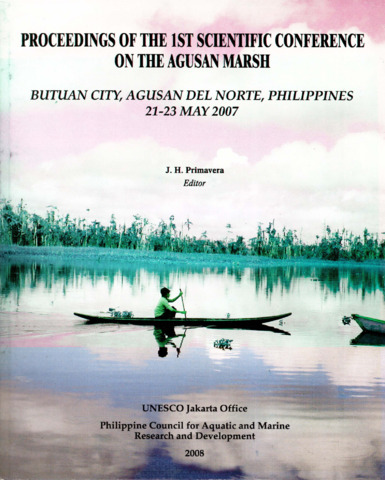
Proceedings of the 1st Scientific Conference on the Agusan Marsh: Butuan City, Agusan del Norte, Philippines, 21-23 May 2007
(UNESCO Jakarta Office, Philippine Council for Aquatic and Marine Research and Development, 2008) -
The Agusan marsh: A situationer with focus on scientific aspects
Primavera, Jurgenne; (UNESCO Jakarta Office, Philippine Council for Aquatic and Marine Research and Development, 2008)
The Agusan Marsh is an extensive floodplain in the middle of the Agusan River Basin in eastern Mindanao where rivers, creeks and tributaries mainly in the provinces of Agusan del Norte, Agusan del Sur and Compostela Valley converge and drain northward to the Agusan River and into Butuan Bay. The main habitats of the Marsh are the freshwater swamp forest (with Terminalia, peat swamp and sago palm forest subtypes), secondary scrub, herbaceous swamp, open water (oxbow/floodplain lakes, pools), and flowing water (rivers, streams). Peat forests have been confirmed in Bunawan and Caimpugan. Over 200 bird species have been known to spend at least part of the year in the Marsh, making it an important site for migratory birds from northern Asia and Siberia. As one of the Philippines' ecologically significant wetlands, the Marsh has been declared a protected site under NIP AS (1994), Presidential Proclamation 913 (1996), and RAMSAR (1999). The Agusan Marsh Wildlife Sanctuary covers -111,540 ha in 8 municipalities of Agusan del Sur. Recently the Agusan Marsh was placed high on the list of Philippine nominations to the World Heritage Natural Sites. Despite all these, very few scientific studies have been conducted on the Marsh but this has not stopped drainage and development for agriculture, construction of dams and reservoirs for irrigation, deliberate or accidental introductions of exotic species, e.g., tilapia, carps, janitor fish, and golden apple snail, and logging in the watershed areas. The latter have been legitimized by Integrated Forest Management Agreements despite the presence of primary forests. The latest proposed intervention is the Agusan River Basin Development Project. There is need for scientific research to provide baseline information on hydrology, sediment dynamics and ecology as prerequisite to any interventions and developments in the Agusan Marsh. -
Technology transfer of aquaculture technologies: framework and strategies
(Southeast Asian Fisheries Development Center, 2008) -
Understanding community-based aquaculture through participatory approaches
(Southeast Asian Fisheries Development Center, 2008) -
Community-based aquaculture and resource management: concepts and approaches
(Southeast Asian Fisheries Development Center, 2008) -
Business planning and management for sustainable small-scale rural aquaculture venture
(Southeast Asian Fisheries Development Center, 2008) -
DNA amplicons using arbitrary primers distinguish polymorphic loci among mangrove thraustochytrid genomes
(Institute of Electrical and Electronics Engineers, 2007)Thraustochytrids - lightly-pigmented estuarine and marine microheterotrophs, taxonomically aligned with heterokont algae - are of great biotechnological interest because they produce substantial amounts of polyunsaturated fatty acids (PUFAs) especially docosahexaenoic acid (DHA:6n3). In this study, twenty-seven strains, isolated from twenty mangrove areas in the Philippine archipelago, were mass-produced in axenic flask cultures using high-glucose medium with continuous agitation. Polymorphic loci of thraustochytrid genomes, determined using four arbitrary primers (OPC02, OPC05, OPC07 and OPC08) in PCR analysis, were randomly amplified as molecular markers for genetic fingerprinting. Electrophoretic banding patterns of DNA amplicons, recognized based on nucleic acid size, were scored on data matrix and analyzed using Jaccard's coefficient and single-linkage hierarchical clustering to characterize degree of genetic relatedness among thraustochytrids. Conclusively, nearest-neighbor dendrogram of randomly amplified polymorphic DNAs (RAPDs) markers classify the strains into two monophenetic clades, representing the two major genera: Schizochytrium and Thraustochytrium. -
Development of transgenic fish: scientific background
; ; ; ; Eguia, Maria Rowena R. (CABI, 2007)
This chapter highlights some of the important examples of transgenic fish development. An overview of important steps in fish transgenesis is given. The status of development in the case of transgenic carp, tilapias, Atlantic salmon and mud loach is discussed. Other future applications of transgenic fish are presented. The key research and capacity needs for further development of transgenic fish are also discussed. -
Philippine thraustochytrids from mangroves: A rich new source of essential fatty acids for human nutrition
(Marine Science Institute, University of the Philippines, 2007) -
Microbial diseases in aquaculture: issues and challenges
(Marine Science Institute, University of the Philippines, 2007)Aquaculture is the farming of aquatic organisms including fish, molluscs, crustaceans and aquatic plants where farming implies some intervention in the rearing process to enhance production, such as regular stocking, feeding, protection from predators, etc. (FAO, 1997). The contribution of aquaculture to global supplies of fish, crustaceans, mollusks and other aquatic animals continues to grow, increasing from 3.9 percent of total production by weight in 1970 to 32.4 percent in 2004 growing more rapidly than all other animal food-producing sectors. Worldwide, aquaculture production has grown at an average rate of 8.8 percent per year since 1970, compared with only 1.2 percent for capture fisheries and 2.8 percent for terrestrial framed meat production systems over the same period (FAO 2006). -
Series: PIDS Discussion Paper Series; No. 2007-20
The current state of aquaculture in Laguna de Bay
(Philippine Institute for Development Studies, 2007)This paper presents some of the preliminary results and findings of an ongoing study, jointly conducted by the Southeast Asian Fisheries Development Center (SEAFDEC AQD) and Philippine Institute for Development Studies (PIDS), which assesses the current state of aquaculture in Laguna de Bay. The study uses primary and secondary data. The primary data were gathered through interviews with key informants and a cross-section survey of fishpen and fishcage operators and their operations in Laguna de Bay conducted in 2007. The secondary data were gathered from the published statistical indices of institutional sources and other relevant literature. The results of the study indicate that aquaculture in Laguna de Bay is a vibrant industry that includes not only fishpen and fishcage operators but also various participants in its input and product markets. Furthermore, they show that aquaculture contributes significantly to fish production in the lake as well as to national aquaculture and fisheries production. The results of the study also indicate that while aquaculture in Laguna de Bay has been an important economic contributor locally and nationally, it has been facing numerous problems over time that constrain its development. Of these, environment-related problems, lack of access to cheap capital, obstruction of navigational lanes by fishpens, existence of illegal fishpens, poaching and overall limited support from the government were considered very serious by aquaculture operators. These problems, therefore, may be the ones needing the most attention. -
Analysis of small-scale coastal aquaculture in the Philippines
(Japan International Research Center for Agricultural Sciences, 2007)We studied the influence of the development of aquaculture in the Philippines on the local economy, focusing on coastal fishers in two towns in Capiz and Iloilo, Panay Island, Philippines. Coastal residents in the two towns closely depend on fishing and aquaculture for both their primary and secondary incomes. The small-scale aquaculture business commenced by coastal fishermen has been expanding particularly after the 1990s. The planting of mangrove trees is promoted and small-scale aquafarming is done by coastal fishermen who exert only small environmental loads. Small-scale aquaculture, including the aquaculture of shellfish, net cage culture, pen culture, and seaweed culture, requires low initial investment and imposes minimal workload on operators in terms of breeding management up to shipment, which is why most coastal fishing people want to continue in the business. On the other hand, pond culture, practiced before the 1990s, promises no further rise in production for several reasons that include overproduction of milkfish and the outbreak of diseases in shrimp and prawn. Under these conditions, small-scale aquaculturists in two towns have established a sustainable aquaculture production system that allows them to maintain mangrove forests, utilize natural recirculation functions and help local residents obtain income. -
Series: JIRCAS Working Report; No. 56
Development of farming schemes following disease occurrences in monodon shrimp farming using intensive method in three Southeast Asian countries
(Japan International Research Center for Agricultural Sciences, 2007)All three countries experienced major progress in intensive shrimp farming at different ties. Intensive farming of monodon shrimp (Penaeus monodon, an indigenous species) was first launched by the Philippines, followed by Thailand, then by Peninsular Malaysia. The survey was conducted from 2000-2005. The disease-causing bacterial that seiously damaged monodon culture were luminous bacteria in the Philippines and white spot virus in Thailand and Malaysia. Production decreased because of these diseases in the mid-1990s in the Philippines and after 2000 in Thailand and Malaysia. In 1998, the Green Water System (hereinafter referred to as GWS) was developed, and a proportion of culture ponds introduced it and resumed monodon culture using the intensive method. In Thailand, the vannamei shrimp (Penaeus vannamei, an exotic species from South America) has now replaced monodon previously raised using the extensive method. In Malaysia, monodon is cultured using only the intensive method, and some culture pond enterprises started to culture vannamei instead of monodon in 2004. In the Philippines, companies engaging in monodon culture have many ponds and lower stocking density because they culture large-size shrimp, but are exposed to high running costs such as fuels and probiotics. On the other hand, in Thailand, individuals engaging in monodon culture have few ponds and higher stocking density since they culture small-scale shrimp. Labor costs are low because most of the work is done by family member. -
Arachidonic acid distribution in seaweed, seagrass, invertebrates and dugong in coral reef areas in the Philippines
(Japan International Research Center for Agricultural Sciences, 2007)Arachidonic acid (ArA) was not a minor component, and ArA distributes widely in coral reef organisms. Seagrass had high linoleic acid and linolenic acid levels with low Ara, EPA and DHA levels, while some species of seaweed had intermediate or high ArA levels (5% to 12%). In starfish, sea cucumber and some species of corals, ArA was the first major fatty acid (20% to 30%), but DHA levels were very low. Bivalves, abalone and shrimps had intermediate ArA levels. Total lipids of abdominal muscle and liver of dugong had respectively ArA levels of 7.8% and 11.0%, which were higher than EPA levels (2.4% and 1.6%), but DHA levels (0.4% and 2.3%) were low. It is clear that ArA is a major fatty acid in coral reef animals. The present results suggest that the existence of an ArA-rich food chain may be widespread in coral reef areas, and that the widespread existence of ArA-rich food chain may lead to intermediate or high ArA contents in tropical species. -
Viral nervous necrosis (VNN) as a critical infectious disease of orange-spotted grouper, Epinephelus coioides, in the Philippines
(Japan International Research Center for Agricultural Sciences, 2007)Orange-spotted grouper, Epinephelus coioides, is a valuable commodity in the Philippines. In 2001, mass mortality occurred in the grouper larvae at Aquaculture Department, Southeast Asian Fisheries Development Center (SEAFDEC/AQD) and the disease was identified as viral nervous necrosis (VNN). Since then, the disease has been observed every year and the grouper hatcheries have been devastated. In this paper, recent studies of VNN which were conducted at the SEAFDEC/AQD from 2001 to 2006 are reviewed. 1) Susceptibility to the VNN virus was tested among fish species that were cultured in mangrove brackish are. Five representative cultured fish species including orange-spotted grouper, Asian sea bass (Lates calcarifer), mangrove red snapper (Lutjanus argentimaculatus), milkfish (Chanos chanos) and rabbitfish (Siganus guttatus) were used in the test where the virus was intraperitoneally injected into the juveniles. Although low or no mortality occurred in the challenge test, histopathological changes were observed in the brain and retina where the virus was re-isolated. The results were the same among the species except for rabbitfish which had no evidence for the infection. It was verified that the virus has a wide host range. 2) To estimate the possible risk of viral spread by vertical transmission, virus distribution was determined in asymptomatic groupers including 7 broodstock and 17 juveniles with body weights ranging from 4 to 12 kg and 2 to 9 respectively. The virus was detected by PCR method. The highest detection rate was in the brain, and the virus was also detectable in other organs such as the gills, heart, spleen, kidney, blood, esophagus, stomach, intestine, liver, gonad, swim bladder and/or skin. 3) As a possible VNN vaccine, a DNA p;asmid encoding the capsid protein of the virus was evaluated. After the challenge, the mortalities between the native and DNA-injected fish appeared significantly different (P<0.05). -
Series: JIRCAS Working Report No. 56
Effects of arachidonic acid supplementation on larval and survival and reproductive performance in rabbitfish, Siganus guttatus
(Japan International Research Center for Agricultural Sciences, 2007)Fry of tropical marine fish needed for aquaculture still comes mostly from the wild. Thus, fry availability is a major constraint in the development and extension of aquaculture, especially in rural areas of developing regions. Although the mission of hatcheries is to provide a stable fry production and supply for farmers, fry production remains variable due to poor fecundity and low survival. For the last four years (2002-2005), SEAFDEC/AQD and JIRCAS have conducted the collaborative project that was aimed at developing advanced diets for improving egg production/quality (2002-2005) and larvae/fry quality (2004-2005) through dietary manipulation. Larval rearing tests: In 2005, larval rearing tests (4 trials with rotifers) were conducted to investigate the effects of enriched-live food (4treatments: low (CS) and high (DHAPS) HUFA with or without arachidonic acid supplementation) on survival and growth in rabbitfish Sigunus guttatus fry. Fry fed the rotifers enriched with a combination of DHAPS+5% ArA showed the best survival (44.4±4.5% for D17 fry in the 4th trial).Growth was not different among the treatments (CS, CS+5% ArA, DHAPS, DHPS+5% ArA). Broodstock tests: From March, 2005 to January,2006, a feeding test has been conducted to investigate the effects of dietary ArA supplementation (0% for diet 1, 0.3% for diet 2 and 0.6% for diet 3) on egg production and quality of wild-caught and hatchery-bled rabbitfish broodstock. The broodstock spawned 13 times for diet1 (six pairs), 14 times for diet 2 (five pairs) and 17 times for diet 3 (six pairs) during the period of May 2005 to January, 2006. The total numbers ofhatched-larvae were 3,818 x 103 for diet 1, 4,391 x 103 for diet 2 and 4,597 x 103 for diet 3. The % of normal larvae did not differ among the dietary treatments. Considering together with the results of mangrove red snapper (2003) and rabbitfish (2004), the optimum level of ArA incorporation appears to be between 0.5% and 0.7%. Judging from the results of fatty acid analysis, DHA and arachidonic acid should be supplemented to diets at the same time as to make DHA/arachidonic acid ratio appropriate. Thus, the present study clearly shows that dietary arachidonic acid supplementation is very promising for the development of fry production technologies in tropical areas. -
Series: JIRCAS Working Report; No. 75
Co-culture trials of sandfish Holothuria scabra and black tiger shrimp Penaeus monodon in mangroves
Lebata-Ramos, Ma. Junemie Hazel; ; Sibonga, Rema ; (Japan International Research Center for Agricultural Sciences, 2012)
To address its mandate to develop environment-friendly culture techniques, the Southeast Asian Fisheries Development Center, Aquaculture Department (SEAFDEC/AQD) is trying to establish a culture system in mangroves for commercially important aquaculture species. Recently, SEAFDEC/AQD has successfully produced sandfish, Holothuria scabra, in the hatchery. Using hatchery-bred juveniles, monoculture and co-culture trials are being conducted in ponds, pens and cages. This study investigated the feasibility of the co-culture of black tiger shrimp, Penaeus monodon, and H. scabra in the mangroves by comparing growth and survival in monoculture and co-culture conditions. Water and sediment quality were compared between treatments. Results showed that growth and survival of P. monodon (P. monodon only = 48.8±4.9%; P. monodon + H. scabra = 46.1±7.4%) and H. scabra (H. scabra only = 13.1±6.1%; P. monodon + H. scabra = 12.3±6.2%) grown together or separately did not significantly differ. P. monodon survivial was positively correlated while growth negatiely correlated with temperature. Feed input significantly increased sulfide levels in both treatments (P. monodon; P. monodon + H. scabra) and sulfide significantly differed between treatments with the highest concentration in P. monodon only, then P. monodon + H. scabra and H. scabra only. Ammonia concentrations followed the same trend as sulfide but did not significantly differ among treatments. P. monodon cultured in mangroves were not affected by the white spot syndrome virus which affected neighboring culture ponds. Results of these initial trials may not be conclusive yet but show a promising culture system for P. monodon that may be integrated with the mangroves.