Books and Book Chapters: Recent submissions
Now showing items 21-40 of 123
-
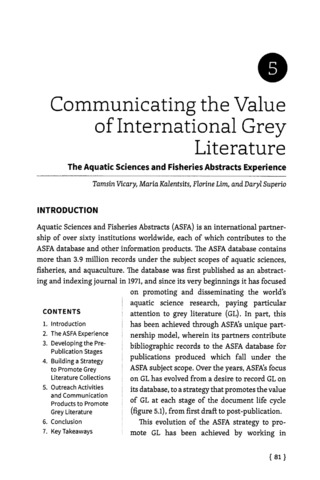
Communicating the value of international grey literature: The Aquatic Sciences and Fisheries Abstracts experience
; ; ; Superio, DarylIn collaboration with its partners, ASFA has worked across multiple platforms to raise awareness and understanding of the effective promotion of grey literature to the managers and users of this valuable information source. ... (ALA Editions, 2022)
-
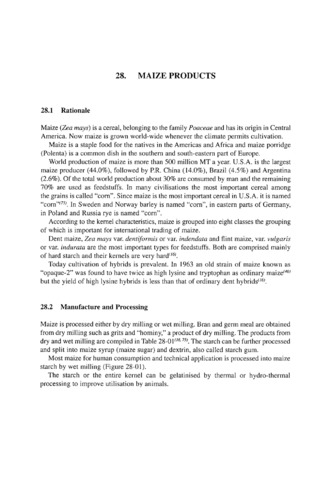
Maize products
(Springer, 2000)Maize (Zea mays) is a cereal, belonging to the family Poaceae and has its origin in Central America. Now maize is grown world-wide whenever the climate permits cultivation. -
Series: FAO Fisheries and Aquaculture Proceedings;67
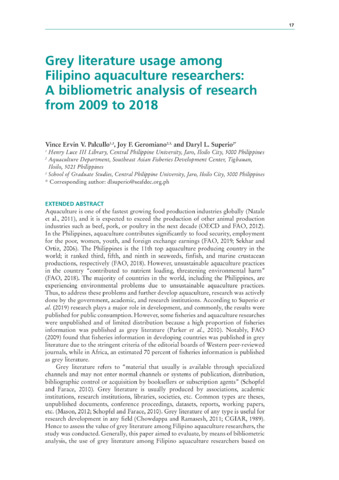
Grey literature usage among Filipino aquaculture researchers: A bibliometric analysis of research from 2009 to 2018
Palcullo, Vince Ervin; Geromiano, Joy F. ; Superio, Daryl (FAO, 2021)
Aquaculture is one of the fastest growing food production industries globally (Natale et al., 2011), and it is expected to exceed the production of other animal production industries such as beef, pork, or poultry in the next decade (OECD and FAO, 2012). In the Philippines, aquaculture contributes significantly to food security, employment for the poor, women, youth, and foreign exchange earnings (FAO, 2019; Sekhar and Ortiz, 2006). The Philippines is the 11th top aquaculture producing country in the world; it ranked third, fifth, and ninth in seaweeds, finfish, and marine crustacean productions, respectively (FAO, 2018). However, unsustainable aquaculture practices in the country “contributed to nutrient loading, threatening environmental harm” (FAO, 2018). The majority of countries in the world, including the Philippines, are experiencing environmental problems due to unsustainable aquaculture practices. Thus, to address these problems and further develop aquaculture, research was actively done by the government, academic, and research institutions. According to Superio et al. (2019) research plays a major role in development, and commonly, the results were published for public consumption. However, some fisheries and aquaculture researches were unpublished and of limited distribution because a high proportion of fisheries information was published as grey literature (Parker et al., 2010). Notably, FAO (2009) found that fisheries information in developing countries was published in grey literature due to the stringent criteria of the editorial boards of Western peer-reviewed journals, while in Africa, an estimated 70 percent of fisheries information is published as grey literature. -
Production of microalgal paste in the Philippines
(Philippine Science Letters, 2020)Technical advances have made possible the production of microalgal concentrate in paste form. Chaetoceros calcitrans was concentrated and made into an algal paste through centrifugation, chemical flocculation, and electrolytic flocculation. The paste can be stored up to three months when refrigerated, and is diluted with seawater for feeding to the tiger prawn, Penaeus monodon. This can also be done with other cultured diatoms, and they can be fed to other penaeid shrimp and other organisms such as the Sydney rock oyster and the Pacific oyster. The use of algal paste can simplify hatchery operations and reduce costs among hatcheries with no microalgal culture facilities. -
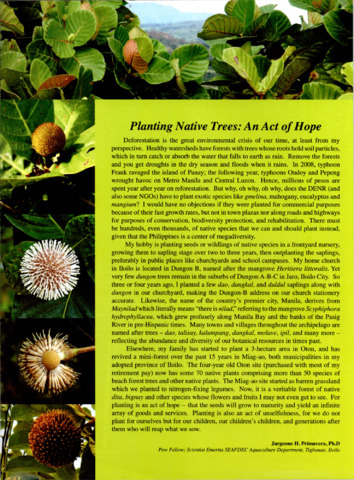
Planting native trees: An act of hope
Primavera, Jurgenne (Green Convergence for Safe Food, Healthy Environment and Sustainable Economy, 2012)
-
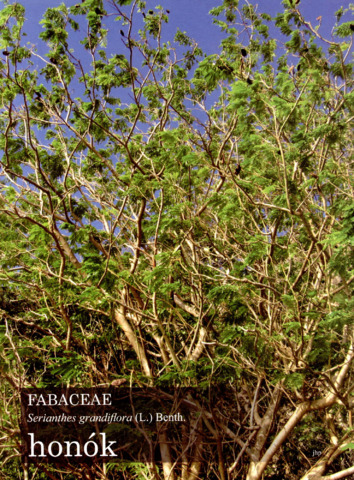
Fabaceae: Serianthes grandiflora (L.) Benth.: Honók
Primavera, Jurgenne (Green Convergence, 2018)
-
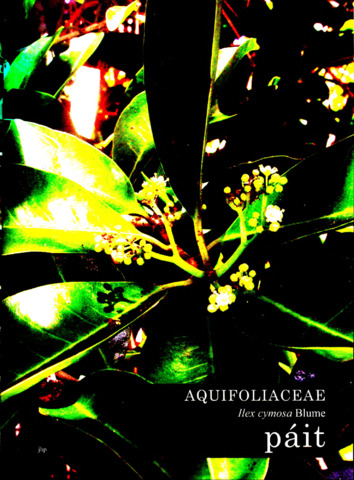
Aquifoliaceae: Ilex cymosa Blume: Páit
Primavera, Jurgenne (Green Convergence, 2018)
-
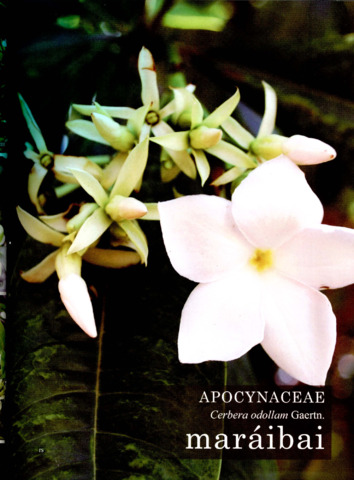
Apocynaceae: Cerbera odollam Gaertn.: Maráibai
Primavera, Jurgenne (Green Convergence, 2018)
-
"Katunggan it Ibajay" Mangrove Ecopark: A dream come true
Primavera, Jurgenne (Green Convergence for Safe Food, Healthy Environment and Sustainable Economy, 2012)
-
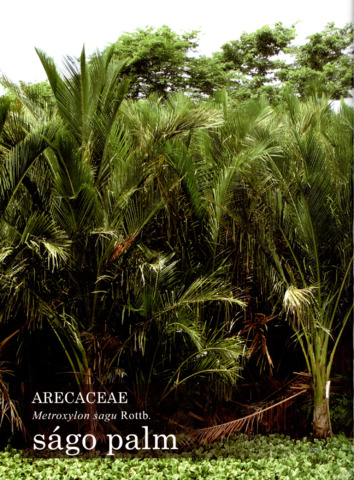
Arecaceae: Metroxylon sagu Rottb.: Ságo palm
Primavera, Jurgenne (Green Convergence, 2018)
-
Biyah diin in pagparagan sin pagtanuman agal agal iban pag'ayad ha pag' urulan sin kabuhi: Binhi atawa tanumun agal agal, manga mangangaun iban kumakangii' iban sakit, manga anib atawa makamula' iban biyah diin in pagpahilunnah sin anib atawa piligru ha pagtanum agal agal
; Faisan, Joseph P., Jr.In buwk-buwk pahati ini nahinang iban kiyasulat paglabay upat tahun ha pagsaliksik ha pag’usaha agal agal ha Pilipinas hinang sin tumpukan sin GlobalSeaweedSTAR Philippine ha bitsara kahatihan sin kamatauran. Makatagama ...; Sibonga, Rema ; ; ; ; (United Kingdom Research and Innovation-Global Challenge Research Fund (UKRI-GCRF), 2021-03)
-
Pagdumala sa uma sa guso ug mga lakang para sa bayo-sekuridad: Semilya, mga peste ug sakit-sakit, mga risgo ug pagdumala niini
; Faisan, Joseph P., Jr.Gisulat kining brosyur matapos ang upat ka tuig nga panukiduki sa ‘GlobalSeaweedSTAR Philippine Team’ sa industriya sa guso sa Pilipinas gamit ang simple nga sinultian nga daling masabtan sa mga layko. Kini magahatag ug ...; Sibonga, Rema ; ; ; ; (United Kingdom Research and Innovation-Global Challenge Research Fund (UKRI-GCRF), 2021-03)
-
Pangangasiwa sa taniman at mga hakbang pangbayo-sekyuridad para sa Eucheumatoids: Mga kultibar, peste at sakit, mga risgo o peligro at mga paraan sa pangasiwaan nito
; Faisan, Joseph P., Jr.Ang polyeto na ito ay inihanda at isinulat ng GlobalSeaweedSTAR Philippine Team sa payak na lengwahe matapos ang apat na taong pananaliksik sa industriya ng pag-aalaga ng mga halamang-dagat sa Pilipinas. Nais nito na ...; Sibonga, Rema ; ; ; ; (United Kingdom Research and Innovation-Global Challenge Research Fund (UKRI-GCRF), 2021-03)
-
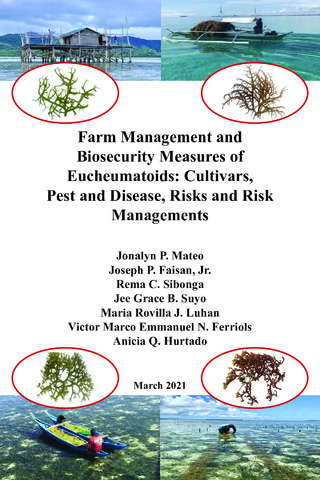
Farm management and biosecurity measures of Eucheumatoids: Cultivars, pest and disease, risks and risk managements
; Faisan, Joseph P., Jr.This brochure was prepared and written after four years of research of the seaweed industry of the Philippines by the GlobalSeaweedSTAR Philippine Team in a layman’s language. This provides the different stakeholders of ...; Sibonga, Rema ; ; ; ; (United Kingdom Research and Innovation-Global Challenge Research Fund (UKRI-GCRF), 2021-03)
-
Field guide to Philippine mangroves
Primavera, JurgenneAwareness of mangrove importance, particularly for coastal protection, has grown among the general public over the past several years. In turn, this has led to numerous planting initiatives by various groups. However, most ... (Zoological Society of London-Philippines, 2009)
-
Ration reduction, integrated multitrophic aquaculture (milkfish-seaweed-sea cucumber) and value-added products to improve incomes and reduce the ecological footprint of milkfish culture in the Philippines
(AquaFish Collaborative Research Support Program, Oregon State University, 2012)In the Philippines, cage culture of milkfish in marine environments is increasing. The practice uses high stocking densities, with significantly greater inputs of artificial feeds which more often than not, have led to excessive feeding and consequently excessive nutrient loading in receiving waters, exacerbating problems with pollution. These could have contributed to occurrence of periodic fish kills in areas of marine milkfish culture clusters. In marine cage culture, about 80% of variable expenses are attributable to feed costs. Experiments were conducted to compare production characteristics of milkfish fed on alternate days versus those raised on daily feeding in marine cage culture. Fish were fed either daily or every other day using a reduced feed ration at 7.5% of fish biomass at the start of culture down to 3% of fish biomass towards harvest. We showed this ration level was as effective as the industry standard that begins at a rate of 10% average body weight. Morevover, we had previously found that milkfish reared in brackishwater ponds on an alternate day feeding scheme using the reduced ration level produced a 56% cost savings in feed with little impact on total yield relative to fish raised on a daily feeding protocol. In the present study, survival rates (~ 90%) were comparable between the control fish fed daily and groups fed on alternate days in marine cages. Similarly, total harvested biomass of fish in the alternate day and daily feeding groups was similar as was the harvest value, although fish on the alternate day feeding scheme grew slightly less. The amount of feed and the corresponding cost of feeds consumed were significantly lower in stocks that were fed on alternate days compared with those fed daily (P < 0.05). Feed conversion ratio (FCR) was lower in the alternate-day fed group (FCR = 2.46) relative to stocks fed daily (FCR = 3.59). Overall, the results demonstrate that feed costs can be reduced by around 32% in stocks fed on alternate days, which yields an estimated 20-25% improvement in production efficiency relative to raising animals on a daily feeding protocol. Hence, a significant costs savings with reduced impact of nutrient loading in the environment is likely to be realized for farmers who adopt an alternate day feeding scheme in raising milkfish in marine cages. -
Alternative feeding strategies to improve milkfish production efficiency in the Philippines
(AquaFish Collaborative Research Support Program, Oregon State University, 2010)In the Philippines, cage culture of milkfish in marine environments is increasing. The practice uses high stocking densities, with significantly greater inputs of artificial feeds which more often than not, has led to excessive feeding and consequently excessive nutrient loading in receiving waters, exacerbating problems with pollution. These could have contributed to occurrence of periodic fish kills in areas of marine milkfish culture clusters. Sixty percent of milkfish farming expenses are attributable to feed costs. A series of experiments were conducted in an attempt to develop alternative feeding strategies that will reduce feed inputs without compromising growth and resulting production. In the first experiment, growth was compared in milkfish fed daily, on alternate days and on alternate 2-week or 4-week starvation and refeeding cycles in a tank environment provided with flow-through water system. Results show, that milkfish fed on alternate days do not grow as well as milkfish that are fed daily. Feed restriction for 2 weeks followed by 2 weeks of refeeding elicited a compensatory growth response such that average body weight (ABW) of fish was not significantly different from ABW of fish fed daily. Another experiment compared growth of fish given a ration equivalent to 10% of BW (usual practice) or 7.5% of BW. Results show no significant effect on growth or final ABW or biomass in fish fed daily or on 2-week cycles of feed restriction and refeeding. Thus, a lower feeding ration can be given to milkfish without compromising yield. Results of the tank experiments were verified in actual marine cage and brackishwater pond production systems using an initial feeding rate of 7.5% rather than 10% ABW. In the experiment in cages, survival rates between the control fish and the groups subjected to cycles of 2-week starvation followed by 2 weeks of normal feeding were comparable, except for one replicate of the starved-refed group where survival rate was very low (38.78%). After 3 cycles of starvation and refeeding, weight gain in the starved-refed groups were generally lower than in the control groups, which may suggest that small-sized fish cannot adapt very well to periodic starvation. In brackishwater ponds, growth, survival and total biomass at harvest was comparable between milkfish fed daily and those fed on alternate days. Hence, FCR was lower in the milkfish fed on alternate days compared to fish fed daily. On the other hand, survival was very low in fish subjected to 2 cycles of 2 weeks starvation followed by 4 weeks of normal feeding. These results suggest that as in tilapia, alternate day feeding can be adopted to milkfish culture in brackishwater ponds without compromising production while at the same time lowering production cost and environmental impact. Overall, these studies provide two practical strategies, reduced ration size and alternate day feeding, to improve production efficiency of milkfish, the largest finfish aquaculture industry in the Philippines. -
Micro-propagation of Kappaphycus and Eucheuma: Trends and prospects
(Springer International Publishing, 2017)Among the red algae, Kappaphycus and Eucheuma are the two most commercially important carrageenophytes farmed extensively in Southeast Asian countries; they rank top in production in terms of volume of raw material produced. The farming of carrageenophytes has emerged as a successful enterprise and provides a promising, alternative livelihood option for low-income, coastal communities in a number of countries. In 2014, carrageenophyte production worldwide, surpassed other red seaweeds and was placed at the top of the production rankings with 10.99 million MT wet weight (77% of total production of farmed red seaweed) and Indonesia being a major producer. However, over time, the productivity of the crop (carrageenophytes) has declined in some regions due to sourcing of seedlings from single, selected genetic stocks considered to have higher yield potential which resulted in strain fatigue, or loss of vigour. The incidences of disease and epiphytic infestations are on rise in recent times which have severely affected biomass production, as well as the yield and product quality (carrageenan). In order to circumvent the crop productivity issues arising from clonal propagation, the raising of planting materials from spores, derived through the red algal sexual reproductive cycle, has been initiated to support the sustainability of selected, farmed carrageenophytes. Alternatively, in vitro tissue culture techniques have also been explored to not only rejuvenate the vigour of seedlings (i.e. the out-planting material) but also to seek seedlings resilient to stress, disease and epiphytes to act as an invigorated mother stock. These efforts have succeeded to a great extent in the development of appropriate techniques for explant culture, callus induction, callus sub-culture and regeneration to micro-propagules with improved traits. The present chapter briefly summarizes the developments and success achieved in micro-propagation of Kappaphycus and Eucheuma and also provides pointers to both gaps and priority areas for future research required for the advancement of sustainable farming of these carrageenophytes. -
Philippine Aquatic Wildlife Rescue and Response Manual Series: Marine Turtles
(Marine Wild Fauna Watch of the Philippines, Inc., 2014)This manual addresses the lack of information materials on how to deal with marine turtle encounters in the Philippine seas to ensure that the proper treatment and intervention is provided. The manual also responds to the Comprehensive Action Plan for Threatened, Charismatic, and Migratory Species of the Sulu-Sulawesi Marine Ecoregion (SSME), which has been identified as the first priority seascape the Coral Triangle Initiative (CTI). The Tri-National Committee of the SSME developed the Comprehensive Action Plans (CAP) that identified seven Key Result Areas (KRAs) to improve the status of marine turtles in the SSME, as follows: (a) Identify best practices in minimizing threats to marine turtle populations and their habitats; (b) Develop and implement nesting habitats and management programs to maximize hatchling production and survival; (c) Provide recommendations on specific features or criteria in marine protected area (MPA) design and MPA network design in relation to the protection and management of marine turtles in SSME waters; (d) Undertake initiatives to promote reduction of incidental capture and mortality of marine turtles; (e) Conduct turtle population habitat research and monitoring protocols; (f) Develop guidelines for MPA network design for marine turtles; and (g) Publish information to promote best practices and successes for marine turtle conservation. This manual is an important step to address gaps and issues on threatened marine wildlife in the Philippines to better protect and conserve marine biodiversity in the Coral Triangle. -
Poly-beta-hydroxybutyrate (PHB) and infection reduction in farmed aquatic animals
(Springer International Publishing, 2020)There is a continuous effort in finding effective and sustainable strategies to control diseases in farmed animals, and in recent years, the application of the bacterial storage compound poly-β-hydroxybutyrate (PHB) was identified as a new disease control agent for aquaculture. The idea of using PHB as a biocontrol agent was conceived based on the knowledge that this biopolymer can be degraded into short-chain fatty acids (SCFAs), and SCFAs are known compounds with antimicrobial properties. At the beginning of this chapter, an overview about the PHB granule, its detection, quantification, production, and recovery in microorganisms is presented. The main topic focuses on the application and beneficial effects of PHB in farmed aquatic animals. The mechanisms by which PHB provides beneficial effects to the host are discussed.