Stakeholder-oriented Manuals: Recent submissions
61-80 / 114
-
Series: Aquaculture extension manual; No. 39
Abalone hatchery
(Aquaculture Department, Southeast Asian Fisheries Development Center, 2008)This manual contains information on abalone hatchery operation, including site selection, design, culture of natural food, broodstock management, spawning, nursery, packing and transport, and profitability analyses. -
Series: Aquaculture extension manual; No. 38
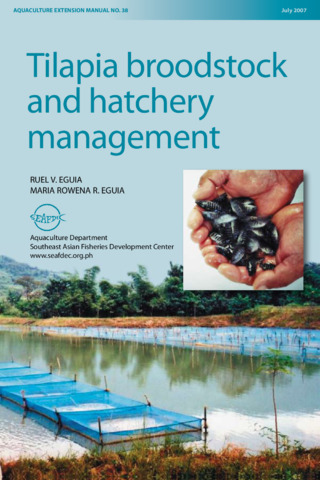
Tilapia broodstock and hatchery management
; Eguia, Maria Rowena R. (Aquaculture Department, Southeast Asian Fisheries Development Center, 2007)
This manual will surely assist tilapia operators and technicians in producing good-quality fry and fingerlings which the industry currently needs. Fisheries researchers, teachers, and students will also find this manual as a good source of basic informarion regarding tilapia broodstock and hatchery management.
(Aquaculture Department, Southeast Asian Fisheries Development Center, 2007)
This manual will surely assist tilapia operators and technicians in producing good-quality fry and fingerlings which the industry currently needs. Fisheries researchers, teachers, and students will also find this manual as a good source of basic informarion regarding tilapia broodstock and hatchery management. -
Series: Aquaculture extension manual; No. 37
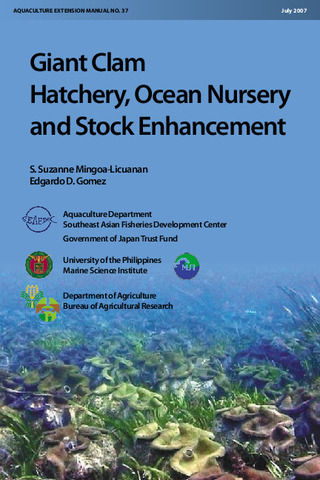
Giant clam hatchery, ocean nursery and stock enhancement
(Aquaculture Department, Southeast Asian Fisheries Development Center, 2007)This manual is meant to serve as a guide to the culture of giant clams (Bivalvia, Subfamily Tridacninae). The first part focuses on hatchery methods. The second part is about the ocean nursery. The first two sections refer to selection and setting the ocean nursery site. Clam transport is introduced next although this is further tackled in the last part of this manual. Finally, the third and last part discusses the purposes of stock enhancement, survey methods for stock assessment, transport, monitoring and record keeping. -
Series: Aquaculture extension manual; No. 35
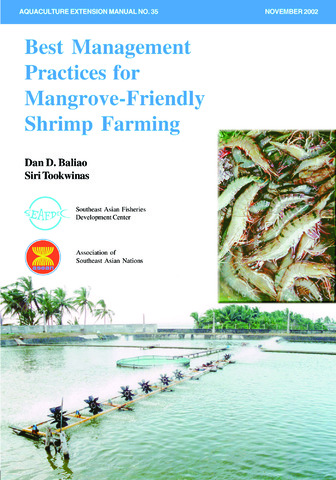
Best management practices for a mangrove-friendly shrimp farming
(Aquaculture Department, Southeast Asian Fisheries Development Center; Association of Southeast Asian Nations, 2002)This 50-page manual puts together the best practices that SEAFDEC/AQD has developed with the Department of Fisheries in Thailand. These practices include the use of biomanipulators and greenwater system, the use of settling ... -
Series: Aquaculture extension manual; No. 30
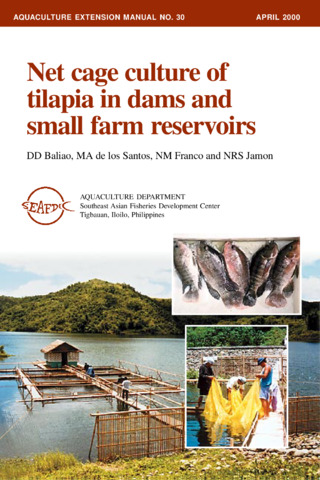
Net cage culture of tilapia in dams and small farm reservoirs
(Aquaculture Department, Southeast Asian Fisheries Development Center, 2000)The manual describes the net cage of tilapia in dams and small farm reservoirs, which has been found to be a low-cost yet high-income earning farm activity and offers an excellent option as an alternative livelihood for poor inland fisherfolks. The following aspects are covered: 1) Characteristics of a suitable site; 2) Design of the net cages - the floating cage, the stationary/fixed cage; 3) Stocking the net cages - source of juveniles, stocking rate, stocking time, acclimation; 4) Management of the cages - feeds and feeding, monitoring activities; 5) Harvesting - partial harvest, total harvest; and, 6) Profitability analysis. -
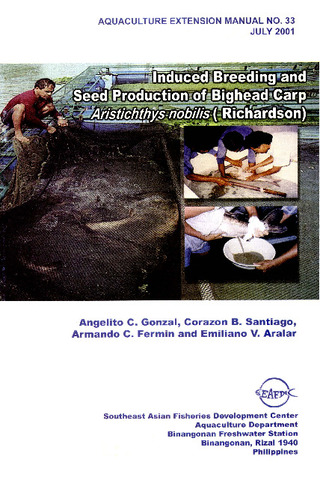
Series: Aquaculture extension manual; No. 33
Induced breeding and seed production of bighead carp Aristichthys nobilis (Richardson)
(Aquaculture Department, Southeast Asian Fisheries Development Center, 2001)A 40-page manual that details the advanced induced spawning technology for Bighead carp developed at SEAFDEC/AQD through the years. This handbook emphasizes the adoption of efficient carp hatchery techniques for optimal ... -
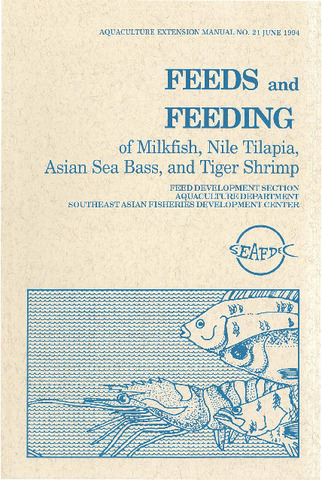
Series: Aquaculture extension manual; No. 21
Feeds and feeding of milkfish, Nile tilapia, Asian sea bass, and tiger shrimp
(Aquaculture Department, Southeast Asian Fisheries Development Center, 1994)A 97-page manual that discusses the nutrient requirements, sources and characteristics of feedstuffs, feed formulation, practical feed formulation, processing and preparation, storage and quality control and feeding ... -
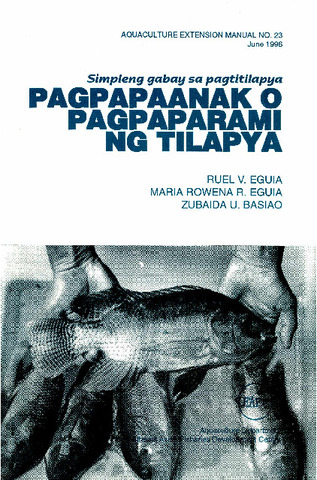
Series: Aquaculture extension manual; No. 23
Pagpapaanak o pagpaparami ng tilapya
; Eguia, Maria Rowena R.; Basiao, Zubaida U. (Aquaculture Department, Southeast Asian Fisheries Development Center, 1996)
The manual discusses spawning tilapia (Oreochromis spp) in concrete tank hatcheries, hapa hatcheries in ponds and in lakes in the Philippines. Also included in the manual are a list of agencies involved in tilapia research, a glossary of technical terms, and useful references. -
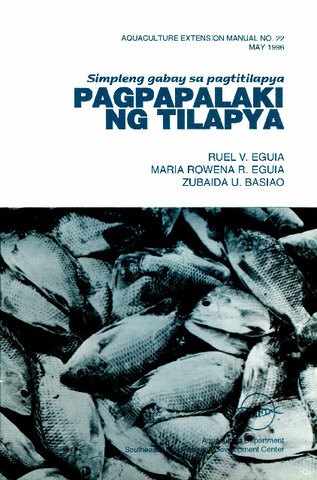
Series: Aquaculture extension manual; No. 22
Pagpapalaki ng tilapya
; Eguia, Maria Rowena R.; (Aquaculture Department, Southeast Asian Fisheries Development Center, 1996)
The manual discusses tilapia culture methods in concrete tanks, netcages, and fishponds. It details the species of tilapia cultured in the Philippines, which include Oreochromis nilotucus, O. mossambicus, O. aureus. It covers the following: site selection; construction of netcages and its modules; fishpond construction and pond preparation; criteria for fry selection; stocking; netcage and pond management including water quality management; and harvest. The manual also lists the agencies involved in tilapia research and development in the Philippines; defines some technical terms in a glossary, and lists some useful references. -
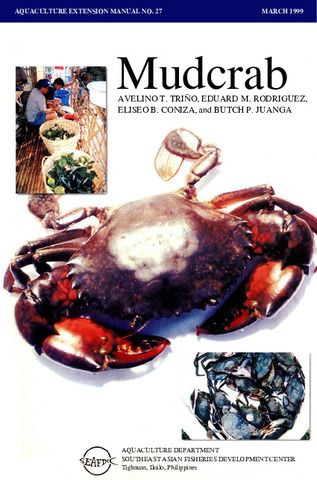
Series: Aquaculture extension manual; No. 27
Mudcrab
(Aquaculture Department, Southeast Asian Fisheries Development Center, 1999)A 32-page manual that gives a general overview of mudcrab species of commercial value and their grow-out monoculture in ponds; polyculture with milkfish; and fattening in ponds, mangroves, and cages. -
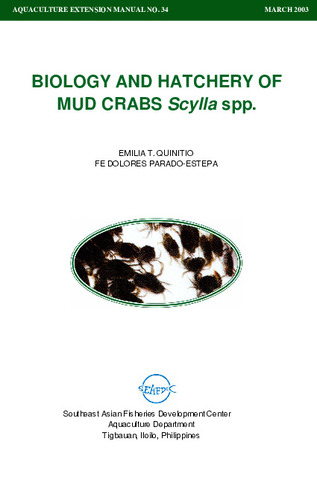
Series: Aquaculture extension manual; No. 34
Biology and hatchery of mud crabs Scylla spp.
Quinitio, Emilia T.; (Aquaculture Department, Southeast Asian Fisheries Development Center, 2003)
This manual describes the principles and procedures for spawning the mature crabs (Scylla serrata, S. tranquebarica, and S. olivacea) and rearing the zoeae to juveniles. Hatchery conditions should satisfy the ecological requirements of each specific stage, thus the manual starts with a section on biology of mud crabs. -
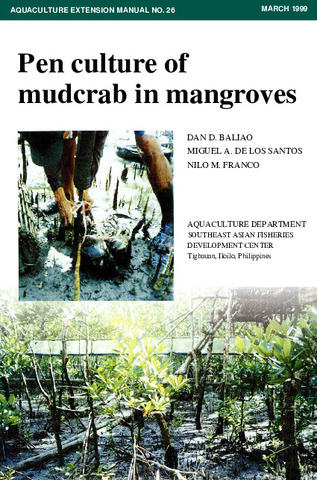
Series: Aquaculture extension manual; No. 26
Pen culture of mudcrab in mangroves
(Aquaculture Department, Southeast Asian Fisheries Development Center, 1999)This manual, describing the pen culture of mudcrab (Scylla spp) in mangroves, is intended for the use of fishfarmers and aquaculturists, extensionists, and students of aquaculture, not only in the Philippines but also in other mudcrab-producing countries in Southeast Asia. It covers the following: Site selection; Installation of net enclosure; Materials; Rearing operation; Feeds and feeding; Stock sampling; Water quality and pen management; Harvesting; and, marketing. -
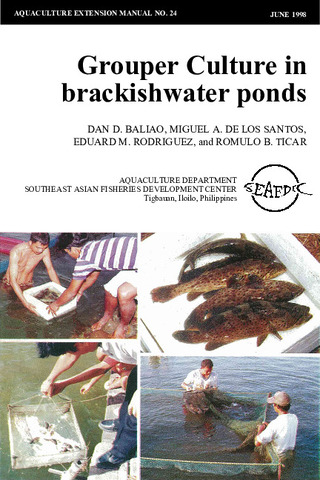
Series: Aquaculture extension manual; No. 24
Grouper culture in brackishwater ponds
(Aquaculture Department, Southeast Asian Fisheries Development Center, 1998)Groupers (Epinephelus) are cultured in the Philippines using tiny fry and juveniles caught from the wild. A SEAFDEC/AQD technology verification study on grouper pond grow-out culture resulted in high productivity and profitability, indicating that grouper culture could become another income source for the country. This aquaculture extension manual is intended as a guide for fishfarmers and aquaculturists, extensionists, and students of aquaculture. It covers the following areas: What are groupers?; Commercially important groupers; Source of fry or fingerlings; Common collection gears for fry/juveniles; Brackishwater pond culture -- pond specifications, site selection, pond preparation, nursery operation, grow-out culture, harvest, post-harvest; Growth, survival and feed efficiency performance of grouper reared in brackishwater pond; Economics; Marketing and transport; and, Diseases. -
Series: Aquaculture extension manual; No. 25
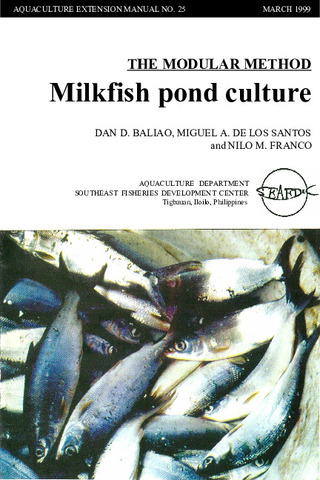
The modular method: Milkfish pond culture
(Aquaculture Department, Southeast Asian Fisheries Development Center, 1999)The modular method of milkfish culture (Chanos chanos) described in the manual is an improvement over the traditional extensive method. The manual is intended for the use of fish farmers and aquaculturists, extensionists, and students of aquaculture not only in the Philippines, but also in other milkfish-producing countries in Southeast Asia and the world. It covers the following: Interesting facts about milkfish -- biological characteristics, artificial breeding of milkfish; Design and operation of modular pond system -- pond preparation, stocking in the nursery or transition ponds, stocking in the rearing ponds, care of stock, pond utilization and production schedule, harvest and post-harvest; and, Economics and costing. -
Series: Aquaculture extension manual; No. 31
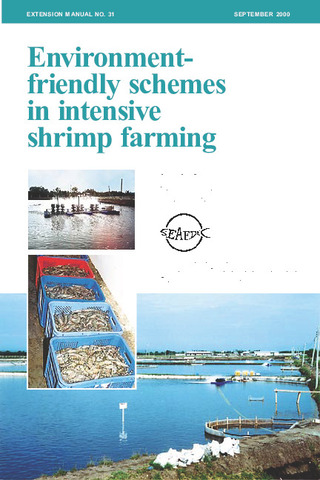
Environment-friendly schemes in intensive shrimp farming
(Aquaculture Department, Southeast Asian Fisheries Development Center, 2000)The black tiger shrimp, Penaeus monodon, has been successfully raised by the SEAFDEC Aquaculture Department, Technology Verification and Extension Section at its Dumangas Brackishwater Station. The approaches in the culture method employed in the series of verification runs in the brackishwater station are documented to serve as an interim guide for shrimp growers while these are still being further refined and standardized. -
Series: Aquaculture extension manual; No. 29
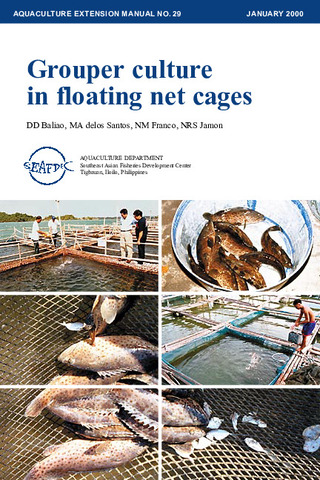
Grouper culture in floating net cages
(Aquaculture Department, Southeast Asian Fisheries Development Center, 2000)The manual describes the culture of groupers (Epinephelus) in floating cages, providing a farming option for grouper growers and also a production alternative to the farmed species being done today, such as shrimp, milkfish and tilapia. The following aspects are covered: species identification for commercially cultured groupers; source of stock; net cage specifications; anchor; hides and shelters; nursery net cage operation; production cages; harvesting; post-harvest; profitability analysis of grouper cage culture; and, cost and return of growing grouper in cages. -
Series: Aquaculture extension manual; No. 28
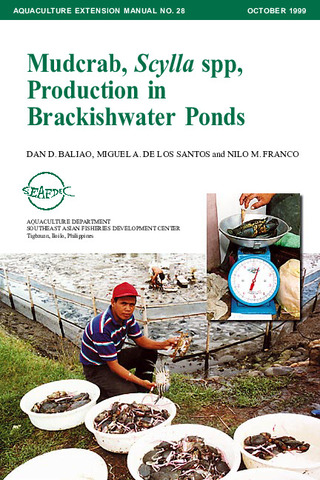
Mudcrab, Scylla spp, production in brackishwater ponds
(Aquaculture Department, Southeast Asian Fisheries Development Center, 1999)Mudcrab (Scylla spp) production in brackishwater ponds is now gaining popularity, especially in communities that need to supplement their income. The manual covers the following: Distribution; Grow-out operation in ponds - site selection, pond specification, pond preparation, source of juveniles, transport and stocking of juveniles, care of pond and stock, feeds and feeding, harvest, post-harvest; Production and profits; Cost and analysis. It is hoped that the manual will be of use to fishfarmers and aquaculturists, extensionists, and students of aquaculture not only in the Philippines but also in other mudcrab producing countries in Southeast Asia. -
Series: Aquaculture extension manual; No. 16
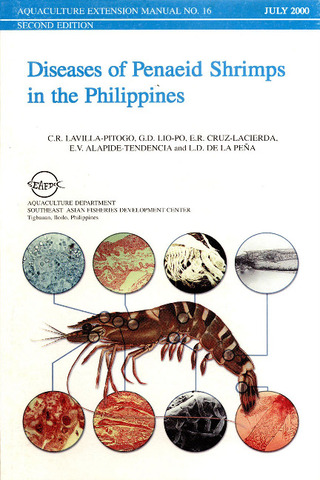
Diseases of penaeid shrimps in the Philippines
; ; ; Tendencia, Eleonor; (Aquaculture Department, Southeast Asian Fisheries Development Center, 2000)
The manual provides information on the diseases that affect the 3 major species of shrimps cultured in the Philippines: Penaeus monodon, P. merguiensis and P. indicus. It includes the common name of the disease, causative agent, species affected, stages affected, gross signs, effects on the host and methods of prevention and treatment. This revised edition includes newly discovered diseases. It is hoped that the manual will be of considerable help to shrimp farmers in identifying the disease and lead to prevention or early disease diagnosis and control. -
Series: Aquaculture extension manual; No. 15 | NACA technology series; No. 5
An improved traditional shrimp culture technique for increasing pond yield
(Network of Aquaculture Centres in Asia, 1986)Details are given of the technology required for an improved method of extensive shrimp (Penaeus monodon) culture, describing the following: grow out facilities, seed supply, pond preparation and management, harvesting and yield. A financial analysis is also included. -
Series: Aquaculture extension manual; No. 16
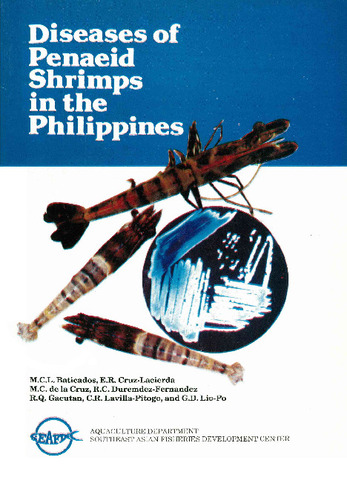
Diseases of penaeid shrimps in the Philippines
(Aquaculture Department, Southeast Asian Fisheries Development Center, 1990)The manual provides information on the diseases that affect the 3 major species of shrimps culture in the Philippines: Penaeus monodon, P. merguiensis and P. indicus. It includes the common name of the disease, causative agent, species affected, stages affected, gross signs, effects on the host and methods of prevention and treatment.