Stakeholder-oriented Manuals: Recent submissions
Now showing items 81-100 of 114
-
Series: Technical report / SEAFDEC Aquaculture Department; No. 1
Development of a brood stock of the jumbo tiger prawn, Penaeus monodon Fabricius
(Aquaculture Department, Southeast Asian Fisheries Development Center, 1976)The full-scale cultivation of sugpo, P. monodon Fabricius, could only be realized if there is an assurance of continuous supply of fry. Obviously, a steady supply will depend largely on the availability of spawners. In December 1975, roughly after 2 1/2 years of intensive study, for the first time in the world, SEAFDEC Aquaculture Department has succeeded in inducing P. monodon to mature and produce normally the first generation of postlarval fry, thereby successfully effecting the completion of P. monodon's life cycle while in captivity. Another significant study the Department has initially carried out which could help augment and stabilize the supply of spawners and eventually stimulate the establishment of more prawn hatcheries and the development of ponds for prawn culture as a major export-oriented, dollar-earning industry, is the possible development of ovarian rematuration of spent spawners. -
Series: Aquaculture extension manual; No. 14 | NACA training manual series; No. 1
Shrimp hatchery design, operation and management
(Network of Aquaculture Centres in Asia, 1986)Details are given of factors to be taken into account for successful hatchery operation. The following aspects are covered: 1) site selection; 2) hatchery design and construction; 3) life cycle; 4) preparation of broodstock for spawning; 5) larval feed; 6) spawning, hatching and larval rearing facilities; 7) spawner selection and egg collection 8) nauplii hatching and transportation; 9) larval rearing; 10) routine hatching, management; 11) port-larvae nursery; and 12) larval harvesting and transportation. -
Series: Technical report / SEAFDEC Aquaculture Department; no. 6
A study on the milkfish fry fishing gears in Panay Island, Philippines
; Bagarinao, Teodora ; (Aquaculture Department, Southeast Asian Fisheries Development Center, 1980)
This study was conducted to obtain information for evaluating the present fry fishing practices and for understanding the behaviour of the fry. A description of the milkfish, Chanos chanos, fry fishing gears is presented. Each gear is illustrated and its operation explained.
; (Aquaculture Department, Southeast Asian Fisheries Development Center, 1980)
This study was conducted to obtain information for evaluating the present fry fishing practices and for understanding the behaviour of the fry. A description of the milkfish, Chanos chanos, fry fishing gears is presented. Each gear is illustrated and its operation explained. -
Series: Technical report / SEAFDEC Aquaculture Department; No. 4
Traditional devices and gear for collecting fry of "sugpo" giant tiger prawn, Penaeus monodon in the Philippines
(Aquaculture Department, Southeast Asian Fisheries Development Center, 1980)Eight typical devices and gears for catching the wild fry of the giant tiger prawn, Penaeus monodon, locally called sugpo are described and illustrated. There are three stationary ones vis. fry lure, fry filter net and set fry trap, and five mobile ones viz. scoop net, fry scare line, fry seine, triangular net, and fry bulldozer. These have been used traditionally in the Philippines. This design and manner of operation are adapted to the behaviors and habits of the sugpo fry such as clinging and incursion with the incoming tidal current in mangrove creeks or at the mouth of the brackish river. -
Series: Technical report / SEAFDEC Aquaculture Department; no. 8
Weather observation at Tigbauan, Iloilo, Philippines from 1977 to 1980
(Aquaculture Department, Southeast Asian Fisheries Development Center, 1981)The observations include: (1) air and sea water temperatures; (2) cloud cover; (3) rainfall; (4) wind direction and speed; (5) salinity; (6) sea wave condition. -
Series: Aquaculture extension manual; No. 4
Milkfish culture in brackishwater ponds
(Aquaculture Department, Southeast Asian Fisheries Development Center, 1979)The manual is intended as a guide for operation in milkfish farming. It is presented under the following major sections: 1) Handling of fry - counting, storage and transport; 2) Pond layout and construction - selection of farm site, layout, construction, plan and specification; 3) Pond operation, culture and management - nursery pond management and rearing pond operation; 4) Harvest and post-harvest - harvest, post harvest, and processing; and 5) Economics and costing - cost of construction, cost of operation, and production/yield. -
Series: Aquaculture extension manual; No. 5
Farming of prawns and shrimps
; ; Primavera, Jurgenne (Aquaculture Department, Southeast Asian Fisheries Development Center, 1983)
The manual provides information on the culture of shrimps and prawns. Considerations regarding farm sites, pond specifications, pond ecosystems and differences between prawn and milkfish culture are examined. Seed supply, farm management practices and economic aspects are detailed. -
Series: Aquaculture extension manual; No. 8
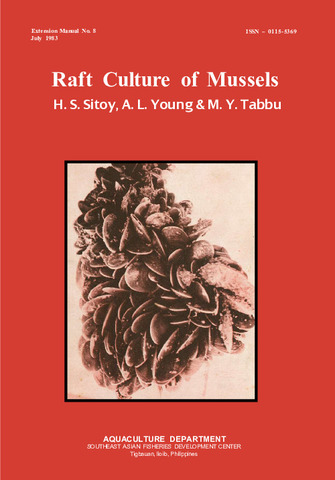
Raft culture of mussels
(Aquaculture Department, Southeast Asian Fisheries Development Center, 1983) -
Series: Aquaculture extension pamphlet / SEAFDEC Aquaculture Department; No. 3
Recommended practices for disease prevention in prawn and shrimp hatcheries
(Aquaculture Department, Southeast Asian Fisheries Development Center, 1989)Disease in prawn is any abnormal condition which may affect adversely the appearance, growth, and function of the animal. It may or may not result in mortalities. Disease outbreaks occur commonly in different culture systems such as hatcheries and grow-out ponds. Disease develops through the interaction of the prawn (the host), the causal agent (the pathogen), and the environment. In the presence of a susceptible host, a pathogen and predisposing environmental conditions (poor water quality, inadequate food, frequent handling, overstocking), disease is very likely to occur. Improved environmental conditions, healthy prawns and absence of disease agents would therefore lessen the chance of a disease outbreak. The causal agents may be pathogenic organisms (viruses, bacteria, fungi, protozoa, helminths, microcrustaceans) or nonpathogenic adverse environmental conditions (extreme temperatures, low oxygen levels, chemical poisons). Living disease agents cause infectious disease which generally result in gradual mortalities. Non-living disease agents cause non-infectious diseases that result in sudden mass mortalities. The environment determines the balance between the prawn as host and the disease agent. Microorganisms are always present in the water and some of them cause disease only when the prawn has been weakened through exposure to stressful environmental conditions. Hatchery personnel should realize that they themselves could transmit disease through their contaminated hands, clothing, and footwear. Equipment such as water pumps, blowers, pipes, and materials such as scoop nets, water hoses, pails, glasswares are also possible carriers of disease agents. Spawners, live natural food like diatoms, rotifers and brine shrimp, and artificial diets could also be vehicles of disease transmission. The prawn culturist, thus, must be able to manage the environment and make it favorable for the prawn. Hatchery management should, therefore, include operation procedures that will reduce the possibility of disease development during larval rearing. This manual recommends practices for disease prevention to prawn hatchery operators and technicians. -
Series: Aquaculture extension pamphlet / SEAFDEC. Aquaculture Department; No. 2
Feeding prawns for grow-out culture
(Aquaculture Department, Southeast Asian Fisheries Development Center, 1989) -
Series: Aquaculture extension pamphlet; No. 1
Recent developments in prawn pond culture
(Aquaculture Department, Southeast Asian Fisheries Development Center, 1989)This document presents the recommended methodology, nominal projections and partial costs and returns, for extensive prawn culture at two production objectives, and semi-intensive culture with costs and returns breakdown for three production targets. Intensive prawn culture procedures are not discussed. Extensive Prawn Culture System I projects a production yield of about 110 to 160 kg/ha/crop or more in four months and survival rate of from 65 to 70%. The extensive Prawn Culture System II aims for a production rate of about 230 kg/ha/crop in four months at about 70% survival with expected average body weight of about 25 grams. The procedures indicated have been verified and are now widely practiced. Production targets under the Semi-intensive Prawn Culture System I range from 350 to 500 kg/ha in four months at survival rate of about 70 to 75% and expected average size at harvest of about 28 to 30 pcs/kg. This method has been confirmed at different collaborative sites using the modified SEAFDEC diet developed by the Feed Development staff of the SEAFDEC Aquaculture Department. -
Series: Technical report / SEAFDEC Aquaculture Department; No. 2
An annotated list of scientific and english common names of commercially important penaeid prawns and shrimps
(Aquaculture Department, Southeast Asian Fisheries Development Center, 1977)There are 318 species of penaeid shrimps (Family Penaeidae) recorded in the world, of which about 80 species are placed under exploitation in fishing industry and/or cultivated artificially. The species under the genus Penaeus are particularly favored for human consumption because of their larger size and palatability and are therefore exposed to extensive capture by fishing boats. The shrimp fishing industry has developed in various parts of coastal waters worldwide extending from the temperate to tropical zones in both hemispheres. The nations engaged in shrimp fishing are numerous; Japan, U.S.A., Mexico, Thailand, India, lead in terms of volume of catch. Japan, for instance one of the large shrimp consuming nations in the world, has been dispatching shrimp fishing boats to many countries whether on her own capital or in joint ventures. Japan annually imports some 100,000 tons of frozen shrimp of which penaeids rank first in quantity. Meanwhile, the demand for shrimp is expected to rise in the years to come. The shrimp fishing industry and its operation are conducted and managed naturally, as indicated above, under international agreement. However, confusions arise particularly regarding the common names of shrimp caught or the products. It is evident that many commercial species of penaeids are given common names which differ from one country to another. For instance, the so-called "white shrimp" adopted by commercial circles includes nine different species. Understandably, these nine species, aside form being closely related biologically, are characterized by whitish coloration of the body. The present list was compiled to show the status of shrimp nomenclature, based on available literature, giving scientific names and English common names adopted or applied. The present article is written in the hope that the common names of penaeid shrimp shall be standardized internationally at least in English. Needless to say, the standardization will contribute greatly to world trading, as well as to scientific studies. -
Series: Technical report / SEAFDEC Aquaculture Department; No. 10
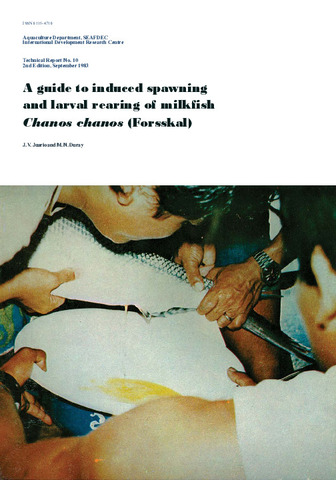
A guide to induced spawning and larval rearing of milkfish Chanos chanos (Forsskal)
(Aquaculture Department, Southeast Asian Fisheries Development Center; International Development Research Centre, 1983)The techniques for the artificial propagation of milkfish (Chanos chanos ) developed at SEAFDEC are presented. These include: 1) capture and transport of spawners; 2) determination of sex and weight and maturity of fish; 3) induced spawning (preparation of injection, males, females); 4) fertilization and incubation; 5) larval rearing; and 6) mass production of larval food. -
Series: Technical report / SEAFDEC Aquaculture Department; 4
Artificial fertilization of eggs and early development of the milkfish Chanos chanos (Forskal)
; ; Primavera, Jurgenne; ; ; ; ; (Aquaculture Department, Southeast Asian Fisheries Development Center, 1977)
Hydrated eggs obtained from a female milkfish were artificially fertilized with the milt collected from a male injected with acetone-dried pituitaries of salmon. The fertilized eggs (1.1 to 1.25 mm in diameter) developed normally in seawater in basins and Petri dishes at a salinity of 30-34 ppt and successfully hatched in 25 to 28½ hours at a temperature of 26.4-29.9°C. The yolk was completely absorbed in about 2½ days and at this period many postlarvae died. A few larvae were reared up to 5 days but all died within 6 days. Effects of feeding the postlarvae from the third day with freshly hatched trochophore larvae of oysters obtained from eggs artificially fertilized in the laboratory could not be ascertained. -
Series: Technical report / SEAFDEC Aquaculture Department; 4
Breeding and larval rearing of the milkfish Chanos chanos (Pisces: Chanidae)
(Aquaculture Department, Southeast Asian Fisheries Development Center, 1977)Two sexually maturing female milkfish were captured in April 1977 and induced to spawn by means of acetone-dried Pacific salmon pituitary powder. The eggs were fertilized and incubated and the resultant young reared to 74-day old, 11 cm long fingerlings. Newly fertilized eggs averaged 1.16 mm in diameter and each had a narrow perivitelline space containing several cortical granules which disappeared within a few minutes. The yolk was slightly yellowish, devoid of oil globules and very finely granulated. Embryonic development was very similar to that of other pelagic fish eggs and hatching occurred between 35 to 36 hr at a salinity of 32 ppt and a temperature range of 28.4-29.2°C. -
Series: Technical report / SEAFDEC Aquaculture Department; No. 7
Studies on the fisheries biology of the giant tiger prawn, Penaeus monodon in the Philippines
(Aquaculture Department, Southeast Asian Fisheries Development Center, 1981)The present study was carried out primarily by means of field surveys and secondarily by laboratory and pond experiments to reveal the fisheries biology of the giant tiger prawn, Penaeus monodon Fabricius, in the Philippines during the period from March 1975 to June 1980. The topics covered in this technical report include: (1) taxonomy and morphology; (2) geographical and ecological distribution; (3) reproduction; (4) spawning; (5) development; (6) growth; (7) migration; (8) conclusions and recommendations. -
Series: Technical report / SEAFDEC Aquaculture Department; No. 9
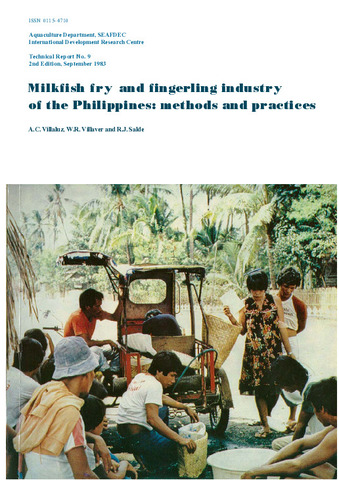
Milkfish fry and fingerling industry of the Philippines: methods and practices
(Aquaculture Department, Southeast Asian Fisheries Development Center; International Development Research Centre, 1983)Milkfish fry catch from Philippine waters can still be increased. Intensified collections in traditional fry grounds and exploitation of new areas may lead to a reduction of adult stock and the possible collapse of the milkfish fry fishery. The implementation of rational conservation and management measures are of immediate concern not only to increase the productivity and number of fry grounds but also to conserve this important aquatic resource. The present methods of catching milkfish fry involve fry filtration by mobile or stationary devices. The design, construction, area and time of operation of the gears are primarily dictated by the bottom topography of the fry grounds, wind direction, local current patterns and tidal fluctuations. Catching, handling, storage and transport activities expose the fish to undue stress which contribute to poor survival. The simple method of lowering the salinity of the water medium considerably reduces mortality. High mortality in nursery ponds has aggravated the seed shortage problem of the milkfish industry. The development of an efficient mass-production technology in rearing milkfish fry to fingerlings and in stunting fingerlings for longer periods could offer the solution not only in meeting the requirements for milkfish seed but also provide part of the fry requirements of other countries in the region. -
Series: Technical report / SEAFDEC Aquaculture Department; no. 11
A guide to the establishment and maintenance of milkfish broodstock
; ; Garcia, Luis Maria; (Aquaculture Department, Southeast Asian Fisheries Development Center, 1984)
The manual describes methods used at the SEAFDEC Aquaculture Department in order to establish milkfish broodstock. It is presented under the following major section headings: Establishing broodstock farms; Farms for rearing bangus juveniles; Maturation cages for rearing broodstock to maturity; Gathering data; Spawning and egg collection; and Larval rearing. -
Series: Technical report / SEAFDEC Aquaculture Department; No. 10
A guide to induced spawning and larval rearing of milkfish Chanos chanos (Forsskal)
(Aquaculture Department, Southeast Asian Fisheries Development Center; International Development Research Centre, 1982)The techniques for the artificial propagation of milkfish (Chanos chanos ) developed at SEAFDEC are presented. These include: 1) capture and transport of spawners; 2) determination of sex and weight and maturity of fish; 3) induced spawning (preparation of injection, males, females); 4) fertilization and incubation; 5) larval rearing; and 6) mass production of larval food. -
Series: Aquaculture extension manual; No. 11 | NACA training manual series; No. 3
Biology and culture of sea bass (Lates calcarifer)
(Network of Aquaculture Centres in Asia, 1986)Information is presented regarding the biology and culture of Lates calcarifer in order to serve as a practical guide for extension workers and farmers. Hatchery design, seed production and hatchery techniques, culture of seabass and financial aspects of the seabass culture industry are described.