Browsing Stakeholder-oriented Manuals by Title
Now showing items 1-20 of 114
-
Series: Aquaculture extension manual; No. 39
Abalone hatchery
(Aquaculture Department, Southeast Asian Fisheries Development Center, 2008)This manual contains information on abalone hatchery operation, including site selection, design, culture of natural food, broodstock management, spawning, nursery, packing and transport, and profitability analyses. -
Series: Technical report / SEAFDEC Aquaculture Department; No. 2
An annotated list of scientific and english common names of commercially important penaeid prawns and shrimps
(Aquaculture Department, Southeast Asian Fisheries Development Center, 1977)There are 318 species of penaeid shrimps (Family Penaeidae) recorded in the world, of which about 80 species are placed under exploitation in fishing industry and/or cultivated artificially. The species under the genus Penaeus are particularly favored for human consumption because of their larger size and palatability and are therefore exposed to extensive capture by fishing boats. The shrimp fishing industry has developed in various parts of coastal waters worldwide extending from the temperate to tropical zones in both hemispheres. The nations engaged in shrimp fishing are numerous; Japan, U.S.A., Mexico, Thailand, India, lead in terms of volume of catch. Japan, for instance one of the large shrimp consuming nations in the world, has been dispatching shrimp fishing boats to many countries whether on her own capital or in joint ventures. Japan annually imports some 100,000 tons of frozen shrimp of which penaeids rank first in quantity. Meanwhile, the demand for shrimp is expected to rise in the years to come. The shrimp fishing industry and its operation are conducted and managed naturally, as indicated above, under international agreement. However, confusions arise particularly regarding the common names of shrimp caught or the products. It is evident that many commercial species of penaeids are given common names which differ from one country to another. For instance, the so-called "white shrimp" adopted by commercial circles includes nine different species. Understandably, these nine species, aside form being closely related biologically, are characterized by whitish coloration of the body. The present list was compiled to show the status of shrimp nomenclature, based on available literature, giving scientific names and English common names adopted or applied. The present article is written in the hope that the common names of penaeid shrimp shall be standardized internationally at least in English. Needless to say, the standardization will contribute greatly to world trading, as well as to scientific studies. -
Series: Technical report / SEAFDEC Aquaculture Department; 4
Artificial fertilization of eggs and early development of the milkfish Chanos chanos (Forskal)
; ; Primavera, Jurgenne ; ; ; ; ; (Aquaculture Department, Southeast Asian Fisheries Development Center, 1977)
Hydrated eggs obtained from a female milkfish were artificially fertilized with the milt collected from a male injected with acetone-dried pituitaries of salmon. The fertilized eggs (1.1 to 1.25 mm in diameter) developed normally in seawater in basins and Petri dishes at a salinity of 30-34 ppt and successfully hatched in 25 to 28½ hours at a temperature of 26.4-29.9°C. The yolk was completely absorbed in about 2½ days and at this period many postlarvae died. A few larvae were reared up to 5 days but all died within 6 days. Effects of feeding the postlarvae from the third day with freshly hatched trochophore larvae of oysters obtained from eggs artificially fertilized in the laboratory could not be ascertained.
; ; ; ; ; (Aquaculture Department, Southeast Asian Fisheries Development Center, 1977)
Hydrated eggs obtained from a female milkfish were artificially fertilized with the milt collected from a male injected with acetone-dried pituitaries of salmon. The fertilized eggs (1.1 to 1.25 mm in diameter) developed normally in seawater in basins and Petri dishes at a salinity of 30-34 ppt and successfully hatched in 25 to 28½ hours at a temperature of 26.4-29.9°C. The yolk was completely absorbed in about 2½ days and at this period many postlarvae died. A few larvae were reared up to 5 days but all died within 6 days. Effects of feeding the postlarvae from the third day with freshly hatched trochophore larvae of oysters obtained from eggs artificially fertilized in the laboratory could not be ascertained. -
Series: Aquaculture extension manual; No. 35
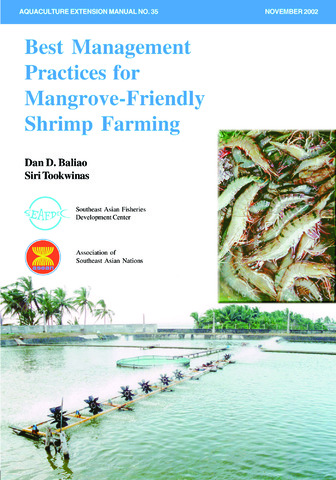
Best management practices for a mangrove-friendly shrimp farming
(Aquaculture Department, Southeast Asian Fisheries Development Center; Association of Southeast Asian Nations, 2002)This 50-page manual puts together the best practices that SEAFDEC/AQD has developed with the Department of Fisheries in Thailand. These practices include the use of biomanipulators and greenwater system, the use of settling ... -
Series: Aquaculture extension manual; No. 78
Best operational practices for biosecure farming of black tiger shrimp (Penaeus monodon) in earthen ponds
Somblingo, Edgar; ; ; Mamauag, Roger Edward (Aquaculture Department, Southeast Asian Fisheries Development Center, 2025-07)
This extension manual "Best Operational Practices for Biosecure Farming of Black Tiger Shrimp (Penaeus monodon) in Earthen Ponds," is designed to meet the urgent needs for a comprehensive, time-ready guide that bridges gap between theoretical aquaculture models and on-ground execution. It consolidates critical technical protocols, from pond design, water management, feed scheduling, biosecurity, probiotics, and efficient harvesting into a coherent step by step format suitable for farm managers and extension workers. Rooted in regionally relevant evidence-based practices, including stocking densities reflective of extensive to intensive systems, precise water quality targets (salinity 15–25 ppt, temperature 29–33 °C, and dissolve oxygen >2.7 ppm), and sludge-removal and disinfection protocols. It provides clear performance benchmarks for growth, survival and productivity. Further, it emphasizes biosecurity-covering intake filtration, probiotic use, routine sampling, and pond drying to mitigate diseases risks endemic to P. monodon. The manuals adaptability across farming intensities and its insistence on monitoring and record-keeping empower farmer to continuously optimize operations, enhancing both economic resilience and environmental stewardship. -
Series: Aquaculture extension manual; No. 11 | NACA training manual series; No. 3
Biology and culture of sea bass (Lates calcarifer)
(Network of Aquaculture Centres in Asia, 1986)Information is presented regarding the biology and culture of Lates calcarifer in order to serve as a practical guide for extension workers and farmers. Hatchery design, seed production and hatchery techniques, culture of seabass and financial aspects of the seabass culture industry are described. -
Series: Aquaculture extension manual; No. 34
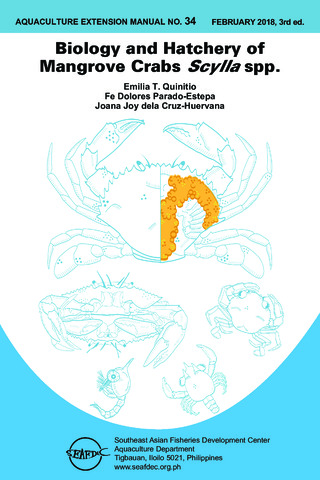
Biology and hatchery of mangrove crabs Scylla spp.
Quinitio, Emilia T.; ; (Aquaculture Department, Southeast Asian Fisheries Development Center, 2018)
This manual includes the biology of crab (Scylla serrata, S. tranquebarica, and S. olivacea), and describes principles and procedures for spawning the mature crabs and rearing the zoea to ‘fly’ size crabs. It focuses on the hatchery rearing of S. serrata as the farming of this species is more economically viable than the two other species. The techniques may be modified depending on the conditions or problems encountered in a specific site. -
Series: Aquaculture extension manual; No. 34
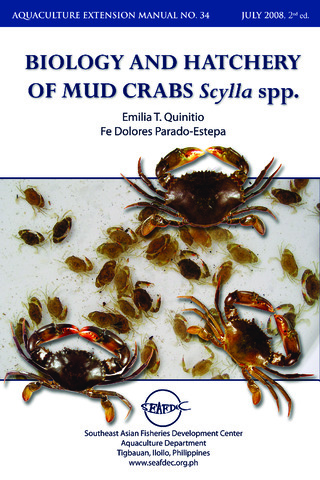
Biology and hatchery of mud crabs Scylla spp.
Quinitio, Emilia T.; (Aquaculture Department, Southeast Asian Fisheries Development Center, 2008)
This manual includes the biology of mud crab, and describes principles and procedures for spawning the mature crabs (Scylla serrata, S. tranquebarica, and S. olivacea) and rearing the zoea to fly size crabs. It focuses on the hatchery rearing of S. serrata as this species is more economically viable than the two other species. The techniques may be modified depending on the conditions or problems encountered in a specific site. -
Series: Aquaculture extension manual; No. 34
Biology and hatchery of mud crabs Scylla spp.
Quinitio, Emilia T.; (Aquaculture Department, Southeast Asian Fisheries Development Center, 2003)
This manual describes the principles and procedures for spawning the mature crabs (Scylla serrata, S. tranquebarica, and S. olivacea) and rearing the zoeae to juveniles. Hatchery conditions should satisfy the ecological requirements of each specific stage, thus the manual starts with a section on biology of mud crabs. -
Series: Aquaculture extension manual; No. 67
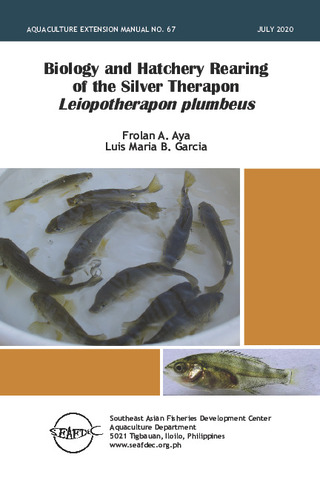
Biology and hatchery rearing of the silver therapon Leiopotherapon plumbeus
Aya, FrolanKnown for its tasty flesh, silver therapon, locally known as ayungin, has been regarded to be one of the most valuable edible native freshwater species in the Philippines. Demands for this fish species remain high which ...; Garcia, Luis Maria (Aquaculture Department, Southeast Asian Fisheries Development Center, 2020-07)
-
Series: Aquaculture extension manual; No. 72
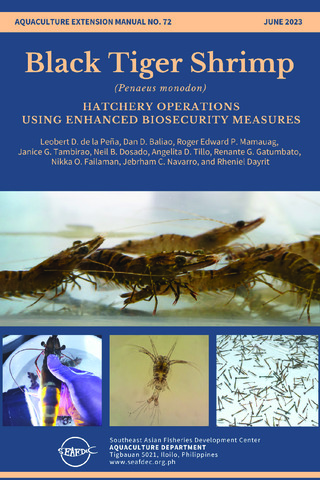
Black tiger shrimp (Penaeus monodon) hatchery operations using enhanced biosecurity measures
; ; Mamauag, Roger EdwardThis manual, titled “Black Tiger Shrimp (Penaeus monodon) Hatchery Operations Using Enhanced Biosecurity Measures,” includes modifications on shrimp hatchery operations done by the Aquaculture Department of the Southeast ...; ; ; ; ; ; ; (Aquaculture Department, Southeast Asian Fisheries Development Center, 2023-06)
-
Series: Technical report / SEAFDEC Aquaculture Department; 4
Breeding and larval rearing of the milkfish Chanos chanos (Pisces: Chanidae)
(Aquaculture Department, Southeast Asian Fisheries Development Center, 1977)Two sexually maturing female milkfish were captured in April 1977 and induced to spawn by means of acetone-dried Pacific salmon pituitary powder. The eggs were fertilized and incubated and the resultant young reared to 74-day old, 11 cm long fingerlings. Newly fertilized eggs averaged 1.16 mm in diameter and each had a narrow perivitelline space containing several cortical granules which disappeared within a few minutes. The yolk was slightly yellowish, devoid of oil globules and very finely granulated. Embryonic development was very similar to that of other pelagic fish eggs and hatching occurred between 35 to 36 hr at a salinity of 32 ppt and a temperature range of 28.4-29.2°C. -
Series: Aquaculture extension manual; No. 40
Breeding and seed production of the Asian catfish Clarias macrocephalus (Gunther)
(Aquaculture Department, Southeast Asian Fisheries Development Center, 2008)Among the topics discussed in this 28-page manual are broodstock development and management, hatchery and nursery, health management and financial analyses of the breeding and seed production of the Asian catfish. This manual was published to disseminate science-based aquaculture technologies developed by AQD to assist catfish nursery and hatchery growers in producing high-quality fingerlings. Researchers in the field of fisheries, students and teachers could benefit from the information on the breeding and seed production of this important aquaculture commodity. -
Series: Aquaculture extension manual; No. 52
Breeding and seed production of the giant freshwater prawn (Macrobrachium rosenbergii)
(Aquaculture Department, Southeast Asian Fisheries Development Center, 2011)An extension manual describing biology, broodstock management, hatchery and nursery operations, feeding management, packing and transport, and health management of the giant freshwater prawn. -
Series: Aquaculture extension manual; No. 75
Breeding, seed production, and culture of African catfish Clarias gariepinus
; Navarro, Jebrham; ; (Aquaculture Department, Southeast Asian Fisheries Development Center, 2024-07)
This manual summarizes the existing techniques on the induced breeding, seed production, and culture of the African catfish based on surveys done in Iloilo, Philippines. SEAFDEC Aquaculture Department will present a standardized way of breeding and culturing the African catfish under captive conditions, but will not encourage growing them in natural freshwater habitats. Previous data have shown that their presence in lakes adversely affects the population of other indigenous species and may lead to a loss of biodiversity. -
Series: Aquaculture extension manual; No. 7
Broodstock of sugpo, (Penaeus monodon Fabricius)
Primavera, Jurgenne (Aquaculture Department, Southeast Asian Fisheries Development Center, 1989)
The manual provides information on the technology involved in induced maturation and broodstock of Penaeus monodon . Following background material on basic aspects of reproductive biology of the species such as mating, maturation, spawning and fecundity, a detailed discussion is presented on the broodstock tank and pen system and the ablation process. -
Series: Aquaculture extension manual; No. 50
Cage culture of the giant freshwater prawn (Macrobrachium rosenbergii)
(Aquaculture Department, Southeast Asian Fisheries Development Center, 2011)An extension manual describing biology, site requirement, grow-out operations, health management, harvest, post harvest handling and processing, and economic analysis. -
Series: Aquaculture extension manual; No. 54
Cage nursery of high-value fishes in brackishwater ponds: Seabass, grouper, snapper, pompano
(Aquaculture Department, Southeast Asian Fisheries Development Center, 2012)This extension manual describes nursery pond requirements, nursery rearing procedures, common diseases of young marine fish, and economic analysis of cage nursery as an enterprise separate from hatchery and grow-out culture. -
Series: State of the art series
Closed-recirculating shrimp farming system
(Aquaculture Department, Southeast Asian Fisheries Development Center, 2000-11)This collaborative SEAFDEC/ASEAN project aimed to develop sustainable shrimp culture technology packages to address the problems in shrimp culture (e.g. discharges from shrimp farms threatening mangrove and marine ecosystems, clearing of mangrove forests to make way for shrimp ponds, etc.). In this context, a closed recirculating shrimp farming system is discussed touching on: pond preparation, water preparation, stocking, feeding, management, DO level, problems, record keeping, and harvesting. -
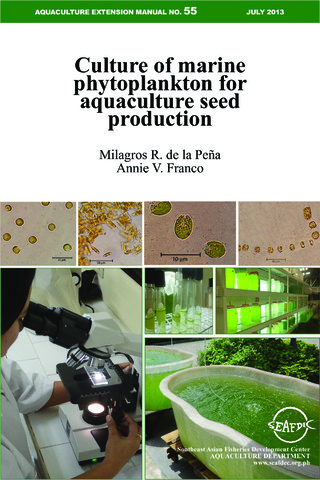
Series: Aquaculture extension manual; No. 55
Culture of marine phytoplankton for aquaculture seed production
(Aquaculture Department, Southeast Asian Fisheries Development Center, 2013)The 32-page extension manual describes the biology, culture techniques and maintenance and mass propagation of 12 phytoplankton species used as live feed in marine hatcheries.