
Stakeholder-oriented Manuals
最新登録資料
-
Series: Aquaculture extension manual; No. 78
Best operational practices for biosecure farming of black tiger shrimp (Penaeus monodon) in earthen ponds
Somblingo, Edgar ; ; ; Mamauag, Roger Edward (Aquaculture Department, Southeast Asian Fisheries Development Center, 2025-07)
This extension manual "Best Operational Practices for Biosecure Farming of Black Tiger Shrimp (Penaeus monodon) in Earthen Ponds," is designed to meet the urgent needs for a comprehensive, time-ready guide that bridges gap between theoretical aquaculture models and on-ground execution. It consolidates critical technical protocols, from pond design, water management, feed scheduling, biosecurity, probiotics, and efficient harvesting into a coherent step by step format suitable for farm managers and extension workers. Rooted in regionally relevant evidence-based practices, including stocking densities reflective of extensive to intensive systems, precise water quality targets (salinity 15–25 ppt, temperature 29–33 °C, and dissolve oxygen >2.7 ppm), and sludge-removal and disinfection protocols. It provides clear performance benchmarks for growth, survival and productivity. Further, it emphasizes biosecurity-covering intake filtration, probiotic use, routine sampling, and pond drying to mitigate diseases risks endemic to P. monodon. The manuals adaptability across farming intensities and its insistence on monitoring and record-keeping empower farmer to continuously optimize operations, enhancing both economic resilience and environmental stewardship.
; ; ; Mamauag, Roger Edward (Aquaculture Department, Southeast Asian Fisheries Development Center, 2025-07)
This extension manual "Best Operational Practices for Biosecure Farming of Black Tiger Shrimp (Penaeus monodon) in Earthen Ponds," is designed to meet the urgent needs for a comprehensive, time-ready guide that bridges gap between theoretical aquaculture models and on-ground execution. It consolidates critical technical protocols, from pond design, water management, feed scheduling, biosecurity, probiotics, and efficient harvesting into a coherent step by step format suitable for farm managers and extension workers. Rooted in regionally relevant evidence-based practices, including stocking densities reflective of extensive to intensive systems, precise water quality targets (salinity 15–25 ppt, temperature 29–33 °C, and dissolve oxygen >2.7 ppm), and sludge-removal and disinfection protocols. It provides clear performance benchmarks for growth, survival and productivity. Further, it emphasizes biosecurity-covering intake filtration, probiotic use, routine sampling, and pond drying to mitigate diseases risks endemic to P. monodon. The manuals adaptability across farming intensities and its insistence on monitoring and record-keeping empower farmer to continuously optimize operations, enhancing both economic resilience and environmental stewardship. -
Series: Aquaculture extension manual; No. 77
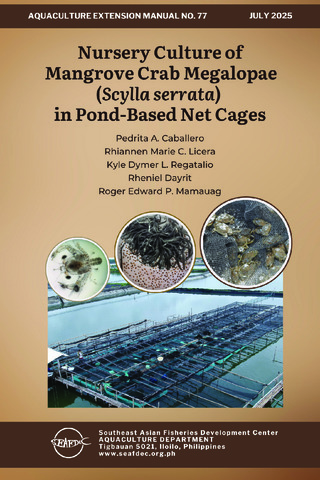
Nursery culture of mangrove crab megalopae (Scylla serrata) in pond-based net cages
Caballero, Pedrita; ; Regatalio, Kyle Dymer ; ; Mamauag, Roger Edward (Aquaculture Department, Southeast Asian Fisheries Development Center, 2025-07)
This manual, titled “Nursery Culture of Mangrove Crab Megalopae (Scylla serrata) in Pond-Based Net Cages,” is part of SEAFDEC/AQD’s effort to assess the potential of using megalopae as the starting stock in pond-based net cage nurseries. The method is intended to enhance survival rates during the grow-out stage. Given the increasing availability of hatchery-reared megalopae and the high cost of crab instars, the manual also evaluates the cost-effectiveness and practical advantages of using megalopae in nursery operations. Hatchery-sourced megalopae offer key benefits over wild-caught ones, including consistent supply, environmental sustainability, disease-free status, species certainty, and stable pricing. This approach could help increase hatchery production cycles and lower overall production expenses in the crab farming industry. The manual covers various aspects, including mangrove crab biology, site selection, pond preparation, nursery management, packing and transport procedures, and economic analysis. The authors hope this resource will serve as a practical guide for crab farmers, farm managers, aquaculture professionals, technicians, and students by providing essential knowledge on science-based aquaculture practices. -
Series: Aquaculture extension manual; No. 76
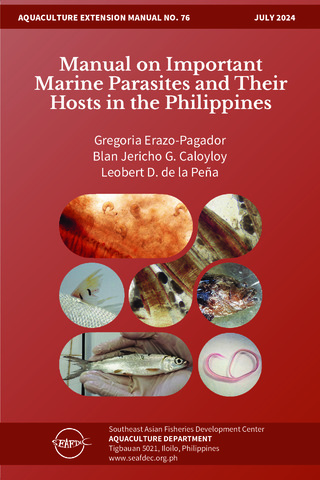
Manual on important marine parasites and their hosts in the Philippines
(Aquaculture Department, Southeast Asian Fisheries Development Center, 2024-07)This manual gives basic information on some parasites of different infected fish submitted to the Southeast Asian Fisheries Development Center/ Aquaculture Department (SEAFDEC/AQD) Diagnostic Service Laboratory in Tigbauan, Iloilo, Philippines. It is intended as a reference for those working in aquaculture in the Philippines. It is also designed to be a valuable reference for students, researchers, and enthusiasts eager to delve into the captivating field of parasitology and parasitic disease management. -
Series: Aquaculture extension manual; No. 75
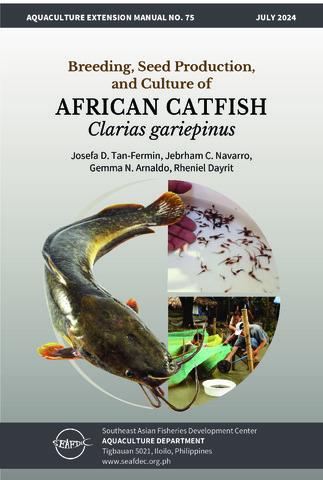
Breeding, seed production, and culture of African catfish Clarias gariepinus
; Navarro, Jebrham; ; (Aquaculture Department, Southeast Asian Fisheries Development Center, 2024-07)
This manual summarizes the existing techniques on the induced breeding, seed production, and culture of the African catfish based on surveys done in Iloilo, Philippines. SEAFDEC Aquaculture Department will present a standardized way of breeding and culturing the African catfish under captive conditions, but will not encourage growing them in natural freshwater habitats. Previous data have shown that their presence in lakes adversely affects the population of other indigenous species and may lead to a loss of biodiversity. -
Series: Aquaculture extension manual; No. 23
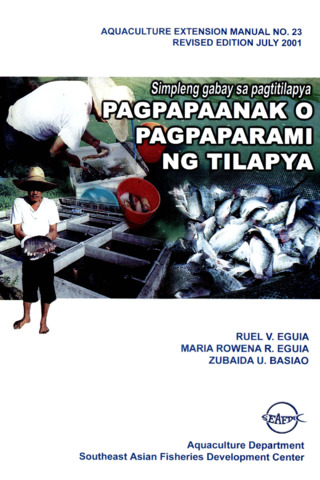
Pagpapaanak o pagpaparami ng tilapya
; Eguia, Maria Rowena R.; Basiao, Zubaida U. (Aquaculture Department, Southeast Asian Fisheries Development Center, 2001-07)
The manual discusses spawning tilapia (Oreochromis spp.) in concrete tank hatcheries, and hapa hatcheries in ponds and lakes in the Philippines. Also included in the manual is a list of agencies involved in tilapia research, a glossary of technical terms, and useful references. -
Series: Aquaculture extension manual; No. 22
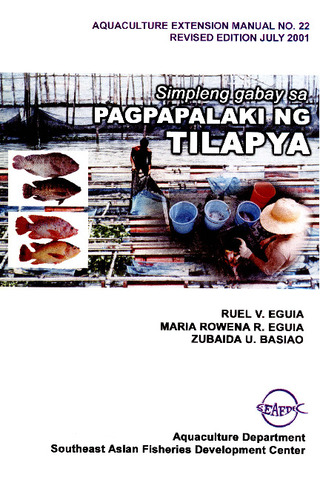
Pagpapalaki ng tilapya
; Romana-Eguia, Maria Rowena R.; Basiao, Zubaida (Aquaculture Department, Southeast Asian Fisheries Development Center, 2001-07)
The manual discusses tilapia culture methods in concrete tanks, net cages, and fishponds. It details the species of tilapia cultured in the Philippines, which include Oreochromis niloticus, O. mossambicus, O. aureus. It covers the following: site selection; construction of netcages and its modules; fishpond construction and pond preparation; criteria for fry selection; stocking; netcage and pond management including water quality management; and harvest. The manual also lists the agencies involved in tilapia research and development in the Philippines; defines some technical terms in a glossary, and lists some useful references. -
Series: Aquaculture extension manual; No. 19
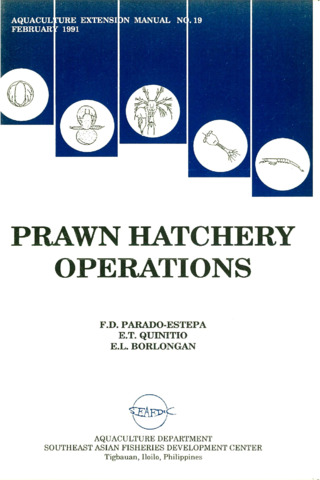
Prawn hatchery operations
; Quinitio, Emilia T.; (Aquaculture Department, Southeast Asian Fisheries Development Center, 1991-02)
The manual, an updated version of the 1984 SEAFDEC/AQD manual, presents the underlying principles and step-by-step instructions of prawn larval and post-larval rearing. The techniques described are not only applicable to Penaeus monodon, but may also be modified and applied to other penaeid and metapenaeid species. The following aspects are covered: Site selection; Life cycle; Hatchery design and planning; Hatchery operations; Diseases; and Economics. -
Series: Aquaculture extension manual; No. 6
Manual on mussel farming
(Aquaculture Department, Southeast Asian Fisheries Development Center, 1979-09)Following a brief account of the biology of the green mussel (Perna viridis), a review is made of mussel farming techniques in the Philippines. The basic principles behind mussel farming are described, considering spatfall, site selection, and selection of suitable collector material. Farm construction and operation procedures are also described, and an examination is made of the economic aspects of mussel farming. -
Series: Aquaculture extension manual; No. 72
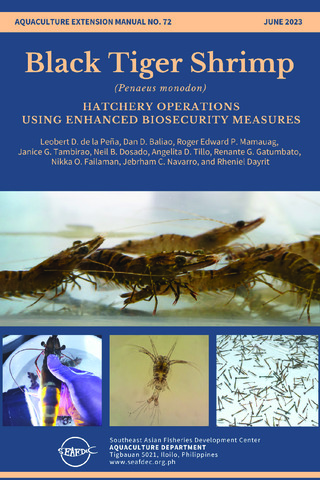
Black tiger shrimp (Penaeus monodon) hatchery operations using enhanced biosecurity measures
; ; Mamauag, Roger EdwardThis manual, titled “Black Tiger Shrimp (Penaeus monodon) Hatchery Operations Using Enhanced Biosecurity Measures,” includes modifications on shrimp hatchery operations done by the Aquaculture Department of the Southeast ...; ; ; ; ; ; ; (Aquaculture Department, Southeast Asian Fisheries Development Center, 2023-06)
-
Series: Aquaculture extension manual; No. 74
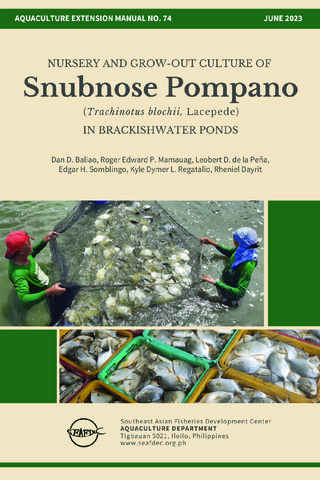
Nursery and grow-out culture of snubnose pompano (Trachinotus blochii, Lacepede) in brackishwater ponds
; Mamauag, Roger EdwardThis manual, titled “Nursery and Grow-out Culture of Snubnose Pompano (Trachinotus blochii, Lacepede) in Brackishwater Ponds,” includes culture techniques and good practices developed through extensive research done at the ...; ; ; ; (2023-06)
-
Series: Aquaculture extension manual; No. 73
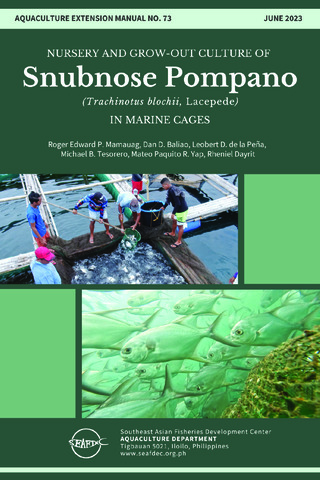
Nursery and grow-out culture of snubnose pompano (Trachinotus blochii, Lacepede) in marine cages
Mamauag, Roger EdwardThis manual, titled “Nursery and Grow-out Culture of Snubnose Pompano (Trachinotus blochii, Lacepede) in Marine Cages,” includes culture methods and good practices that are the product of research done at the Aquaculture ...; ; ; ; ; (2023-06)
-
Series: Aquaculture extension manual; No. 71
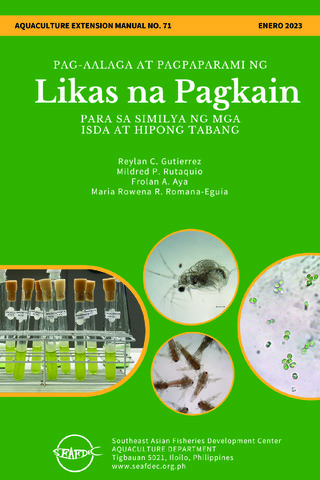
Pag-aalaga at pagpaparami ng likas na pagkain para sa similya ng mga isda at hipong tabang
; ; Aya, Frolan; Romana-Eguia, Maria Rowena R. (Aquaculture Department, Southeast Asian Fisheries Development Center, 2023-01)
Inilalarawan sa manwal na ito ang iba’t-ibang paraan ng pag-aalaga at pagpaparami ng microalgae at iba pang natural na organismong pagkain para sa mga similya ng isda at hipong tabang na inaalagaan at pinaparami sa mga hatcheries. Sa pamamagitan ng manwal na ito, maisusulong ang paggamit ng mga natural at naproseso na mga nasabing organismo bilang isang paraan para mapabuti ang produksyon ng mga isda at hipong tabang. Ang manwal na ito ay sadyang isinulat para makatulong sa mga lokal na may-ari ng mga hatcheries ng ulang at isdang tabang kabilang na ang kanilang mga technicians. Ito ay naglalayong magkaroon sila ng mas mahusay na pag-unawa sa kahalagahan ng pagpaparami at pag-aalaga ng ng mga likas na pagkain bilang isang kritikal na aspeto sa pag-aalaga at masaganang produksyon ng mga similya sa hatchery. -
Series: Aquaculture extension manual; No. 71
Culture of natural food for farmed freshwater fish and prawn larvae
; ; Aya, Frolan; Romana-Eguia, Maria Rowena R. (Aquaculture Department, Southeast Asian Fisheries Development Center, 2023-01)
This manual describes the various methods for culturing microalgae and other natural food organisms fed to freshwater fish/prawn larvae that are produced and reared in hatcheries. Hence, it will encourage/ promote the use of natural food organisms be these live and/or processed (concentrated algal pastes), as a means of optimizing larval fish/prawn production. The manual was written purposely for local freshwater fish/prawn hatchery owners/operators and their technicians. The authors prepared the manual for hatchery operators to have a better understanding of how and why there is a need to culture natural food organisms as part of the standard larval rearing protocol and to increase/boost fish and/or prawn seedstock production. -
Series: Aquaculture extension manual; No. 70
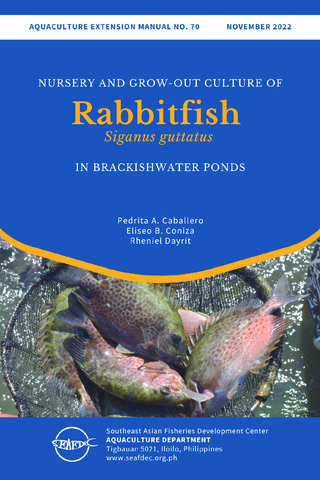
Nursery and grow-out culture of rabbitfish Siganus guttatus in brackishwater ponds
(Aquaculture Department, Southeast Asian Fisheries Development Center, 2022-11)Rabbitfish Siganus guttatus is a promising aquaculture species due to its tasty meat and commands a higher price than some aquaculture species. Moreover, it has a low protein requirement, resulting in a low-cost feed input. ... -
Series: Aquaculture extension manual; No. 69
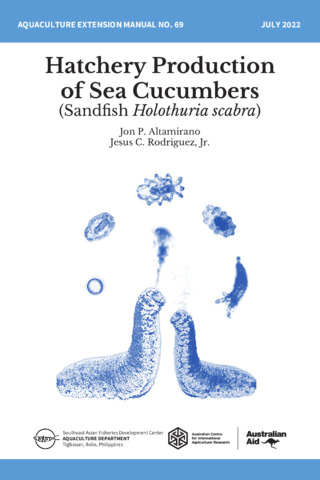
Hatchery production of sea cucumbers (sandfish Holothuria scabra)
Altamirano, JonThis manual, entitled Hatchery Production of Sea Cucumbers (Sandfish Holothuria scabra) includes the consolidated methods, practical protocols and good practices in sea cucumber breeding that were established within the ...; (Aquaculture Department, Southeast Asian Fisheries Development Center; Australian Centre for International Agricultural Research, 2022-07)
-
Series: Aquaculture Technology Module; No. 4
Site selection for brackishwater ponds
(Aquaculture Department, Southeast Asian Fisheries Development Center, 1986)This module is intended as a guide in selecting a good site for a brackishwater fishpond. -
Series: Aquaculture extension manual; No. 68
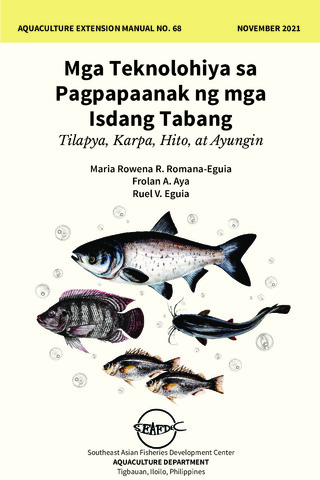
Mga teknolohiya sa pagpapaanak ng mga isdang tabang: Tilapya, karpa, hito, at ayungin
Romana-Eguia, Maria Rowena R.Ang babasahing ito ay isinulat upang ipamahagi sa mga mambabasa ang simpleng kaalaman sa pagpapaanak at pagpaparami ng mga isdang tabang tulad ng tilapya, karpa, hito, at ayungin. Ang mga teknolohiyang may kinalaman sa ...; Aya, Frolan ; (Aquaculture Department, Southeast Asian Fisheries Development Center, 2021-08)
-
Series: State of the art series
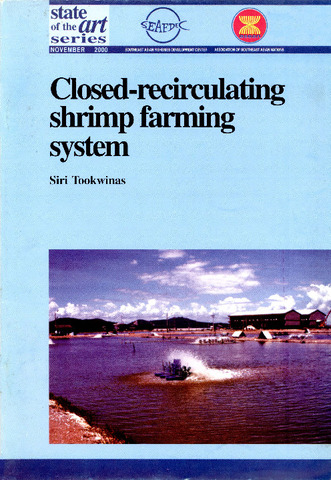
Closed-recirculating shrimp farming system
(Aquaculture Department, Southeast Asian Fisheries Development Center, 2000-11)This collaborative SEAFDEC/ASEAN project aimed to develop sustainable shrimp culture technology packages to address the problems in shrimp culture (e.g. discharges from shrimp farms threatening mangrove and marine ecosystems, clearing of mangrove forests to make way for shrimp ponds, etc.). In this context, a closed recirculating shrimp farming system is discussed touching on: pond preparation, water preparation, stocking, feeding, management, DO level, problems, record keeping, and harvesting. -
Series: State of the art series
Environment-friendly schemes in intensive shrimp farming
(Aquaculture Department, Southeast Asian Fisheries Development Center, 2000-09)The manual details the procedures of intensive shrimp farming but with provisos for the treatment of sludge and water. These provisos include (1) the use of water reservoir where pond water is stored for at least a week before being used in the grow-out ponds, (2) the use of a “tail” pond to hold drained water so it can be treated and recycled, (3) the use of long-arm paddle wheel so water aeration-circulation is made more efficient, and (4) the use of fishes to help condition the water and substantially produce green water. -
Series: Aquaculture extension manual; No. 9
Prawn hatchery design and operation
(Aquaculture Department, Southeast Asian Fisheries Development Center, 1985)Various factors to be taken into account in the operation of a prawn hatchery are examined under the following headings: 1) site selection; 2) hatchery facilities and equipment; 3) larval stages of prawn; 4) spawner and broodstock collection and transport; 5) larval rearing; 6) post-larval rearing; 7) harvesting, packing and transporting; 8) diseases; and 9) economics.




 RSS 1.0