Conference Proceedings: Recent submissions
Now showing items 661-680 of 767
-
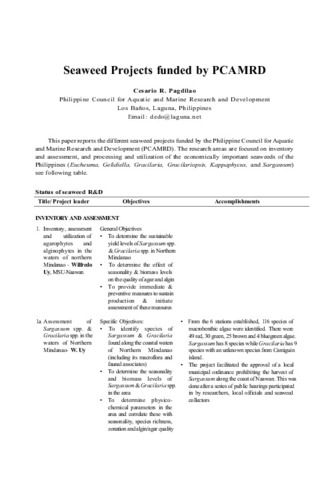
Seaweed projects funded by PCAMRD
(Aquaculture Department, Southeast Asian Fisheries Development Center, 2002) -
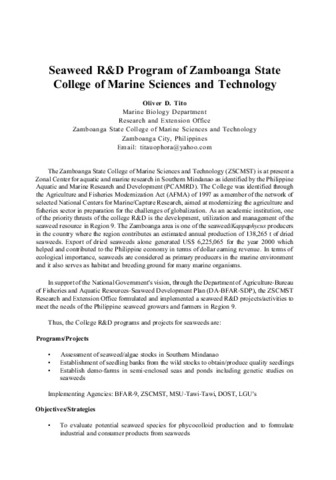
Seaweed R&D Program of Zamboanga State College of Marine Sciences and Technology
(Aquaculture Department, Southeast Asian Fisheries Development Center, 2002) -
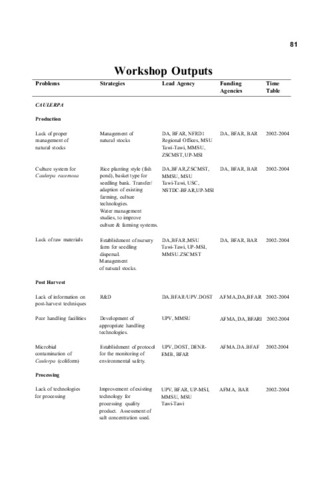
Workshop outputs
(Aquaculture Department, Southeast Asian Fisheries Development Center, 2002) -
Status of seaweed farming in Region 9
(Aquaculture Department, Southeast Asian Fisheries Development Center, 2002) -
Status of seaweed farming in Region 6
(Aquaculture Department, Southeast Asian Fisheries Development Center, 2002) -
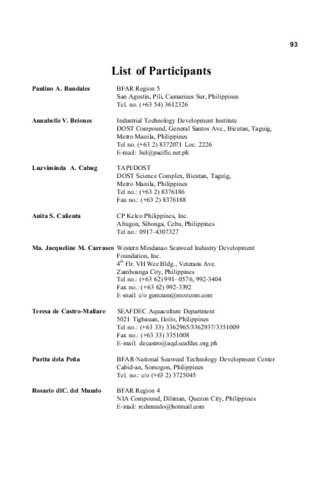
List of participants
(Aquaculture Department, Southeast Asian Fisheries Development Center, 2002) -
Appendix
(Aquaculture Department, Southeast Asian Fisheries Development Center, 2002) -
Kappaphycus farming: Farmer's experience
(Aquaculture Department, Southeast Asian Fisheries Development Center, 2002) -
Status of Kappaphycus and Caulerpa farming in Palawan
(Aquaculture Department, Southeast Asian Fisheries Development Center, 2002) -
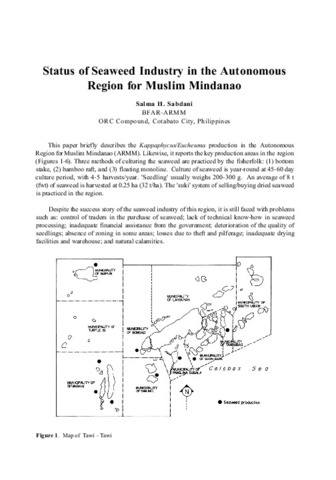
Status of seaweed industry in the Autonomous Region for Muslim Mindanao
(Aquaculture Department, Southeast Asian Fisheries Development Center, 2002) -
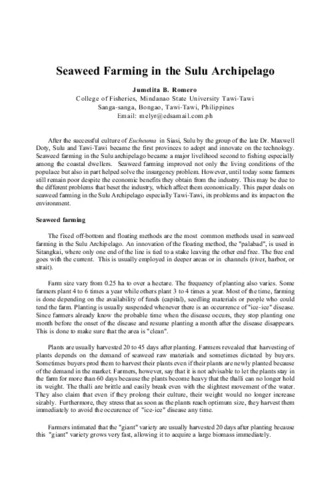
Seaweed farming in the Sulu archipelago
(Aquaculture Department, Southeast Asian Fisheries Development Center, 2002) -
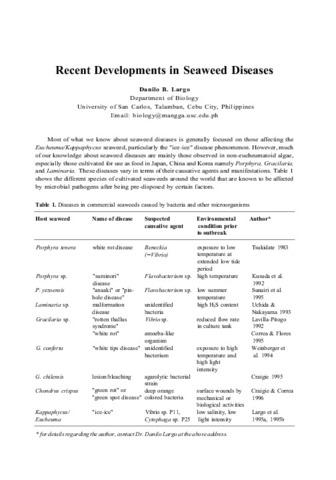
Recent developments in seaweed diseases
(Aquaculture Department, Southeast Asian Fisheries Development Center, 2002) -
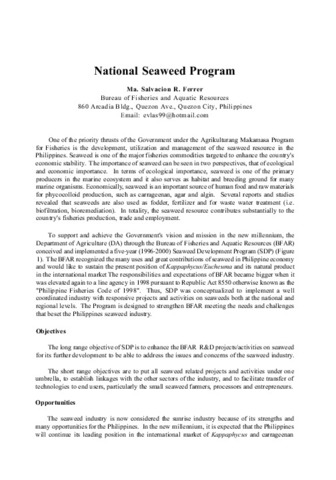
National seaweed program
(Aquaculture Department, Southeast Asian Fisheries Development Center, 2002) -
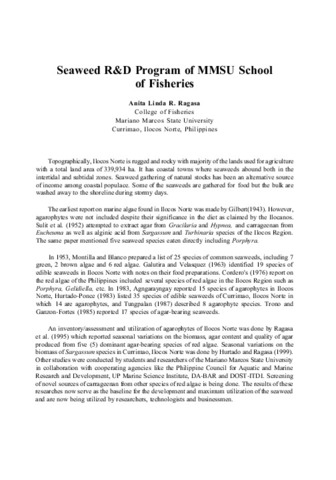
Seaweed R&D program of MMSU School of Fisheries
(Aquaculture Department, Southeast Asian Fisheries Development Center, 2002) -
Growth with Equity in Mindanao (GEM) Program and the seaweed industry
(Aquaculture Department, Southeast Asian Fisheries Development Center, 2002) -
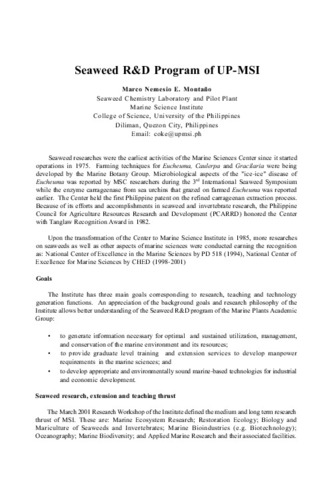
Seaweed R&D program of UP-MSI
(Aquaculture Department, Southeast Asian Fisheries Development Center, 2002) -
Preliminary pages
(Aquaculture Department, Southeast Asian Fisheries Development Center, 2002) -
Water quality assessment of the Langat River, Selangor, Malaysia using the natural algal periphyton community and laboratory bioassays of two Chlorella species
(Aquaculture Department, Southeast Asian Fisheries Development Center, 1990)The physico-chemical conditions in 10 sampling stations off the headwaters of the Langat River, Selangor, Malaysia were studied. Monitoring was done twice a month from June to December 1980. Changes in water quality were observed downstream. A total of 35 taxa of periphyton in four main divisions of algae were identified. The decrease in the number of species in downstream stations could be due to changes in the river rather than to chemical pollution. Two species of Chlorella , namely, C. pyrenoidosa and C. vulgaris , were grown in filtered river water obtained from the different sampling stations to assess their growth responses. Results suggest that pollution in the Langat River was caused mainly by heavy siltation rather than chemical pollutants. -
Antithamnion sparsum , its life history and hybridization with A. defectum in culture
(Aquaculture Department, Southeast Asian Fisheries Development Center, 1990)Antithamnion sparsum isolated from the southern and western coasts of Korea showed a basically Polysiphonia -type life history. However, it sometimes exhibited a monoecious reproduction and the carpospores released from the cystocarp by self-fertilization unexpectedly developed into plants bearing spermatangia alone. These male plants were not functional up to 60 days in culture. The results of intraspecific crosses between populations of A. sparsum were successful and the hybrid carpospores gave rise to normal tetrasporophytes. On the other hand, the interspecific crosses between A. sparsum and A. defectum were only partly successful, as evidenced by gonimoblast development and the release of carpospores in case of A. sparsum (male) x A. defectum (female), but not in A. sparsum (female) x A. defectum (male). These results seem to suggest that both species are still undergoing speciation. -
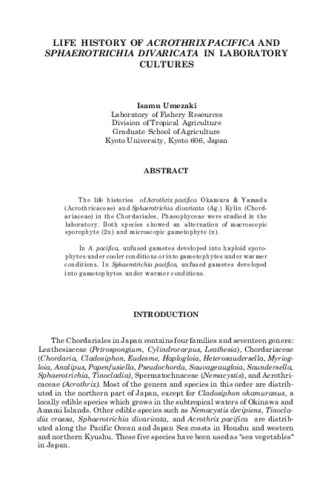
Life history of Acrothrix pacifica and Sphaerotrichia divaricata in laboratory cultures
(Aquaculture Department, Southeast Asian Fisheries Development Center, 1990)The life histories of Acrothrix pacifica and Sphaerotrichia divaricata in the Chordariales, Phaeophyceae were studied in the laboratory. Both species showed an alternation of macroscopic sporophyte (2n) and microscopic gametophyte (n). In A. pacific , unfused gametes developed into haploid sporophytes under cooler conditions or into gametophytes under warmer conditions. In S. pacifica , unfused gametes developed into gametophytes under warmer conditions.