Mencari Proceedings of the First International Conference on the Culture of Penaeid Prawns/Shrimps berdasarkan Tanggal Terbit
Now showing items 1-20 of 79
-
Staggered harvesting as a method of increasing prawn production with supplemental feeding
(Aquaculture Department, Southeast Asian Fisheries Development Center, 1985)Prawns, like any other animals, exhibit dissimilarities in growth rates. As they grow, a wide range of body weight distribution from the same population is observed. Staggered harvesting method is commonly practised in cultured animals having this characteristic. Selective or partial harvesting is especially useful in this type of management system. In this case, the larger shrimps are caught earlier than the small ones thus giving chance for the smaller ones to grow bigger. The study was conducted in four one-ha ponds. Recommended pond preparation was followed. Partial harvesting was employed in experimental ponds by using 2-4 units of 8 knots selective pound nets once a week commencing after three months culture until final harvest. Control ponds were harvested only once at the end of the culture period. The results show a mean production value of 506 kg from control ponds and 639 kg from experimental ponds. Average survival rate for experimental ponds was higher (92.90%) than for control (77.65%). Final average body weight was higher for experimental ponds (21.8 g) than for control (20.5 g). Size-wise, production of big size group (30-35 g) is 578.0 kg compared to 434.6 kg for small size group (13.1-13.4 g) from both control ponds with over-all production of 1,012.6 kg. On the other hand, production from the two experimental ponds for big and small size groups is 872.2 and 405.8 kg, respectively. The means of the total weights of marketable size Penaeus monodon from control and experimental ponds are 289.0 and 436.1 kg, respectively. That is, 43.5% of the stock reached marketable size in ponds with staggered/partial harvest method compared to only 27.5% from control ponds. -
Lipids and essential fatty acids in the nutrition of Penaeus monodon larvae
(Aquaculture Department, Southeast Asian Fisheries Development Center, 1985)Total lipid levels and fatty acid distribution during larval development of Penaeus monodon were determined. Larvae were cultured utilizing standard rearing procedures and feeding schemes adopted by the Crustacean Hatchery of SEAFDEC Aquaculture Department in Tigbauan, Iloilo, Philippines. At each developmental stage (spawned egg, nauplius, protozoea, mysis, postlarva), samples were collected for biochemical analysis. Lipid content decreased with developmental stage (from egg to postlarva), indicating utilization of lipids as energy source during larval development and metamorphosis. The major fatty acids in the egg lipid were 16:0 (palmitic), 16:1 (palmitoleic), 18:0 (stearic), 18:1 (oleic), 18:3 (linolenic), 20:4 (arachidonic), 20:5 (eicosapentaenoic), and 22:6 (docosahexa-enoic acids. As the larvae developed, levels of 16:1 and 18:1 fatty acids decreased with a corresponding increase in polyunsaturated fatty acids (PUFA), particularly 20:5ω3 and 22:6ω3. These indicate the importance of PUFA as dietary components. Comparison was made between fatty acid changes during larval development and the fatty acid constituents of commonly used larval feeds (algae, rotifer, brine shrimp, egg yolk) for P. monodon. The algae and zooplankton were found to contain 20:5ω3, while egg yolk was high in total lipids but low in polyunsaturates. Most larval diets were deficient in 22:6ω3 fatty acid. Crustaceans have been shown to have a limited capacity to biosynthesize long-chain PUFA; these have to be provided in their diet. These essential fatty acids must be available in appropriate amounts to ensure successful larval development and survival. -
The tolerance of Penaeus monodon eggs and larvae to fungicides against Lagenidium sp. and Haliphthoros philippinensis
(Aquaculture Department, Southeast Asian Fisheries Development Center, 1985)The in vivo effect of mycostatic levels of fungicides against the fungi Lagenidium sp. and Haliphthoros sp. were tested on Penaeus monodon eggs and larvae. Hatching rate and survival of nauplii, zoeae, myses and postlarvae exposed to 10 mg/ℓ Benzalkonium chloride, 1 mg/ℓ Clotrimazole, 1 mg/ℓ Crystal Violet, 10 mg/ℓ 2,4-D, 10 mg/ℓ Daconil, 20 mg/ℓ laundry detergent, 1 mg/ℓ Econazole nitrate, 10 mg/ℓ Resiguard, 0.2 mg/ℓ and 10 mg/ℓ Treflan-R, 0.01 mg/ℓ and 0.2 mg/ℓ Trifluralin were monitored daily for 96 hr in a static bioassay in glass aquaria. Results showed that all test chemicals had no inhibitory effect on hatching rate but survival rate of hatched nauplii was significantly reduced in most treatments except that of 0.2 mg/ℓ Treflan-R. Tests with zoeae, myses and postlarvae indicated that 0.2 mg/ℓ Treflan-R and 0.01 mg/ℓ and 0.2 mg/ℓ Trifluralin did not adversely affect survival. In addition, Benzalkonium chloride caused no significant mortalities among exposed myses. -
Diseases, parasites, commensals and fouling of commercial Penaeid prawns of the Portonovo coast of South India
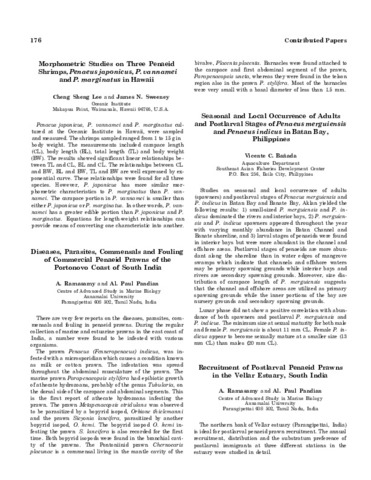
(Aquaculture Department, Southeast Asian Fisheries Development Center, 1985)There are very few reports on the diseases, parasites, commensals and fouling in penaeid prawns. During the regular collection of marine and estuarine prawns in the east coast of India, a number were found to be infested with various organisms. The prawn Penaeus (Fenneropenaeus) indicus, was infested with a microsporidian which causes a condition known as milk or cotton prawn. The infestation was spread throughout the abdominal musculature of the prawn. The marine prawn Parapenaeopsis stylifera had epibiotic growth of athecate hydrozoans, probably of the genus Tubularia, on the dorsal side of the carapace and abdominal segments. This is the first report of athecate hydrozoans infesting the prawn. The prawn Metapenaeopsis stridulans was observed to be parasitized by a bopyrid isopod, Orbione thielemanni and the prawn Sicyonia lancifera, parasitized by another bopyrid isopod, O. kemi. The bopyrid isopod O. kemi infesting the prawn S. lancifera is also recorded for the first time. Both bopyrid isopods were found in the branchial cavity of the prawns. The Pontoniinid prawn Chernocaris placunae is a commensal living in the mantle cavity of the bivalve, Placenta placenta. Barnacles were found attached to the carapace and first abdominal segment of the prawn, Parapenaeopsis uncta, whereas they were found in the telson region also in the prawn P. stylifera. Most of the barnacles were very small with a basal diameter of less than 1.5 mm. -
Morphometric studies on three Penaeid shrimps, Penaeus japonicus, P. vannamei and P. marginatus in Hawaii
(Aquaculture Department, Southeast Asian Fisheries Development Center, 1985)Penaeus japonicus, P. vannamei and P. marginatus cultured at the Oceanic Institute in Hawaii, were sampled and measured. The shrimps sampled ranged from 1 to 15 g in body weight. The measurements included carapace length (CL), body length (BL), total length (TL) and body weight (BW). The results showed significant linear relationships between TL and CL, BL and CL. The relationships between CL and BW, BL and BW, TL and BW are well expressed by exponential curve. These relationships were found for all three species. However, P. japonicus has more similar morphometric characteristics to P. marginatus than P. vannamei. The carapace portion in P. vannamei is smaller than either P. japonicus or P. marginatus. In other words, P. vannamei has a greater edible portion than P. japonicus and P. marginatus. Equations for length-weight relationships can provide means of converting one characteristic into another. -
Variation in tissue lipid content and fatty acid composition during ovarian maturation of unablated and ablated Penaeus monodon broodstock
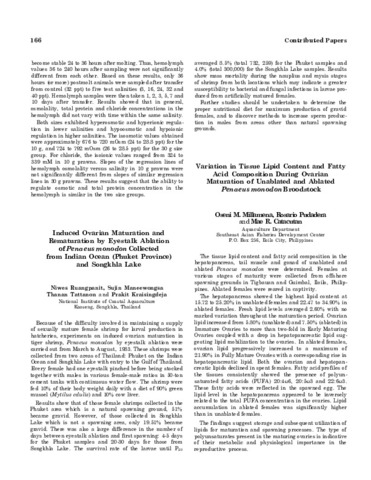
(Aquaculture Department, Southeast Asian Fisheries Development Center, 1985)The tissue lipid content and fatty acid composition in the hepatopancreas, tail muscle and gonad of unablated and ablated Penaeus monodon were determined. Females at various stages of maturity were collected from offshore spawning grounds in Tigbauan and Guimbal, Iloilo, Philippines. Ablated females were reared in captivity. The hepatopancreas showed the highest lipid content at 15.72 to 25.20% in unablated females and 22.47 to 34.90% in ablated females. Fresh lipid levels averaged 2.60% with no marked variation throughout the maturation period. Ovarian lipid increased from 5.80% (unablated) and 7.50% (ablated) in Immature Ovaries to more than two-fold in Early Maturing Ovaries coupled with a drop in hepatopancreatic lipid suggesting lipid mobilization to the ovaries. In ablated females, ovarian lipid progressively increased to a maximum of 21.90% in Fully Mature Ovaries with a corresponding rise in hepatopancreatic lipid. Both the ovarian and hepatopancreatic lipids declined in spent females. Fatty acid profiles of the tissues consistently showed the presence of polyunsaturated fatty acids (PUFA) 20:4ω6, 20:5ω3 and 22:6ω3. These fatty acids were reflected in the spawned egg. The lipid level in the hepatopancreas appeared to be inversely related to the total PUFA concentration in the ovaries. Lipid accumulation in ablated females was significantly higher than in unablated females. The findings suggest storage and subsequent utilization of lipids for maturation and spawning processes. The type of polyunsaturates present in the maturing ovaries is indicative of their metabolic and physiological importance in the reproductive process. -
Earthworm, marine annelids and squid as feed ingredients in formulated diets for juvenile Penaeus monodon
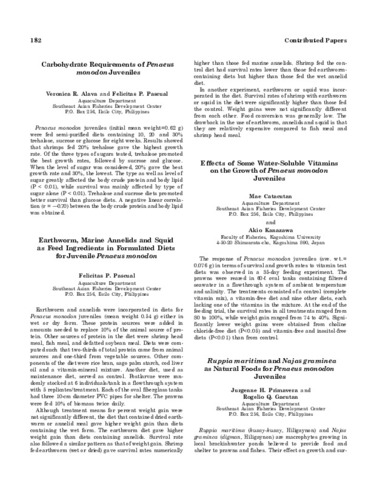
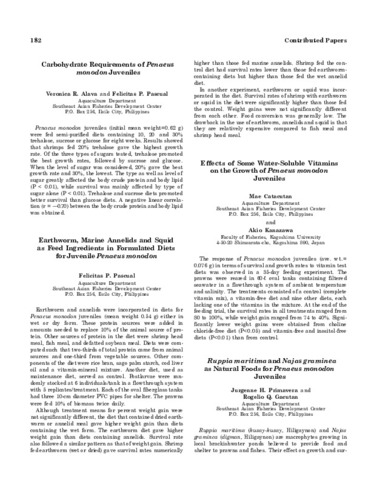
(Aquaculture Department, Southeast Asian Fisheries Development Center, 1985)Earthworm and annelids were incorporated in diets for Penaeus monodon juveniles (mean weight 0.54 g) either in wet or dry form. These protein sources were added in amounts needed to replace 10% of the animal source of protein. Other sources of protein in the diet were shrimp head meal, fish meal, and defatted soybean meal. Diets were computed such that two-thirds of total protein came from animal sources and one-third from vegetable sources. Other components of the diet were rice bran, sago palm starch, cod liver oil and a vitamin-mineral mixture. Another diet, used as maintenance diet, served as control. Postlarvae were randomly stocked at 6 individuals/tank in a flowthrough system with 5 replicates/treatment. Each of the oval fiberglass tanks had three 10-cm diameter PVC pipes for shelter. The prawns were fed 10% of biomass twice daily. Although treatment means for percent weight gain were not significantly different, the diet that contained dried earthworm or annelid meal gave higher weight gain than diets containing the wet form. The earthworm diet gave higher weight gain than diets containing annelids. Survival rate also followed a similar pattern as that of weight gain. Shrimp fed earthworm (wet or dried) gave survival rates numerically higher than those fed marine annelids. Shrimp fed the control diet had survival rates lower than those fed earthworm-containing diets but higher than those fed the wet annelid diet. In another experiment, earthworm or squid was incorporated in the diet. Survival rates of shrimp with earthworm or squid in the diet were significantly higher than those fed the control. Weight gains were not significantly different from each other. Food conversion was generally low. The drawback in the use of earthworm, annelids and squid is that they are relatively expensive compared to fish meal and shrimp head meal. -
Effects of some water-soluble vitamins on the growth of Penaeus monodon juveniles
(Aquaculture Department, Southeast Asian Fisheries Development Center, 1985)The response of Penaeus monodon juveniles (ave. wt.= 0.076 g) in terms of survival and growth rates to vitamin test diets was observed in a 35-day feeding experiment. The prawns were reared in 60-ℓ oval tanks containing filtered seawater in a flowthrough system of ambient temperature and salinity. The treatments consisted of a control (complete vitamin mix), a vitamin-free diet and nine other diets, each lacking one of the vitamins in the mixture. At the end of the feeding trial, the survival rates in all treatments ranged from 80 to 100%, while weight gain ranged from 74 to 40%. Significantly lower weight gains were obtained from choline chloride-free diet (P<0.05) and vitamin-free and inositol-free diets (P<0.01) than from control. -
The influence of temperature and salinity on oxygen consumption of Penaeus monodon postlarvae
(Aquaculture Department, Southeast Asian Fisheries Development Center, 1985)The effect of salinity and temperature on oxygen consumption at different developmental ages of Penaeus monodon postlarvae (P5 to P60) was studied. The design was a 2 × 5 factorial, using two levels of temperature (15 and 30°C) and 4 levels of salinity (10, 15, 20 and 30 ppt). One-day old postlarvae (P1) were acclimated to various salinities prior to the start of the experiments. Oxygen consumption was determined after three hours using a YSI dissolved oxygen meter vis-a-vis Winkler titration method. Respiratory activity as affected by temperature and salinity varies, dependent on the postlarval stage tested. Statistical analyses showed that temperature did not significantly influence oxygen uptake at early stages (P5-P8) until P25-P28. Its effect started to become apparent when the postlarvae were P35-P38 and was most pronounced at P49-P52. general, the postlarvae consumed more oxygen at higher temperature and the variation in the oxygen consumption of the postlarvae under the two temperatures become less obvious as the postlarvae were older. Salinity seemed to affect the oxygen consumption of the young postlarvae, P5-P8 and P25-P28, more than temperature. Differences in rate of oxygen consumption at various salinities were greater in younger postlarvae (P5-P38) than in older postlarvae (P42_P60). The relationship between rate of oxygen consumption and body weight is nearly linear in the various salinity-temperature treatments. In all cases, the regression was significant at 1% level. P. monodon postlarvae behaved as respiratory con-formers in all the salinities tested at ambient temperatures. The least oxygen consumption rate was noted at salinities of 20 and 30 ppt at low temperature (15°C) and 20 ppt at high temperature (30°C). The importance of these findings is discussed and related to improvement of postlarvae transport methodology. -
Carbohydrate requirements of Penaeus monodon juveniles
(Aquaculture Department, Southeast Asian Fisheries Development Center, 1985)Penaeus monodon juveniles (initial mean weight=0.62 g) were fed semi-purified diets containing 10, 20 and 30% trehalose, sucrose or glucose for eight weeks. Results showed that shrimps fed 20% trehalose gave the highest growth rate. Of the three types of sugars tested, trehalose promoted the best growth rates, followed by sucrose and glucose. When the level of sugar was considered, 20% gave the best growth rate and 30%, the lowest. The type as well as level of sugar greatly affected the body crude protein and body lipid (P < 0.01), while survival was mainly affected by type of sugar alone (P < 0.01). Trehalose and sucrose diets promoted better survival than glucose diets. A negative linear correlation (r = —0.70) between the body crude protein and body lipid was obtained. -
Ruppia maritima and Najas graminea as natural foods for Penaeus monodon juveniles
; Primavera, Jurgenne (Aquaculture Department, Southeast Asian Fisheries Development Center, 1985)
Ruppia maritima (kusay-kusay, Hiligaynon) and Najas graminea (digman, Hiligaynon) are macrophytes growing in local brackishwater ponds believed to provide food and shelter to prawns and fishes. Their effect on growth and survival of Penaeus monodon juveniles (PL50; carapace length, 4.01 mm; body weight, 0.053 g) were studied in 80-ℓ glass aquaria. The treatments were: (a) a commercial pellet (40% protein); (b) live Ruppia; (c) decaying Ruppia; (d) live Najas; and (e) decaying Najas. The pellet was offered to satiety (approx. 100% of body weight) twice daily. Live Ruppia and Najas were transplanted in the aquaria using pond soil a week prior to the experiment. Decaying Ruppia and Najas were transferred from ponds. Salinity was maintained at 15 ppt and 50% of the water was changed regularly. Highly significant differences (P < 0.01) in mean carapace length (CL) and mean body weight (BW) on the 10th, 20th and 30th days were observed among treatments. Increase in CL was fastest with decaying Najas and slowest in live Ruppia (14% vs. 17% after 30 days). Growth with decaying Ruppia was comparable to pellets on the 10th and 20th days but was faster after 30 days. Body weight on all sampling days was highest in decaying Najas and lowest in live Ruppia. Percentage increases were 122, 273 and 565% on the 10th, 20th and 30th days, respectively, with decaying Najas. Those given live Ruppia registered increases of 11, 67 and 94%, respectively. The rapid growth rate of animals on decaying Najas was compensated negatively by a low survival rate (31%), significantly lower than on live Najas (100%). Other survival percentages were: decaying Ruppia, 59% and pellet, 53%.
(Aquaculture Department, Southeast Asian Fisheries Development Center, 1985)
Ruppia maritima (kusay-kusay, Hiligaynon) and Najas graminea (digman, Hiligaynon) are macrophytes growing in local brackishwater ponds believed to provide food and shelter to prawns and fishes. Their effect on growth and survival of Penaeus monodon juveniles (PL50; carapace length, 4.01 mm; body weight, 0.053 g) were studied in 80-ℓ glass aquaria. The treatments were: (a) a commercial pellet (40% protein); (b) live Ruppia; (c) decaying Ruppia; (d) live Najas; and (e) decaying Najas. The pellet was offered to satiety (approx. 100% of body weight) twice daily. Live Ruppia and Najas were transplanted in the aquaria using pond soil a week prior to the experiment. Decaying Ruppia and Najas were transferred from ponds. Salinity was maintained at 15 ppt and 50% of the water was changed regularly. Highly significant differences (P < 0.01) in mean carapace length (CL) and mean body weight (BW) on the 10th, 20th and 30th days were observed among treatments. Increase in CL was fastest with decaying Najas and slowest in live Ruppia (14% vs. 17% after 30 days). Growth with decaying Ruppia was comparable to pellets on the 10th and 20th days but was faster after 30 days. Body weight on all sampling days was highest in decaying Najas and lowest in live Ruppia. Percentage increases were 122, 273 and 565% on the 10th, 20th and 30th days, respectively, with decaying Najas. Those given live Ruppia registered increases of 11, 67 and 94%, respectively. The rapid growth rate of animals on decaying Najas was compensated negatively by a low survival rate (31%), significantly lower than on live Najas (100%). Other survival percentages were: decaying Ruppia, 59% and pellet, 53%. -
Observations on the nauplii production from wild, cultivated and mixed populations of the blue shrimp (Penaeus stylirostris)
(Aquaculture Department, Southeast Asian Fisheries Development Center, 1985)Due to low nauplii production from cultivated broodstock and to minimize dependence on wild stock, an experiment was run in which four treatments, consisting of combinations of 400 adult blue shrimp (Penaeus stylirostris) from wild and cultivated (F6) populations, were applied (wild females and males, wild females and cultivated males, cultivated females and wild males, and cultivated females and males). Females were inspected every third day. Those observed with spermatophores were captured and transferred to individual 100-ℓ spawning tanks. Water was treated with EDTA and erythromycin phosphate. More than 300 individual spawns were evaluated within a 180-day period. To evaluate the nauplii production per female, an analysis of variance for a factorial arrangement (43 × 2) was conducted. The factors considered were: the abovementioned treatments, different ovarian maturation stages, adhesion of the spermatophore, and kind of spawning (complete or partial). The mixed populations had higher nauplii production than the cultivated broodstock. All the females were tagged around an eyestalk and examined for rematuration. Up to six rematurations per female were registered as well as a minimum of four days between successive spawnings for the same female. The effect of rematuration on the quantity of nauplii is discussed. Gonadosomatic index for wild and cultivated females is compared. Selective criteria for spawners are given. -
A brief review of the larval rearing techniques of penaeid prawns
(Aquaculture Department, Southeast Asian Fisheries Development Center, 1985)As early as half a century ago, Hudinaga successfully spawned and attempted to rear the larvae of Penaeus japonicus. Publications in the 1960 s, 70's and 80's on breakthroughs in larval rearing of one penaeid species after another indicated that practical prawn farming had become a reality. At present, there are 24 Penaeus species and seven Metapenaeus species whose larval rearing techniques are partially or fully established. Among them, only nine species are propagated on a large commercial scale. The other species are now produced only on a small scale or experimentally. There are many published papers dealing with larval rearing techniques of penaeid prawns. However, it is recognized that numerous details and problems remain unsolved pending further investigation and improvement. P. japonicus is the species which boasts the longest research history and the most successful larval rearing techniques. Nevertheless, there is little which scientists are able to do with the serious "white-turbid midgut gland disease" which has plagued the postlarvae of P. japonicus for the past several years. Similarly. P. monodon larval culture in the Philippines was once seriously affected by a fungus disease cause by Lagenidium sp., which resulted in poor survival rate. Suitable larval rearing methods differ from one species to another, all showing varying degrees of modification from the major principles of larval rearing techniques of penaeid prawns. For example, a hatchery can easily obtain several hundred spawners of P. japonicus, but this is never the case with P. monodon. Therefore, the community culture method for rearing larvae in large tanks is preferred for the former species, while the separate tank method, also called the monoculture method, is best for the latter. In general, larval rearing techniques of prawns is at its rapid growing stage. The status of larval rearing including rearing methods, feeding regimes and rearing systems, are herein summarized and introduced. The high priority problems to be solved, such as 1) selection of spawners, 2) improvement of rearing techniques, 3) larval diseases, 4) shipping methods, and 5) social impact are discussed and the prospects of larval rearing are described. -
Evaluation of artificial feeds for shrimp (Penaeus monodon) production in brackishwater ponds
(Aquaculture Department, Southeast Asian Fisheries Development Center, 1985)The experiment was conducted in fifteen 500-m2 brackishwater ponds to determine the response of Penaeus monodon juveniles fed with various artificial diets. Five treatments with three replicates each were: two commercial feeds containing 45% and 40% crude protein (treatments I and II), two experimental diets formulated to contain 35% crude protein (treatments III and IV) and control, without feeding (treatment V). Shrimp were fed twice daily at feeding rates based on shrimp consumption. Highest mean harvest weight was attained in treatment I (23.47 g) > III (19.25 g) > II (18.86 g) > IV (11.29 g) > V (9.27 g). Statistical analysis showed that differences in growth were significant at 5% probability level. However, growth in treatments I, II and III are comparable, also growth in treatments II, III and IV. Growth in treatments I, II, III and IV was significantly different from treatment V. Highest mean survival was attained in treatment III (91.82%) > I (88.93%) > II (86.95%) > IV (83.62%) V (82.62%). Statistical analysis showed no significant differences among treatments at 5% probability level. Projecting on a hectare basis, mean yield for each treatment was: I (628.37 kg) > II (496.35 kg) per crop in 120 days culture. Good yield was attributed to provision of formulated feeds, use of pumps in addition to tidal change for water exchange and control of predators, and pest eradication through proper pond preparation. -
Characterization of ovarian maturation stages in wild unablated Penaeus monodon
(Aquaculture Department, Southeast Asian Fisheries Development Center, 1985)At least five wild-caught Penaeus monodon from various maturation stages (initially classified in vivo as 0, I, II, III, IV, V) were measured, weighed and dissected for histological and histochemical studies. The anterior and posterior parts of the thoracic and abdominal regions of the ovary were sampled and stained with Mallory trichrome, alcian blue-periodic acid-Schiff (AB-PAS) and Sudan black. Results showed that the ovary is composed of the ovarian wall and its extensions, zone of proliferation, follicle cell layer and oocytes. The proliferating cells are less than 10 µm, have thin rims of cytoplasm, and increase in size as maturation proceeds. Based on histology, the stages were finally classified into groups (1) previtellogenic (stage 0), (2) vitellogenic (stages I and II), (3) cortical rod (stages III and IV), and (4) spent (stage V). The previtellogenic group consists only of perinucleolar oocytes (46-72 µm) which are stained negatively with AB-PAS and Sudan black. Oocytes bigger than 55 µm are enveloped by a single layer of follicle cells. The vitellogenic group is composed mostly of yolky oocytes (121-211 µm) with the following cytoplasmic inclusions: small granules of glycoproteins, medium-size globules of lipoglycoproteins, and few large lipid droplets. The cortical rod group consists mostly of yolky oocytes (288-408 µm) with additional rod-like bodies which contain acid and basic mucopolysaccharides but no lipid. The presence of cortical rods is a characteristic feature of mature penaeid ovaries. The spent group is similar to the previtellogenic group but contains some yolky oocytes, thicker follicle cell layers, or irregularly shaped perinucleolar oocytes. Th GSI ranges of the four groups are 0.899-1.937, 3.099-7.598, 5.631-12.000 and 1.848-2.919, respectively. -
Effect of cholesterol in artificial diets for Mediterranean prawns
(Aquaculture Department, Southeast Asian Fisheries Development Center, 1985)Mediterranean prawn (Penaeus kerathurus Forsskal) postlarvae (2 months old) were fed ad libitum with previously tested artificial diet (41% D.W., mainly of vegetal origin) supplemented with different percentages of cholesterol (0, 0.1, 0.5, 1.0 and 3.0%) and fresh bivalve mussel. Growth and survival rates were determined twice. Considering supplemented formulas only, data show that: (a) individual weights were higher with 0.1% cholesterol in the diet; (b) survival sharply dropped in the last week of the experiment, in particular with 0.1 and 3.0% cholesterol diets; and (c) with 1.0% cholesterol, mortality and growth counterbalanced giving over-all better results. No artificial feed can compete with the natural diet, either for survival rate or for individual growth. -
The response of Penaeus monodon juveniles to varying protein/energy ratios in test diets
(Aquaculture Department, Southeast Asian Fisheries Development Center, 1985)The response of Penaeus monodon juveniles (0.71±0.11 g) to varying protein/energy ratios in test diets was determined. Purified diets consisting of different levels of protein, lipid and carbohydrates were formulated. Two sets of experiments were conducted with the following diet combinations: (1) 30, 30, 50% protein, 5, 10, 15% lipid and 0, 10, 20% carbohydrate and (2) 40, 45, 50% protein, 5% lipid and 20, 25, 30% carbohydrate. Protein and energy ratios ranged from 89-198 mg protein/Kcal while the energy values for all diets were 165-415 Kcal/100 g. The diets were given twice daily at 10% of the body weight. Results showed that a two- to three-fold increase was observed in the body weight of prawns fed with diet combinations of 40-50% protein, 5-10% lipid and 20% carbohydrate with energy values of 285-370 Kcal/100 g. Reduction in protein content of the diet from 50 to 40% while maintaining the total energy level (285 Kcal/100 g) resulted in a change in growth that was not significant. An increase in energy level, at constant dietary protein level, resulted in improved utilization of protein and feed conversion efficiency. -
Study on the larval rearing of Penaeus merguiensis
(Aquaculture Department, Southeast Asian Fisheries Development Center, 1985)Nursing postlarvae of Penaeus merguiensis in the same tank as rearing always results in low survival rates, around 30%. One reason is that stocking density for P1 is too high for postlarvae grown to P20 size. Another reason may be that it is impossible to sufficiently clean a tank containing culture stock. In order to overcome the first constraint and to test whether the second is valid, rearing of nauplii to early postlarval stage was done in one tank, then early postlarvae were moved to another tank for nursing to P20. Rearing was done in rectangular, concrete tanks (5 m × 5 m × 2m) of 50 ton capacity, with an initial stocking density of 20-40 nauplii/ℓ. Chaetoceros sp. at a density of 3-4 × 10⁴ cell/ml, or Tetraselmis sp. at 1-3 × 10⁴ cell/ml were fed to zoea stage, then rotifer was given when the larvae metamorphosed to mysis stage. Within 8-10 days, when all of the larvae metamorphosed to postlarval stage, they were transferred to the nursing tank. Postlarval nursing was done in rectangular, concrete tanks with a capacity of 12 or 30 tons. The stocking rate was 12 postlarvae/ℓ in the 12-ton tanks and 8 postlarvae/ℓ in the 30-ton tanks. The early postlarvae were fed constantly with brine shrimp, and the older postlarvae were fed 4-5 times daily with squid meat. Fifty to seventy percent of seawater was exchanged, and siphoning of food remnants was done daily. The postlarvae grew to an intermediate size (1.0-2.5 cm total length) for stocking in grow-out ponds within 12 to 20 days. The results of rearing in 50-ton tanks with an initial stocking density of 20-25 postlarvae/ℓ, 25-30 postlarvae/ℓ and 30-40 postlarvae/ℓ produced survival rates of 74.3%, 63.6% and 47.6%, respectively. The survival rate for nursing in 12-ton tanks, with stocking density of 12 postlarvae/ℓ was 85.0% and for 30-ton tanks with stocking density of 8 postlarvae/ℓ was 61.7%. These results seem to indicate that the rearing and nursing of shrimp would be more efficient if carried out in separate tanks. -
The biology of Penaeus monodon in the capture fisheries off orissa coast, India in the context of occurrence of natural broodstock
(Aquaculture Department, Southeast Asian Fisheries Development Center, 1985)The tiger prawn of India, Penaeus monodon Fabricius has a differential distribution in the two coasts of India. Density is high in the northeastern part of the Bay of Bengal gradually declining towards the mid-east and becoming quite scarce towards the south. On the west coast, the distribution is more sparse and limited to a few months, off Bombay. The only known inshore areas of capture fisheries are the Godavari estuarine system, and the lagoons off Orissa at Chilka and Madras at Pulicat. The only known offshore capture exists off the Orissa coast at Paradip and Puri extending south to Visakhapatnam and Kakinada Bay. The greatest production comes off the brackishwater "bheri" (wild culture) system in the extensive "sunderbans" of West Bengal on the northeast where millions of seed recruited to the Hooghly estuarine complex are drawn in along with tidal waters and "cultured." The distribution profoundly affects the maturity, breeding and recruitment of this highly euryhaline species. The distribution can be related to the cyclic currents in the Bay of Bengal which have a profound effect on the salinity and temperature profile. It can also be related to the immense quantity of freshwater inflow from the mighty Hooghly-Matlah-Roopnarayan Padma estuarine complex at the head of the Bay and the other major riverine estuaries on the mid-east coast viz., the Mahanadi, Godavari and Krishna. The pattern of circulation and estuarine flows is such that it might also positively influence the food distribution, both live and detrital, in this region. Ripe (gravid) and ripening females and males of P. monodon in the size range of 100-250 g are captured off Paradip coast in the not very deep (30-40 m) waters where coastal trawlers operate, from October through April corresponding to the post-monsoon stability in the water movement and the increasing salinity. This offers a good augury for setting up hatcheries in adjacent zones using naturally mature forms. Catch records from one major freezing plant are presented to indicate the density and distribution of the species at the Paradip-Puri coast. -
Effects of diet on reproductive performance of ablated Penaeus monodon broodstock
(Aquaculture Department, Southeast Asian Fisheries Development Center, 1985)Four practical diets were compared for their effects upon ovarian maturation and spawning of ablated Penaeus monodon broodstock. Diets were formulated based upon the fatty acid profile of wild P. monodon. Diets 1 and 3 were cod liver oil-based while Diets 2 and 4 were soybean oil-based. Experimental treatments consisted of each of the formulated diets given in combination with natural food (squid, mussel, and annelids). An all-natural diet served as control. The fatty acid composition and total lipid content of the diets and of P. monodon fed with these diets were assessed. Reproductive performance was evaluated in terms of number of spawnings, fecundity, egg and nauplii production and hatching rate of eggs. Broodstock response was best in Diet 1 and comparable with the control, followed by Diets 3 and 4, and was poorest in Diet 2. Broodstock performance appeared to be related to the fatty acid pattern of the diet. All pelleted diets contained similar levels of total lipids. However, there were differences in amounts of important polyunsaturated fatty acids (PUFA): 20:4ω6 (arachidonic), 20:5ω3 (eicosapentaenoic) and 22:6ω3 (docosahexaenoic) acids. The fatty acid profiles of Diets 1 and 3 more closely resemble the profile of maturing ovaries of wild P. monodon; the PUFA content of these diets and ω3/ω6 ratios were higher compared to Diets 2 and 4. Diet 2, showing the poorest profile among the diets, was low in ω3/ω6 ratio and contained minimal levels of PUFA.