SEAFDEC/AQD Institutional Repository: Recent submissions
3381-3400 / 4221
-
Nutrient cycles: Nutrient dynamics in culture ponds.
(Aquaculture Department, Southeast Asian Fisheries Development Center, 2004)The general over-development of aquaculture had profound disturbance on the surrounding ecosystem, affecting, not only fisheries, but aquaculture itself through release of effluent loaded with nutrients into open waters leading to eutrophication and deterioration of water quality. Shrimp aquaculture is one of the fastest growing economic activities in the Asia-Pacific region, where almost 80% of the world production of farmed shrimp occurs, but has slowed down recently for a number of reasons. These include eutrophication of coastal waters, mangrove destruction, stock losses due to disease outbreaks, primarily as a result of unrestricted expansion and environmental problems from mismanagement and over intensification (Phillips et al., 1993). Estimates of N and P quantities (95% of the N and 71% of P) entering waterways from shrimp pond indicate most of the materials originate from the added feeds and fertilizer, hence, water and soil quality in pond become a balance between metabolites pond inputs, shrimp wastes and on water exchange (Briggs & Smith, 1994 (Macintosh & Phillips, 1992; Briggs & Funge-Smith, 1994). Feed input is the major factor that causes deterioration of pond bottom and water quality (Boyd, 1992). Several processes may limit eutrophication by improving shrimp feed stability through extrusion, adoption of biofilters and bioaugmentation with the use of commercially available “waste digester” and “probiotics” through bacteria mineralization. -
Verification of semi-intensive shrimp culture techniques: Myanmar.
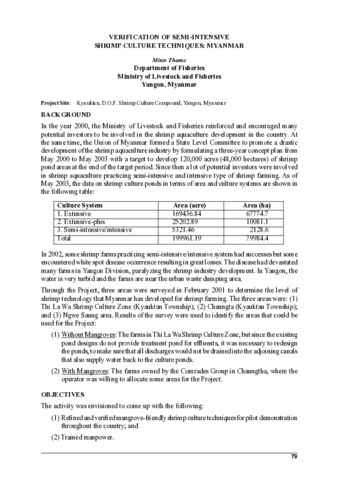
(Aquaculture Department, Southeast Asian Fisheries Development Center, 2004)In the year 2000, the Ministry of Livestock and Fisheries reinforced and encouraged many potential investors to be involved in the shrimp aquaculture development in the country. At the same time, the Union of Myanmar formed a State Level Committee to promote a drastic development of the shrimp aquaculture industry by formulating a three-year concept plan from May 2000 to May 2003 with a target to develop 120,000 acres (48,000 hectares) of shrimp pond areas at the end of the target period. Since then a lot of potential investors were involved in shrimp aquaculture practicing semi-intensive and intensive type of shrimp farming. In 2002, some shrimp farms practicing semi-intensive/intensive system had successes but some encountered white spot disease occurrence resulting in great losses. The disease had devastated many farms in Yangon Division, paralyzing the shrimp industry development. In Yangon, the water is very turbid and the farms are near the urban waste dumping area. Through the Project, three areas were surveyed in February 2001 to determine the level of shrimp technology that Myanmar has developed for shrimp farming. The three areas were: (1) Thi La Wa Shrimp Culture Zone (Kyauktan Township); (2) Chaungta (Kyauktan Township); and (3) Ngwe Saung area. Results of the survey were used to identify the areas that could be used for the Project. -
Verification of semi-intensive shrimp culture techniques: Vietnam.
(Aquaculture Department, Southeast Asian Fisheries Development Center, 2004)Vietnam has about 260,000 ha devoted for shrimp culture in early 1999. The total production was estimated at about 80,000 tons in 2000, so that productivity was about 300 kg/ha only. In 1990–1997, vast areas of mangroves were destroyed by many fish farmers for conversion into shrimp culture ponds. The Vietnam Government and local authorities have been trying to mobilize and educate farmers for them to refrain from destroying mangroves for shrimp culture; and at the same time promote increased shrimp productivity/ha in order to increase profit; and generate employment without necessarily destroying the mangroves. Cathai is an island district in north Vietnam with 12 communes in two islands, Catba and Cathai. Phulong Island in Catba Island, has the largest mangrove area. Before 1990, the total mangrove area of Phulong was about 2000 ha but in 1998 only about 1200 ha remained, because about 800 ha had been converted into shrimp ponds. However, due to lack of technology in shrimp culture especially the semi–intensive pond culture, production ranged from 200 to 300 kg/ha/crop, while in extensive ponds, production was only 50–70 kg/ha/year. Local authorities and the people of Phulong have been expecting to increase productivity from shrimp culture. Using the mangrove-friendly shrimp technology modeled by the Philippines and Thailand, the objective of the semi–intensive shrimp pond culture activity in Vietnam is to obtain 1000–1500kg/ha and to develop a model for an improved shrimp culture system. In the Memorandum of Agreement signed between the Ministry of Fisheries and the Southeast Asian Fisheries Development Center for the implementation of the Project in Vietnam, the Research Institute for Marine Products (RIMP) in Haiphong was chosen to carry out the demonstration activity focusing on the semi–intensive mangrove-friendly shrimp culture in Phulong, Cathai District, Haiphong, Vietnam. The ponds used for the Project had a total area of about 6.0 ha. Construction of the pond facilities following the Project’s scheme was completed in December 1999. -
Mitigation measures of effluents from shrimp farms on mangrove and coastal resources.
(Aquaculture Department, Southeast Asian Fisheries Development Center, 2004)More than 80 % of shrimp production of Phuket comes from small-scale intensive farms. Most of shrimp farms use direct supply of seawater from the open sea and released effluents to canals. The effect of the unlimited effluents from shrimp farms cause deterioration in the coastal natural resources and the environment. The effluent quality and loading from marine shrimp farms have been studied in Thailand (Songsanjinda and Tunvilai, 1993; Tookwinas et al., 1994 & 1998). Macintosh and Philips (1992) reviewed the feeding habitats of shrimps and found out that 77.5 % of nitrogen and 86% of phosphorus added to the intensive pond are lost to the shrimp pond environment and would be decomposed at the bottom of the pond. After harvesting, if the effluent is directly drained out to the natural waters it would have a lot of effects on the coastal environment, such as deterioration of water quality for aquatic larva surviving near the coastal or mangrove areas. Therefore, the mitigation measures of effluent from shrimp farming on mangrove and coastal resources should be assessed, in order that the shrimp culture meets the coastal or mangrove–friendly schemes. -
Evaluation of seawater irrigation for intensive marine shrimp farming.
(Aquaculture Department, Southeast Asian Fisheries Development Center, 2004)The seawater irrigation system has benefited the intensive marine shrimp culture making shrimp culture sustainable and increasing shrimp production. The results obtained from this research study indicated that the adverse effects of shrimp farms on mangrove and costal environments around the irrigation system could be controlled and minimized. There are three main critical control points identified in this study that need to be considered: 1) Supply canals in the system should be cleaned and renovated every 2-3 years. 2) Wastewater treatment system should be monitored to avoid the accumulation of solid wastes while the solid wastes should be properly managed. 3) The seawater irrigation system can minimize shrimp pathogens from entering the culture ponds, however for disease prevention, farmers should adopt good aquaculture practices including pond preparation, seed quality, and prevention of disease carriers. Managing the seawater irrigation system needs a systematic teamwork. The above critical control points of the system should be monitored regularly and managed properly. The pond manager should assess the system regularly to prevent the adverse effects to the shrimp farms and to the environment. -
Integrated physical and biological technologies for water recycling in shrimp farms.
(Aquaculture Department, Southeast Asian Fisheries Development Center, 2004)Environment-friendly shrimp culture system has been an issue for improving shrimp farming and making it sustainable. In the past decade, Thailand adopted the open shrimp culture system, which consumed a lot of coastal and estuarine waters. The huge amount of nutrients and organic matter are dumped into the water receiving areas, resulting in eutrophication of the natural resource. A strategy developed to solve the problem was to reduce the water consumption in shrimp farms by recycling the water and re-using it for succeeding culture operations. The technologies that have been adopted for water treatment in recycling included physical, biological and chemical treatments. Since the effluent from shrimp farms is turbid, in high volume, and enriched with organic nutrients, the integration of physical and biological treatment was considered a potential treatment system that can be used extensively in recycling the effluents from shrimp farms. -
Mangrove plantation for enhancing food web in water recycling shrimp farms.
(Aquaculture Department, Southeast Asian Fisheries Development Center, 2004)Environmental deterioration in ponds and costal waters has been a common evidence after each intensive shrimp culture due to the accumulation of organic wastes and occurrence of eutrophication processes. Mangrove is a wetland that potentially supports the natural food web in the estuary and coastal areas. The planting of mangroves in recycling shrimp farms would serve the purpose of developing sustainable shrimp farms by utilizing the enriched organic matters and nutrients thus enhancing the natural food web in the shrimp farms. However, mangrove trees in pond dikes tend to grow small and the roots may not be able to support the tree during pond erosion resulting in the mortality of the mangrove trees. Brackishwater weeds, which cover the soil in the pond dikes, could serve the function of the young mangrove trees. -
Promotion of mangrove-friendly shrimp aquaculture in Southeast Asia
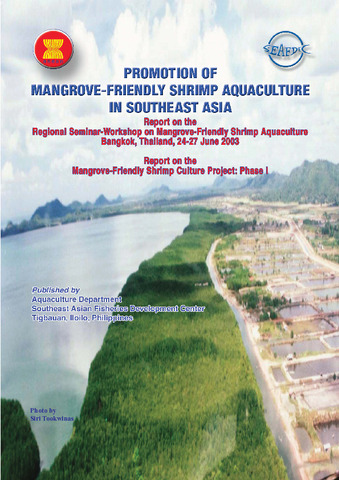
(Aquaculture Department, Southeast Asian Fisheries Development Center, 2004)Sulit, Virgilia T. -
Environment-friendly schemes in intensive shrimp farming.
(Aquaculture Department, Southeast Asian Fisheries Development Center, 2004)International environmental pressure groups call for shrimp importing countries to impose a trade embargo against farmed shrimps produced in a manner considered deleterious to the environment. In fact, Europe had banned in 2000 the importation of shrimps from some Asian countries. The subject of such protest actions included: (1) discharge of substances potentially harmful to marine organisms (chemicals used during pond preparation and therapeutants used during culture period); (2) discharge of excessive organic load during regular water change and harvests; and (3) chemical residues in shrimps harvested and marketed. In the Philippines, a mandate from the national government was given to SEAFDEC in 1996 to rehabilitate the shrimp industry, which almost reached the brink of virtual collapse due to diseases brought about by some environmentally destructive practices. Mangrove-friendly aquaculture or what is sometimes referred to as the environment-friendly aquaculture was launched by AQD as a five-year program starting in 1998. The focus was later changed to shrimp culture and made part of the ASEAN-SEAFDEC Fisheries Consultative Group (FCG) collaborative project with AQD as Lead Department for technology development and verification, and Thailand as Lead Country for promoting the technology within the Southeast Asian region. -
An improved strategy for building brackishwater culture ponds with iron pyrite soils in mangrove swamps
(Aquaculture Department, Southeast Asian Fisheries Development Center, 1985)The problems associated with acid sulfate soil limit the potential utilization of vast coastal areas of mangrove swamps for brackishwater aquaculture. There is an estimated 4.8 million ha of mangrove area in the ASEAN countries alone. Until recently, most attempts to build earthen ponds in these areas have yielded poor results. Aquatic Farms, as technical consultants for a 250 ha-prawn farm in Johore Peninsula, Malaysia, developed a construction technique that utilized the volcano-like burrow mounds of the mud lobster (Thalassina anomala) to cover and seal pond embankments that has minimized the culture problems usually experienced with iron pyrite soil. The strategy, pond design and construction technique are described. Pond dynamics and performance are discussed since the commencement of culture operations and these are compared with a nearby prawn farm that was constructed using conventional techniques. A cost benefit analysis is given in conclusion. -
Intermediate culture of chinese prawn without feeding in nursery ponds
(Aquaculture Department, Southeast Asian Fisheries Development Center, 1985)The aim of the experiments is to find a new way to accomplish intermediate culture of the penaeid prawn in nursery ponds. Experiments have been carried out in prawn farms in Haiyang County, Shandong Province. Prawn fry were stocked at high density in a nursery pond. Commercial fertilizer was added to the nursery pond to fertilize the pond water as nutrients for the planktonic and benthic organisms. The prawn fry in the pond fed only on the available natural food organisms without any special feed supply and grew normally. The survival and growth rate of the prawn fry are discussed. -
Characterization of ovarian maturation stages in wild unablated Penaeus monodon
(Aquaculture Department, Southeast Asian Fisheries Development Center, 1985)At least five wild-caught Penaeus monodon from various maturation stages (initially classified in vivo as 0, I, II, III, IV, V) were measured, weighed and dissected for histological and histochemical studies. The anterior and posterior parts of the thoracic and abdominal regions of the ovary were sampled and stained with Mallory trichrome, alcian blue-periodic acid-Schiff (AB-PAS) and Sudan black. Results showed that the ovary is composed of the ovarian wall and its extensions, zone of proliferation, follicle cell layer and oocytes. The proliferating cells are less than 10 µm, have thin rims of cytoplasm, and increase in size as maturation proceeds. Based on histology, the stages were finally classified into groups (1) previtellogenic (stage 0), (2) vitellogenic (stages I and II), (3) cortical rod (stages III and IV), and (4) spent (stage V). The previtellogenic group consists only of perinucleolar oocytes (46-72 µm) which are stained negatively with AB-PAS and Sudan black. Oocytes bigger than 55 µm are enveloped by a single layer of follicle cells. The vitellogenic group is composed mostly of yolky oocytes (121-211 µm) with the following cytoplasmic inclusions: small granules of glycoproteins, medium-size globules of lipoglycoproteins, and few large lipid droplets. The cortical rod group consists mostly of yolky oocytes (288-408 µm) with additional rod-like bodies which contain acid and basic mucopolysaccharides but no lipid. The presence of cortical rods is a characteristic feature of mature penaeid ovaries. The spent group is similar to the previtellogenic group but contains some yolky oocytes, thicker follicle cell layers, or irregularly shaped perinucleolar oocytes. Th GSI ranges of the four groups are 0.899-1.937, 3.099-7.598, 5.631-12.000 and 1.848-2.919, respectively. -
Growth and survival of Penaeus monodon postlarvae with different feeding regimes and stocking densities in earthen brackishwater nursery ponds
(Aquaculture Department, Southeast Asian Fisheries Development Center, 1985)The effect of different stocking densities (50, 100 and 150/m2) and two feeding regimes (natural food, consisting mainly of lablab, and natural food plus artificial diet) on the growth and survival of Penaeus monodon postlarvae (PL4 to PL5) were evaluated in eighteen 40 m2 earthen brackishwater nursery ponds using tidal water exchange for a period of 45 days. Results of the experiment indicated that the effect of different stocking densities was highly significant (P<0.01) on growth but not on survival for the two feeding regimes. Likewise, no interaction effect was discerned. Shrimps given artificial feed (Treatments II, IV and VI) obtained higher mean weight gains of 1.55, 1.17 and 1.05 g, respectively, than those that were not given artificial feed (I-1.44 g, III-0.92 g, and V-0.66 g). Similarly, those reared with artificial feed attained better survival of 41.62% (II), 67.44% (V) and 52.14% (VI) compared to shrimp that were not given artificial feed (I-42.53%, III-54.61% and V-46.90%). An exploratory economic study showed that the nursery operation gave promising results in all treatments. High rate of investment (ROI) was obtained to give a safe margin for the risk involved in this kind of business. Among all treatments, treatment V had the highest ROI of 693% and shortest payback period of 0.19 years. -
Hepatopancreas cells as monitor cells for the nutritional value of prawn diets in aquaculture
; ; Quinitio, Emilia T. (Aquaculture Department, Southeast Asian Fisheries Development Center, 1985)
The hepatopancreas is considered to be the central organ of metabolism in decapod Crustacea. It is a system of blind tubules consisting of four cell types. The E-cells at the summits of the tubules develop into R-cells (for resorption of nutrients), F-cells (for production of digestive enzymes) and B-cells (function unknown). The ultrastructure of Penaeus monodon R-cells changes largely after starvation and feeding different diets. B-cells show slight reactions, while F- and E-cells are rather constant. Thirteen day-starvation results in a large decrease of the cell size and in a significant reduction of all cell organelles. After seven days starvation and four days refeeding with various extreme diets, the R-cells develop completely different food-specific ultrastructures. A distinct proliferation of the endoplasmic reticulum is characteristic of protein diets. Large fat drops are the main feature after refeeding with cod liver oil. Sucrose feeding results in "empty" cells with only few organelles. The most diversified ultrastructure with fat droplets and a high amount of all cell organelles is obtained by feeding a mixed diet. The study indicates that R-cells are very sensitive to the application of different diets. They could be used as monitor cells for the nutritional value and the availability of a diet for prawns. Particularly poor or badly formulated feed could be detected early by electron microscopy. This method may be very helpful for the development of artificial prawn diets in aquaculture, especially if natural sources will be used as food components.
(Aquaculture Department, Southeast Asian Fisheries Development Center, 1985)
The hepatopancreas is considered to be the central organ of metabolism in decapod Crustacea. It is a system of blind tubules consisting of four cell types. The E-cells at the summits of the tubules develop into R-cells (for resorption of nutrients), F-cells (for production of digestive enzymes) and B-cells (function unknown). The ultrastructure of Penaeus monodon R-cells changes largely after starvation and feeding different diets. B-cells show slight reactions, while F- and E-cells are rather constant. Thirteen day-starvation results in a large decrease of the cell size and in a significant reduction of all cell organelles. After seven days starvation and four days refeeding with various extreme diets, the R-cells develop completely different food-specific ultrastructures. A distinct proliferation of the endoplasmic reticulum is characteristic of protein diets. Large fat drops are the main feature after refeeding with cod liver oil. Sucrose feeding results in "empty" cells with only few organelles. The most diversified ultrastructure with fat droplets and a high amount of all cell organelles is obtained by feeding a mixed diet. The study indicates that R-cells are very sensitive to the application of different diets. They could be used as monitor cells for the nutritional value and the availability of a diet for prawns. Particularly poor or badly formulated feed could be detected early by electron microscopy. This method may be very helpful for the development of artificial prawn diets in aquaculture, especially if natural sources will be used as food components. -
Seasonal abundance of Penaeid prawn seed in the Ennore estuary, Madras in relation to hydrography and lunar phase
(Aquaculture Department, Southeast Asian Fisheries Development Center, 1985)An estimate of seed resources in the coastline, estuarine, and backwater bodies is an important prerequisite for developing prawn farming. A one-year (1983) survey on penaeid seed, based on tide and lunar periodicity, indicates the following species: Metapenaeus dobsoni, Penaeus indicus, P. japonicus, M. monoceros, P. semisulcatus and P. monodon in order of their abundance. P. indicus and P. japonicus are predominant in February and March (77.5 and 82.06% of total seed, respectively) when the average salinity ranges from 33.6 to 35.1 ppt followed by M. dobsoni. A second peak of P. indicus is observed in June when M. dobsoni showed its highest peak (47.35%) with continued abundance up to December. During the northeast monsoon, when the average salinity fell to a lower range of 19.9 to 24.6 ppt, P. monodon and M. monoceros showed moderate abundance. As the site chosen is very near the bar mouth, most of the seed collected were postlarvae. In Penaeus and Metapenaeus genera, total size range is 7-15 mm and 3-4 mm, respectively. Afternoon collections showed greater abundance followed by forenoon and night collections. Low tide and Full Moon collections showed greater abundance than those made during high tide and New Moon. Differences in seasonality may reflect breeding intensity of the respective prawn species in the sea. Variations in hydrographic features may also significantly contribute to seasonal abundance. A strong correlation between salinity and seed abundance is seen. The seed potential of these prawns in Ennore estuary is discussed. -
Effect of carrageenan micro-binded diet on the larval stages of Penaeus indicus
(Aquaculture Department, Southeast Asian Fisheries Development Center, 1985)At present, most hatcheries depend on live food like diatoms, Chlorella, rotifer and brine shrimp to rear the larval stages of various penaeid species. Mass production of live feed requires much space (tanks) and labor, and is often affected by environmental conditions. The possibility of substituting live food with artificial diet for Penaeus indicus larvae was evaluated. Carrageenan micro-binded diet (C-MBD) was selected as test diet and its composition was modified from C-MBD designed for P. japonicus (about 45% protein). Larvae stocked at 100/ℓ and fed five times/day at 0.8 mg/larva/day had an average survival rate of 45% from Z1 to M1. Water temperature was 26.5-30.5°C and salinity 32-33 ppt. An average survival rate of 70.2% from M1 to PL1 was attained when the stocking density was 30/ℓ and feeding was three times/day at 0.3 mg/larva/day (water temperature 25.5-28.5°C, salinity 27-32 ppt). From PL1 to PL5 at stocking density of 20/ℓ with feeding rate of 0.3 mg/larva/day (fed 3 times a day), the average survival rate was 64.9% (water temperature 25.5-28.5% C, salinity 28-32 ppt). The results show that the present composition of C-MBD is highly effective for myses up to the early postlarval stages of P. indicus. -
Staggered harvesting as a method of increasing prawn production with supplemental feeding
(Aquaculture Department, Southeast Asian Fisheries Development Center, 1985)Prawns, like any other animals, exhibit dissimilarities in growth rates. As they grow, a wide range of body weight distribution from the same population is observed. Staggered harvesting method is commonly practised in cultured animals having this characteristic. Selective or partial harvesting is especially useful in this type of management system. In this case, the larger shrimps are caught earlier than the small ones thus giving chance for the smaller ones to grow bigger. The study was conducted in four one-ha ponds. Recommended pond preparation was followed. Partial harvesting was employed in experimental ponds by using 2-4 units of 8 knots selective pound nets once a week commencing after three months culture until final harvest. Control ponds were harvested only once at the end of the culture period. The results show a mean production value of 506 kg from control ponds and 639 kg from experimental ponds. Average survival rate for experimental ponds was higher (92.90%) than for control (77.65%). Final average body weight was higher for experimental ponds (21.8 g) than for control (20.5 g). Size-wise, production of big size group (30-35 g) is 578.0 kg compared to 434.6 kg for small size group (13.1-13.4 g) from both control ponds with over-all production of 1,012.6 kg. On the other hand, production from the two experimental ponds for big and small size groups is 872.2 and 405.8 kg, respectively. The means of the total weights of marketable size Penaeus monodon from control and experimental ponds are 289.0 and 436.1 kg, respectively. That is, 43.5% of the stock reached marketable size in ponds with staggered/partial harvest method compared to only 27.5% from control ponds. -
Evaluation of artificial feeds for shrimp (Penaeus monodon) production in brackishwater ponds
(Aquaculture Department, Southeast Asian Fisheries Development Center, 1985)The experiment was conducted in fifteen 500-m2 brackishwater ponds to determine the response of Penaeus monodon juveniles fed with various artificial diets. Five treatments with three replicates each were: two commercial feeds containing 45% and 40% crude protein (treatments I and II), two experimental diets formulated to contain 35% crude protein (treatments III and IV) and control, without feeding (treatment V). Shrimp were fed twice daily at feeding rates based on shrimp consumption. Highest mean harvest weight was attained in treatment I (23.47 g) > III (19.25 g) > II (18.86 g) > IV (11.29 g) > V (9.27 g). Statistical analysis showed that differences in growth were significant at 5% probability level. However, growth in treatments I, II and III are comparable, also growth in treatments II, III and IV. Growth in treatments I, II, III and IV was significantly different from treatment V. Highest mean survival was attained in treatment III (91.82%) > I (88.93%) > II (86.95%) > IV (83.62%) V (82.62%). Statistical analysis showed no significant differences among treatments at 5% probability level. Projecting on a hectare basis, mean yield for each treatment was: I (628.37 kg) > II (496.35 kg) per crop in 120 days culture. Good yield was attributed to provision of formulated feeds, use of pumps in addition to tidal change for water exchange and control of predators, and pest eradication through proper pond preparation. -
Growth and productivity of juvenile banana prawns, Penaeus merguiensis in natural and laboratory systems
(Aquaculture Department, Southeast Asian Fisheries Development Center, 1985)Growth and survival of Penaeus merguiensis juveniles were measured over four years in the Norman River estuary, south-eastern Gulf of Carpentaria. Growth in carapace length for the first 8-9 weeks after settlement was essentially linear and averaged 1.2 mm/week in summer at 29.5°C and 0.45 mm/week in winter at 19.5°C. A comparison of different cohorts under varying temperatures and salinities indicated that growth was temperature- but not salinity-dependent. Survival of newly settled postlarvae varied seasonally and was highest in spring (October-November). In the laboratory, a study of moulting rate and moult increment at 15, 20, 25, 30 and 35°C demonstrated that the optimal temperature for growth was 25-30°C. Survival of juveniles was also highest at intermediate temperatures. Effects of salinity and food ration amounts are discussed. -
Effect of various levels of squid protein on growth and some biochemical parameters of Penaeus japonicus juveniles
(Aquaculture Department, Southeast Asian Fisheries Development Center, 1985)An unknown growth factor previously suspected in squid meal was found in the protein fraction of squid (Loligo vulgaris). It is clearly different from hydro-alcohol-soluble feed attractants that are also present in squid meal. This squid protein fraction (SPF) improves the growth of Penaeus japonicus juveniles when added either in a semi-purified or in a more complex mixed diet. This growth-promoting effect does not seem to be related to the amino acid composition of SPF. In order to obtain more information on its action, several levels (1.5 to 16.0%) of SPF were added to a mixed diet. The diets were isoproteic (59% D.M.), isolipidic (8.5% D.M.), supplemented with vitamins, cholesterol, glucosamine, etc. They were fed as wet pellets to 3 replicates of 15 shrimp; blue mussel was used as the control. The growth of shrimp increased with the SPF level and attained a plateau above 6%. Body weight was significantly higher than that of the control group at this level. RNA content and RNA:DNA ratio increased with the SPF level indicating that growth was improved more by hypertrophy than by hyperplasy of the cells. The hepatosomatic ratio remained unchanged. The assay of two digestive enzymes, proteases and amylases, showed no clear effect of SPF on protease or amylase activities. More experiments are needed to explain the effect of the unknown growth factor of SPF.