SEAFDEC/AQD Institutional Repository: Recent submissions
701-720 / 4221
-
Studies on the experimental transmission model of monodon baculovirus (MBV) and hepatopancreatic parvovirus (HPV) in shrimp (Penaeus monodon)
(Aquaculture Department, Southeast Asian Fisheries Development Center, 2005-03)Series of experiments on the transmission of monodon baculovirus (MBV) and hepatopancreatic parvovirus (HPV) in Penaeus monodon were undertaken. Feeding of MBV-infected carcasses to experimental shrimps resulted to 100% infection at day 4 post-infection as determined by wet-mount technique and histopathology of hepatopancreas. Oral route of infection was also efficient in inducing HPV infection in postlarval P. monodon. Percentage of infection was 100% at 5-7 days post-infection which was also determined using the wet-mount technique, originally developed for MBV, and through histopathology. Further studies on the transmission of HPV showed that age of shrimps is an important factor in its pathogenicity. Results showed that HPV could be transmitted efficiently in postlarval P. monodon, but less efficient in juveniles. No infection was induced among the adult shrimp samples. It was also shown that the oral route of infection is more efficient in transmitting HPV rather than water-borne inclusion bodies. This is the first report of horizontal transmission of HPV in postlarval P. monodon in the Philippines. -
Standardization of diagnostic methods for monodon baculovirus (MBV) and hepatopancreatic parvovirus (HPV): Establishment of monoclonal antibodies (MAbs) against MBV and HPV
(Aquaculture Department, Southeast Asian Fisheries Development Center, 2005-03)Monodon baculovirus (MBV) and hepatopancreatic parvovirus (HPV) remain as two of the serious pathogens that infect black tiger shrimp (Penaeus monodon) in the Philippines. It is, therefore, necessary to prevent the spread and occurrence of such pathogens, especially in shrimp hatcheries where postlarvae (PLs) stocked in culture ponds are usually obtained. One effective means is to establish rapid and reliable diagnostic techniques for these viruses. This research was undertaken mainly to develop monoclonal antibodies (MAbs) against MBV and HPV. Consequently, these MAbs will be used as primary reagents to establish an appropriate immunologically-based detection method for MBV and HPV. Immunologically-based diagnostic methods have proven to be rapid, sensitive and quite specific. Furthermore, they could be performed in the field using very simple set-up. Four main studies were conducted for this research. The first involves the development of infection model of HPV in P. monodon. Series of experiments showed that HPV could be horizontally-transmitted in postlarval P. monodon through the oral route. This allowed the availability of infected materials to be used as immunogen and for screening of antibodies. The infection model also provided a method by which the pathogen could be further studied, including its control in hatchery conditions. The second study describes the development of MAbs against HPV and MBV, including the optimization of an immunofluourescent antibody test (IFAT), as a screening technique. The third study involves the production of polyclonal antibodies (PAbs) against MBV and HPV wherein IFAT, immunohistochemistry (IHC) and enzyme-linked immunosorbent assay (ELISA) were optimized and used to screen the antibodies as to their usefulness in MBV and HPV diagnosis. The fourth set of experiments were undertaken to determine the efficiency of chlorine as a disinfectant in inhibiting HPV infection in P. monodon PLs. The results of each study are discussed in this report. -
Standardization of PCR techniques as the detection method for white spot syndrome virus (WSSV) infection in shrimp (Penaeus monodon)
(Aquaculture Department, Southeast Asian Fisheries Development Center, 2005-03)Several runs were conducted using the three published PCR protocols and the three DNA extraction methods. All three primer pairs designed by individual authors based on the sequence of a cloned fragment of the white spot syndrome virus (WSSV) genome successfully detected the Philippine WSSV isolates. In addition, a high specificity of the assay was also obtained. CTAB and DNAzol extraction methods consistently gave a better DNA quality using the three PCR protocols. Any of the three PCR protocols can be used in the rapid and sensitive detection of WSSV in shrimp (Penaeus monodon) and crab (Episesarma vesicolor). -
Recent Advances in Diagnosis and Prevention of Fish and Shrimp Diseases in Southeast Asia: General information
(Aquaculture Department, Southeast Asian Fisheries Development Center, 2005-03)Research is the main component of the Regional Fish Disease Project supported by the Government of Japan (GOJ) Trust Fund. When the project started in 2000, research was undertaken by scientists of the SEAFDEC Aquaculture Department only. Subsequently, scientists from three research institutions under the Department of Fisheries in Thailand and those from the SEAFDEC Marine Fisheries Research Department (MFRD) in Singapore joined the project in 2001 and 2002, respectively. During the period from 2000 to 2004, a total of 29 research studies were conducted in the following five categories:- Establishment and standardization of diagnostic methods
- Biology and pathogenesis of disease pathogens
- Disease prevention and control
- Establishment of evaluation methods for residual chemicals in aquaculture products
- Epizootiology and prevention of koi herpesvirus disease
-
Background and objectives of the Regional Fish Disease Project
(Aquaculture Department, Southeast Asian Fisheries Development Center, 2005-03) -
Development of specific enzyme-linked immunosorbent assay for yellowtail kingfish (Seriola lalandi) follicle stimulating hormone using recombinant gonadotropins
; Palma, Peter ; ; ; ; (Elsevier, 2019)
We developed a specific competitive enzyme-linked immunosorbent assay (ELISA) for yellowtail kingfish (Seriola lalandi) follicle stimulating hormone (FSH). We previously produced a full-length single chain recombinant yellowtail kingfish FSH using the Pichia pastoris expression system. We used the same method to produce the β subunit of the hormone, against which polyclonal antibodies were raised in rabbits. We first confirmed immunoreactivity of the polyclonal antibodies with the recombinant full length FSH and FSHβ as well as plasma and pituitary FSH of sexually immature and mature yellowtail kingfish by Western blot analysis. We then developed a precise and reproducible ELISA for yellowtail kingfish FSH and validated the assay in plasma and pituitary extracts. The intra- and inter-assay coefficients of variation was <2.2% and 10.2%, respectively. The sensitivity of the assay was 78 pg/ml. For further validation of the assay, we measured the plasma FSH in immature yellowtail kingfish treated with increasing doses (blank, 50, 100 and 150 µg/kg) of kisseptin2-10 peptide from a previous study. The dose response observed in treated females was not significant, however the increased plasma FSH levels coincided with the significantly higher estradiol levels we previously reported in the treated groups. We assessed the applicability of the assay in measuring circulating FSH in other species. We observed parallelism between the linearized FSH standard curve and displacement curves of serially diluted plasma from Atlantic bluefin tuna (Thunnus thynnus) and tilapia (Oreochromis niloticus). We also observed similar parallelism with full length recombinant giant grouper (Epinephelus lanceolatus) FSH. The ELISA we developed for yellowtail kingfish FSH will be useful in understanding the reproductive biology of the species as well as enhancing its aquaculture.
; ; ; ; (Elsevier, 2019)
We developed a specific competitive enzyme-linked immunosorbent assay (ELISA) for yellowtail kingfish (Seriola lalandi) follicle stimulating hormone (FSH). We previously produced a full-length single chain recombinant yellowtail kingfish FSH using the Pichia pastoris expression system. We used the same method to produce the β subunit of the hormone, against which polyclonal antibodies were raised in rabbits. We first confirmed immunoreactivity of the polyclonal antibodies with the recombinant full length FSH and FSHβ as well as plasma and pituitary FSH of sexually immature and mature yellowtail kingfish by Western blot analysis. We then developed a precise and reproducible ELISA for yellowtail kingfish FSH and validated the assay in plasma and pituitary extracts. The intra- and inter-assay coefficients of variation was <2.2% and 10.2%, respectively. The sensitivity of the assay was 78 pg/ml. For further validation of the assay, we measured the plasma FSH in immature yellowtail kingfish treated with increasing doses (blank, 50, 100 and 150 µg/kg) of kisseptin2-10 peptide from a previous study. The dose response observed in treated females was not significant, however the increased plasma FSH levels coincided with the significantly higher estradiol levels we previously reported in the treated groups. We assessed the applicability of the assay in measuring circulating FSH in other species. We observed parallelism between the linearized FSH standard curve and displacement curves of serially diluted plasma from Atlantic bluefin tuna (Thunnus thynnus) and tilapia (Oreochromis niloticus). We also observed similar parallelism with full length recombinant giant grouper (Epinephelus lanceolatus) FSH. The ELISA we developed for yellowtail kingfish FSH will be useful in understanding the reproductive biology of the species as well as enhancing its aquaculture. -
Aquaculture breeding enhancement: Maturation and spawning in sea cucumbers using a recombinant relaxin-like gonad-stimulating peptide
; ; ; ; ; Palma, Peter; Suwansa-ard, Saowaros ; ; (Frontiers Media, 2019-02-19)
Wild sea cucumber resources have been rapidly exhausted and therefore there is an urgent need to develop approaches that will help restocking. Currently, there is a lack of information regarding the genes involved in sea cucumber reproductive processes. The neurohormone relaxin-like gonad-stimulating peptide (RGP) has been identified as the active gonad-stimulating peptide in sea stars (Asteroidea), which could also be present in other echinoderm groups. In this study, a sea cucumber RGP was identified and confirmed by phylogenetic analysis. A recombinant Holothuria scabra RGP was produced in the yeast Pichia pastoris and confirmed by mass spectrometry. To assess bioactivity, four levels of purification were tested in an in vitro germinal vesicle breakdown (GVBD) bioassay. The most pure form induced 98.56 ± 1.19% GVBD in H. scabra and 89.57 ± 1.19% GVBD in Holothuria leucospilota. Cruder levels of purification still resulted in some GVBD. Upon single injection into female H. scabra, the recombinant RGP induced head waving behavior followed by spawning within 90–170 min. Spawned oocytes were fertilized successfully, larvae settled and developed into juveniles. Our results provide a key finding for the development of a break-through new artificial breeding approach in sea cucumber aquaculture. -
Development of a giant grouper Luteinizing Hormone (LH) Enzyme-Linked Immunosorbent Assay (ELISA) and its use towards understanding sexual development in grouper
; ; Palma, Peter; ; ; (Elsevier, 2020-07-13)
A recombinant giant grouper Luteinizing Hormone (LH) consisting of tethered beta and alpha subunits was produced in a yeast expression system. The giant grouper LH β-subunit was also produced and administered to rabbits for antibody development. The recombinant LH and its antibody were used to develop an Enzyme Linked Immunosorbent Assay (ELISA). This ELISA enabled detection of plasma LH levels in groupers at a sensitivity between 391 pg/ml and 200 ng/ml. Different species of grouper were assayed with this ELISA in conjunction with gonadal histology and body condition data to identify links between circulating LH levels and sexual development. We found that circulating levels of LH decreased when oocytes began to degenerate, and sex-transition gonadal characteristics were apparent when LH levels decreased further. When circulating LH levels were related to body condition (body weight/ body length), transitioning-stage fish had relatively high body condition but low plasma LH levels. This observation was similar across multiple grouper species and indicates that plasma LH levels combined with body condition may be a marker for early male identification in the protogynous hermaphrodite groupers. -
Value chain analysis of the horse mussel Modiolus metcalfei (Hanley, 1843) fishery in Iloilo, Philippines
(Asian Fisheries Society, 2020-06-30)The exploitation of horse mussels Modiolus metcalfei (Hanley, 1843) in Dumangas, Iloilo has been going on for decades, yet effective fisheries management remains hindered by the poor understanding of the fishery. A value chain analysis was conducted to provide a better understanding of the horse mussel fishery in the area and identify upgrading strategies. Mapping of the value chain used data gathered through fisherfolk interviews, key informant interviews, and field observations. The collectors, processors, retailers, and ambulant vendors are the key players in the fishery. It is a sphere of both men and women who create value additions along the chain. While both men and women may engage in marketing, the majority of men are involved in the collection while women do the processing. The collector-cum-ambulant vendor benefits the most with a monthly income of PHP10,892.78 (USD217.86) with value addition of PHP8.30 kg-1 (USD0.17), followed by the collector with a monthly income of PHP9,597.46 (USD191.95) with a value addition of PHP4.00 kg-1 (USD0.08) and retailer with a monthly income of PHP5,000.00 (USD100.00) with value addition of PHP4.55 kg-1 (USD0.09). The actor who benefits the least in this value chain is the processor with a monthly income of PHP4,185.10 (USD83.70) with value addition of PHP2.30 kg-1 (USD0.05). Upgrading strategies at every node of the value chain along with its enabling strategies were proposed to improve the income of key actors and maximise the economic benefits from the horse mussel fishery. -
In-vitro evaluation of some commercial probiotics used in the grow-out culture of the tiger shrimp Penaeus monodon: Effect on bacterial parameters
(Research India Publications, 2007)This study was conducted to evaluate 8 commercial probiotic products being marketed for the grow-out culture of the tiger shrimp Penaeus monodon and the “SEAFDEC Indigenous Probiotic”. Bacterial parameters investigated consisted of: 1) inherent bacterial population, 2) Total Bacterial Count (TBC), 3) effect on Vibrio harveyi, and 4) presumptive Vibrio populations. Results showed that upon activation, the TBCs of Probiotics A, B, C, F, G and H were precisely as claimed in its product brochure at equal or +/- 1 log difference. In contrast, Probiotics D and E yielded TBCs that were 3 and 2 logs lower than stated in their respective product brochures. At 24 h after pond water inoculation, Probiotics A and E caused an almost 2 logs increased TBCs, Probiotic F a one log increase while no apparent differences from the control were observed in the TBCs of the other test probiotics. The “SEAFDEC Indigenous Probiotic”, Probiotics A, G and H induced the inhibition of luminescent Vibrio by 100% for 48 h exposure, 90% in 24 h, 84-63% in 5-6 days and 77-81% in 5-6 days, respectively. However, such inhibitory effect was not sustained on extended periods. In contrast, the other test Probiotics did not inhibit luminescent Vibrio. On the contrary, Probiotics C, E and F even resulted in a 2 and 1 log increase of the V. harveyi population. For the presumptive Vibrio counts, Probiotics B, E and F had 1-2 logs higher numbers of green colonies than controls while Probiotics A and E yielded higher numbers of yellow colonies. This study showed that inoculation of the shrimp pond waters with Probiotics A, C, D, E and F caused at least one log increase in TBCs. The TBCs of the Probiotics in the presence of ammonia, nitrite and phosphate were affected by the presence or absence of aeration. -
Series: Aquaculture extension manual; No. 67
Biology and hatchery rearing of the silver therapon Leiopotherapon plumbeus
Aya, FrolanKnown for its tasty flesh, silver therapon, locally known as ayungin, has been regarded to be one of the most valuable edible native freshwater species in the Philippines. Demands for this fish species remain high which ...; Garcia, Luis Maria (Aquaculture Department, Southeast Asian Fisheries Development Center, 2020-07)
-
Series: Milkfish Podcasts
Milkfish aquaculture: Alternate-day feeding strategy for reducing cost of milkfish culture in brackishwater ponds and marine cages in the Philippines
(AquaFish Collaborative Research Support Program (AquaFish CRSP), 2012-02-02)This podcast provides information on how an alternate-day feeding strategy can be used to reduce costs for culturing milkfish in ponds or marine cages. -
Training on business planning and financial management to support the Sustainable Mariculture Investment Program
(Aquaculture Department, Southeast Asian Fisheries Development Center, 2013-07)The Sustainable Mariculture Investment Program (SMIP) of the Development Bank of the Philippines being undertaken by the Southeast Asian Fisheries Development Center/Aquaculture Department (SEAFDEC/AQD) in partnership with ... -
Survey and assessment of mariculture activities in Panabo Mariculture Park (Davao del Norte), Tagabuli Bay and Malalag Bay (Davao del Sur)
(Aquaculture Department, Southeast Asian Fisheries Development Center, 2013-07)The Development Bank of the Philippines (DBP) embarked on a financing program called the Sustainable Mariculture Investment Program (SMIP) aimed to make credit and support facilities available for the establishment, ... -
Sustainable Mariculture Investment Program (completion report)
(Aquaculture Department, Southeast Asian Fisheries Development Center, 2013-07) -
Assessment of relocation sites for mariculture operations in Tagabuli Bay, Sta. Cruz, Davao del Sur
(Aquaculture Department, Southeast Asian Fisheries Development Center, 2013-07) -
Milkfish value chain through Sustainable Mariculture Investment Program
(Development Bank of the Philippines (DBP), 2013-07) -
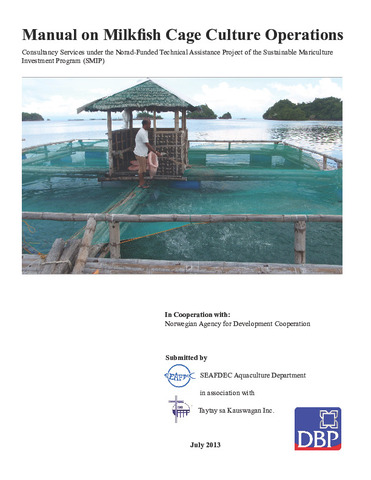
Manual on milkfish cage culture operations
(Aquaculture Department, Southeast Asian Fisheries Development Center, 2013-07)Milkfish (Chanos chanos, or bangus) culture is the largest finfish aquaculture industry in the Philippines and continues to be a top aquaculture commodity primarily because it is easy to culture and can be grown in a wide range of environments. Milkfish thrives in freshwater, brackishwater, marine, and even hypersaline habitats. Milkfish production is increasing rapidly with much of the production moving away from the traditional culture in brackishwater ponds to fish cages in coastal marine waters. To provide a general view of the milkfish culture industry, brief descriptions on breeding, hatchery production, and nursery operation are included in this manual. This manual is meant to serve as a guide for those interested to venture into marine cage farming of milkfish. Milkfish culture has been practiced in the Philippines, Indonesia, and Taiwan for centuries and has been the focus of aquaculture research in a number of institutions for several decades. Innovations in culture practices as a result of information from research data and from farmer’s experiences have been adopted by industry practitioners and these are documented in the recently published book entitled Milkfish Aquaculture in Asia (Liao and Leano, 2010). The recent concern about the rapid growth of aquaculture and its possible environmental impacts, and risks that can threaten the sustainability of this expanding industry has also been the subject of many conferences to develop good management practices in aquaculture. Principles and guidelines on better management practices in marine finfish culture had been drafted and included in this manual. -
Evaluation standard for assessing mariculture parks
(Aquaculture Department, Southeast Asian Fisheries Development Center, 2013-07)The Evaluation Standard for the Sustainable Mariculture Investment Program (SMIP) of the Development Bank of the Philippines (DBP) is designed to provide an objective and detailed mechanism for assessing investment ... -
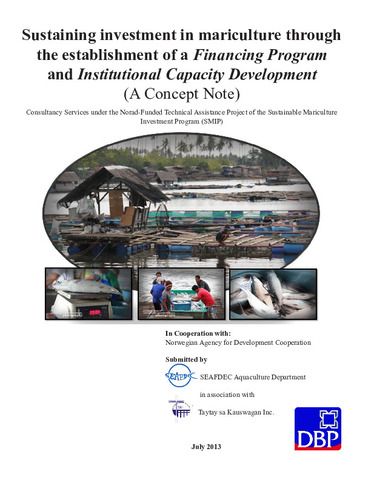
Sustaining investment in mariculture through the establishment of a financing program and institutional capacity development (a concept note)
(Aquaculture Department, Southeast Asian Fisheries Development Center, 2013-07)