Browsing SEAFDEC/AQD-Government of Japan-Trust Fund (GOJ-TF) by Title
Now showing items 1-20 of 172
-
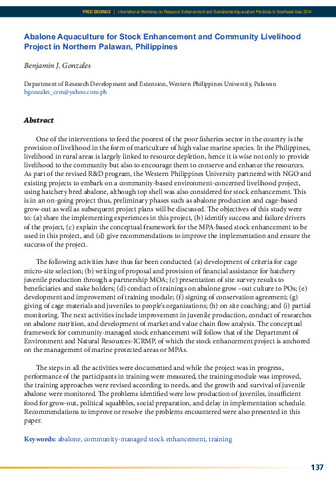
Abalone aquaculture for stock enhancement and community livelihood project in northern Palawan, Philippines
(Aquaculture Department, Southeast Asian Fisheries Development Center, 2015)One of the interventions to feed the poorest of the poor fisheries sector in the country is the provision of livelihood in the form of mariculture of high value marine species. In the Philippines, livelihood in rural areas ... -
Advances in diagnosis and management of shrimp virus diseases in the Americas
(Aquaculture Department, Southeast Asian Fisheries Development Center, 2002)The most important diseases of cultured penaeid shrimp, in terms of economic impact, in Asia, the Indo-Pacific, and the Americas, have infectious etiologies. Although diseases with bacterial, fungal, and parasitic etiologies ... -
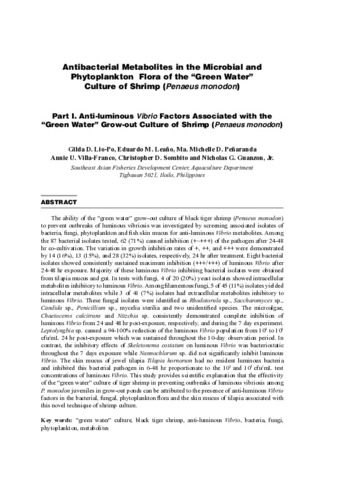
Antibacterial metabolites in the microbial and phytoplankton flora of the "green water" culture of shrimp (Penaeus monodon): Part I. Anti-luminous vibrio factors associated with the "green water" grow-out culture of shrimp (Penaeus monodon)
(Aquaculture Department, Southeast Asian Fisheries Development Center, 2005-03)The ability of the “green water” grow-out culture of black tiger shrimp (Penaeus monodon) to prevent outbreaks of luminous vibriosis was investigated by screening associated isolates of bacteria, fungi, phytoplankton and ... -
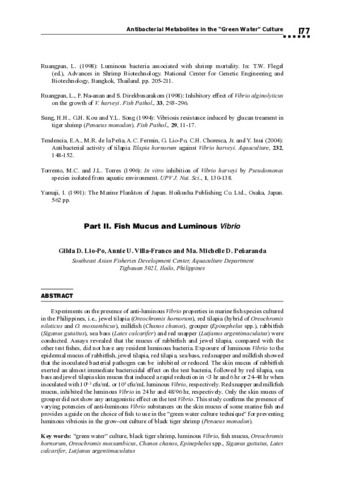
Antibacterial metabolites in the microbial and phytoplankton flora of the "green water" culture of shrimp (Penaeus monodon): Part II. Fish mucus and luminous Vibrio
(Aquaculture Department, Southeast Asian Fisheries Development Center, 2005-03)Experiments on the presence of anti-luminous Vibrio properties in marine fish species cultured in the Philippines, i.e., jewel tilapia (Oreochromis hornorum), red tilapia (hybrid of Oreochromis niloticus and O. mossambicus), ... -
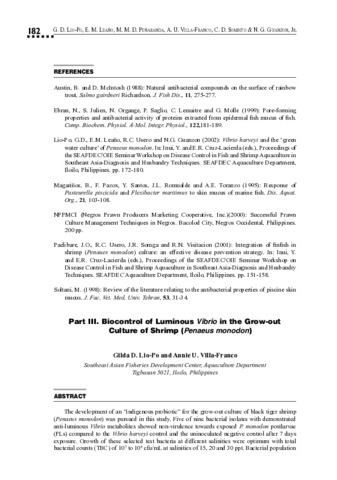
Antibacterial metabolites in the microbial and phytoplankton flora of the "green water" culture of shrimp (Penaeus monodon): Part III. Biocontrol of luminous Vibrio in the grow-out culture of shrimp (Penaeus monodon)
(Aquaculture Department, Southeast Asian Fisheries Development Center, 2005-03)The development of an “indigenous probiotic” for the grow-out culture of black tiger shrimp (Penaeus monodon) was pursued in this study. Five of nine bacterial isolates with demonstrated anti-luminous Vibrio metabolites ... -
Appendices: Diseases in farmed mud crabs Scylla spp.
(Aquaculture Department, Southeast Asian Fisheries Development Center, 2004) -
Application of DNA-based markers in stock enhancement programs
Romana-Eguia, Maria Rowena R. (Aquaculture Department, Southeast Asian Fisheries Development Center, 2006)
Aquaculture and fisheries management require tools for identifying individuals or groups of aquatic organisms for the purpose of monitoring performance (growth, survival and behavior) and stock structure. In aquaculture ...
(Aquaculture Department, Southeast Asian Fisheries Development Center, 2006)
Aquaculture and fisheries management require tools for identifying individuals or groups of aquatic organisms for the purpose of monitoring performance (growth, survival and behavior) and stock structure. In aquaculture ... -
Application of the United States Soybean Export Council program's soy-optimized floating feeds and low volume, high density cage aquaculture technologies
(Aquaculture Department, Southeast Asian Fisheries Development Center, 2015)The United States Soybean Export Council s (USSEC) Soy-In-Aquaculture (SIA) project in the Philippines introduced the Low Volume High Density (LVHD) cage culture production methodology in 2003. The aim of this technology ... -
AquaHealth Online: A new learning environment for capacity building in aquatic animal health
(Aquaculture Department, Southeast Asian Fisheries Development Center, 2004)Due to significant requirement of trained personnel in Fish Health Management, the Aquaculture Department of the Southeast Asian Fisheries Development Center (SEAFDEC/AQD) offered 14 sessions of face-to-face (F2F) training ... -
ASEAN-SEAFDEC directives related to species of international concern
(Aquaculture Department, Southeast Asian Fisheries Development Center, 2006)To achieve sustainable fisheries for food security in the ASEAN region, the Resolution (RES) and Plan of Action (POA) urge the Member Countries to rectify their fisheries practices through improvement of existing fisheries ... -
Assessment of humphead wrasse (Cheilinus undulatus), spawning aggregations and declaration of marine protected area as strategy for enhancement of wild stocks
(Aquaculture Department, Southeast Asian Fisheries Development Center, 2015)Humphead wrasse, known as the Napoleon fish (Cheilinus undulatus), is the largest living member of the family Labridae. It is slow growing but can grow to a maximum size exceeding 2 m and 190 kg. This species was the first ... -
Background and objectives of the Meeting on Current Status of Transboundary Fish Diseases in Southeast Asia: Occurrence, Surveillance, Research and Training
(Aquaculture Department, Southeast Asian Fisheries Development Center, 2004) -
Background and objectives of the Regional Fish Disease Project
(Aquaculture Department, Southeast Asian Fisheries Development Center, 2005-03) -
Bacterial diseases
Tendencia, Eleonor; (Aquaculture Department, Southeast Asian Fisheries Development Center, 2004)
Bacteria are very common in the aquatic environment. Most bacterial disease agents are part of the normal flora of the water. They cause disease only when the fish are stressed due to poor environmental conditions, inadequate ... -
Bacterial isolation, identification and storage
; Tendencia, Eleonor (Aquaculture Department, Southeast Asian Fisheries Development Center, 2004)
Bacterial isolation, purification and identification are the first steps to bacteriological studies. Isolation is done to obtain pure bacterial cultures. Bacteria are usually isolated from fish kidney and spleen; and from ... -
BFAR-CHED Philippine National Aquasilviculture Program (PNAP) in Bataan
(Aquaculture Department, Southeast Asian Fisheries Development Center, 2015)Under the Philippine Aquasilviculture Program, the Bataan Peninsula State University (BSPU) rehabilitated denuded mangrove resources, established aquasilviculture technology demonstration projects as a livelihood option ... -
Biology and pathogenicity of the gill monogenean of grouper (Epinephelus coioides) cultured in the Philippines
(Aquaculture Department, Southeast Asian Fisheries Development Center, 2005-03)The diplectanid monogenean Pseudorhabdosynochus lantauensis was the most abundant parasite recovered from the gills of cultured orange-spotted grouper (Epinephelus coioides) in the Philippines. The morphology of P. lantauensis ... -
Biology and status of aquaculture for giant clams (Tridacnidae) in the Ryukyu Islands, southern Japan
(Aquaculture Department, Southeast Asian Fisheries Development Center, 2006)The Ryukyu Islands consist of many islands located between Kyushu in mainland Japan and Taiwan. The islands in the south-western area of the Ryukyu Islands belong to the Okinawa Prefecture. The Ryukyu Islands are strongly ... -
Chlorine disinfection against hepatopancreatic parvovirus (HPV) infection in shrimp (Penaeus monodon) larvae
(Aquaculture Department, Southeast Asian Fisheries Development Center, 2005-03)Experiments were undertaken to determine the efficacy of chlorine as a disinfectant in inhibiting HPV infection among P. monodon postlarvae (PLs). Based on histopathological examination, 50 ppm and 200 ppm active chlorine ... -
Community-based shrimp stock enhancement for coastal socio-ecological restoration in the Philippines
(Aquaculture Department, Southeast Asian Fisheries Development Center, 2015)The reality of declining quality of coastal areas has been evident for many developing countries, especially in Southeast Asia. In the Philippines, rural coastal zones and estuaries are now being characterized by declining ...