Conference Proceedings: Recent submissions
Now showing items 341-360 of 767
-
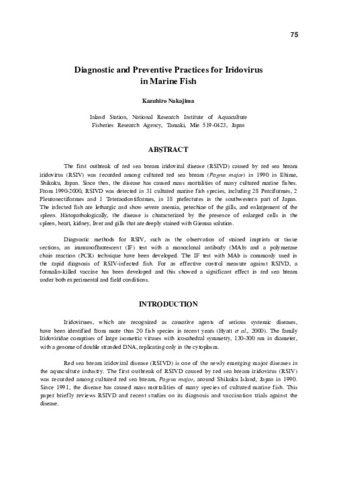
Diagnostic and preventive practices for iridovirus in marine fish
(Aquaculture Department, Southeast Asian Fisheries Development Center, 2002)The first outbreak of red sea bream iridoviral disease (RSIVD) caused by red sea bream iridovirus (RSIV) was recorded among cultured red sea bream (Pagrus major) in 1990 in Ehime, Shikoku, Japan. Since then, the disease has caused mass mortalities of many cultured marine fishes. From 1990-2000, RSIVD was detected in 31 cultured marine fish species, including 28 Perciformes, 2 Pleuronectiformes and 1 Teteraodontiformes, in 18 prefectures in the southwestern part of Japan. The infected fish are lethargic and show severe anemia, petechiae of the gills, and enlargement of the spleen. Histopathologically, the disease is characterized by the presence of enlarged cells in the spleen, heart, kidney, liver and gills that are deeply stained with Giemsa solution. Diagnostic methods for RSIV, such as the observation of stained imprints or tissue sections, an immunofluorescent (IF) test with a monoclonal antibody (MAb) and a polymerase chain reaction (PCR) technique have been developed. The IF test with MAb is commonly used in the rapid diagnosis of RSIV-infected fish. For an effective control measure against RSIVD, a formalin-killed vaccine has been developed and this showed a significant effect in red sea bream under both experimental and field conditions. -
Diagnostic and preventive practices for WSSV in Japan
(Aquaculture Department, Southeast Asian Fisheries Development Center, 2002)White spot syndrome (WSS), considered equivalent to PAV (penaeid acute viremia) in Japan, has become the most serious problem not only in the farming industry but also in hatcheries for sea ranching of kuruma prawn, Penaeus japonicus. The prevalence of WSSV (white spot syndrome virus), the causative agent of WSS, was examined in wild kuruma prawn broodstocks by nested PCR (polymerase chain reaction). As a result, WSSV was detected at the highest prevalence (10.1%) in the ovary of female prawn. This result indicates that spawners are sources of infection. In 1997, brooders were pre-screened using PCR to detect WSSV before these spawned. WSSV was noted to occur in postlarvae obtained from brooders caught between July and August. In 1998 and 1999, eggs were selected based on WSSV detection by PCR from receptaculum seminis of spawned broodstock. Consequently, WSSV did not occur in their offsprings in both years. These results strongly indicate that selection of eggs based on PCR results is a practical way of controlling WSSV in hatcheries. -
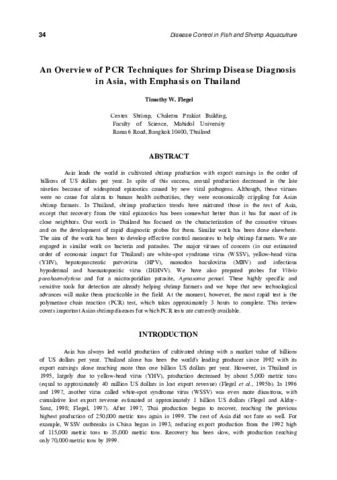
An overview of PCR techniques for shrimp disease diagnosis in Asia, with emphasis on Thailand
(Aquaculture Department, Southeast Asian Fisheries Development Center, 2002)Asia leads the world in cultivated shrimp production with export earnings in the order of billions of US dollars per year. In spite of this success, annual production decreased in the late nineties because of widespread epizootics caused by new viral pathogens. Although, these viruses were no cause for alarm to human health authorities, they were economically crippling for Asian shrimp farmers. In Thailand, shrimp production trends have mirrored those in the rest of Asia, except that recovery from the viral epizootics has been somewhat better than it has for most of its close neighbors. Our work in Thailand has focused on the characterization of the causative viruses and on the development of rapid diagnostic probes for them. Similar work has been done elsewhere. The aim of the work has been to develop effective control measures to help shrimp farmers. We are engaged in similar work on bacteria and parasites. The major viruses of concern (in our estimated order of economic impact for Thailand) are white-spot syndrome virus (WSSV), yellow-head virus (YHV), hepatopancreatic parvovirus (HPV), monodon baculovirus (MBV) and infectious hypodermal and haematopoeitic virus (IHHNV). We have also prepared probes for Vibrio parahaemolyticus and for a microsporidian parasite, Agmasoma penaei. These highly specific and sensitive tools for detection are already helping shrimp farmers and we hope that new technological advances will make them practicable in the field. At the moment, however, the most rapid test is the polymerase chain reaction (PCR) test, which takes approximately 3 hours to complete. This review covers important Asian shrimp diseases for which PCR tests are currently available. -
Advances in diagnosis and management of shrimp virus diseases in the Americas
(Aquaculture Department, Southeast Asian Fisheries Development Center, 2002)The most important diseases of cultured penaeid shrimp, in terms of economic impact, in Asia, the Indo-Pacific, and the Americas, have infectious etiologies. Although diseases with bacterial, fungal, and parasitic etiologies are also important, certain virus-caused diseases stand out as the most significant. The pandemics due to the penaeid viruses WSSV, TSV, YHV, and IHHNV have collectively cost the penaeid shrimp industry billions of dollars in lost crops, jobs, and export revenue. Although not as sudden nor as catastrophic in their onset and course, certain bacterial, fungal, and parasitic diseases of shrimp have also been responsible for very significant production losses, and the relative importance of many of these diseases should not be discounted. The social and economic impacts of the pandemics caused by WSSV and TSV have been especially profound in the Americas, and in the wake of these viral pandemics the shrimp culture industry has sought ways to restore the industry’s levels of production to the “pre-virus” years. Central to improving disease) prevention and management strategies is the incorporation of the concepts of biosecurity into shrimp farm design and operational strategies. Disease management in shrimp aquaculture is an important component to biosecurity of farms and to the sustainability of individual farms, shrimp farming countries, or entire geographic regions. The first step in disease management requires the availability of accurate and reliable diagnostic methods and knowledge of the biology of the diseases of concern. The recognition of the need for biosecurity and disease management in the Americas is reflected in the recent proliferation of shrimp disease diagnostic laboratories in the Americas. Where there were only a handful of shrimp disease diagnostic laboratories a decade ago, there are 40 or more such laboratories serving the industry today. Diagnostic methods may be applied to determining the cause of disease(s) that are adversely affecting the culture performance or survival of farmed shrimp stocks or they may be used for surveillance purposes to screen for the presence of specific pathogens in otherwise healthy shrimp for the purpose of disease control. As diagnostic methods have improved and become more widely available, the interest in culturing specific pathogen-free (SPF) shrimp stocks in biosecure facilities has increased markedly in many regions in the Americas. The methods being used in shrimp disease diagnostic laboratories in the Americas were recently surveyed. Of the 40 laboratories contacted, 27 responded to the survey. Approximately 75% of the labs responding to the survey provide diagnostic services using both molecular (PCR, RT-PCR and gene probes) and classical (routine histology and microbiology) methods, while nearly all (93%) of the diagnostic labs offer diagnostic testing and screening services based on molecular methods (i.e. assays with gene probes and PCR/RT-PCR). -
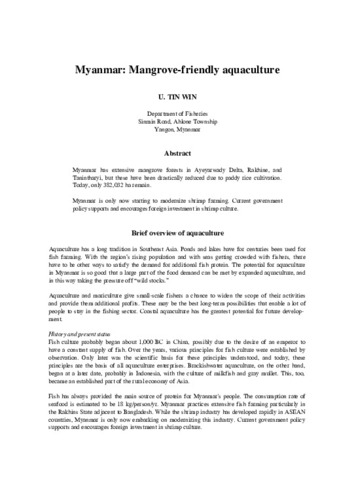
Myanmar: Mangrove-friendly aquaculture
(Aquaculture Department, Southeast Asian Fisheries Development Center, 2000)Myanmar has extensive mangrove forests in Ayeyarwady Delta, Rakhine, and Tanintharyi, but these have been drastically reduced due to paddy rice cultivation. Today, only 382,032 ha remain. Myanmar is only now starting to modernize shrimp farming. Current government policy supports and encourages foreign investment in shrimp culture. -
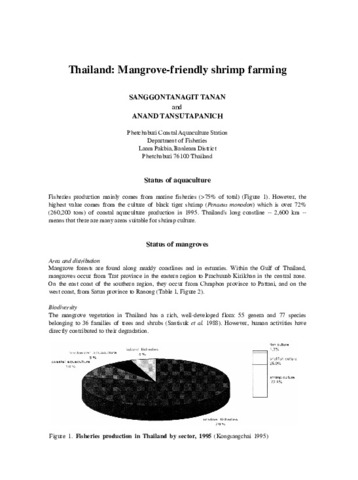
Thailand: Mangrove-friendly shrimp farming
(Aquaculture Department, Southeast Asian Fisheries Development Center, 2000) -
Cambodia: Mangrove-friendly aquaculture
(Aquaculture Department, Southeast Asian Fisheries Development Center, 2000)Cambodia has 435 km of coastline with 85,000 ha of mangrove forest. A big part of the mangrove area is in Koh Kong province (63,700) where intensive shrimp culture activity is also concentrated. Shrimp (Penaeus monodon) farms occupy 850 ha, producing 450 tons/yr (1995). But lately, production decreased by 20% due to diseases and self-pollution. The government has since placed restrictions on shrimp farming. -
Indonesia: Mangrove-friendly aquaculture
(Aquaculture Department, Southeast Asian Fisheries Development Center, 2000)The paper describes the mangrove forests in Indonesia, the most extensive in the world. It also describes the causes for their destruction, and the government intervention for aquaculture development ("tambak") and mangrove area conservation ("tambak tumpangsari"). A strategic plan for improving the mangrove areas is presented, including a development program for coastal planning and land zoning process. The paper concludes that "tambak" will continue to be developed to expand fish production. The statement is based on Indonesia's rate of population increase vis-a-vis the certain decrease in natural resources on a per capita basis. Aquaculture would continue to expand while capture fishery declines. Thus, a socio-economic shift to other employment alternatives would be necessary. -
Viet Nam: Mangrove-friendly aquaculture
(Aquaculture Department, Southeast Asian Fisheries Development Center, 2000) -
Philippines: Mangrove-friendly aquaculture
(Aquaculture Department, Southeast Asian Fisheries Development Center, 2000)Mangrove areas in the Philippines were once considered vast tracts of wasteland that can be developed into other land uses. The economic "advantages" associated with such exploitation were considered socially "valuable" to human communities. Such advantages and exploitation, however, are now questioned, with the cost to society reevaluated. This paper discusses the factors causing mangrove deforestation with emphasis on aquaculture. Existing and future programs like the government's Coastal Resource Management project for the implementation of mangrove-friendly aquaculture are presented. Research needs and problems affecting mangrove management are likewise discussed. -
Integrated mangrove forest and aquaculture systems in Indonesia
(Aquaculture Department, Southeast Asian Fisheries Development Center, 2000)Silvofisheries is a form of integrated mangrove tree culture with brackishwater aquaculture. It is a form of low input sustainable aquaculture. This integrated approach to conservation and utilization of the mangrove resource allows for maintaining a relatively high level of integrity in the mangrove area while capitalizing on the economic benefits of brackishwater aquaculture. Silvofisheries is being promoted in Indonesia as part of a mangrove rehabilitation, conservation and management program. Pond-based silvofisheries follow three design models: (1) the basic “empang parit” model that is essentially identical to an extensive aquaculture pond with maintenance of mangrove trees on the central platform; (2) modification of the basic model to include a dike constructed around the treed central platform so that the water level within the mangrove area and the open water perimeter culture area can be controlled separately; and (3) further modification of the second model to completely separate the open water culture area from the mangrove area by a gated dike with the pond culture area consolidated to a square or rectangular shape at the end of the enclosed diked area. The ratio of mangrove tree to open water culture area is 8:2 to 6:4. In addition, various methods of minimizing the costs associated with pond construction are being considered. This includes the cultivation of mangrove crabs (Scylla sp.) in pens. The State Forestry Company in Indonesia has successfully developed and implemented silvofisheries sites (e.g., 6,000 ha in West Java-Cikiong with 1,508 farmers; 5,300 ha in Blanakan with 2,060 farmers). A conditional lease program with non-government organizations providing technical assistance to farmers has been successful. This program exemplifies what can be accomplished in mangrove rehabilitation and management within a controlled and enforced program. Production and financial return from silvofishery varies with the system, site characteristics, the level of energy input (mainly from mangrove litter - green manure) and utilization by cultured species, among other factors. Annual profit of up to $2,000/ha/yr for a milkfish and shrimp polyculture silvofisheries system has been reported. There is a need to refine data and analysis, since all costs are often not included, and revenue projections are often based on expected production rather than actual production. Farm interviews in West Java showed a range in gross income from $313 to $946/ha/yr while net profit per individual farm (1.5-10 ha farm size) ranged from $943 to $1,558/farm/yr. There was greater production effort per unit area by farmers with smaller farms. Individual silvofishery farmers often combine incomes from multiple sources. The application of silvofisheries practices requires reasonable measures of caution as with any activity in an environmentally sensitive area as the mangroves. Additional important considerations in the development of silvofisheries as part of an activity within the mangrove ecosystem include the issues of land ownership, integrated coastal zone planning and development, comparative economic assessment, systems models, optimizing use of inputs, selection of mangrove tree and aquaculture species, better understanding of trophic production and food web utilization, and improvement of economic return. -
Silvofishery: An aquaculture system harmonized with the environment
(Aquaculture Department, Southeast Asian Fisheries Development Center, 2000)Mangrove forests are valuable biologically and economically, but these have been decreasing yearly. It is usually converted into human settlement and for brackishwater aquaculture. To arrest the massive decrease of mangrove forests, reforestation of mangroves has been done but most failed because of conflict among users. To resolve such problems, a system that combines utilization and conservation called silvofisheries has been introduced. Costs-and-returns of silvofishery ponds per year differ depending on scale and type of species cultured. The following are necessary to maintain the silvofishery pond in good condition: good site and design, suitable vegetation, high economic value of target organisms, good water quality and quantity, and optimal rearing conditions (stocking density, adequate feeding, etc.). -
Japan: Mangrove areas and their utilization
(Aquaculture Department, Southeast Asian Fisheries Development Center, 2000)Although Japan has large-scale aquaculture, there is no aquaculture development in mangrove areas because the total area is small (553 ha) and strictly protected. Mangroves are preserved in comparatively good condition. Future development of aquaculture in mangrove areas is considered small-scale. Rather than aquaculture, Japan practices enhancement and management of wild fisheries. Tourism is another industry that would have an important role in mangrove utilization. But basic research on mangrove ecosystems is essential prior to determining policies for utilization of mangrove areas. International cooperative research work is important to encourage mangrove-friendly aquaculture and protect the environment. -
Brunei Darussalam: Mangrove-friendly aquaculture
(Aquaculture Department, Southeast Asian Fisheries Development Center, 2000)Aquaculture in Brunei Darussalam is quite recent compared to other countries. Cage culture of marine fishes and pond culture of marine shrimp are popular. Mangrove area utilized for aquaculture (shrimp ponds) is very minimal, 190 ha of the total 18,418 ha. This report describes the status of mangroves and practices of aquaculture in Brunei Darussalam. -
Malaysia: Mangrove-friendly aquaculture
(Aquaculture Department, Southeast Asian Fisheries Development Center, 2000)The paper describes some mangrove-friendly aquaculture activities that are practiced in Malaysia. Among these are the culture of cockle and oyster, semi-intensive culture of tiger prawn, fish cage culture, and pen culture of mud crab. Policies, regulations, future directions and priority areas in research and development that can contribute to sustainable mangrove utilization are discussed. -
Mangrove-Friendly Aquaculture : Proceedings of the Workshop on Mangrove-Friendly Aquaculture organized by the SEAFDEC Aquaculture Department, January 11-15, 1999, Iloilo City, Philippines
(Aquaculture Department, Southeast Asian Fisheries Development Center, 2000)The proceedings have three review papers on the mangroves of Southeast Asia, silvofisheries, and Indonesia's integrated mangrove forest and aquaculture systems. The rest of the papers, all on mangrove-friendly aquaculture efforts are from the Philippines, Japan, Thailand, Vietnam, Malaysia, Brunei Darussalam, Indonesia, and Cambodia. All the countries represented had varied methodologies, with Cambodia in its initial stages while some countries like Indonesia and Thailand have tested methodologies. The proceedings include a tabulation of the reported mangrove-friendly technology by country -- e.g. silvofisheries in ponds (mangrove and fish/shrimp/mudcrab) and pens (mangrove and mudcrab). The workshop recommendations are classified into three major topics: problems associated with mangroves, problems associated with aquaculture practices, and socioeconomic and cultural issues. -
Proceedings of the Aquaculture Workshop for SEAFDEC/AQD Training Alumni, 8-11 September 1992, Iloilo, Philippines
(Aquaculture Department, Southeast Asian Fisheries Development Center, 1993)The workshop was conducted to maintain linkage between Southeast Asian Fisheries Development Center, Aquaculture Department and its alumni. It also aimed to: assess the effectiveness of the training alumni and among trainees; inform alumni of the recent technologies developed by the Department; recommend ways to make the training courses more responsive to the needs of the fish farmers and the aquaculture industry. The training alumni identified several problems regarding the capability of the technical staff in aquaculture, i.e. shrimp seed production, marine fish seed production, grow-out culture, and fish diseases. The contributions of the selected participants during the meeting which are contained in this volume are cited individually. -
Prawn industry development in the Philippines: proceedings of the National Prawn Industry Development Workshop, 10-13 April 1984, Iloilo City, Philippines
(Aquaculture Department, Southeast Asian Fisheries Development Center, 1984) -
Advances in milkfish biology and culture: proceedings of the Second International Milkfish Aquaculture Conference, 4-8 October 1983, Iloilo City, Philippines
(Aquaculture Department, Southeast Asian Fisheries Development Center; International Development Research Centre; Island Publishing House, Inc., 1984)Abstracts of the 17 papers presented at the conference are cited individually in this issue. -
Perspectives in aquaculture development in Southeast Asia and Japan: Proceedings of the Seminar on Aquaculture Development in Southeast Asia, Iloilo City, Philippines, 8-12 September 1987
(Aquaculture Department, Southeast Asian Fisheries Development Center, 1988)This proceedings is a comprehensive account of the seminar and contains the papers read and discussed at the sessions, and the recommendations reached and formulated.