Conference Proceedings: Recent submissions
Now showing items 261-280 of 767
-
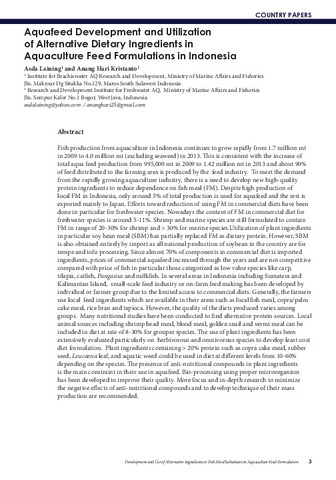
Aquafeed development and utilization of alternative dietary ingredients in aquaculture feed formulations in Indonesia
(Aquaculture Department, Southeast Asian Fisheries Development Center, 2015)Fish production from aquaculture in Indonesia continues to grow rapidly from 1.7 million mt in 2009 to 4.0 million mt (excluding seaweed) in 2013. This is consistent with the increase of total aqua feed production from 995,000 mt in 2009 to 1.42 million mt in 2013 and about 90% of feed distributed to the farming area is produced by the feed industry. To meet the demand from the rapidly growing aquaculture industry, there is a need to develop new high-quality protein ingredients to reduce dependence on fish meal (FM). Despite high production of local FM in Indonesia, only around 5% of total production is used for aquafeed and the rest is exported mainly to Japan. Efforts toward reduction of using FM in commercial diets have been done in particular for freshwater species. Nowadays the content of FM in commercial diet for freshwater species is around 5-11%. Shrimp and marine species are still formulated to contain FM in range of 20-30% for shrimp and > 30% for marine species.Utilization of plant ingredients in particular soy bean meal (SBM) has partially replaced FM as dietary protein. However, SBM is also obtained entirely by import as all national production of soybean in the country are for tempe and tofu processing. Since almost 70% of components in commercial diet is imported ingredients, prices of commercial aquafeed increased through the years and are not competitive compared with price of fish in particular those categorized as low value species like carp, tilapia, catfish, Pangasius and milkfish. In several areas in Indonesia including Sumatera and Kalimantan Island, small-scale feed industry or on-farm feed making has been developed by individual or farmer group due to the limited access to commercial diets. Generally, the farmers use local feed ingredients which are available in their areas such as local fish meal, copra/palm cake meal, rice bran and tapioca. However, the quality of the diets produced varies among groups. Many nutritional studies have been conducted to find alternative protein sources. Local animal sources including shrimp head meal, blood meal, golden snail and vermi meal can be included in diet at rate of 8-30% for grouper species. The use of plant ingredients has been extensively evaluated particularly on herbivorous and omnivorous species to develop least-cost diet formulation. Plant ingredients containing > 20% protein such as copra cake meal, rubber seed, Leucaena leaf, and aquatic weed could be used in diet at different levels from 10-60% depending on the species. The presence of anti-nutritional compounds in plant ingredients is the main constraint in their use in aquafeed. Bio-processing using proper microorganism has been developed to improve their quality. More focus and in-depth research to minimize the negative effects of anti-nutritional compounds and to develop technique of their mass production are recommended. -
Status of development and use of alternative ingredients in aquaculture feed formulations in Singapore
(Aquaculture Department, Southeast Asian Fisheries Development Center, 2015)The aquaculture industry in Singapore started in 1980s. The country has approximately 130 aquaculture farms, mostly located in the western part of the country. Aquaculture production mainly comes from coastal farms and the cultured fishes are milkfish, mullet, Asian sea bass, grouper, snapper, and pompano. With regard to land-based farms, the fish produced are mainly freshwater fish species such as catfish, tilapia, snakehead, gourami, marble goby and various species of carps. In 2013, the aquaculture industry produced approximately 4,200 metric tons (mt) which represented 8% of the entire country s fish consumption. The rest of the fish and other aquatic products consumed by the populace were imported from the neighboring countries and from Norway for salmon. -
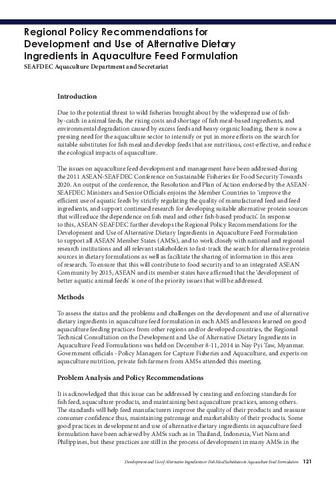
Regional policy recommendations for development and use of alternative dietary ingredients in aquaculture feed formulation
(Aquaculture Department, Southeast Asian Fisheries Development Center, 2015)The paper presents the key problems on development and use of alternative dietary ingredients in aquaculture feed formulations in Southeast Asia based on the discussion and reviews during the Regional Technical Consultation. Policy recommendations are also presented. -
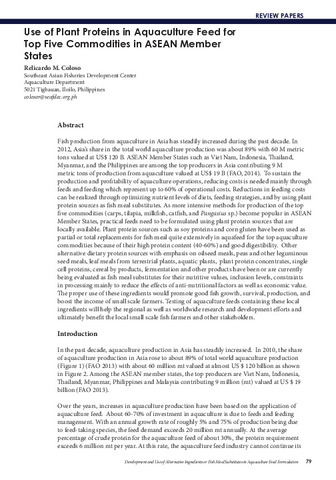
Use of plant proteins in aquaculture feed for top five commodities in ASEAN member states
(Aquaculture Department, Southeast Asian Fisheries Development Center, 2015)Fish production from aquaculture in Asia has steadily increased during the past decade. In 2012, Asia s share in the total world aquaculture production was about 89% with 60 M metric tons valued at US$ 120 B. ASEAN Member States such as Viet Nam, Indonesia, Thailand, Myanmar, and the Philippines are among the top producers in Asia contributing 9 M metric tons of production from aquaculture valued at US$ 19 B (FAO, 2014). To sustain the production and profitability of aquaculture operations, reducing costs is needed mainly through feeds and feeding which represent up to 60% of operational costs. Reductions in feeding costs can be realized through optimizing nutrient levels of diets, feeding strategies, and by using plant protein sources as fish meal substitutes. As more intensive methods for production of the top five commodities (carps, tilapia, milkfish, catfish, and Pangasius sp.) become popular in ASEAN Member States, practical feeds need to be formulated using plant protein sources that are locally available. Plant protein sources such as soy proteins and corn gluten have been used as partial or total replacements for fish meal quite extensively in aquafeed for the top aquaculture commodities because of their high protein content (40-60%) and good digestibility. Other alternative dietary protein sources with emphasis on oilseed meals, peas and other leguminous seed meals, leaf meals from terrestrial plants, aquatic plants, plant protein concentrates, single cell proteins, cereal by products, fermentation and other products have been or are currently being evaluated as fish meal substitutes for their nutritive values, inclusion levels, constraints in processing mainly to reduce the effects of anti-nutritional factors as well as economic value. The proper use of these ingredients would promote good fish growth, survival, production, and boost the income of small scale farmers. Testing of aquaculture feeds containing these local ingredients will help the regional as well as worldwide research and development efforts and ultimately benefit the local small scale fish farmers and other stakeholders. -
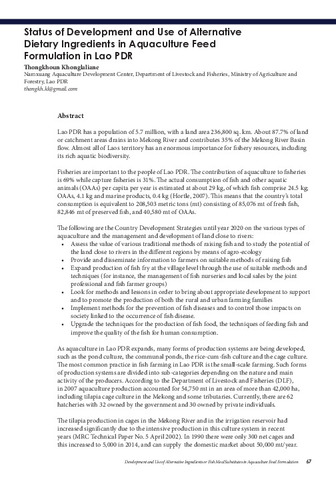
Status of development and use of alternative dietary ingredients in aquaculture feed formulation in Lao PDR
(Aquaculture Department, Southeast Asian Fisheries Development Center, 2015)Lao PDR has a population of 5.7 million, with a land area 236,800 sq. km. About 87.7% of land or catchment areas drains into Mekong River and contributes 35% of the Mekong River Basin flow. Almost all of Laos territory has an enormous importance for fishery resources, including its rich aquatic biodiversity. -
Use of plant protein sources in aquafeed for high value marine species in ASEAN member states
(Aquaculture Department, Southeast Asian Fisheries Development Center, 2015)Cultured marine aquatic species are predominantly carnivorous. Major species in the region are seabass, grouper, snapper, tiger shrimp, mangrove crab and abalone. These species, except for abalone, require a high level of dietary protein mostly supplied by marine sources such as fish meal. Global production of marine fish and marine shrimps showed a 3-4 fold increase from 1995 to 2010. For the same period, the usage of commercial feed for production of marine fish and shrimps increased while the fish meal portion in the formulation decreased. This is indicative of fish meal being substituted with alternative sources in commercial feed production, and to some extent the substitution of marine oil which particularly improved the FCR for the marine fish production from 2.0 to 1.9 and for marine shrimps from 2.0 to 1.6. Plant products that include cereal grains, legumes and oilseeds have the most potential among the alternative ingredients for use in aquafeed. The use of these resources for high value marine species is limited due to a variety of anti-nutritional substances they contain. Removal of these substances by processing techniques has improved utilization but with added cost. Hence, fish meal is still the primary source of protein for marine carnivores and its substitution with higher amounts of alternative plant proteins may be difficult compared with lower levels of replacements. The Asian region has accounted for the more than 50% of the total global aquaculture production in 2012 with indications of increased utilization of alternative protein sources in commercial feed production. For the major marine species in the region the increasing trend of plant protein usage with the targeted levels of substitution of fish meal with plant protein sources should be sustainable. -
A new type of fish diet, non-fish meal extruded pellet for yellowtail, Seriola quinqueradiata
(Aquaculture Department, Southeast Asian Fisheries Development Center, 2015)A non-fish meal diet using plant and/or animal protein materials for yellowtail, Seriola quinqueradiata was developed. Three kinds of non-fish meal diets and a control diet containing 50% fish meal were processed. In the non-fish meal diets, the fish meal was replaced with commercially available plant or animal materials and supplemented with taurine and other ingredients for maintaining palatability. These diets were fed to one year old yellowtail (body weight: 753±96 g) in net cages. No significant differences in growth, daily weight gain, daily feed rate, feed conversion ratio and protein efficiency ratio were observed among fish given the diets. Non-fish meal diets were processed in a factory and their biological characteristics were studied such as uptake, stomach evacuation rate, and disease resistance. In addition, the diet palatability of each substitute protein source for fish was examined and ingredients that enhanced palatability of the non-fish meal diets were identified. Non-fish meal diets have the potential to support the growth of one year old yellowtail. -
Status and development and use of alternative dietary ingredients in aquaculture feed formulation in Malaysia
(Aquaculture Department, Southeast Asian Fisheries Development Center, 2015)In 2013, capture fisheries contributed 85% (1.48 million mt) of total fish production in Malaysia. An additional 17.6% (261,000 mt) was recorded as fish-by-catch (FBC). On the contrary, aquaculture contributed 15% (260,800 mt) of the total fish production (49.0% marine fish and 51.0% freshwater fish). An estimated 150,000 mt FBCs were processed to fish meal (FM) producing 30,000 mt FM annually. In 2013, 16,600 mt of FM, valued at MYR50 million (USD15.6 million) were exported while 7,700 mt valued at MYR33 million (USD10.3 million) were imported. FBCs may consist of fish, crustaceans, mollusks and others. The quality of each FBC sample differs depending on the amount of fish and varies with the season and fishing ground. The use of FM, plant protein sources and fish oil (FO) in the aquafeed industry is not known. However, based on marine fish and shrimp feed price, the use of FM and FO in aquafeed was estimated to be 30-40%. Studies on FM and FO replacement in aquafeed using poultry by-product meal, fermented shrimp head waste, soybean meal, palm oil and soybean oil as well as the use of biofloc technology in white shrimp farming were also discussed. In order to improve feed and feeding practices, Department of Fisheries, Malaysia conducted good aquaculture practices on feeding management, feed formulation and fish nutrition courses to stakeholders (farmers and government officials). In addition, there are measures taken to monitor feed and feeding practices through random auditing process in aquaculture farms in Malaysia based on Good Aquaculture Practices (MyGAP) and Animal Feed Act 2009. Due to the increasing price of FM and FO, the aquafeed industry has started to replace in the feed formulations since the increasing feed cost has hindered farmers from buying aquafeed. As a result, there were traces of porcine DNA detected in almost all commercial aquafeed. Additionally, aquaculture farmers tend to formulate their own farm-made aquafeed instead of using commercial pellets. Thus, in order to sustain fish production, Department Fisheries promotes farming and consumption of omnivorous and herbivorous fish species as tilapia, catfish and grass carp. In addition, the Department of Fisheries also organizes Aquaculture Practices Awareness programs among aquafeed manufacturers and farmers to implement relevant rules and act to reduce the use of FM and FO. Lastly, research and development on FM and FO substitution in aquafeed with locally available ingredients are still ongoing and being done by Department of Fisheries, universities and the private sector. -
Status of development and use of alternative dietary ingredients in aquaculture feed formulations in Cambodia
(Aquaculture Department, Southeast Asian Fisheries Development Center, 2015)Aquaculture production has been practised in Cambodia for centuries where usually high value fish are grown in cages and fed low value fish. The use of low value fish or trash fish as feed also provides a storage mechanism where seasonally abundant and cheap fish are fed to high value species. In 2014, the production from aquaculture was 120,000 metric tons (mt), an increase of 25% from 2013, along with production from rice fields with an increase of 15% at 160,000 mt. Wild-harvested fish production in 2014 from small-scale fisheries and marine fisheries were 345,005 mt and 120,250 mt, respectively. -
Development and use of alternative dietary ingredients for fish meal in Myanmar
(Aquaculture Department, Southeast Asian Fisheries Development Center, 2015)Myanmar is situated in the Southeast Asian region bordering China, Laos, Thailand, Bangladesh and India. It covers a fish landing total area of 677,000 km2 and about 526,000 hectares of marine swamp areas along its 2,800 km coastal length. One main river (Ayeyarwaddy) and other rivers, (Sittaung, Thanlwin and Chindwin), are conjugated with the sea at the Gulf of Martaban which makes the formation of very diverse aquatic animal species inhabitants in Myanmar waters. The geographical, climatic and natural conditions are so diverse and favorable that it is recognized as one of the richest natural fishing grounds in the region promising potential environments for aquaculture expansion. In Myanmar, there is significant potential for continued expansion and growth of aquaculture and culture based capture fisheries. -
Status on development and use of alternative dietary ingredients in aquaculture feed formulations in Viet Nam
(Aquaculture Department, Southeast Asian Fisheries Development Center, 2015)This paper reviewed fish catch production and estimated demand of aquafeed, fish meal, fish oil, soybean meal in Viet Nam for year 2013. Fish catch production was around 2.8 million metric tons (mt) while marine fish production was 1.9 million mt. Estimated marine trash fish production was 0.8 million mt with over 100 species including the dominant species anchovy (Stolephorus spp.), lizard fish (Saurida spp.) and pony fish (Leistognathus spp.). Approximately 0.5 million mt of marine trash fish was used for livestock, aquaculture and fish meal. Local marine fish meal consisting of protein content from 50 to 68% and catfish byproduct meal containing protein level from 50 to 60% were available. Based on FCR values of 5 major species including catfish, black tiger shrimp, white leg shrimp, Asian seabass, and snake head, aquafeed production was estimated at around 2.5 million mt. Marine fish oil/squid liver oil requirement was from 15.5 to 31 thousand mt. Fish meal demand was from 252 and 430 thousand mt. Almost all fish meal and marine fish oil used in aquafeed were imported. Moreover, soybean and other plant ingredients are potential alternative sources to replace fish meal and fish oil. Vietnamese farmers produced 168 thousand mt soybean while soybean demand amounts for aquafeed were from 693 to 1,140 thousand mt. In 2013, feedmills imported approximately 3 million mt of soybean meal (cake) from many countries in the world. Some other plant protein sources which were also imported, have good nutrient profiles but they contain some anti-nutritional factors. In the future, research on replacement of fish meal and fish oil with plant and animal by-product sources and feed additives for aquafeed should be studied. In particular, the management of local fish meal plants and capture fishery should be improved. -
Processing of alternative feed ingredients in aquaculture feed
(Aquaculture Department, Southeast Asian Fisheries Development Center, 2015)Fish meal and fish oil have been used worldwide in aquaculture feed formulations. Production of these ingredients has been relatively constant for decades. However, supplies of industrial fisheries are limited, and unlikely to be able to support increasing demand for these products for a growing aquaculture industry. Finding alternative ingredients therefore, is necessary to address the long-term sustainable growth of aquaculture globally, thereby meeting projected increases in consumer demand for safe, high quality farmed aquatic food. Potential alternative ingredients have been identified, mostly coming from plant-derived nutrient sources, such as seeds, grains, leaves and other agricultural by-products. The use of these alternative ingredients however, may cause anti-nutrient inclusion in the feedstuffs that may interfere with feed utilization and affect the health and production of farmed aquatic products. To get rid of these anti-nutrients, and at the same time improve their nutritive value, various processing techniques (e.g. soaking, moist/dry heat treatment, chemical treatment, dehulling, fermentation), among others may be applied to these ingredients prior to use. Specific obstacles to the use of these ingredients will be the type of treatment, processing procedures and methods required to enhance the nutritive value of the product. Proper evaluation of processed feed ingredients in consideration of factors such as ingredient characterization and functionality, digestibility, palatability, nutrient utilization and/or interference of utilization, influence on immune status and organoleptic qualities, and economic viability need to be done to support their potential effective use in diet formulation. These alternative feed ingredients may offer sound potential when used in the right application. The priorities and future directions of feed manufacturing and researches on alternative feed ingredients with application of proper processing procedures are discussed in this report. The correct use of alternative ingredients with proper application of the right processing techniques may confer significant nutritional and technical advantages to the feed design and management process and may result in high quality feeds for healthy sustainable aquaculture. -
FAO policies and initiatives promoting responsible and efficient use of feed ingredients from marine animal origin
(Aquaculture Department, Southeast Asian Fisheries Development Center, 2015)After rapid development for three decades, aquaculture has become the most important source of food fish in Asia, which currently supplies about 55 per cent of food fish for the people. The rapid growth of aquaculture production has been largely the result of intensification of aquaculture, which heavily relies on artificial feeding. The development of shrimp and high value marine and inland finfish culture has greatly increased the demand for feed ingredients from animal sources, particularly fish meal and fish oil and low value fish as direct feed. Due to various factors, the production of fish meal from whole fish has, overall, declined gradually since 2005 despite some fluctuations. This decrease has been only partly offset by a growing share of fish meal production obtained from fishery by-products. In contrast, the overall demand for fish meal continued to grow, pushing prices to historic high at US$1,919 per mt in January 2013, with an increase of 206 percent between January 2005 and January 2013. The soaring price of fish meal and fish oil has significantly affected the economic return from farm production that relies on the feed with high content of fish meal and fish oil or direct use of low value fish as feed. Furthermore, the increasing use of fish meal and fish oil from whole fish that can be direct source of animal food for people has raised major public concerns. Due to the population and economic growth, it is projected that in 2030 the Asia-Pacific region will need to increase fish production by 30 million mt, mainly through aquaculture. With the on-going process of aquaculture intensification and potential increase of high value commodities that require high protein in feed, it is anticipated that demand of Asian aquaculture for feed ingredients, particularly the protein source, will continue to increase. With the stagnant capture fish production and potentially more production to be directed for direct consumption by people, there will be a gap between the demand for feed ingredients and the supply of traditional sources such as fish meal, fish oil and fresh/frozen low value fish. How effectively the gap can be filled might determine the future of the aquaculture industry and whether the increasing demand of people for fish can be met effectively. Therefore, responsible and effective use of feed ingredients from animal sources of marine origin is the key to achieve sustainable growth of aquaculture for food security and nutrition, livelihood development and economic growth in the region. This paper provides a global and regional picture of use of marine origin animal feed and feed ingredients in aquaculture. It also briefly discussed major issues on the use of marine origin animal feed and feed ingredients in aquaculture. It briefly introduced the FAO policy and its global and regional initiatives that promote responsible and efficient use of feed ingredients from marine animal origin. -
Status on development and use of alternative dietary ingredients in aquaculture feed formulations in Thailand
(Aquaculture Department, Southeast Asian Fisheries Development Center, 2015)Thailand is one of the major producers of aquaculture commodities and aquafeeds in Asia. As the aquafeed industry has been growing continuously, the government through the Department of Fisheries (DOF) had undertaken the enactment of the Animal Feed Quality Control Act (1982) since 1992.The DOF oversees production of commercial aquafeeds of eight species. At present, there are many negative impacts by both aquaculture activities and the aquafeed industry. These include the use of feed ingredients from non-sustainable sources. Researches on the use of alternative dietary ingredients in aquafeeds are on-going. However, these solutions need to be cost-effective to be commercially feasible and alternative culture-systems have to be considered to improve feed efficiency. Thus, the important sectors that are involved to ensure the sustainable development and use of alternative dietary ingredients in aquafeeds are the: 1) government, 2) feed millers, and 3) fish farmers. -
Overview on the use of plant protein in aquaculture feed
(Aquaculture Department, Southeast Asian Fisheries Development Center, 2015)Fish meal (FM) is the best and main protein source for fish and shrimp feed because of the favorable amino acid profile, highly unsaturated fatty acids, palatability and absence of antinutritional factors. Aquaculture production has increased (about 8-9% a year) and is expected to increase further at the same rate to meet the demand for increase world population and health concern. In this connection, more aquafeed is required. Aquafeed rely much on fish meal (FM) and fish oil (FO) for the supply of major essential nutrients (essential amino acids, essential fatty acids, mineral and attractant). Therefore, more FM is required. However, world fish meal production has been relatively static in the last 15 years and is unlikely to increase further, coupled with public pressure on sustainable feed (fish in fish out ratio or fish meal independent ratio). Thus, levels of FM use in fish feed will have to be reduced and replaced by alternative protein sources for a sustainable increase in aquaculture production. Therefore, the identification and development of alternative feed ingredients that can replace FM is recognized as an international research priority. Consequently, several international integrated projects have been established in Europe, USA and Australia to reduce fish meal and fish oil in fish feeds. A European integrated project involving 14 countries, 32 partners with 4 major programs has been established to develop feeds from sustainable alternatives to fish meal and fish oil to produce safe, healthy seafood; assess the health benefits of fish farmed on the new diets; assess the safety of fish farmed on the new diets; assess perceptions regarding farmed fish and to devise a framework to communicate the risk and benefit of consuming farmed fish to the public and other stake holders. The strategic goal of this project is to tailor aquaculture feeds to produce high-quality fish with significantly reduced use of fish meal (FM) and fish oil (FO). -
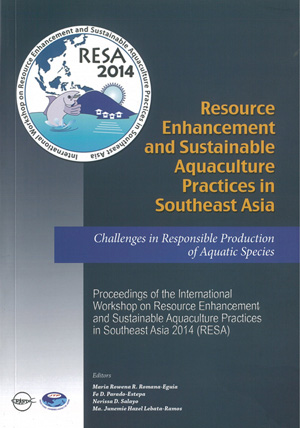
Resource enhancement and sustainable aquaculture practices in Southeast Asia: challenges in responsible production of aquatic species : proceedings of the international workshop on resource enhancement and sustainable aquaculture practices in Southeast Asia 2014 (RESA)
(Aquaculture Department, Southeast Asian Fisheries Development Center, 2015-08)The conference was held in order to promote and augment regional initiatives on resource enhancement and sustainable aquaculture practices, and to contribute to poverty alleviation, livelihood and food security in Southeast Asia. The contributions of the selected participants during the conference which are contained in this volume are cited individually. -
Shrimp metabolism: The roles of lactate dehydrogenase (c31), glycogen phosphorylase (c34) and protein kinase (PK) as revealed by RNA interference
(Aquaculture Department, Southeast Asian Fisheries Development Center, 2015)Energy metabolism is well-studied in vertebrate systems, providing insights on the genes and mechanisms involved in different pathways necessary for the survival of an organism. Yet, such studies are still lacking in invertebrate systems much more in shrimp. An earlier study has showed several contigs from the black tiger shrimp to be homologous to white spot syndrome virus (WSSV), a devastating pathogen in shrimp, including contig 31-WSSVORF82 (c31) and contig 34-WSSVORF21 (c34). This study aims to unveil the roles of three genes: c31, c34 and protein kinase (PK) in the shrimp system and its possible role in WSSV-infection. Rapid amplification of cDNA ends-polymerase chain reaction or RACE-PCR was used to obtain the full-length sequence of c31 and c34, followed by in vivo gene silencing using RNAi technology, and intramuscularly injecting dsRNA to WSSVchallenged Macrobrachium rosenbergii and Penaeus (Marsupenaeus) japonicus. Gene expression followed for healthy shrimps and dsRNA-treated shrimps. Mrc31 was revealed to be the enzyme lactase dehydrogenase (LDH), commonly released during tissue damage and is a marker for disease. The most parsimonious tree pictured Mrc31 to be sister clades to LDH of other shrimp species, Penaeus monodon and P. vannamei, supported with 100% and 72% bootstrap values, respectively. Mrc34 was highly homologous to the glycogen phosphorylase (GP) enzymes of other organisms including that of another shrimp, M. japonicus, bearing a bootstrap value of 99%. For PK, phylogenetic analysis revealed that the three open reading frames (ORFs) from P. monodon, M. rosenbergii and P. japonicus have 30% homology to WSSV-PK supported by a 98% bootstrap value. Mortality data from dsRNA-treated and WSSV-infected shrimps showed that treatment with dsRNA-LDH, GP and PK had significantly higher survival rates compared to that of the controls, Phosphate Buffered Saline (PBS) and Green Fluorescent Protein (GFP). Silencing the three genes in the shrimp has rendered some protective effect against the virus. Gene expression showed that all three genes are present in immune-related organs such as the gills, hepatopancreas and hemocyte. This study is the first to report the possible identities and functions of contigs 31, 34 and PK providing valuable data on the shrimp's genome. -
Reproductive biology of christian crabs (Charybdis feriatus, Linnaeus, 1758) in San Miguel Bay, Philippines
(Aquaculture Department, Southeast Asian Fisheries Development Center, 2015)The reproductive biology of Charybdis feriatus was investigated from April 2012 to March 2013 to determine gonad maturity, gonado-somatic index (GSI), fecundity, breeding cycle and size at first maturity. Every month, samples of 30 specimens were randomly collected. Gravimetric and volumetric methods were used to estimate fecundity. Results showed that Charybdis feriatus breeds continuously with a distinct period of reproductive activity during the northeast monsoon. Spawning peaks in January where higher values of GSI, mature, and berried female crabs were observed. Female gonad (ovary) weights range from 0.5 to 18.1 grams while mean GSI of female and male were 7.35% and 6.27%, respectively. Berried females were present year round, the highest occurring in December (50%). Fecundity ranged from 1,513,660 to 6,357,133 eggs. The smallest reproductively active female was 8.3 cm. Fecundity was highly correlated with size (r2=0.92). In view of these observations, the following options are recommended for crab fishery resource management: (1) to set a closed season for crab fisheries, (2) to regulate catches by not taking egg-bearing swimming crabs, and (3) to allow egg-bearing crabs to release its eggs and the larvae in fishing grounds and/or marine protected areas. -
First record of Laem-Singh virus in black tiger shrimp (Penaeus monodon) in the Philippines
(Aquaculture Department, Southeast Asian Fisheries Development Center, 2015)Laem-Singh Virus (LSNV), a single-stranded RNA virus that causes growth retardation in Penaeus monodon, is also known as Monodon Slow-Growth Syndrome (MSGS) virus. Black Tiger shrimps afflicted with this virus exhibit unusual dark color, a weight gain of less than 0.1 g in 1 to 2 weeks, unusual yellow markings, bamboo-shaped abdominal markings and brittle antennae. It was first detected in Thailand and the virus quickly spread to neighboring Asian countries such as Malaysia and Singapore. The shrimp economy of countries where infections have occurred experienced losses in the export of live shrimps and broodstocks. An earlier study in 2009 reported that LSNV was not present in the Philippines. However, since no follow-up researches were done in the succeeding years, this study was conducted to detect the presence of virus in selected sites of Luzon. Results based on biased sampling method and RT-PCR data indicated that LSNV is indeed present in the country. This is further supported by DNA sequence data, showing 100% identity with LSNV India isolate. Phylogenetic analysis showed that the Philippine isolate clustered closely with other LSNV isolates. The outcome of this study might have implications in the current practices in the Philippine shrimp aquaculture industry. -
Growth performance of brackishwater enhanced selected tilapia (BEST) reared in brackishwater ponds
(Aquaculture Department, Southeast Asian Fisheries Development Center, 2015)Tilapia culture contributes greatly to world aquaculture production. Several tilapia strains have been developed locally and one of these has been developed for brackishwater aquaculture. BEST or the Brackishwater Enhanced Selected Tilapia was developed by the Bureau of Fisheries and Aquatic Resources with the aim of promoting brackishwater culture of this commodity to further improve tilapia production in the Philippines. This study will determine the growth performance of BEST reared in organically fertilized brackishwater ponds at three different stocking densities. The study was conducted in nine (9) units of 200m2 ponds. Pond preparation was done following standard procedures that include drying, liming, teaseed application and fertilization. Stocking was done after twenty days when primary productivity in the ponds was noted. Three culture systems were used, namely: extensive (Treatment 1 or T1), semiintensive (Treatment 2 or T2) and intensive (Treatment 3 or T3) systems. The study was conducted for 120 days. Results showed that fish in ponds in treatment T1 had an average body weight (ABW) of 52.1g, T2 stocks with ABW of 223.1 g and T3 stocks with an ABW of 214.5 g. Meanwhile, T1 stocks had a survival rate of 91.9% while stocks under T2 and T3 had survival rates of 80 % and 84% respectively. T1 results showed losses amounting to P382 since total revenue of P958 is smaller than total cost of P1,340. T2 harvest on the other hand registered a total revenue of P 10,368 and total cost of P 4,375 hence net return of P 5,634. T3 also had total revenue of P 21,419 with a total cost of over P 8,498 giving a net return of P12, 471. T2 showed a return on investment (ROI) of 128% and a payback period of 0.77 year. T3 had an ROI of 139% and payback period of 0.71 year. Average feed conversion ratio (FCR) in two runs for two treatments are the same at 1.1 Water parameters like DO, salinity, temperature; water level and pH were also taken. Water level in the ponds ranged from 70 to 74 cm, salinity at 6.3-6.9 ppt, DO at 1.5-1.7ppm, temperature at a constant 29°C, monthly pH ranges were from 7.1 to 8.0 and transparency of 34-47 cm.