
Books
Browse by
การส่งล่าสุด
-
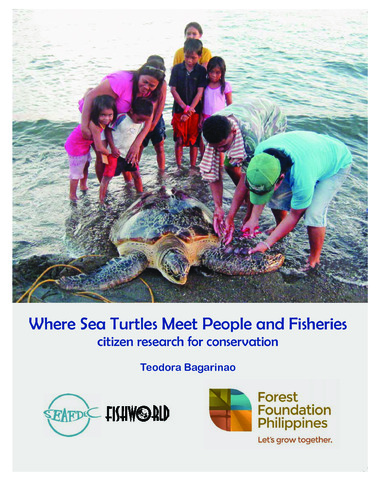
Where sea turtles meet people and fisheries: Citizen research for conservation
Bagarinao, Teodora (Aquaculture Department, Southeast Asian Fisheries Development Center; Forest Foundation Philippines, 2025)
Since 2000, SEAFDEC FishWorld has served as a focal point for community engagement in marine biodiversity conservation, with a particular emphasis on sea turtle protection in the waters surrounding Panay and Guimaras Islands. This book presents the outcomes of a long-term initiative involving the documentation, tagging, release, and care of sea turtles incidentally captured in local fisheries. It provides a permanent record of 335 sea turtles, including documentary photographs of 214 individuals, and offers extensive data and new insights into the status and ecology of these endangered species in Philippine waters. The volume details the interactions between sea turtles, fishing gear, and coastal communities, highlighting collaborative efforts among FishWorld, fishers, and government agencies to promote conservation and reduce turtle capture. Written for fishers, conservation practitioners, government officers, educators, and the general public, the book combines scientific information with accessible, pictorial presentation. It contributes significantly to national efforts to raise awareness, foster community participation, and strengthen the protection of sea turtles and the marine ecosystems that sustain them.
(Aquaculture Department, Southeast Asian Fisheries Development Center; Forest Foundation Philippines, 2025)
Since 2000, SEAFDEC FishWorld has served as a focal point for community engagement in marine biodiversity conservation, with a particular emphasis on sea turtle protection in the waters surrounding Panay and Guimaras Islands. This book presents the outcomes of a long-term initiative involving the documentation, tagging, release, and care of sea turtles incidentally captured in local fisheries. It provides a permanent record of 335 sea turtles, including documentary photographs of 214 individuals, and offers extensive data and new insights into the status and ecology of these endangered species in Philippine waters. The volume details the interactions between sea turtles, fishing gear, and coastal communities, highlighting collaborative efforts among FishWorld, fishers, and government agencies to promote conservation and reduce turtle capture. Written for fishers, conservation practitioners, government officers, educators, and the general public, the book combines scientific information with accessible, pictorial presentation. It contributes significantly to national efforts to raise awareness, foster community participation, and strengthen the protection of sea turtles and the marine ecosystems that sustain them. -
The pawikan album: The sea turtles captured around Panay and Guimaras Islands, Philippines
Bagarinao, Teodora; ; (Aquaculture Department, Southeast Asian Fisheries Development Center, 2010)
SEAFDEC FishWorld worked with fishers and government officers to document 93 sea turtles captured by fishing gears along the coasts of Panay and Guimaras Islands, Philippines in 2000-2009: three leatherbacks Dermochelys coriacea (128-150 cm curved carapace length), two loggerheads Caretta caretta (77 cm), 18 olive ridleys Lepidochelys olivacea (47-69 cm), 18 hawksbills Eretmochelys imbricata (20-89 cm), and 52 green turtles Chelonia mydas (30-108 cm). Most green turtles were caught in near shore fish corrals, and most olive ridleys by gill nets and long lines. Of the 18 hawksbills, 2 adults were caught in fish corrals, 3 juveniles were entangled in nets in Iloilo Strait, 6 were pets off our people,and 7 were captives at a turtle feeding station near a known hawksbill nesting site in Lawi, Guimaras. Sixty documented turtles were released, 47 of them with monel or inconel tags of the Pawikan Conservation Project, Department of Environment and Natural Resources. The others died from entanglement, serious injuries, slaughter for market, and diseases. Six female green turtles had multiple fibropapillomas; two died, three were released, and the latest one healed well after the surgical removal of several large tumors and was released. One green turtle brought to FishWorld has advanced shell rot, is unable to submerge, but is doing well on a diet of red seaweed Gracilaria. Three pet hawksbills were retrained for life at sea; one was released after 17 months, another after 57 months, but one is still at FishWorld as Conservation Ambassador. The most important result of FishWorld's work in the past 10 years is that many captured sea turtles were checked for health condition, treated where necessary or possible, tagged, and released back to sea. In addition, data on 93 sea turtles were gathered that can be used in the continuing effort to monitor the locations, risks and threats, health and diseases, and movements of these endangered species. -
Common edible molluscs of the Philippines: A field guide
(Aquaculture Department, Southeast Asian Fisheries Development Center, 1981)The Molluscs comprise the largest phylum of marine invertebrates, with over 80,000 species described (Barnes, 1974). They are soft-bodied animals, which, in most cases, secrete a protective outer "shell." Two major classes ... -
Beach forest species and mangrove associates in the Philippines
Primavera, Jurgenne; (Aquaculture Department, Southeast Asian Fisheries Development Center, 2012)
This new publication supported by UNESCO’s Man and Biosphere Programme introduces researchers and the general public to beach forest species and mangroves associates and describes their medicinal, traditional and commercial uses based on recent research and the older, hard-to-access literature. The shorelines and riverbanks of the Philippines were among the first sites opened for human settlement. Not surprisingly, vegetation in the coastal forest was the first to disappear, followed by mangroves and other forest types. Due to their early loss, beach forests are not well studied as other flora and therefore not familiar to the average Filipino. The 2004 Indian Ocean tsunami, and sea-level rise associated with global warming, have highlighted the role of beach forest-mangrove greenbelts in conferring protection on coastal communities. The publication is a collection of 140 species both familiar and poorly known, with around 100 treated exhaustively including scientific names, English names, local/regional names, botanical descriptions and folk uses. -
Philippine deforestation: A national Spoliarium
(Aquaculture Department, Southeast Asian Fisheries Development Center, 2010)Originally published in the Philippine Star on 3 December 2009. Edited and reprinted with permission. -
Realities in Philippine science
(Aquaculture Department, Southeast Asian Fisheries Development Center, 2010)Originally published in the Philippine Star on 16 October 2008. Edited and reprinted with permission. -
Happy birthday Darwin: Lamentations on science and religion
(Aquaculture Department, Southeast Asian Fisheries Development Center, 2010)Posted in Bahay Kubo Research (http://www.bahaykuboresearch.net) on 23 April 2009. -
What good is science education?
(Aquaculture Department, Southeast Asian Fisheries Development Center, 2010)Originally published in the Philippine Star on 20 August 2009. Edited and reprinted with permission. -
Myths in Philippine science
(Aquaculture Department, Southeast Asian Fisheries Development Center, 2010)Originally published in the Philippine Star on 9 October 2008. Edited and reprinted with permission. -
Airing laundry: The value of critical evaluation in science
(Aquaculture Department, Southeast Asian Fisheries Development Center, 2010)Originally published in the Philippine Star on 16 April 2009. Edited and reprinted with permission. -
Asking good questions
(Aquaculture Department, Southeast Asian Fisheries Development Center, 2010)Originally published in the Philippine Star on 5 February 2009. Edited and reprinted with permission. -
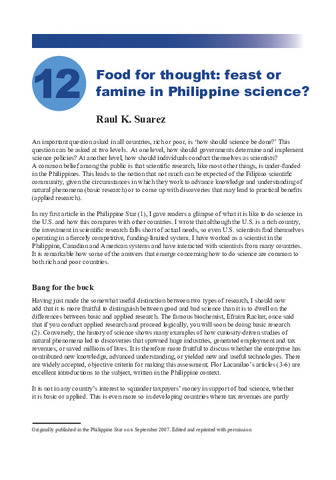
Food for thought: Feast or famine in Philippine science?
(Aquaculture Department, Southeast Asian Fisheries Development Center, 2010)Originally published in the Philippine Star on 6 September 2007. Edited and reprinted with permission. -
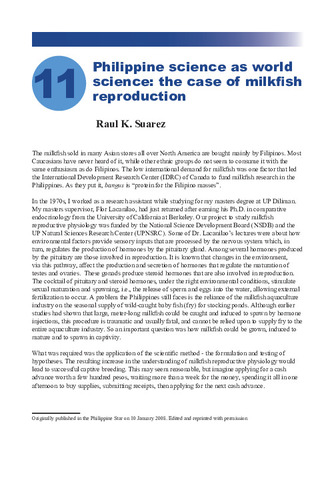
Philippine science as world science: The case of milkfish reproduction
(Aquaculture Department, Southeast Asian Fisheries Development Center, 2010)Originally published in the Philippine Star on 10 January 2008. Edited and reprinted with permission. -
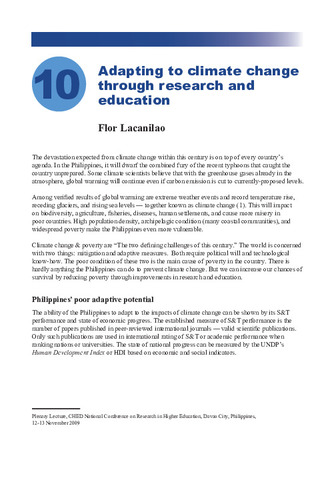
Adapting to climate change through research and education
(Aquaculture Department, Southeast Asian Fisheries Development Center, 2010)Plenary Lecture, CHED National Conference on Research in Higher Education, Davao City, Philippines, 12-13 November 2009. -
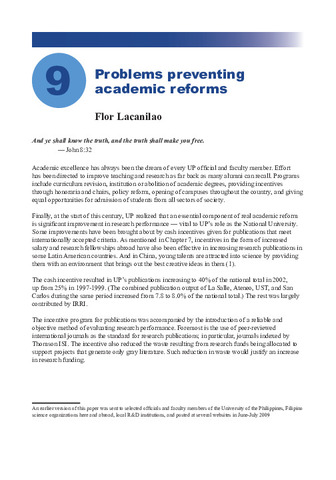
Problems preventing academic reforms
(Aquaculture Department, Southeast Asian Fisheries Development Center, 2010)An earlier version of this paper was sent to selected officials and faculty members of the University of the Philippines, Filipino science organizations here and abroad, local R&D institutions, and posted at several websites ... -
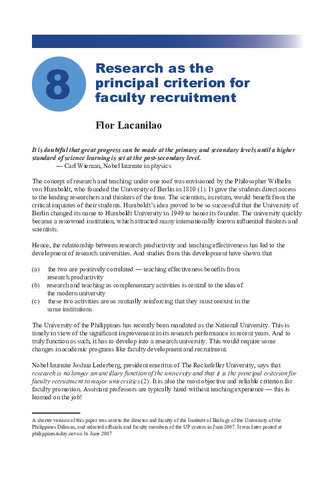
Research as the principal criterion for faculty recruitment
(Aquaculture Department, Southeast Asian Fisheries Development Center, 2010)A shorter version of this paper was sent to the director and faculty of the Institute of Biology of the University of the Philippines Diliman, and selected officials and faculty members of the UP system in June 2007. It ... -
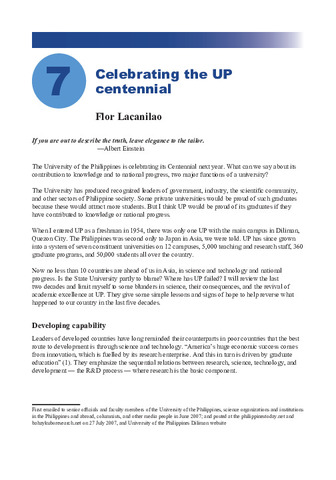
Celebrating the UP centennial
(Aquaculture Department, Southeast Asian Fisheries Development Center, 2010)First emailed to senior officials and faculty members of the University of the Philippines, science organizations and institutions in the Philippines and abroad, columnists, and other media people in June 2007; and posted ... -
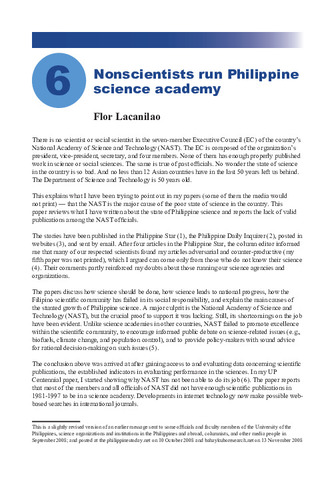
Nonscientists run Philippine science academy
(Aquaculture Department, Southeast Asian Fisheries Development Center, 2010)This is a slightly revised version of an earlier message sent to some officials and faculty members of the University of the Philippines, science organizations and institutions in the Philippines and abroad, columnists, ... -
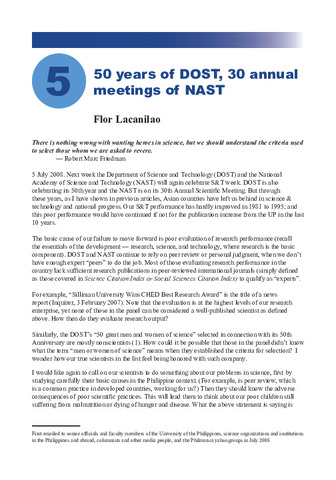
50 years of DOST, 30 annual meetings of NAST
(Aquaculture Department, Southeast Asian Fisheries Development Center, 2010)First emailed to senior officials and faculty members of the University of the Philippines, science organizations and institutions in the Philippines and abroad, columnists and other media people, and the Philmarsci ... -
Straight talk to Filipino scientists
(Aquaculture Department, Southeast Asian Fisheries Development Center, 2010)Originally sent as email to some academic communities and science organizations in the Philippines and abroad in February 2007.


 RSS 1.0