SEAFDEC/AQD Institutional Repository: Recent submissions
Now showing items 1961-1980 of 4221
-
Series: ACIAR Monograph 110
Digestive enzyme activity in developing grouper (Epinephelus coioides) larvae
; ; Mamauag, Roger Edward ; (Australian Centre for International Agricultural Research, 2004)
This study was undertaken to determine the activities of alkaline and acid type proteases [proteinases], α-amylase, lipase [triacylglycerol lipase], trypsin, chymotrypsin, leucine aminopeptidase [cytosol aminopeptidase], and alkaline and acid phosphatases during larval development of the grouper, Epinephelus coioides. The maximum variation in specific activities of alkaline and acid type proteases, α-amylase, lipase, trypsin, chymotrypsin, leucine aminopeptidase, and acid and alkaline phosphatases in the digestive tract of grouper larvae was mostly related to the onset or the end of metamorphosis during larval development.
; (Australian Centre for International Agricultural Research, 2004)
This study was undertaken to determine the activities of alkaline and acid type proteases [proteinases], α-amylase, lipase [triacylglycerol lipase], trypsin, chymotrypsin, leucine aminopeptidase [cytosol aminopeptidase], and alkaline and acid phosphatases during larval development of the grouper, Epinephelus coioides. The maximum variation in specific activities of alkaline and acid type proteases, α-amylase, lipase, trypsin, chymotrypsin, leucine aminopeptidase, and acid and alkaline phosphatases in the digestive tract of grouper larvae was mostly related to the onset or the end of metamorphosis during larval development. -
Series: ACIAR Monograph 110
Localisation of enzymes in the digestive system during early development of the grouper (Epinephelus coioides)
(Australian Centre for International Agricultural Research, 2004)This study was undertaken to investigate the occurrence of some digestive enzymes in the gastrointestinal tract during early development in the grouper. This work was conducted to provide information on formulating an appropriate feeding scheme and an artificial diet for the early development of the grouper, Epinephelus coioides. Larvae of E. coioides were reared in 5 tonne rectangular concrete tanks. The digestive enzymes localized were acid phosphatase (ACP), alkaline phosphatase (ALP), nonspecific esterase (NSE), aminopeptidase (AMP), trypsin (TRP), maltase (MAL) and lipase (LIP). Weak enzyme activity occurred during the yolk sac stage. High AMP activity started at day 14 prior to Artemia feeding at day 16. Fluctuations in TRP activity might be related to stomach formation. Occurrence of MAL during early development demonstrated a capacity to digest carbohydrates. An increase in LIP activity coincided with the occurrence of gastric glands. Insignificant changes in digestive enzymes were observed in the metamorphosing grouper larvae from day 40 to 60. -
Series: ACIAR Monograph 110
Changes in the gastrointestinal tract and associated organs during early development of the grouper (Epinephelus coioides)
(Australian Centre for International Agricultural Research, 2004)The histomorphological changes in the gastrointestinal tract of Epinephelus coioides and associated organs during its early development were studied. Larvae of E. coioides were reared in 5-tonne tanks using the semi-intensive culture system. Larval samples were collected at days 0, 2, 4, 6, 8, 10, 12, 14, 16, 20, 25, 30, 35, 40, 45 and 60. The total length (TL) of about 10-20 larvae per sampling was measured. At least 3 samples were examined from each stage for longitudinal sections using light microscopy. The digestive tract of day 0 larvae was a straight, undifferentiated tube composed of simple cuboidal cells. At day 2, cellular differentiation was observed in the pharynx, oesophagus, primordial stomach and intestine. The primordial stomach broadened into a voluminous pouch at day 10. The gastric gland was observed in the stomach from day 20. Day 35 seemed to be the proper time to feed larvae with minced fish when using the semi-intensive rearing system. Insignificant histomorphological changes in the metamorphosing grouper larvae were observed from days 40-60. -
Series: ACIAR Monograph 110
Environmental factors affecting embryonic development, hatching and survival of early stage larvae of the grouper (Epinephelus coioides)
(Australian Centre for International Agricultural Research, 2004)These series of experiments were conducted to determine the effects of density (200, 400, 800 and 1600 eggs/litre), salinity (8, 16, 24, 32 and 40 ppt), aeration (0, 0.62, 1.25, 2.50 and 3.75 ml/min/litre) and light intensity (0, 120, 230, 500 and 700 lx) on the survival of fertilized eggs and early stage larvae of Epinephelus coioides. Under statice incubation conditions, the highest egg viability, hatching rate and percentage of normal larvae were obtained at a stocking density of 400 eggs/litre with moderate aeration (100 ml/min) and salinity of 32-42 ppt. Gentle aeration at 0.62 to 1.25 ml/min/litre, rearing water of 16 to 24 ppt and a light intensity of 500 to 700 lx maximized the survival of early stage E. coioides larvae in the hatchery. -
Series: Aquaculture extension manual No. 45
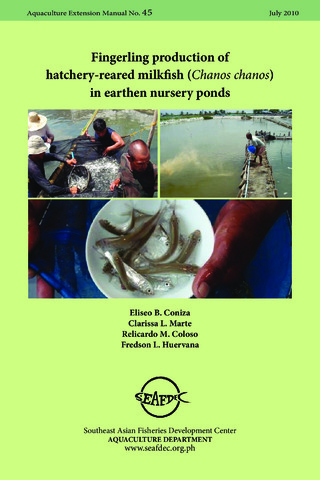
Fingerling production of hatchery-reared milkfish (Chanos chanos) in earthen nursery ponds
(Aquaculture Department, Southeast Asian Fisheries Development Center, 2010)Fingerling production of milkfish in ponds maybe operated as a commercial enterprise or a component of milkfish farming that comprises nursery, transition and rearing or grow-out phases. The fishpond nursery is used to grow milkfish fry to fingerlings 1-3 g in weight or 1-2 inches in length. The nursery pond is the smallest of the major fishpond compartment ranging from 500 to 5,000 m2, and is about 10% of the total farming area. The pond is prepared with utmost care to eliminate predators and competitors. The area should have good topography, is free from flooding and should have soil with good water retention properties for good dike construction and efficient culture management. Water supply should be adequate year-round and free from pollutants. Good pond water quality is maintained and natural food should be adequate to enhance growth and survival. With high stocking densities, supplemental feed is also provided. The three types of nurseries are based on feed sources: lablab, plankton with supplemental feeding and direct feeding. Select hatchery-reared fry (21 day old) that swim actively in schools, are uniform in size, have robust body, and are resistant to handling and transport stress. The ideal fry stocking density is 5-40 pieces/m2. Survival ranging from 50-90% can be expected after 25-45 days of rearing. Harvest, packing, transport, acclimation and stocking of the fry or fingerlings are carefully done during the cooler part of the day. Economic indicators show that fingerlings production is a profitable business. The improvement of milkfish grow-out technology from extensive or traditional to modified-extensive, semi-intensive and intensive culture in ponds, pens or in sea cages has increased demand for good quality fingerlings. Mass production of hatchery-reared fingerlings in earthen nursery ponds during peak season of fry availability can help bridge the supply gap. A steady supply of fingerlings for a whole year s operation will further increase production and ensure a sustainable supply of affordable market-sized fish. -
Series: Aquaculture extension manual; No. 53
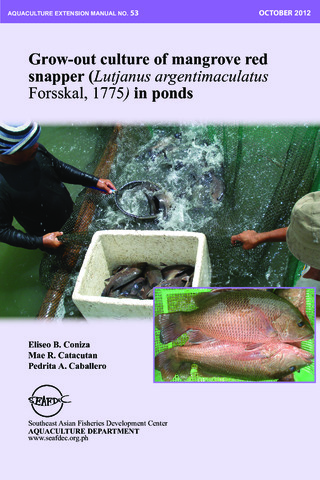
Grow-out culture of mangrove red snapper (Lutjanus argentimaculatus Forsskal, 1775) in ponds
(Aquaculture Department, Southeast Asian Fisheries Development Center, 2012)The mangrove red snapper is among the high-value marine fishes with great potential for export. Snapper is important to coastal fishery and ideal for aquaculture particularly in Southeast Asia. Grow-out culture of snapper are described - pond culture and culture in cages inside the ponds. In the pond culture, the whole area can be maximized and the available natural food can be utilized by snapper. In rearing snapper in cages inside the pond, fish sampling and harvesting are easily done and also in preventing of disease infection and securing of fish stocks during flooding. In both culture methods a good site would have a mangrove buffer space about 20-100 m that lies between the ponds and the source of water like river or sea. Pond soil with a good water retention property is desirable for dike construction. Water supply should be adequate year-round, free from pollutants and run-off flooding. Pond supplies, labor and technology should be available on the selected site which is also accessible to markets with peaceful locale. The pond for growing snapper should be prepared well in order to promote good growth of fish, to minimize pollution, and prevents the proliferation of pathogens. Stocking of healthy and larger uniform size juveniles will mean higher survival, faster growth and shorter culture period. Proper handling of juveniles during harvest, size-grading, counting, packing, transport, acclimation and stocking should be observed and should be done during the cooler part of the day. Recommended juveniles for grow-out is about 20-100 g average body weight (ABW) and stocking densities of 5,000/ha in ponds, and at 5 pcs/m3 or 5,000 pcs/ha when stocked in cages inside the pond. During culture, good water quality is maintained and when necessary the cleaning of net cages, repair of dike leaks and seepages, and aeration are to be considered. Snapper dietary protein is about 48-50%. The following are the factors to consider in the feeding management of snapper: total stock (pcs), survival (%), ABW (g), feed rate (% biomass), feed type, feed size, feeding frequency and time. Economic analysis based on 0.422 ha pond shows that feeds accounted for 60-67% and juveniles contribute 23-25% of the variable cost. The feed conversion ratios, return on investments, payback period and discounted benefit-cost ratios are 2.5 and 2.6; 203 and 43%; 0.46 and 1.76 yr; 1.4 and 1.2 for culture of snapper in pond and culture in cages inside the pond, respectively, are likewise acceptable. -
Series: Aquaculture extension manual; No. 41
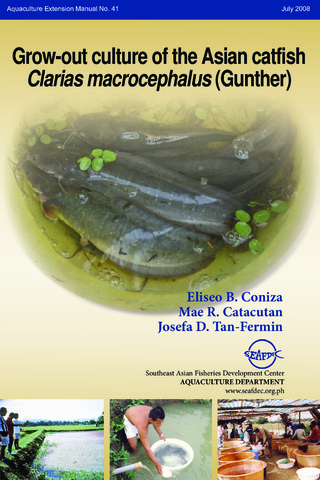
Grow-out culture of the Asian catfish Clarias macrocephalus (Gunther)
(Aquaculture Department, Southeast Asian Fisheries Development Center, 2008)Asian catfish Clarias macrocephalus is an esteemed food fish especially in Southeast Asia due to its tender and delicious meat. This commodity constitutes a valuable fishery for small-scale fishers in the region and has a great potential for aquaculture. The important considerations in the grow-out culture of catfish are reliable water supply, soil with good compaction properties for dike construction, supply of fingerlings, feeds, labor, pond supplies and technology assistance. The farm must also be accessible by road, near to market facilities and has a peaceful environment. Rearing catfish in ponds is the most popular and commonly practiced. The pen culture is a system fully enclosed by nets on all sides but utilizes the dug-out pond, dam or lake bed as bottom enclosure. Tanks in abandoned old hatcheries with freshwater source can be used for catfish culture. In the cage culture system the stock is fully enclosed by nylon nets on all sides and bottom similar to an inverted mosquito net installed in suitable areas like reservoirs, dams, lakes and dug-out ponds. The rice-fish (catfish) culture is also practiced where the rice pond canals are utilized to retain water at 1-2 m depth to provide shelter to the fish while the rice plot maintains 10-20 cm water depth. For the stock, select fingerlings that are active, healthy and uniform in size. Handling of fish stock is important to avoid mortality due to stress during harvest, sorting, counting and transport. Furthermore, stocking of fish is recommended during the cooler part of the day. Catfish fingerlings stocking density is about 5 to 20 pcs/m2 depending on the water supply and support facilities of the farm. The catfish, C. macrocephalus, requires a substantial amount of dietary protein for growth. For this species a formulated diet with crude protein (CP) of 34%, moist diet (trash fish or blanched chicken entrails plus rice bran or cooked broken rice), and a combination of pellet feeds (50%) and moist diet (50%) have been tested and acceptable for the grow-out culture. Economic evaluation based on a grow-out culture in pond with an area of 1,000 m2 showed that feeds and fingerlings are the major variable costs. The net income, return on investments and payback period, respectively range from PhP22,972-PhP35,741, 80-122% and 0.8-1.2 years when using pellet, moist feed or a combination of these feeds. Feeding using formulated diet has an advantage of convenience, quality and quantity over moist diet which has issues such as inconsistent supply, storage requirement and fouling the rearing water. -
Series: Aquaculture extension manual; No. 32
The farming of the seaweed Kappaphycus
(Aquaculture Department, Southeast Asian Fisheries Development Center, 2000)A 24-page manual that introduces the carrageenan-producing seaweed Kappaphycus whose culture has spread from Jolo in Mindanao to at least 14 sites in the Visayas and Luzon. Four culture methods are presented: fixed off-bottom, ... -
Series: Aquaculture extension manual; No. 36
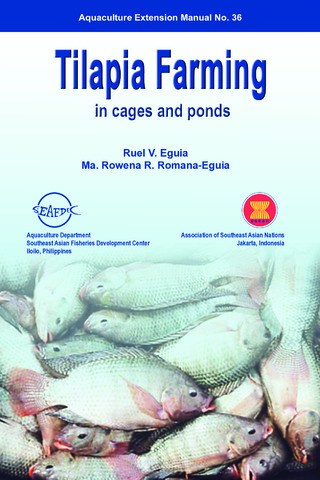
Tilapia farming in cages and ponds
; Romana-Eguia, Ma. Rowena R.This 40-page manual describes the farming practices for tilapia in cages, pens, ponds, and tanks. Also details selection of quality seedstock, maintenance of stock (feeding, water management), and harvesting. A list of ... (Aquaculture Department, Southeast Asian Fisheries Development Center, 2004)
-
Series: NACA technology series; No. 4 | Aquaculture extension manual; No. 12
A prototype warm water shrimp hatchery
(Aquaculture Department, Southeast Asian Fisheries Development Center, 1989)A description is given of the prototype warm water shrimp hatchery established and operated by SEAFDEC Aquaculture Department since 1982. Hatchery design, operation and management, larval rearing in small indoor tanks, larval rearing in large nursery tanks, routine hatchery management, harvesting and transportation and financial aspects are covered. -
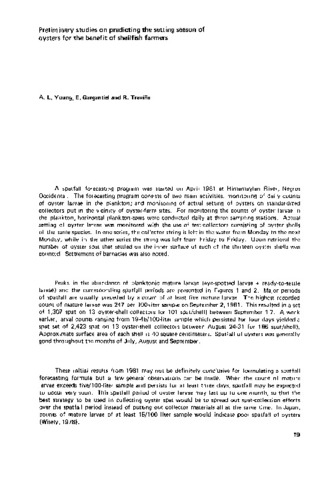
Preliminary studies on predicting the setting season of oysters for the benefit of shellfish farmers
(Aquaculture Department, Southeast Asian Fisheries Development Center, 1981)Preliminary findings from a spatfall forecasting programme initiated in April 1981 at Himamaylan River, Negros Occidental are presented. Two main activities are involved: 1) monitoring of daily counts of oyster larvae in the plankton; and 2) monitoring of actual setting of oysters on standardized collectors put in the vicinity of oyster farm sites. Findings indicate that when the count of mature larvae exceeds 5 per 100 ml sample and persists for at least 3 days, spat may be expected to occur shortly afterwards. -
Acute toxicity of un ionized ammonia to milkfish (Chanos chanos) fingerlings
(Aquaculture Department, Southeast Asian Fisheries Development Center, 1981)The acute toxicity of un-ionized ammonia to milkfish (Chanos chanos) fingerlings was determined using a static bioassay system. Median lethal concentrations found show that milkfish fingerlings have a high tolerance to ammonia and it is unlikely that levels as high as those employed for the acute exposure would be found to occur under natural conditions. Although the threat of acute toxicological effects induced by ammonia are remote, such conditions might be encountered in stressed natural environments or in heavily loaded aquaculture systems. -
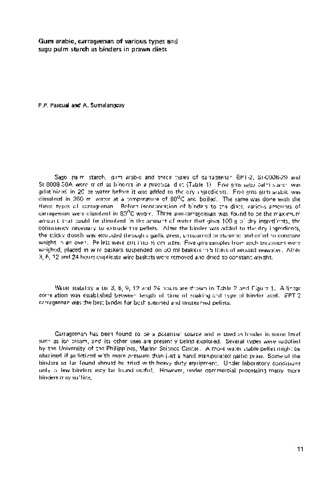
Gum arabic, carrageenan of various types and sago palm starch as binders in prawn diets
(Aquaculture Department, Southeast Asian Fisheries Development Center, 1981)An experiment was undertaken in order to investigate the use of sago palm starch, gum arabic and carrageenans as binders in prawn diets. Water stability data are presented; EPT-2 carrageenan was found to be the best binder for both steamed and unsteamed pellets. -
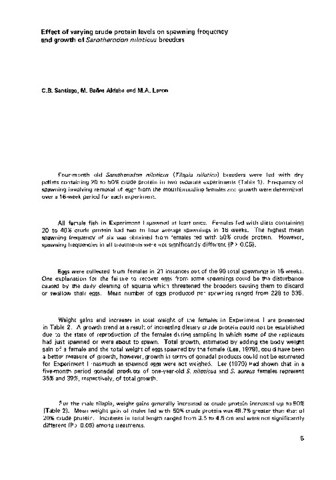
Effect of varying crude protein levels on spawning frequency and growth of Sarotherodon niloticus breeders
(Aquaculture Department, Southeast Asian Fisheries Development Center, 1981)Four-month-old S. niloticus breeders were fed with dry pellets containing 20-50% crude protein and the frequency of spawning involving removal of egg from the mouthbrooding females and growth were determined. When the diets contain high quality proteins from fish meal and soybean oil meal and the amounts of daily food allowance are at satiation level, the influence of increasing dietary crude protein on spawning frequency involving egg removal from the brooder and growth may not be significant. -
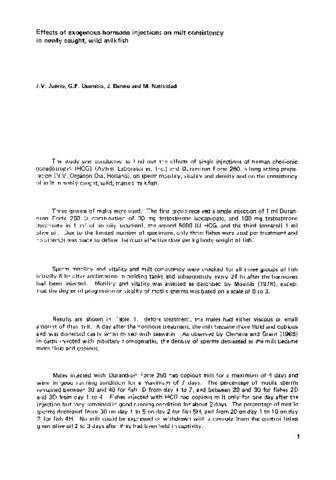
Effects of exogenous hormone injections on milt consistency in newly caught, wild milkfish
(Aquaculture Department, Southeast Asian Fisheries Development Center, 1981)A study was conducted to determine the effects of single injections of human chorionic gonadotropin (HCG) and Durandron Forte 250 on sperm motility, vitality and density and also on the consistency of milt in newly caught, wild, mature milkfish (Chanos chanos). In contrast to HCG, single injections of Durandron Forte 250 were effective not only in inducing spermiation but also in maintaining newly caught mature males in good running condition for a maximum of 7 days, despite daily handling and collection of approximately 3ml milt. -
Effects of 2-phenoxy ethanol and MS-222 on milkfish fingerlings (Chanos chanos) as anaesthetic agents
(Aquaculture Department, Southeast Asian Fisheries Development Center, 1981)An experiment was undertaken in order to determine an adequate anaesthetic and optimum concentrations for use in the handling of fingerling milkfish (Chanos chanos). The compounds 2-phenoxy ethanol and MS-222 were investigated. Results show the latter to be adequate with optimum concentrations between 100 and 200 ppm. -
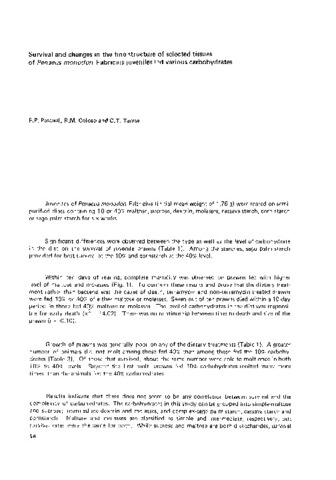
Survival and changes in the fine structure of selected tissues of Penaeus monodon Fabricius juveniles fed various carbohydrates
(Aquaculture Department, Southeast Asian Fisheries Development Center, 1981)Penaeus monodon juveniles were reared on semipurified diets containing various carbohydrates (maltose, sucrose, dextrin, molasses, cassava starch, corn starch or sago palm starch). Significant differences were observed between the type as well as the level of carbohydrate in the diet on the survival of the juveniles. Results indicate that there does not seem to be any correlation between survival and the complexity of the carbohydrates. -
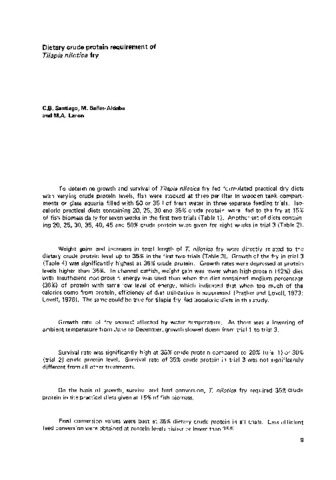
Dietary crude protein requirement of Tilapia nilotica fry
(Aquaculture Department, Southeast Asian Fisheries Development Center, 1981)To determine growth and survival of Tilapia nilotica fry fed formulated practical dry diets with varying crude protein levels, fish were subjected to 3 seperate feeding trials. Isocaloric practical diets containing 20, 25, 30 and 35% crude protein were fed to fry at 15% fish biomass daily for 7 weeks in 2 trials and another set containing 20, 25, 30, 35, 40, 45 and 50% was given for 8 weeks. On the basis of growth, survival and feed conversion, T. nilotica fry required 35% crude protein in the practical diets given at 15% fish biomass. -
Gill lesions associated with acute exposure to ammonia
(Aquaculture Department, Southeast Asian Fisheries Development Center, 1981)Histopathological effects of ammonia on the gills of milkfish (Chanos chanos) fingerlings were examined qualitatively. -
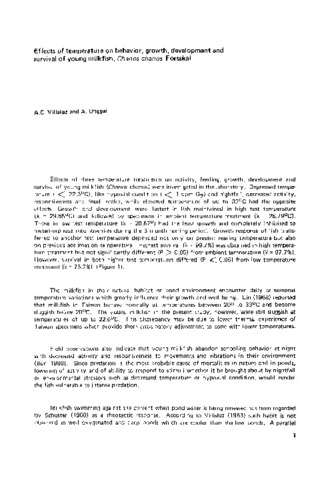
Effects of temperature on behavior, growth, development and survival of young milkfish, Chanos chanos Forsskal
(Aquaculture Department, Southeast Asian Fisheries Development Center, 1981)The effects of 3 temperature treatments on activity, feeding, growth, development and survival of young milkfish (Chanos chanos) were investigated under laboratory conditions. It is believed that the results may be applied to develop a land-based mass production technology in rearing milkfish fry to fingerlings.