SEAFDEC/AQD Institutional Repository: Recent submissions
Now showing items 581-600 of 4221
-
Genetic diversity, population structure and demographic history of the tropical eel Anguilla bicolor pacifica in Southeast Asia using mitochondrial DNA control region sequences
; ; ; ; ; Romana-Eguia, Maria Rowena R. ; (Elsevier, 2021-04)
The tropical catadromous eel, Anguilla bicolor pacifica, an important fishery resource in Southeast Asia, is under threat due to overexploitation (especially of its glass eel phase) and the limited information on their current genetic status which is necessary for resource management. Mitochondrial DNA (mtDNA) control region sequences, a useful marker for population genetic studies in many aquatic organisms, were used to investigate the genetic diversity, population structure and demographic history of A. bicolor pacifica in the region. A total of 151 specimens were collected from three sites in Southeast Asia, namely: Phu Yen, Vietnam (n = 48); General Santos, Philippines (n = 52); and, Palu, Indonesia (n = 51). A total of 138 haplotypes were identified using the mtDNA control region sequences. In spite of the lack of shared haplotypes, low and non-significant \(F_{ST}\) values, high haplotype diversity in concurrence with relatively low nucleotide diversity, a haplotype network with no phylogeographic structuring indicate no significant genetic population structuring among the eel samples from Vietnam, Philippines and Indonesia. Population expansion of A. bicolor pacifica was also suggested based on the results of the neutrality tests, mismatch distribution analysis and Bayesian skyline plot. Taken together, a joint management strategy for A. bicolor pacifica must involve countries in Southeast Asia particularly Vietnam, Philippines and Indonesia for its sustainable use.
; (Elsevier, 2021-04)
The tropical catadromous eel, Anguilla bicolor pacifica, an important fishery resource in Southeast Asia, is under threat due to overexploitation (especially of its glass eel phase) and the limited information on their current genetic status which is necessary for resource management. Mitochondrial DNA (mtDNA) control region sequences, a useful marker for population genetic studies in many aquatic organisms, were used to investigate the genetic diversity, population structure and demographic history of A. bicolor pacifica in the region. A total of 151 specimens were collected from three sites in Southeast Asia, namely: Phu Yen, Vietnam (n = 48); General Santos, Philippines (n = 52); and, Palu, Indonesia (n = 51). A total of 138 haplotypes were identified using the mtDNA control region sequences. In spite of the lack of shared haplotypes, low and non-significant \(F_{ST}\) values, high haplotype diversity in concurrence with relatively low nucleotide diversity, a haplotype network with no phylogeographic structuring indicate no significant genetic population structuring among the eel samples from Vietnam, Philippines and Indonesia. Population expansion of A. bicolor pacifica was also suggested based on the results of the neutrality tests, mismatch distribution analysis and Bayesian skyline plot. Taken together, a joint management strategy for A. bicolor pacifica must involve countries in Southeast Asia particularly Vietnam, Philippines and Indonesia for its sustainable use. -
Series: State of the art series
Closed-recirculating shrimp farming system
(Aquaculture Department, Southeast Asian Fisheries Development Center, 2000-11)This collaborative SEAFDEC/ASEAN project aimed to develop sustainable shrimp culture technology packages to address the problems in shrimp culture (e.g. discharges from shrimp farms threatening mangrove and marine ecosystems, clearing of mangrove forests to make way for shrimp ponds, etc.). In this context, a closed recirculating shrimp farming system is discussed touching on: pond preparation, water preparation, stocking, feeding, management, DO level, problems, record keeping, and harvesting. -
Series: State of the art series
Environment-friendly schemes in intensive shrimp farming
(Aquaculture Department, Southeast Asian Fisheries Development Center, 2000-09)The manual details the procedures of intensive shrimp farming but with provisos for the treatment of sludge and water. These provisos include (1) the use of water reservoir where pond water is stored for at least a week before being used in the grow-out ponds, (2) the use of a “tail” pond to hold drained water so it can be treated and recycled, (3) the use of long-arm paddle wheel so water aeration-circulation is made more efficient, and (4) the use of fishes to help condition the water and substantially produce green water. -
Genetic identification of all four mangrove mud crab species (genus Scylla) using multiple molecular markers
; ; ; ; ; ; Quinitio, Emilia T.; (Springer, 2021-02-05)
Misleading identification and subsequent publications on biological, molecular, and aquaculture data of mangrove mud crab (genus Scylla de Hann 1833) is a major concern in many countries. In this study, multiple molecular markers were used for genetic identification of all four known mud crab species under genus Scylla collected from India, Philippines, Myanmar, Malaysia and Indonesia. Internal Transcribed Spacer (ITS-1), Polymerase chain reaction (PCR)–Restriction Fragment Length Polymorphism (PCR–RFLP) and PCR-based species-specific markers were used to resolve taxonomic ambiguity. PCR–RFLP techniques using NlaIV and BsaJI restriction endonucleases were efficient to differentiate four different mud crab species under genus Scylla with specific fragment profile. The results also justified the use of ITS-1 and PCR-based species-specific markers to identify mud crab species available in many countries quite rapidly and effectively. Several new molecular markers generated during the study are reported here to resolve the taxonomic ambiguity of Scylla species and the results reconfirmed that India is only having two commonly available mud crab species which was reported by the authors earlier. -
Growth, metamorphosis and survival of orange-spotted rabbitfish (Siganus guttatus) larvae fed sodium iodide-supplemented brine shrimp (Artemia sp.)
Legaspi, Ma. Irene; ; ; ; Mamauag, Roger Edward (Elsevier, 2021-04)
In an attempt to improve the hatchery production of orange-spotted rabbitfish (Siganus guttatus), the present study evaluated the effects of iodine-supplementation of larval food (Artemia) on endogenous thyroid hormone (TH) levels in larvae, and subsequently on their metamorphosis, growth and survival. Rabbitfish larvae (20 days after hatching, DAH) were fed unsupplemented (control) and sodium iodide (0.8 g L−1) -supplemented Artemia. The larvae were reared in 250-L fiberglass tanks at a stocking density of five larvae L−1. Each treatment has three replicates. The study was conducted until 50% of the larval population in both treatments has completely metamorphosed. Iodine-supplementation in larval food resulted in significantly higher levels of thyroxine (T4) and triiodothyronine (T3), (TH) in rabbitfish larvae (p < 0.05). Treated rabbitfish larvae had significantly higher mean body weight (0.20 ± 0.01 g) than the control (0.14 ± 0.01 g) and a lower muscle fiber (MF) count (0.003 ± 0.001 MF μm−2) than the control (0.009 ± 0.002 MF um−2) (p < 0.05). However, survival was not different between the two treatments. Furthermore, using the statistical tool probit analysis on the metamorphic period index, it showed that 50% of the population in the control group metamorphosed at 42.4 DAH while 50% of the population in the treated group metamorphosed at 31.2 DAH. Cumulative stress index test indicated a positive response of larvae fed supplemented Artemia (p < 0.05). This study demonstrated that feeding sodium iodide-supplemented Artemia to rabbitfish larvae enhances the endogenous TH levels which in turn accelerates the metamorphosis and improves fish muscle fiber growth and stress tolerance. -
Can Ulva reticulata replace Gracilariopsis heteroclada as natural food for the abalone Haliotis asinina?
Lebata-Ramos, Ma. Junemie Hazel; (Springer, 2021-02-04)
Abalone are among the most important fishery resources with high commercial values worldwide, with Haliotis asinina being the most in demand and widely studied species in the Philippines. Abalone culture in the country mainly depends on the red alga, Gracilariopsis heteroclada, as food for cultured stocks. This however, is not sustainable as this alga is also being farmed both for agar production and human consumption. Hence, other sources of natural food need to be explored for large-scale culture of abalone. This study investigated the viability of Ulva reticulata as food for abalone. This green alga is common in the intertidal zones of the Philippines but of no commercial value. H. asinina early juveniles (N = 60, shell length 2.12–3.07 cm, body weight 1.7–5.9 g) obtained from the Abalone Hatchery of SEAFDEC Aquaculture Department were randomly distributed (n = 10) in three replicate containers and fed with G. heteroclada and U. reticulata for 15 days. After 15 days, abalone fed with G. heteroclada were significantly larger and heavier (2.82 ± 0.04 cm and 4.64 ± 0.19 g) than those fed with U. reticulata (2.62 ± 0.03 cm and 3.45 ± 0.14 g). Abalone fed with U. reticulata also exhibited weakness, hardfoot, and easily detached from the walls of the culture containers. Based on these results, despite its availability in large quantities, U. reticulata could not be solely used as an alternative natural food to G. heteroclada for abalone culture. However, its potential as a partial substitute to G. heteroclada may be further examined. -
First histopathological description of parasites and shell conditions of the donkey's ear abalone Haliotis asinina (Linnaeus, 1758) cultured in marine cages and land-based tanks in the Philippines
; Pakingking, Rolando V., Jr.; (National Shellfisheries Association, 2020-08-26)
This study is the first attempt to assess parasitic infestations in grow-out cage culture and land-based grow-out tanks of the donkey's ear abalone Haliotis asinina in the Philippines. This histopathological study of the parasites was conducted from 2010 to 2013. Using 30 samples of abalones collected monthly from two sites, samples were measured and fixed in 10% formaldehyde in seawater, and routine histological techniques were used to identify the parasites. Water temperatures of the grow-out floating sea cages and the abalone hatchery facilities whose abalones were collected measured 27.5°C–32.5°C and 26°C–29°C, respectively; salinity in the area of the sea cages was 32–34 ppt, whereas salinity of the abalone hatchery was 32–35 ppt. Examination of the shell from cage-cultured abalones revealed the presence of burrowing polychaetes belonging to the families Serpulidae (prevalence, 32.5%) and Dorvilleidae (prevalence, 30%); on the other hand, only Dorvilleidae (prevalence of 28.5%) was detected in abalones from the hatchery. Histological examination revealed the presence of unknown ciliates (prevalence, 37.5%), Nematopsis sp. (prevalence, 17%), and metacestode Tylocephalum sp. (prevalence, 8.5%) from the grow-out cage-cultured abalones, whereas unidentified ciliates (prevalence, 32.5%) and Nematopsis sp. (prevalence, 10.5%) were detected from hatchery stock. The data collected showed that there was low-intensity infection and prevalence of parasites in abalones from grow-out cages and hatchery. These records of parasites constitute baseline information for future research work on abalones. -
Lipids and fatty acid composition in the crustacean model organism Artemia sp. as influenced by poly‐β‐hydroxybutyrate (PHB) supplementation
Ludevese-Pascual, Gladys; Laranja, Joseph Leopoldo ; ; Amar, Edgar ; ; ; (Wiley, 2020-12)
The effects of dietary poly-β-hydroxybutyrate (PHB) on the lipid and fatty acids (FA) in crustaceans were investigated using Artemia as model species. Supplying PHB either in crystalline or amorphous form significantly increased the whole-body lipid contents of starved Artemia. Co-supplying dietary PHB with bacterial PHB degrader Comamonas testosteroni at 106 cells ml−1 for 24 hr also significantly increased this parameter. These findings have important implications on the lipid-saving effects of PHB in crustacean tissues. Dietary PHB, however, did not contribute to the increase in docosahexaenoic acid (DHA) of the naturally DHA-deprived Artemia. Alternative strategy of co-supplying dietary PHB with highly unsaturated fatty acid (HUFA)-rich emulsion for 24 hr effectively improved the nutritional contents of Artemia and at the same time assured efficient delivery of PHB to the larval predator. According to a 13C stable isotope tracer study, the significantly higher δ13C levels measured in Artemia 2 hr postfeeding with 13C-labelled R. eutropha DSM545 indicate that PHB offered in natural matrix is rapidly assimilated. Overall, this study demonstrated the lipid-saving effects of PHB in Artemia. PHB assimilation following gastrointestinal degradation could attribute to its reported beneficial effects in various aquatic farmed species. -
Understanding biosecurity: Knowledge, attitudes and practices of seaweed farmers in the Philippines
(Springer, 2021-01-26)Farmers are one of the most important components of any plant-based cultivation industry. The Philippines is one of the world’s major producers of red carrageenophyte algae and has tens of thousands of farmers involved in this industry. The production of algae such as Kappaphycus and Eucheuma increased significantly from the early 1970s, when the industry was established, before declining from the mid-2000s, due to a number of reasons, including disease and epiphyte outbreaks. The introduction of biosecurity measures has been one approach used to tackle this decline. Biosecurity-related knowledge, attitude and practices (KAP) of the seaweed farmers were assessed in the four highest seaweed producing regions in the Philippines: (1) Tawi-Tawi, (2) Palawan, (3) Zamboanga and (4) Bohol. Analyses showed that seaweed farmers from Tawi-Tawi had relatively higher KAP mean scores than the other three sites. Palawan and Bohol farmers, however, scored lower on their knowledge, higher on their attitude and highest on their practices compared with the other areas. Farmers from Zamboanga scored the lowest in both their attitude and practice mean scores, although their knowledge score was one of the highest. This is the first KAP assessment applied to the seaweed farming industry globally and the results, in which the farmers’ biosecurity-related knowledge and practices, which scored “Fair” (50–75%) across all the regions, and their attitudes, which scored predominantly “Good” (> 75%) suggest that there is potential to raise the score for biosecurity practices. This assessment highlights how biosecurity challenges are currently addressed by seaweed farmers in the Philippines and suggests how the KAP survey could be used as a tool by policymakers and scientists to address gaps in biosecurity management practices. -
Navigating risks and uncertainties: Risk perceptions and risk management strategies in the Philippine seaweed industry
(Elsevier, 2021-04)The Philippine seaweed industry is affected by multiple but interrelated risks. Farmers mainly encountered environment-related risks (e.g. disease, pest infestations) which, if unmanaged, could result to production failure. Traders and processors considered volatility of seaweed supply and poor quality of raw materials as precursors of other risks such as increased competition among local traders and processing companies. Gender differences in awareness and knowledge of risks were more prominent among seaweed farmers but not among traders and processors as roles become more homogenous up the value chain. Poor governance resulted in the adoption of informal and market-driven strategies to prevent or minimise losses. However, this restricted farmers to participating in higher-income trading and processing activities and contributed to increased market inefficiency. The lack of government support has also curtailed the capacity of traders and processors to engage in product development and diversification. Gender and community experiences influence and shape people’s understanding of their situations and environment including their coping and adaptive strategies in sustaining livelihoods amidst recurring risk events. Embedding informal structures and the differential needs of the stakeholders in the national institutional framework is therefore essential for the promotion of resilient and sustainable seaweed industry. -
Interactive influence of dietary protein and lipid on maturation of Indian white prawn, Penaeus indicus broodstock
Santander-Avancena, Sheryll; ; ; Monteclaro, Harold ; Quinitio, Gerald (Wiley, 2021)
The establishment of protein and lipid requirements for growth of penaeid species is essential in maximizing productivity but information on the effects of these nutrients on gonad maturation is still lacking. Indian white prawn, Penaeus indicus (H. Milne Edwards) broodstock, were fed formulated maturation diets containing varying levels of dietary protein (35, 45 and 55%) and lipid (6, 12 and 18%) combinations following a 3×3 factorial design. Control group was fed with fresh mussel, squid and polychaete. Results indicate that treatment groups receiving diets of 45/18 and 55/12 protein/lipid combinations and the control exhibited higher maturation rates than the other treatments (p = 1.9 × 10⁻⁴). Shrimp broodstocks fed diets containing the lowest protein or lipid levels exhibited poor gonad maturation. Hepatopancreas damage and gonadal atresia were apparent in treatments with high dietary lipid based on histological and biochemical analyses. The diet with 55/12 protein/lipid combination is therefore best recommended for P. indicus gonad maturation. This study demonstrated that a well‐formulated diet that satisfies the protein and lipid requirements can support successful gonadal maturation comparable with feeding the broodstocks fresh maturation diets. -
AQD Matters 2020 November - December
(Aquaculture Department, Southeast Asian Fisheries Development Center, 2021-01)In this issue: 1) Iloilo mudworm likes it dark, study finds; 2) AQD's online presence grew during pandemic; 3) In-house training on effective presentation skills; 4) OPLAN BALIK SUGPO updates -
Feed mill: Products and services
(Aquaculture Department, Southeast Asian Fisheries Development Center, 2021-02)The SEAFDEC/AQD Feed Mill, previously known as Feed Production Laboratory, was established in 1991 as a service unit of the Feed Development Section (now Nutrition and Feed Development Section) funded by the Government of ... -
Series: Aquaculture extension manual; No. 9
Prawn hatchery design and operation
(Aquaculture Department, Southeast Asian Fisheries Development Center, 1985)Various factors to be taken into account in the operation of a prawn hatchery are examined under the following headings: 1) site selection; 2) hatchery facilities and equipment; 3) larval stages of prawn; 4) spawner and broodstock collection and transport; 5) larval rearing; 6) post-larval rearing; 7) harvesting, packing and transporting; 8) diseases; and 9) economics. -
Series: Aquaculture extension manual; No. 9
A guide to prawn hatchery design and operation
(Aquaculture Department, Southeast Asian Fisheries Development Center, 1984) -
Growth and survival of oyster Crassostrea iredalei (Faustino, 1932): A comparison of wild and hatchery-bred spat in grow-out culture
Lebata-Ramos, Ma. Junemie Hazel; ; ; Sibonga, Rema ; ; (Elsevier, 2021-03-15)
Oyster farming is an important industry both in developed and developing countries. The high demand for oysters has caused overexploitation of natural stocks. This led to dwindling spat fall and unstable production. This study was conducted to compare growth and survival of wild and hatchery-bred spat of the oyster Crassostrea iredalei in grow-out culture. Results of the experiment revealed that both wild (n = 1450) and hatchery-bred spat (n = 1450) had comparable growth rates in grow-out culture. Growth rates of wild and hatchery-bred oysters did not differ significantly at 5.69 ± 0.88 mm shell length (SL) and 8.85 ± 1.07 g body weight (BW) mo−1 and 6.88 ± 1.33 mm SL and 8.26 ± 1.15 g BW mo−1, respectively. Growth rates, in terms of shell length, both for wild (p < 0.05, r = 0.74) and hatchery-bred oysters (p < 0.05, r = 0.76), showed strong positive correlation with salinity. Meat yield was almost the same at 16.41 ± 0.57% for wild oysters and 15.59 ± 0.37% for the hatchery-bred ones. Proximate composition of dried whole flesh oyster samples also showed the same amounts of crude protein, crude fat, crude fiber, nitrogen free extract, and ash in both wild and hatchery-bred oysters. The length-weight relationships of wild [W = 0.000492 L2.6512 (R2 = 86.8%, p < 0.001)] and hatchery-bred [W = 0.000052 L3.1779 (R2 = 92.6%, p < 0.001)] C. iredalei were also calculated from the length and weight data obtained during the duration of culture and revealed higher b for the smaller hatchery-bred oysters. Moreover, mean survival at harvest did not significantly differ at 85.03 ± 1.09% for wild oysters and 85.31 ± 1.40% for the hatchery-bred ones (Two-sample t-test, p > 0.05). The results of this study showed the potential of hatchery-bred oyster spat as seeds for grow-out culture to address the declining number of spat fall in natural oyster beds. Producing the same quality of oysters, it can be inferred that the hatchery-bred spat are just as competent as their wild conspecifics. -
Vibrio harveyi-like bacteria associated with fin rot in farmed milkfish Chanos chanos (Forsskal) fingerlings in the Philippines
; Pakingking, Rolando V., Jr.; ; (Elsevier, 2021-03)
Milkfish (Chanos chanos) is a commercially important species widely cultured and consumed in the Philippines. It is a hardy fish but due to culture intensification, occurrence of bacterial disease is inevitable. The causative agent of fin rot disease in milkfish fingerlings (total length [TL] = 2.8–4.5 cm) reared in intensive nursery earthen ponds in the Philippines was investigated in the current study. Following biochemical characterization tests and 16S rRNA sequencing, seven isolates recovered from affected fish were identified as Vibrio harveyi-like bacteria. Immersion challenge of milkfish (TL = 5.64 ± 0.76 cm) using a representative strain (CCL-01) at inoculum dose of 108 CFU/mL resulted in fin rot as early as 1-day post-infection (dpi) and concomitant mortalities of 57% ± 0.58 at 7 dpi. Moreover, when milkfish (TL = 6.18 ± 0.66 cm) stocked at 5, 10, and 20 fish/5 L were exposed to the computed 168-h lethal dose (LD50) at 6.63 × 10⁴ CFU/mL, significant mean mortality of 45% ± 1.0 coupled with typical signs of fin rot were particularly obtained in fish stocked at 20 fish/5 L (biomass = 4 g/L) while low mortality of 0% and 7% ± 0.58 were recorded in fish stocked at 5 fish/5 L and 10 fish/5 L, respectively, at 7 dpi. Vibrio harveyi-like bacteria was reisolated in lesions and kidney of all challenged fish while none in any of the control fish. The current data clearly indicate that the isolated V. harveyi-like bacteria is an opportunistic pathogen capable of instigating disease epizootics in milkfish fingerlings stocked at higher densities. -
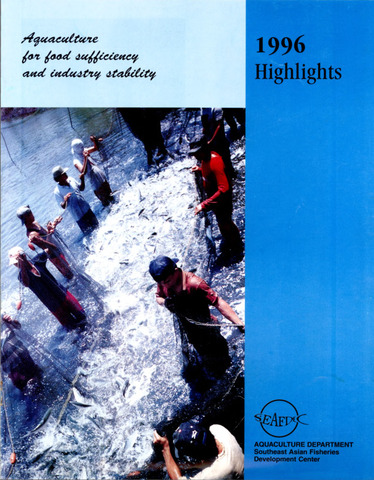
Aquaculture for food sufficiency and industry stability: 1996 highlights
(Aquaculture Department, Southeast Asian Fisheries Development Center, 1997-08)The SEAFDEC Aquaculture Department is mandated to: 1) promote and undertake aquaculture research relevant and appropriate for the region; 2) develop human resources for the region; and, 3) disseminate and exchange information on aquaculture. The document provides highlights of activities of the Department for the year 1996. -
The information-seeking behavior of aquatic science librarians in response to a query
Superio, Daryl; Oliveros, Mary Grace H. ; Palcullo, Vince Ervin ; Geromiano, Joy F. (Routledge, 2020-10-01)
When searching for information in response to a query, their own library’s online public access catalog (OPAC) and databases remain the most preferred resource for most aquatic science librarians. This preference does not vary regardless of age, gender, educational degree, position or designation, country classification, or type of library. While the Internet acts as a supplement to the library collection, whenever the requested information is not available at the library, librarians prefer Googling instead of looking at other sources. Other than aquatic science-specific open access repositories and databases, some of the librarians have identified Google Scholar, DOAJ, ResearchGate, and Academia, among many others as valuable resources that help them fulfill their clientele’s query. -
Touch-sensitive bristles on the carapace of the mud crab Scylla paramamosain may be receptors for courtship signals
; Bagarinao, Teodora; ; ; ; (Springer, 2021)
Bristle patches on the carapace behind the eyes were found for the first time in both males and females of the four species of mud crab Scylla spp. Electrocardiography revealed that the bristle patches of Scylla paramamosain were sensitive to touch (with a glass capillary) but not to chemical stimulation (with sugarcane juice). To elucidate the function of these touch signals, the courtship behaviour of S. paramamosain was video-recorded in a broodstock tank. A male approached a female, extended a walking leg over her carapace, touched her bristle patches with a dactyl, mounted her, and probed the bristle patches further with the third maxillipeds. Touch stimulus may be a signal for courtship in Scylla and one of the chain stimuli for the completion of mating behaviour.