Browsing SEAFDEC/AQD Publications in Print and for Sale by Issue Date
Now showing items 1-20 of 30
-
Seaweeds of Panay
(Aquaculture Department, Southeast Asian Fisheries Development Center, 2006)This practical book on the seaweeds of Panay, Philippines, acquaints and provides information to members of the academe and research institutions, policy makers, fishermen and businessmen regarding the taxonomy, distribution, ecology and economic importance of these resources. It consists of 4 major parts: (1) Introduction, which reviews the literature, habitat, distribution, morphological structure and reproduction; 2) Classification, which describes the classes to which the seaweeds generally belong; 3) Collection and preservation, which explains the procedure used in treatment of specimens; and, 4) Taxonomic list. A glossary is included, covering technical terms used. All species listed and described in this book are macrobenthic and were collected in Panay and Guimaras Islands. -
Series: Aquaculture extension manual; No. 39
Abalone hatchery
(Aquaculture Department, Southeast Asian Fisheries Development Center, 2008)This manual contains information on abalone hatchery operation, including site selection, design, culture of natural food, broodstock management, spawning, nursery, packing and transport, and profitability analyses. -
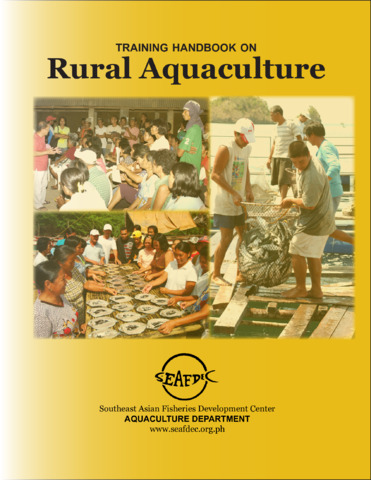
Training handbook on rural aquaculture
(Aquaculture Department, Southeast Asian Fisheries Development Center, 2009)This handbook covers four important factors in undertaking sustainable aquaculture livelihood namely: (1) aquatic resources and environment; (2) socioeconomic attributes of fishing communities; (3) appropriate and economically feasible aquaculture technologies; and, (4) policy issues and institutional arrangements related to a balanced fishery management and aquaculture livelihood. The long-term outcomes of these strategies shall be measured in terms of environmental sustainability, economic uplift of the community, and equitable distribution of benefits among different sectors of the community. -
The Malalison experience: empowering an island community in west central Philippines
; ; ; Amar, Edgar C. ; (Aquaculture Department, Southeast Asian Fisheries Development Center, 2009)
A 64-page booklet that describes SEAFDEC/AQD’s community fishery resources management project from 1991 to 1998 with a post project assessment in 2009.
; (Aquaculture Department, Southeast Asian Fisheries Development Center, 2009)
A 64-page booklet that describes SEAFDEC/AQD’s community fishery resources management project from 1991 to 1998 with a post project assessment in 2009. -
Series: Aquaculture extension manual; No. 43
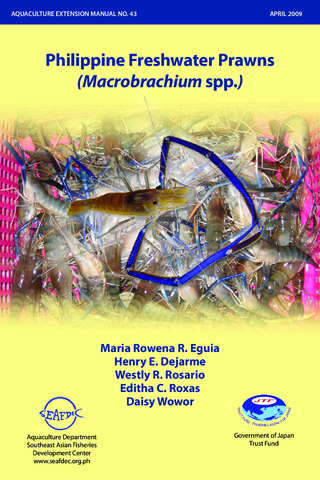
Philippine freshwater prawns (Macrobrachium spp.)
Eguia, Maria Rowena R.; ; ; ; (Aquaculture Department, Southeast Asian Fisheries Development Center, 2009)
This manual provides information on the biology, morphology, natural distribution, habitat, and economic importance of 22 notable species of Macrobrachium in the Philippines. -
Series: Aquaculture extension manual No. 45
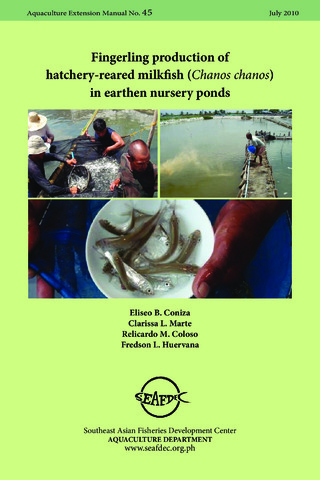
Fingerling production of hatchery-reared milkfish (Chanos chanos) in earthen nursery ponds
(Aquaculture Department, Southeast Asian Fisheries Development Center, 2010)Fingerling production of milkfish in ponds maybe operated as a commercial enterprise or a component of milkfish farming that comprises nursery, transition and rearing or grow-out phases. The fishpond nursery is used to grow milkfish fry to fingerlings 1-3 g in weight or 1-2 inches in length. The nursery pond is the smallest of the major fishpond compartment ranging from 500 to 5,000 m2, and is about 10% of the total farming area. The pond is prepared with utmost care to eliminate predators and competitors. The area should have good topography, is free from flooding and should have soil with good water retention properties for good dike construction and efficient culture management. Water supply should be adequate year-round and free from pollutants. Good pond water quality is maintained and natural food should be adequate to enhance growth and survival. With high stocking densities, supplemental feed is also provided. The three types of nurseries are based on feed sources: lablab, plankton with supplemental feeding and direct feeding. Select hatchery-reared fry (21 day old) that swim actively in schools, are uniform in size, have robust body, and are resistant to handling and transport stress. The ideal fry stocking density is 5-40 pieces/m2. Survival ranging from 50-90% can be expected after 25-45 days of rearing. Harvest, packing, transport, acclimation and stocking of the fry or fingerlings are carefully done during the cooler part of the day. Economic indicators show that fingerlings production is a profitable business. The improvement of milkfish grow-out technology from extensive or traditional to modified-extensive, semi-intensive and intensive culture in ponds, pens or in sea cages has increased demand for good quality fingerlings. Mass production of hatchery-reared fingerlings in earthen nursery ponds during peak season of fry availability can help bridge the supply gap. A steady supply of fingerlings for a whole year s operation will further increase production and ensure a sustainable supply of affordable market-sized fish. -
Series: Aquaculture extension manual; No. 46
Intensive culture of sea bass, Lates calcarifer Bloch, in brackishwater earthen ponds
(Aquaculture Department, Southeast Asian Fisheries Development Center, 2010)An extension manual describing criteria for site selection, monoculture and polyculture operations including feeds and feeding, harvest, common diseases, economic analysis. -
Series: Aquaculture extension manual; No. 49
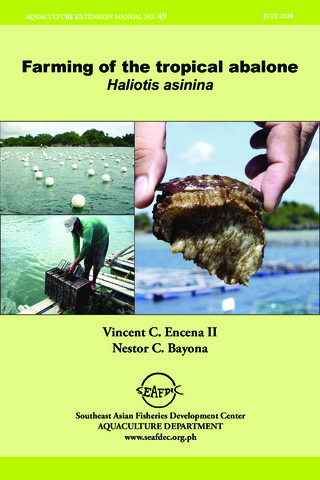
Farming of the tropical abalone Haliotis asinina
(Aquaculture Department, Southeast Asian Fisheries Development Center, 2010)This manual was written to provide abalone growers a practical guide on how to culture abalone based on the studies and trials conducted by SEAFDEC Aquaculture Department. -
Series: Aquaculture extension manual; No. 47
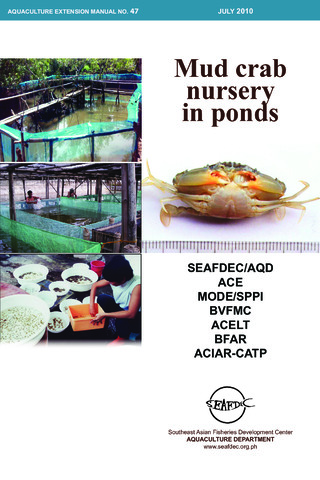
Mud crab nursery in ponds
Quinitio, Emilia T.An extension manual that is highly illustrated, detailing the biology, nursery, harvest, marketing, costs-and-returns of mudcrab nursery in ponds.; ; ; ; ; ; (Aquaculture Department, Southeast Asian Fisheries Development Center, 2010)
-
Series: Aquaculture extension manual; No. 48
Seed production of sandfish (Holothuria scabra) in Vietnam
(Aquaculture Department, Southeast Asian Fisheries Development Center, 2010)An extension manual describing broodstock management, larval rearing, and management of nursery systems. -
The pawikan album: The sea turtles captured around Panay and Guimaras Islands, Philippines
Bagarinao, Teodora; ; (Aquaculture Department, Southeast Asian Fisheries Development Center, 2010)
SEAFDEC FishWorld worked with fishers and government officers to document 93 sea turtles captured by fishing gears along the coasts of Panay and Guimaras Islands, Philippines in 2000-2009: three leatherbacks Dermochelys coriacea (128-150 cm curved carapace length), two loggerheads Caretta caretta (77 cm), 18 olive ridleys Lepidochelys olivacea (47-69 cm), 18 hawksbills Eretmochelys imbricata (20-89 cm), and 52 green turtles Chelonia mydas (30-108 cm). Most green turtles were caught in near shore fish corrals, and most olive ridleys by gill nets and long lines. Of the 18 hawksbills, 2 adults were caught in fish corrals, 3 juveniles were entangled in nets in Iloilo Strait, 6 were pets off our people,and 7 were captives at a turtle feeding station near a known hawksbill nesting site in Lawi, Guimaras. Sixty documented turtles were released, 47 of them with monel or inconel tags of the Pawikan Conservation Project, Department of Environment and Natural Resources. The others died from entanglement, serious injuries, slaughter for market, and diseases. Six female green turtles had multiple fibropapillomas; two died, three were released, and the latest one healed well after the surgical removal of several large tumors and was released. One green turtle brought to FishWorld has advanced shell rot, is unable to submerge, but is doing well on a diet of red seaweed Gracilaria. Three pet hawksbills were retrained for life at sea; one was released after 17 months, another after 57 months, but one is still at FishWorld as Conservation Ambassador. The most important result of FishWorld's work in the past 10 years is that many captured sea turtles were checked for health condition, treated where necessary or possible, tagged, and released back to sea. In addition, data on 93 sea turtles were gathered that can be used in the continuing effort to monitor the locations, risks and threats, health and diseases, and movements of these endangered species. -
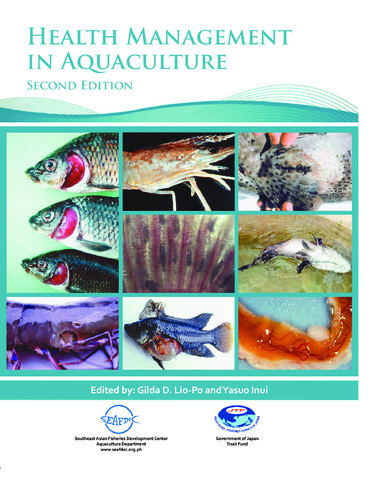
Health management in aquaculture
(Aquaculture Department, Southeast Asian Fisheries Development Center, 2010-07)A textbook on diseases of cultured warmwater fish and shrimps in the Philippines. Eleven chapters cover essential information on the basic principles of disease causation, major diseases of cultured fish and crustaceans, particularly shrimps, and methods of prevention and control. Emphasis is made on major diseases that occur in the Philippines and other countries in the Asian region. Included also are topics on harmful algae, immunology and molecular biological diagnostic techniques. -
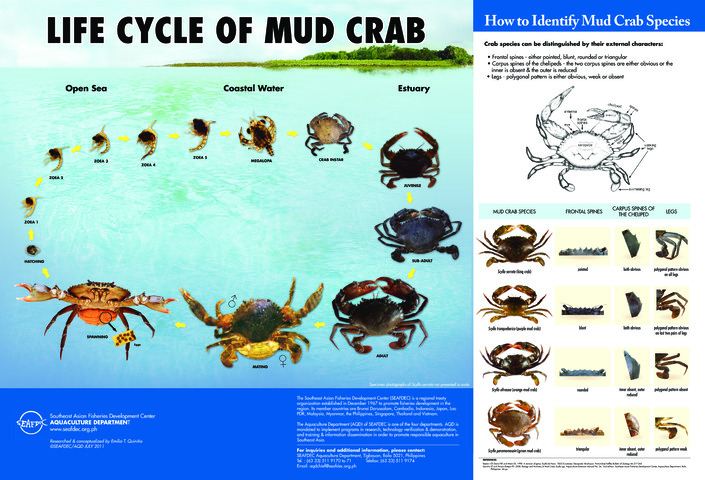
Life cycle of mud crab
Quinitio, Emilia T.Researched and conceptualized by Emilia T. Quinitio. (Aquaculture Department, Southeast Asian Fisheries Development Center, 2011)
-
Series: Aquaculture extension manual; No. 51
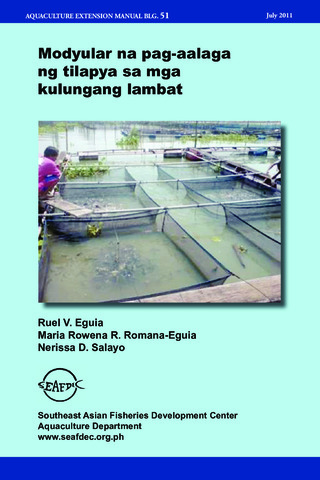
Modyular na pag-aalaga ng tilapya sa mga kulungang lambat
; Romana-Eguia, Maria Rowena R.An extension manual detailing traditional cage culture method, concept of modular cage culture, economic feasibility of modular cage culture, and post harvest processing.; (Aquaculture Department, Southeast Asian Fisheries Development Center, 2011)
-
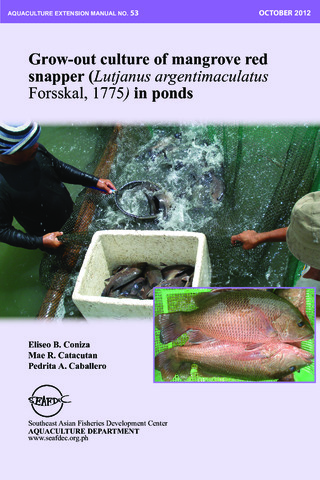
Series: Aquaculture extension manual; No. 53
Grow-out culture of mangrove red snapper (Lutjanus argentimaculatus Forsskal, 1775) in ponds
(Aquaculture Department, Southeast Asian Fisheries Development Center, 2012)The mangrove red snapper is among the high-value marine fishes with great potential for export. Snapper is important to coastal fishery and ideal for aquaculture particularly in Southeast Asia. Grow-out culture of snapper are described - pond culture and culture in cages inside the ponds. In the pond culture, the whole area can be maximized and the available natural food can be utilized by snapper. In rearing snapper in cages inside the pond, fish sampling and harvesting are easily done and also in preventing of disease infection and securing of fish stocks during flooding. In both culture methods a good site would have a mangrove buffer space about 20-100 m that lies between the ponds and the source of water like river or sea. Pond soil with a good water retention property is desirable for dike construction. Water supply should be adequate year-round, free from pollutants and run-off flooding. Pond supplies, labor and technology should be available on the selected site which is also accessible to markets with peaceful locale. The pond for growing snapper should be prepared well in order to promote good growth of fish, to minimize pollution, and prevents the proliferation of pathogens. Stocking of healthy and larger uniform size juveniles will mean higher survival, faster growth and shorter culture period. Proper handling of juveniles during harvest, size-grading, counting, packing, transport, acclimation and stocking should be observed and should be done during the cooler part of the day. Recommended juveniles for grow-out is about 20-100 g average body weight (ABW) and stocking densities of 5,000/ha in ponds, and at 5 pcs/m3 or 5,000 pcs/ha when stocked in cages inside the pond. During culture, good water quality is maintained and when necessary the cleaning of net cages, repair of dike leaks and seepages, and aeration are to be considered. Snapper dietary protein is about 48-50%. The following are the factors to consider in the feeding management of snapper: total stock (pcs), survival (%), ABW (g), feed rate (% biomass), feed type, feed size, feeding frequency and time. Economic analysis based on 0.422 ha pond shows that feeds accounted for 60-67% and juveniles contribute 23-25% of the variable cost. The feed conversion ratios, return on investments, payback period and discounted benefit-cost ratios are 2.5 and 2.6; 203 and 43%; 0.46 and 1.76 yr; 1.4 and 1.2 for culture of snapper in pond and culture in cages inside the pond, respectively, are likewise acceptable. -
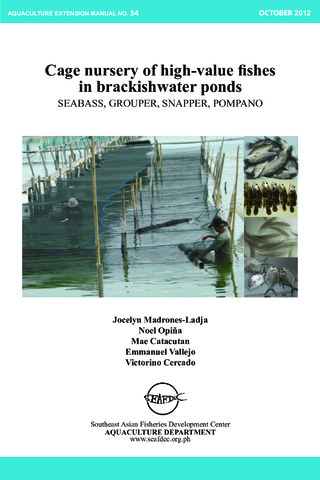
Series: Aquaculture extension manual; No. 54
Cage nursery of high-value fishes in brackishwater ponds: Seabass, grouper, snapper, pompano
(Aquaculture Department, Southeast Asian Fisheries Development Center, 2012)This extension manual describes nursery pond requirements, nursery rearing procedures, common diseases of young marine fish, and economic analysis of cage nursery as an enterprise separate from hatchery and grow-out culture. -
Beach forest species and mangrove associates in the Philippines
Primavera, Jurgenne; (Aquaculture Department, Southeast Asian Fisheries Development Center, 2012)
This new publication supported by UNESCO’s Man and Biosphere Programme introduces researchers and the general public to beach forest species and mangroves associates and describes their medicinal, traditional and commercial uses based on recent research and the older, hard-to-access literature. The shorelines and riverbanks of the Philippines were among the first sites opened for human settlement. Not surprisingly, vegetation in the coastal forest was the first to disappear, followed by mangroves and other forest types. Due to their early loss, beach forests are not well studied as other flora and therefore not familiar to the average Filipino. The 2004 Indian Ocean tsunami, and sea-level rise associated with global warming, have highlighted the role of beach forest-mangrove greenbelts in conferring protection on coastal communities. The publication is a collection of 140 species both familiar and poorly known, with around 100 treated exhaustively including scientific names, English names, local/regional names, botanical descriptions and folk uses. -
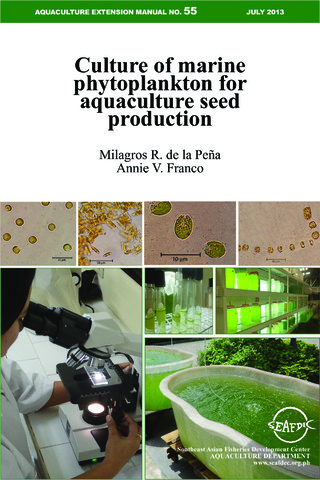
Series: Aquaculture extension manual; No. 55
Culture of marine phytoplankton for aquaculture seed production
(Aquaculture Department, Southeast Asian Fisheries Development Center, 2013)The 32-page extension manual describes the biology, culture techniques and maintenance and mass propagation of 12 phytoplankton species used as live feed in marine hatcheries. -
Field guide to mangrove identification and community structure analysis
Lebata-Ramos, Ma. Junemie Hazel (Aquaculture Department, Southeast Asian Fisheries Development Center, 2013)
The mangrove field guide is a 32-page field guide with a one page introduction on mangroves, followed by a key to mangrove genera and species (with colored pictures of the whole plant and plant parts), then a definition of important terms used in the key, species code for use during mangrove community structure, instructions on how to conduct mangrove community structure analysis plus the formulas for the different indices (relative density, dominance, frequency; importance value and species diversity) and a sample data sheet. The guide, measuring 9 cm x 14 cm, is printed on PVC material hence it can get wet, soaked or be left in the water for days. -
Series: Aquaculture extension manual; No. 56
Hatchery production of snubnose pompano Trachinotus blochii Lacepede
(Aquaculture Department, Southeast Asian Fisheries Development Center, 2014)A 26-page extension manual describing the biology, broodstock acquisition & management, larval rearing, harvest & transport and prevention of diseases & parasites in hatchery production of pompano.