Conference Proceedings: Recent submissions
Now showing items 481-500 of 767
-
The economics of different prawn and shrimp pond culture systems: A comparative analysis
(Aquaculture Department, Southeast Asian Fisheries Development Center, 1985)The paper aims to present a comparative economic evaluation of different pond culture systems for prawn (Penaeus monodon) and shrimp (P. indicus and P. merguiensis) using standard economic tools and methods of analysis. The different culture systems include extensive and semi-intensive monoculture of prawns and shrimps and the extensive polyculture of these species with milkfish (Chanos chanos). Data used in the analysis were taken from both SEAFDEC AQD and industry experience. The technical data were gathered from researchers and private sector experiences in prawn and shrimp farming. Financial estimates were determined after the peculiarities of aquaculture vis-a-vis other business ventures in agriculture and industry were taken into consideration. The study shows that the extensive monoculture of prawns and the extensive polyculture of prawn with shrimp and milkfish are profitable culture systems. Return on investment (ROI) and payback period for prawn extensive monoculture systems range from 10 to 65% and from 1.4 to 8.6 years, respectively. For polyculture systems, ROI ranges from 8 to 85% and payback period from 1.1 to 10.5 years. The semi-intensive culture of prawn shows moderate results. This is largely due to higher capital requirements for semi-intensive culture as compared to extensive culture. The extensive and semi-intensive monoculture of shrimps on the other hand show poor results, with semi-intensive monoculture registering net losses after all costs are considered. -
Brackishwater shrimp culture in India and its impact on socio-economics
(Aquaculture Department, Southeast Asian Fisheries Development Center, 1985)Utilization of potential area for shrimp culture in the traditional system was very meager — just 1.8% of total estimated available area of 1.45 million ha. The traditional paddy and fish culture and paddy cum fish culture systems and the return on investment (ROI) are explained. To adopt intensive culture, there is adequate scientific information based on many successful achievements throughexperimental trials indicating body weight of 16.7 g in 45 days for P. indicus with more than 80% survival rate proving economic viability. Basic studies were also made to find out the seasonal seed availability in different regions. Shrimp production to the extent of 500-700 kg/ha was achieved in many demonstration ponds organized by the Marine Products Export Development Authority indicating commercial reality of shrimp culture in India. As vast potential areas are available, shrimp culture will minimize the present 75% idle capacity of the Indian seafood processing industry which is over-dependent on shrimp as its major product for export. Furthermore, adding more areas to culture has direct impact on the socio-economic status of the rural population. Three thousand self-employed people are now known to be directly engaged in seed collection. In addition, the shrimp farmer realizes returns two to three times more than his counterpart in paddy cultivation, in the same field and for more or less the same period of time. In West Bengal, of total export value of 43 crores, up to 25 crores is realized by farmers for their production of shrimp through culture reflecting better unit return for their raw material than that realized byprocessor/exporter of the end-product. Therefore, bringing additional areas under shrimp culture will directly affect the socio-economic status of the rural people employing an average of 5 persons/ha, and indirectly affect no less than 15,000 casual workers in the seafood processing industry by additional utilization of manpower and working hours. As productivity from capture appears bleak, brackish-water shrimp culture has been accorded top priority in India's national developmental programmes for more harvest from aquatic sources otherwise termed the "Blue Revolution." -
The effects of manures and pelleted feeds on survival, growth and yield of Penaeus stylirostris and Penaeus vannamei in Panama
(Aquaculture Department, Southeast Asian Fisheries, Development Center, 1985)Brackishwater ponds (0.8 m deep and 600 m2) on the Pacific Coast of Panama were stocked at 5/m2 with post-larval shrimp (1 cm, 0.05 g) collected from the wild. Species composition at stocking was 56% Penaeus vannamei, 33% P. stylirostris and 11% P. occidentalis. Experimental treatments received different nutrient inputs consisting of cow manure (4,500 kg/ha dry wt.), chicken manure (4,500 kg/ha), 25% protein pelleted feed (790 kg/ha) and a control (no nutrient input), each replicated five times, in random order. Water was exchanged 5 to 10% per day and the production period was 120 days during the 1982 rainy season. -
Genetic changes during development of penaeid shrimp
(Aquaculture Department, Southeast Asian Fisheries Development Center, 1985)As penaeid shrimp grow from the earliest naupliar stages, through protozoeal and mysis stages, to postlarvae, they develop greater morphological and behavioral resemblance to the adults. Electrophoretic analysis of cytoplasmic enzymes from nauplii, protozoea, mysis, postlarvae, and adults show that each stage has a unique pattern of gene activity. Thirteen enzyme stains and a general protein stain have been used on larval samples from Penaeus stylirostris, P. vannamei and P. aztecus. Some enzymes, such as phospho-glucose isomerase, are produced in the same isozymic form during all of the stages. Other enzymes exhibit changes in the number and position of isozymic bands during development, e.g. glutamate dehydrogenase. Some of these differences among developmental stages can only be explained by changes in the number and/or identity of the genes that are active at each stage. This finding suggests larval and adult responses to selection may be relatively independent. -
Osmotic, total protein and chloride regulation in Penaeus monodon
(Aquaculture Department, Southeast Asian Fisheries Development Center, 1985)The osmotic, total protein and chloride ion regulation in two size groups (10 and 30 g) of Penaeus monodon Fabricius was investigated. Preliminary experiments showed that osmolality, total protein and chloride concentrations tend to become stable 24 to 36 hours after molting.Thus,hemolymph values 36 to 240 hours after sampling were not significantly different from each other. Based on these results, only 36 hours (or more) postmolt animals were sampled after transfer from control (32 ppt) to five test salinities (8, 16, 24, 32 and 40 ppt). Hemolymph samples were then taken 1, 2, 3, 5, 7 and 10 days after transfer. Results showed that in general, osmolality, total protein and chloride concentrations in the hemolymph did not vary with time within the same salinity.Both sizes exhibited hyperosmotic and hyperionic regulation in lower salinities and hypoosmotic and hypoionic regulation in higher salinities. The isosmotic values obtained were approximately 676 to 720 mOsm (24 to 28.8 ppt) for the 10 g, and 724 to 792 mOsm (26 to 28.5 ppt) for the 30 g size group. For chloride, the isoionic values ranged from 324 to 339 mM in 10 g prawns. Slopes of the regression lines of hemolymph osmolality versus salinity in 10 g prawns were not significantly different from slopes of similar regression lines in 30 g prawns. These results suggest that the ability to regulate osmotic and total protein concentration in the hemolymph is similar in the two size groups. -
The effects of stocking densities on growth and survival of Penaeus vannamei in cow manure-enriched ponds
(Aquaculture Department, Southeast Asian Fisheries Development Center, 1985)Ecuadorian Penaeus vannamei were stocked in eight dirt ponds (approximately 163 m2) at four different types of density, i.e., 5 shrimp/m2, 10 shrimp/m2, 15 shrimp/m2, and 20 shrimp/m2. The initial body weight ranged between 1.1 and 3.8 g. No commercial feed was given to the shrimp. The only input to the pond was 30 kg of cow manure/week. Shrimp were sampled either weekly or bi-weekly for body weight measurements. Water quality parameters, such as temperature, pH, DO and turbidity were recorded twice daily; nutrients (nitrite, nitrate, ammonium and phosphate) and BOD were measured twice weekly. The chemical composition of the cow manure was analyzed. After 14 weeks' experiment, the shrimp were harvested, weighed and counted. Survival and total yield were compared among treatments. The results showed negative correlation between stocking density and growth. The weekly growth of shrimp was between 0.7 and 1.0 g. There was no relationship between stocking density and survival. Survival averaged 68%. The most suitable stocking density should be judged by profit. However, the total yield of shrimp was higher in the higher stocking density. -
Penaeid larval culture using microencapsulated diets
(Aquaculture Department, Southeast Asian Fisheries Development Center, 1985)Whilst it has been possible for many years to feed postlar-val penaeids successfully on artificial diets, problems of nutrient leaching, particle breakdown, and water fouling have prevented the use of such diets for early planktonic larval stages. It has recently been demonstrated that the technique of microencapsulation may be used to overcome these problems. Live foods used for penaeid culture have been successfully replaced by microencapsulated diets, both in the laboratory and at the hatchery level. The technology has now reached the level at which dietary requirements of individual species can be met by the incorporation of specific nutrients. Capsules can be supplied to function either as complete nutrient delivery systems or as food supplements. The present paper reviews this progress towards the total replacement of live foods in penaeid culture, and assesses the results of recent culture trials. -
Effects of some water-soluble vitamins on the growth of Penaeus monodon juveniles
(Aquaculture Department, Southeast Asian Fisheries Development Center, 1985)The response of Penaeus monodon juveniles (ave. wt.= 0.076 g) in terms of survival and growth rates to vitamin test diets was observed in a 35-day feeding experiment. The prawns were reared in 60-ℓ oval tanks containing filtered seawater in a flowthrough system of ambient temperature and salinity. The treatments consisted of a control (complete vitamin mix), a vitamin-free diet and nine other diets, each lacking one of the vitamins in the mixture. At the end of the feeding trial, the survival rates in all treatments ranged from 80 to 100%, while weight gain ranged from 74 to 40%. Significantly lower weight gains were obtained from choline chloride-free diet (P<0.05) and vitamin-free and inositol-free diets (P<0.01) than from control. -
Effect of cholesterol in artificial diets for Mediterranean prawns
(Aquaculture Department, Southeast Asian Fisheries Development Center, 1985)Mediterranean prawn (Penaeus kerathurus Forsskal) postlarvae (2 months old) were fed ad libitum with previously tested artificial diet (41% D.W., mainly of vegetal origin) supplemented with different percentages of cholesterol (0, 0.1, 0.5, 1.0 and 3.0%) and fresh bivalve mussel. Growth and survival rates were determined twice. Considering supplemented formulas only, data show that: (a) individual weights were higher with 0.1% cholesterol in the diet; (b) survival sharply dropped in the last week of the experiment, in particular with 0.1 and 3.0% cholesterol diets; and (c) with 1.0% cholesterol, mortality and growth counterbalanced giving over-all better results. No artificial feed can compete with the natural diet, either for survival rate or for individual growth. -
The response of Penaeus monodon juveniles to varying protein/energy ratios in test diets
(Aquaculture Department, Southeast Asian Fisheries Development Center, 1985)The response of Penaeus monodon juveniles (0.71±0.11 g) to varying protein/energy ratios in test diets was determined. Purified diets consisting of different levels of protein, lipid and carbohydrates were formulated. Two sets of experiments were conducted with the following diet combinations: (1) 30, 30, 50% protein, 5, 10, 15% lipid and 0, 10, 20% carbohydrate and (2) 40, 45, 50% protein, 5% lipid and 20, 25, 30% carbohydrate. Protein and energy ratios ranged from 89-198 mg protein/Kcal while the energy values for all diets were 165-415 Kcal/100 g. The diets were given twice daily at 10% of the body weight. Results showed that a two- to three-fold increase was observed in the body weight of prawns fed with diet combinations of 40-50% protein, 5-10% lipid and 20% carbohydrate with energy values of 285-370 Kcal/100 g. Reduction in protein content of the diet from 50 to 40% while maintaining the total energy level (285 Kcal/100 g) resulted in a change in growth that was not significant. An increase in energy level, at constant dietary protein level, resulted in improved utilization of protein and feed conversion efficiency. -
Effect of dietary fatty acids on the fatty acid composition of Penaeus monodon juveniles
(Aquaculture Department, Southeast Asian Fisheries Development Center, 1985)Six purified diets containing either pollack liver oil or a combination of dietary fatty acids (18:1ω9, 18:3ω3, 20:5ω3) at 5% level and a control (no lipid) were assessed for their influence on the fatty acid composition of Penaeus monodon juveniles (0.2-0.5 g). After a 35-day feeding period, the fatty acid composition of the neutral lipid (NL) and polar lipid (PL) fractions of prawn total lipids was analyzed. All treatments showed that the prawn lipid contained high level of polyenoic acids (20:4ω6, 20:5ω3, 22:6ω3); likewise the sum of ω3 series fatty acids were high in the PL fraction. The component fatty acids of prawns showed a correlation with those of the diet. However, some dietary fatty acids were incorporated more into the NL fraction (18:1ω9, 20:5ω3) than in the PL fraction (20:4ω6). The ratios of 18:1ω9/22:6ω3 and (18:1ω9 + 20:1ω9)/(20:5ω3 + 22:6ω3) were found to be the lowest in the PL of the prawn pollack liver oil. -
Factors affecting maturation and spawning of Penaeus esculentus in the laboratory
(Aquaculture Department, Southeast Asian Fisheries Development Center, 1985)Adult tiger prawns Penaeus esculentus were held in laboratory tanks under varying conditions of tank size, density, temperature and photoperiod for assessment of ovarian maturation and spawning. Both eyestalk ablated and intact females were studied. Maturation and spawning of intact females was favored by conditions of warm temperature (26°C) and long days (14.5 hr), whereas ovary maturation did not occur at lower temperature (20°C) and short days (12 hr). Tank size was a critical factor with intact females as maturation and spawning required a large tank (4 m2). Spawning did not occur in small tanks (1 m2) despite ideal temperature and photoperiod conditions. Unilaterally ablated females matured and spawned under both short day-cold temperature conditions and in small tanks, but the success rate was greater under long day-warm temperature conditions in large tanks. Intact females required 40-60 days before onset of ovary maturation, whereas ablated females showed maturation to ovary stage III approximately 20 days after ablation. Mating success was severely limited under small tank conditions but occurred normally in the large tanks. -
Water quality criteria for farming the grass shrimp, Penaeus monodon
(Aquaculture Department, Southeast Asian Fisheries Development Center, 1985)Physiological and growth effects of pH, salinity, temperature, heavy metals, pesticides and others on juvenile grass shrimp Penaeus monodon have been investigated to determine the biologically safe concentrations. Optimal pH, salinity and temperature are found to be in the range of 8.0-8.5, 15-25 ppt, and 28-33°C, respectively. A dissolved oxygen concentration of 3.7 ppm seems to be the critical oxygen pressure to support the normal life of grass shrimp. To avoid poor survival and retarded growth, the recommended level for each pollutant are: heavy metals, 0.0025 ppm Hg, 0.1 ppm Cu, 0.15 ppm Cd, 0.25 ppm Zn; pesticides, 0.0004 ppb parathion, 0.001 ppb malathion, 0.008 ppb rotenone, 0.01 ppb Azodrin, 0.033 ppb Saturn, 0.01 ppb paraquat, 0.01 ppb Endosulfan, 1 ppb Butachlor; surfactants, 0.1 ppm Dunall OSE, 0.2 ppm BP 1100, 0.5 ppm Seagreen 805; and others, 0.033 ppm H2S, 0.1 ppm NH3. -
The growth of a bialgal culture and its use as food for shrimp larvae
(Aquaculture Department, Southeast Asian Fisheries Development Center, 1985)The cultivation of the microalga Tetraselmis chuii with the protection of the extracellular products of Chlorella kessleri, grown in a bialgal culture, allows its development in outdoor tanks without special conditions of sterilization or aeration. Fish meal and agricultural inorganic compounds are used as fertilizers. The growth of the mixed species is analyzed comparing it with monoalgal cultures. The best fit of growth data to a logistic curve is performed and the whole curve is compared using a covariance analysis. The stratification of T. chuii in the tank favors its harvest at high concentration. A bialgal culture (based on T. chuii at 50 cells/mm3) as food for the larvae of the shrimps Penaeus notialis and P. schmitti, together with hard boiled egg yolk and rotifers, achieves good development and survival. -
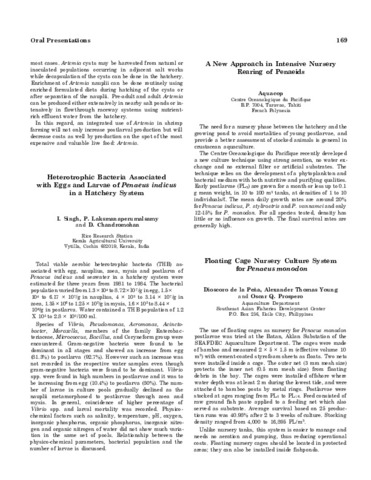
Floating cage nursery culture system for Penaeus monodon
(Aquaculture Department, Southeast Asian Fisheries Development Center, 1985)The use of floating cages as nursery for Penaeus monodon postlarvae was tried at the Batan, Aklan Substation of the SEAFDEC Aquaculture Department. The cages were made of bamboo and measured 2 × 5 × 1.5 m (effective volume 10 m3) with cement-coated styrofoam sheets as floats. Two nets were installed inside a cage. The outer net (3 mm mesh size) protects the inner net (0.5 mm mesh size) from floating debris in the bay. The cages were installed offshore where water depth was at least 2 m during the lowest tide, and were attached to bamboo posts by metal rings. Postlarvae were stocked at ages ranging from PL5 to PL16. Feed consisted of raw ground fish paste applied to a feeding net which also served as substrate. Average survival based on 25 production runs was 40.98% after 2 to 3 weeks of culture. Stocking density ranged from 4,000 to 16,895 PL/m3. Unlike nursery tanks, this system is easier to manage and needs no aeration and pumping, thus reducing operational costs. Floating nursery cages should be located in protected areas; they can also be installed inside fishponds. -
Carbohydrate requirements of Penaeus monodon juveniles
(Aquaculture Department, Southeast Asian Fisheries Development Center, 1985)Penaeus monodon juveniles (initial mean weight=0.62 g) were fed semi-purified diets containing 10, 20 and 30% trehalose, sucrose or glucose for eight weeks. Results showed that shrimps fed 20% trehalose gave the highest growth rate. Of the three types of sugars tested, trehalose promoted the best growth rates, followed by sucrose and glucose. When the level of sugar was considered, 20% gave the best growth rate and 30%, the lowest. The type as well as level of sugar greatly affected the body crude protein and body lipid (P < 0.01), while survival was mainly affected by type of sugar alone (P < 0.01). Trehalose and sucrose diets promoted better survival than glucose diets. A negative linear correlation (r = —0.70) between the body crude protein and body lipid was obtained. -
Survival, growth and production of white shrimp Penaeus indicus in brackishwater ponds
(Aquaculture Department, Southeast Asian Fisheries Development Center, 1985)This study was conducted in 4 one-ha ponds, 70-100 cm deep and 2 two-ha ponds, 40-70 cm deep to evaluate the survival, growth and production of white shrimp, Penaeus indicus stocked at 50,000/ha and cultured within a period of 90 days with supplementary feeding. It was observed that mean survival and yield per ha obtained were significantly higher in deeper ponds, 70.36% and 343.2 kg/ha, respectively, compared with those in shallow ponds, 37.50% and 180 kg/ha, respectively (P < 0.05). There was no significant difference in mean body weight at harvest for deep ponds (9.80 g) and shallow ponds (9.55 g). Results suggest that white shrimp production is better in deeper ponds than in shallow ponds. -
A new approach in intensive nursery rearing of penaeids
(Aquaculture Department, Southeast Asian Fisheries Development Center, 1985)The need for a nursery phase between the hatchery and the growing pond to avoid mortalities of young postlarvae, and provide a better assessment of stocked animals is general in crustacean aquaculture. The Centre Oceanologique du Pacifique recently developed a new culture technique using strong aeration, no water exchange and no external filter or artificial substrates. The technique relies on the development of a phytoplankton and bacterial medium with both nutritive and purifying qualities. Early postlarvae (PL3) are grown for a month or less up to 0.1 g mean weight, in 10 to 100 m3 tanks, at densities of 1 to 10 individuals/ℓ. The mean daily growth rates are around 20% for Penaeus indicus, P. stylirostris and P. vannamei and only 12-15% for P. monodon. For all species tested, density has little or no influence on growth. The final survival rates are generally high. -
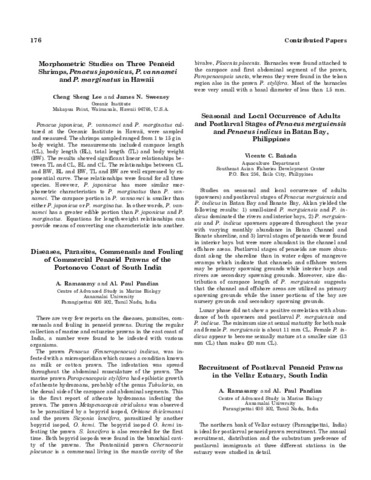
Seasonal and local occurrence of adults and postlarval stages of Penaeus merguiensis and Penaeus indicus in Batan bay, Philippines
(Aquaculture Department, Southeast Asian Fisheries Development Center, 1985)Studies on seasonal and local occurrence of adults (spawners) and postlarval stages of Penaeus merguiensis and P. indicus in Batan Bay and Banate Bay, Aklan yielded the following results: 1) small-sized P. merguiensis and P. indicus dominated the rivers and interior bays, 2) P. merguiensis and P. indicus spawners appeared throughout the year with varying monthly abundance in Batan Channel and Banate shoreline, and 3) larval stages of penaeids were found in interior bays but were more abundant in the channel and offshore areas. Postlarval stages of penaeids are more abundant along the shoreline than in water edges of mangrove swamps which indicate that channels and offshore waters may be primary spawning grounds while interior bays and rivers are secondary spawning grounds. Moreover, size distribution of carapace length of P. merguiensis suggests that the channel and offshore areas are utilized as primary spawning grounds while the inner portions of the bay are nursery grounds and secondary spawning grounds. Lunar phase did not show a positive correlation with abundance of both spawners and postlarval P. merguiensis and P. indicus. The minimum size at sexual maturity for both male and female P. merguiensis is about 11 mm CL. Female P. indicus appear to become sexually mature at a smaller size (13 mm CL) than males (20 mm CL). -
Nutritional value of marine yeast fed to larvae of Penaeus monodon in combination with algae
(Aquaculture Department, Southeast Asian Fisheries Development Center, 1985)Saccharomyces cerevasiae and Rhodotorula aurantica, two marine yeast species, were fed to Penaeus monodon larvae (N6 to M1) singly and in combination with Tetraselmis sp. and Chaetoceros calcitrans in varying proportions. Larvae fed combination diets gave survival rates comparable to or higher than those fed algae or yeast alone. Chemical analyses show that the yeasts have low fat, moderate protein and high carbohydrate content. They also contain essential amino acids but are different in the fatty acids found to be essential for prawns. When used in combination with algae, the nutritional value of the yeasts seemed to have been improved. The use of marine yeasts in larval rearing could reduce economic and technological inputs in the production of natural foods for larval rearing. They are cheaper and easier to mass produce. They can be grown to very high densities using cheap carbon sources like molasses, brown sugar and coconut water with added nutrients in relatively shorter periods of time.