Conference Proceedings: Recent submissions
281-300 / 767
-
Distribution and abundance of hard clam shells Meretrix meretrix along the coastal areas of Panguil bay, Lanao del Norte, Philippines
(Aquaculture Department, Southeast Asian Fisheries Development Center, 2015)Meretrix meretrix is believed to be abundant in Panguil Bay and in the absence of relevant fishery statistics, it is useful to quantify their biomass with a view to determining their fishery potential. This study aims to monitor the gonadal development, identify the associated macrofauna and determine the distribution and abundance of hard clam shells M. meretrix along the coastline of four municipalities of Lanao del Norte at Panguil Bay. Four sampling sites were selected and established to achieve and relate some generalities using the transect-quadrat method. Clams were counted, measured and identified. Physicochemical parameters were also noted every sampling. M. meretrix was found to be most abundant in Raw-an Pt. Baroy (28-542 pcs./m2) followed by Mayao, Lala (0.3-26 pcs/m2). M. meretrix at Aloha Tubod occurred in low densities (0.1-4 pcs/m2). No hard clam shell was found in Taguitic, Kapatagan. Mean length differed significantly at the three locations. The coastal area of Mayao, Lala, had the highest diversity (H' = 4.236737) in terms of shell species identified and recorded during the twelve months sampling period. Most of the shells dissected were sexually immature with male shellfishes being more predominant than females. Differences in distribution, density and length size of hard clam shells were compared in this study at four locations. Anthropogenic causes e.g. exploitation as well as environmental parameters such as salinity levels and sediment quality are suggested to be the main cause of the variation. These results will be used as baseline information to properly manage hard clam shell resources in Panguil Bay. -
Preliminary trials on the optimization of hormone dosages for induced breeding of Philippine silver perch, Leiopotherapon plumbeus
; Aya, Frolan ; Romana-Eguia, Maria Rowena R. (Aquaculture Department, Southeast Asian Fisheries Development Center, 2015)
The silver perch Leiopotherapon plumbeus, locally known as ayungin, is an endemic freshwater fish that is commercially valuable as it commands a high price in the local market. Due to excessive fishing and other potential causes such as predation by invasive alien species, the local L. plumbeus stocks are observed to be depleting hence there is a need for an induced breeding protocol to propagate silver perch and conserve what remains of the resource. In this study, 30 females (total length or TL: 109.4 ± 12.2 mm; total body weight or TBW: 20.3 ± 6.1 g) and 60 males (TL: 97.1 ± 11.6 mm; TBW: 13.4 ± 5.5 g) were injected once intra-muscularly with different doses of hormones. Various dosages of human chorionic gonadotropin (HCG), luteinizing hormone releasing hormone analog (LHRHa) and salmon gonadotropin releasing hormone (sGnRH) were evaluated to identify the most effective dosage and hormone that resulted to high ovulation, fertilization and hatching rate. For the hormone sGnRH, 20, 30 and 40 µg/kg body weight (BW) and 1, 2 and 3 µg/kg BW for LHRHa were the dosages used in the experiment. The dosage used for HCG is 50 IU/g BW and served as the control. The findings of the experiment determined that the use of 20 µg/kg body weight of sGnRH resulted to high ovulation, fertilization and hatching rates. The result of the experiment would provide an efficient protocol for the local fishermen so they can produce, on demand, a large supply of this high quality fish species.
; Romana-Eguia, Maria Rowena R. (Aquaculture Department, Southeast Asian Fisheries Development Center, 2015)
The silver perch Leiopotherapon plumbeus, locally known as ayungin, is an endemic freshwater fish that is commercially valuable as it commands a high price in the local market. Due to excessive fishing and other potential causes such as predation by invasive alien species, the local L. plumbeus stocks are observed to be depleting hence there is a need for an induced breeding protocol to propagate silver perch and conserve what remains of the resource. In this study, 30 females (total length or TL: 109.4 ± 12.2 mm; total body weight or TBW: 20.3 ± 6.1 g) and 60 males (TL: 97.1 ± 11.6 mm; TBW: 13.4 ± 5.5 g) were injected once intra-muscularly with different doses of hormones. Various dosages of human chorionic gonadotropin (HCG), luteinizing hormone releasing hormone analog (LHRHa) and salmon gonadotropin releasing hormone (sGnRH) were evaluated to identify the most effective dosage and hormone that resulted to high ovulation, fertilization and hatching rate. For the hormone sGnRH, 20, 30 and 40 µg/kg body weight (BW) and 1, 2 and 3 µg/kg BW for LHRHa were the dosages used in the experiment. The dosage used for HCG is 50 IU/g BW and served as the control. The findings of the experiment determined that the use of 20 µg/kg body weight of sGnRH resulted to high ovulation, fertilization and hatching rates. The result of the experiment would provide an efficient protocol for the local fishermen so they can produce, on demand, a large supply of this high quality fish species. -
Perceptions on the effects of maritime activities on the Philippine aquatic ecosystem
(Aquaculture Department, Southeast Asian Fisheries Development Center, 2015)Throughout history, humans create an impact on marine ecosystems. May it be positive or negative, such impact is long-term and shapes the overall image of the system. As humanity increases its number, so does the impact it creates. Humanity has relied on the oceans for food, recreation and for various economic opportunities. Overfishing and pollution affects the life in the seas. Advancements in fishing technology, such as tracking technologies and better transportation have reduced fish stocks significantly when matched with non-sustainable practices, such as dredging and trawling. Intentional dumping from sewages, industrial run-off and chemicals has brought about pollution in the seas. Though some pollution may be accidental, like oil spills, it still causes adverse effects to the sea. Excess nutrients coming from fertilizers and intensive farming practices have resulted to what is known as eutrophications. Lastly, changes in the marine environment have led to the introduction of invasive alien species and marine organisms, which are oftentimes difficult to eradicate. Such effects have made researchers rethink of various ways to maintain marine activities while sustaining its ecosystem. Through this study, the researchers determined the effects of maritime activities on the population of aquatic creatures directly from the seafarers, and found out their perspectives on how to remedy such effects and sustain the marine ecosystem. This research is descriptive in nature, conducted with 100 purposively selected seafarers from Manila. The participants were given a questionnaire that asked for demographics and their perceptions on the effects of maritime activities on the marine ecosystem and ways to provide solutions to minimize or avoid its negative impacts. Findings show equal distribution on gender, with majority at the low socioeconomic level (47%) and are Tagalog in ethnicity (56%). The seafarers believe that the maritime activities cause harm on aquatic creatures (43%), limits propagation of aquatic species (36%), makes them prone to mortality (11%) and cause pollution to the atmosphere (10%). Likewise, their perception of minimizing the consequences lies within the proper conditioning of ships and running them in good condition (57%), maintaining a clean place for the marine inhabitants (28%) and creating a good waste-renewal system (15%). The results of the paper is directed towards proper handling and maintenance of the shipping industry and strict supervision for waste management. -
Growth and survival of nile tilapia (Oreochromis niloticus) juveniles fed diets with varying levels of irradiated chitosan
; ; Romana-Eguia, Maria Rowena R. (Aquaculture Department, Southeast Asian Fisheries Development Center, 2015)
Chitin is a natural biopolymer and the second most abundant after cellulose. Chitosan, a derivative of chitin which is soluble in acidic aqueous media, is used in many applications like food, cosmetics, biomedical and pharmaceutical products. It is used in agriculture for enhancing growth in crops while in aquaculture, chitosan is believed to improve the immune response of fish to stress-inducing agents, thus enhancing survival and possibly growth. This preliminary study was conducted to investigate the effects of various concentrations of irradiated chitosan on the growth performance of Nile tilapia, O. niloticus. Fish was fed with a control diet and three formulated diets containing increasing levels of irradiated chitosan (10g, 20g and 50g kg-1). Juvenile O. niloticus was fed once daily for 21 days. The ration was based on 5% of the fish biomass. Tilapia fingerlings (n=30 per tank) of uniform size were randomly distributed in four experimental groups each with three replicates following a completely randomized design. Growth and food utilization parameters were measured. Specific growth rate (SGR), mean weight gain (MWG), mean length increment (MLI) and feed conversion ratio (FCR) were computed and analyzed using ANCOVA. Results from the feeding trials showed no significant difference (P>0.05) in the different performance parameters under the different fish feed treatments. MWG, MLG, SGR and FCR varied in the stocks fed different fish feed treatments but with no significant differences. The results also showed 45-62% survival ratio. These suggest that although there is no significant difference between treatments and control, irradiated chitosan-supplemented diets do not retard the growth of O. niloticus. Chitosan should be studied further to determine how it can improve the growth performance, feed utilization and immune response of Nile tilapia. -
Modelling the impact of different stress agents on Holothurian immunity
(Aquaculture Department, Southeast Asian Fisheries Development Center, 2015)Due to dietetic and pharmacological values of many species of sea cucumbers (Holothuroidea, Echinodermata), and depletion of their natural resources, the species of little or no commercial value attract attention as new raw material resource, and methods of their aquaculture are developed. Both monitoring and supporting the health of animals in natural and artificial conditions demand the approaches providing reliable markers. This study compared the influence of two stress agents, namely lead and bacterial toxin Yersinia pseudotuberculosis (ТсТYp), on some of the markers of immune response of the Far Eastern holothurian Eupentacta fraudatrix. Phagocytes (P2 type) were isolated after 48h treatment of holothurians E. fraudatrix with Pb(NO3)2 (2 and 4 mg/L). In another experiment, coelomocyte were incubated with ТсТYp (0.2 and 0.5 µg/g) for 18h. Apoptosis level and FITC-conjugated concanavalin A (con A) and binding of lectins from Glycin Max and Dolichos biflorus to P2 surface receptors, and activity of antioxidant enzymes were measured. Lead induced an increase in catalase and decreases in superoxide dismutase and glutathione-S-transferase and glutathione reductase activities at dose of 2 but not 4 mg/L. 2 mg/L lead also increased apoptosis level. Noteworthy, receptors to lectins from G. Max and D. biflorus were poorly expressed in the control, and significantly expressed under lead treatment at a dose of 2 but not 4 mg/L (D. biflorus) or decreased at a dose of 2 but not 4 mg/L (G. Max). Binding con A was significant in the control and additionally increased under treatment with 2, but not 4 mg/L. Meanwhile, ТсТYp also induced reversed concentration-dependent effect on apoptosis: 48h incubation with 0.5 µg/g decreased apoptosis, and 0.2 µg/g-increased it. Additionally, 0.2 µg/g ТсТYp decreased binding con A and D. biflorus lectin. Commercially available catalase restored % lectin binding to the control level. Data obtained indicate that lead and ТсТYp differently influenced phagocyte activity, and complex definition of apoptosis level and activity of antioxidant enzymes. Finally, variations in expression of cell surface receptors may be useful for estimation of the level of stress damage to holothurians. -
Preliminary assessment of the abundance and fishery of snapping shrimp (Alpheus sp.) in Calape, Bohol, Philippines
(Aquaculture Department, Southeast Asian Fisheries Development Center, 2015)Snapping shrimp Alpheus sp. is abundant in Calape, Bohol, particularly in coastal areas with a wide intertidal zone, mangroves and rich mud banks. Locally known as takla , it is considered as one of the major seafood delicacies in the municipality. An initial assessment of the natural population and fishery of the snapping shrimp was conducted. Using quadrat sampling, mean density was noted at 7 individuals m-2, body weight ranging from 3.87-12.86 g and total length at 4.78-7.44 cm. The largest individual was identified as male having larger claws, the size being two times larger than that found in females. Apart from actual field sampling, a total of 80 shrimp gatherers were surveyed to obtain relevant fishery information for the snapping shrimp. The snapping shrimp is sold in the local public market and traded in hotels and seafood restaurants at PhP50.00 bundle-1 (a bundle averaging 20 pieces) and PhP180.00 a kilo. The current average catch per gatherer is at 75 pieces on a daily basis which is relatively lower compared to the average catch in the 1980s and 1990s ranging from 150-300 pieces day-1. Destruction of mangrove swamps due to fishpond conversion, unabated mangrove cutting for commercial firewood production and unrestricted gathering of snapping shrimps were identified as possible causes for the decline. These baseline data are essential for the local government and the community to come up with appropriate protection and conservation measures. An intensive and comprehensive study on the snapping shrimps ecology and biology also need to be conducted to provide basis for sound and holistic management of this valuable resource. -
A preliminary study on the diagnosis of coral reef healthiness and establishment of coral replenishment technology
(Aquaculture Department, Southeast Asian Fisheries Development Center, 2015)Field surveys for coral reef through line-intercept-transect (LIT) and temperature profiling using data-loggers were done at three layers of 5, 10, and 15 m depths in coral reef areas, Nogas Island, Anini-y, Antique, Philippines. Preliminary data based on the LIT survey showed that both coverages of substrates by any type of organism and by Scleractinia decreased in the deeper layers. For Scleractinia, Porites sp. occurred predominantly in all the depth layers with the occurrence decreasing with depth. Temperature fluctuation was largest in the 5 m depth layer, where effects of tidal level were also confirmed. While the average temperature decreased with depth, this did not differ beyond 1°C between 5 and 15 m layers during November 2012 to March 2013. Fragments of the Porites sp. and Acropora sp. were sampled and transferred to aquaria at the Tigbauan Main Station of SEAFDEC/AQD. Acropora sp. sampled from the deepest layer alone showed bleaching and thereafter, a part of the fragments regained the color. Experimental trials to clarify the effects of ocean acidification and warming on the health of the coral using the live fragments of Porites sp. showed decreasing trends in both photosynthetic rates and daily growth rates in acidic condition (pH = 7.6), while decrease of zooxanthellae density was observed under warmer conditions (31°C ) for one month. A new methodology for the determination of density of zooxanthellae was established using the fragments of Porites sp. In this study, the need for studies on several coral communities as well as further basic research on coral biology, particularly, responses to the changing environments are discussed for diagnosis of coral reef healthiness and establishment of effective coral replenishment technology. -
Preliminary trials on the effects of weaning and larval diets on survival and growth of silver therapon (Leiopotherapon plumbeus) larvae
Aya, Frolan; ; Garcia, Luis Maria (Aquaculture Department, Southeast Asian Fisheries Development Center, 2015)
Success in larval rearing of silver therapon can be achieved through early weaning of fish larvae from live food to artificial diet. Two experiments were carried out to investigate the effects of (a) weaning age (abrupt and gradual) and (b) larval diets (artificial and live foods) on survival and growth of silver therapon (Leiopotherapon plumbeus). In the first experiment, larvae were randomly stocked in round 4-l plastic basins at 15 larvae per basin to provide triplicates of four weaning age treatments (8, 14, 20 and 26 days after hatching or DAH, respectively). Larvae were fed thrice daily for 21 days with commercial feed (CF) and with copepods (COP) which served as the control. Larvae weaned at 26 DAH had the highest survival, body weight and total length among the treatment groups, which were comparable with that of the control. In the co-feeding protocol, larvae were fed Artemia nauplii (ART) as the control group and co-fed with either zooplankton i.e. 50% COP + 50% CF or 50% ART + 50% CF for 8 (8-15 DAH), 6 (14-19 DAH) and 4 (20-23 DAH) days, and suddenly weaned to FM until 21 days. Survival ranged from 22.2 ± 16.8 to 40.0 ± 24.0% between treatments, but was still lower than the control (88.9 ± 3.8%). Body weight and total length were significantly higher in larvae with co-feeding for 4 days (70.1 ± 2.8 mg; 18.1 ± 0.8 mm), but were still lower than that of the control (142.8 ± 7.6 mg; 22.3 ± 0.3 mm). In the second experiment, 26-day old larvae were stocked in 20-l glass aquaria at 4 larvae l-1. Larval diets ((I) commercial prawn feed (38% crude protein); (II) Artemia nauplii; (III) copepods; and (IV) free-living nematode Panagrellus redivivus) were given twice daily for 28 days. Survival was highest in larvae fed Artemia nauplii and poor in copepod fed larvae. Final total length (TL) of larvae fed prawn diet was higher than those fed copepod or nematodes. However, best growth was noted in larvae fed Artemia nauplii (TL= 24.30 ± 0.81 mm; BW = 156 ± 8 mg; specific growth rate or SGR = 5.33 ± 0.19%/d). -
Larval rearing of silver therapon (Leiopotherapon plumbeus) in outdoor tanks
Aya, Frolan; ; ; Garcia, Luis Maria (Aquaculture Department, Southeast Asian Fisheries Development Center, 2015)
Silver therapon (Leiopotherapon plumbeus, Kner 1864), locally known as ayungin, is an important freshwater food fish species found in Laguna de Bay, the largest lake in the Philippines. Its market price is twice that of other most sought after freshwater fishes such as tilapia and milkfish. However, intense fishing pressure on the species has significantly reduced the wild stock in Laguna de Bay. Studies to develop hatchery techniques for this indigenous freshwater fish species are therefore needed to produce seedstock for possible culture and wild stock rehabilitation. This study highlights the successful larval rearing of silver therapon in outdoor concrete tanks. Larvae reared in outdoor tanks with natural food (grown two weeks beforehand) reached the juvenile stage (40 days after hatching (DAH)), suggesting the presence of some suitable live food organisms in pre-conditioned rearing water. However, larval survival rates were low (11.58 ± 6.56% at stocking density of 0.9 larvae l-1), which is probably linked to the density of food items, particularly during the onset of exogenous feeding or due to high stocking density of larvae. To improve the availability of natural food for the larvae, fertilization of the rearing water in the outdoor tanks stocked with larvae at two densities (0.4 and 0.6 larvae l-1) was performed. Larval growth and survival were improved at stocking density of 0.4 larvae l-1 than at 0.6 larvae l-1. Diet composition of first-feeding silver therapon larvae in outdoor tanks inoculated with cultured microalgae (Chorella sorokiniana) and zooplankton was also determined. Larvae were able to consume rotifers and some phytoplankton beginning at 2 DAH and larger preys such as cladocerans and insect larvae starting at 12 DAH. The efficacy of raising silver therapon larvae in outdoor tanks using ambient lake water was also evaluated. Larvae reared in ambient lake water grew well but survival (48.44 ± 7.85%) was significantly improved in treatments where tropical almond or talisay Terminalia catappa leaves were added during the first two weeks of larval rearing. -
Development of a simple, rapid, cost-effective diagnostic kit for WSSV
(Aquaculture Department, Southeast Asian Fisheries Development Center, 2015)Shrimp aquaculture is one of the most important sources of income and livelihood in the Philippines. For the past two decades, the white spot syndrome virus (WSSV) has adversely affected the production of the Philippine shrimp industry resulting to losses in revenue. Shrimps infected by the virus experience up to 100% mortality, 3 to 10 days post-infection. One way of controlling the disease is early detection, which remains to be too complicated and inaccessible to shrimp farmers. Being a DNA virus, the first step to WSSV diagnosis is the isolation of high-quality DNA suitable for polymerase chain reaction (PCR) or loop-mediated isothermal amplification (LAMP). Using readily available and affordable reagents, a DNA extraction protocol has been especially developed for rapid WSSV-detection; DNA has been successfully extracted from the pleopods of shrimps and the results were comparable with that of commercially available kits from Promega and Zymoresearch. LAMP has been optimized for WSSV detection in the temperature range of 55°C to 68°C and was shown to be faster and ten times more sensitive than conventional PCR. This study together with a locally fabricated machine, offers a more convenient, practical and efficient way of detecting WSSV, with the advantage of using non-invasive means of obtaining shrimp tissue therefore not losing any shrimp meat in the process. -
Optimization of feeding and growth conditions for hatchery-bred larvae of indigenous Philippine silver perch, Leiopotherapon plumbeus (Perciformes: Terapontidae)
; Aya, Frolan; ; Romana-Eguia, Maria Rowena R. (Aquaculture Department, Southeast Asian Fisheries Development Center, 2015)
The Philippine silver perch, locally known as ayungin, is an endemic fish species and is considered as a potential candidate for aquaculture and for stock enhancement. However, high mortality associated with early larval stages presents a significant bottleneck to its latent commercialization. Culture experiments considered interactions among prey proportions, growth conditions and their consequences on fish growth performance and survival. Two phases of the experiment were conducted: (1) a short duration feeding trial utilizing different prey proportions of Brachionus calyciflorus and Moina macrocopa and (2) an indoor larval rearing technique that ensured optimum growth and survival of juveniles. Findings of this research will be used to propose an efficient rearing strategy addressing the aquaculture of this indigenous species. -
Resource assessment of sea cucumber in northern Iloilo, central Philippines
(Aquaculture Department, Southeast Asian Fisheries Development Center, 2015)A resource assessment of sea cucumber was conducted in six out of eight coastal towns in northern Iloilo, a fisheries rich area facing the Visayan Sea in the central Philippines. A yearlong assessment was conducted in 2012. Fishery dependent survey was done with the use of survey questionnaire translated into dialect. Six trained enumerators administered the questionnaires to 114 gatherers and 18 local traders. Fishery independent survey involving Belt Transect Method (BTM) for intertidal areas and Timed-Search Method (TSM) for subtidal areas were conducted in 21 GPS (Global Positioning System)-referenced sampling stations. Sample specimens were also collected and prepared for taxonomic identification. External morphology, internal structures (dissected samples) and spicule analysis were used in the identification. Fishery dependent survey showed that gleaning (40%) is the most dominant extraction method used. Various methods were also employed including the dangerous compressor diving and the destructive karas, a method using a rake-like device to scrape the sea bed. In terms of volume, the most heavily exploited sea cucumber belongs to the Stichopus groups. The trade of sea cucumber is dominated by island-based traders. Almost half of the traders are women, signifying that trading is a woman's domain as well. Derived monthly income from sea cucumber trade ranges from PhP 2,000-3,000 for gatherers and PhP 2,000-5,000 for the traders. Fishery independent survey resulted in the identification of six sea cucumber genera (Bohadschia, Holothuria, Paracaudina, Pseudocholochirus and Stichopus). Of the 32 species found belonging to the six genera, only 16 were identified up to the species level. Samples of unidentified specimen were sent to the University of the Philippines - Marine Science Institute (UP MSI) laboratory for molecular taxonomic identification. In terms of species count, the most dominant genera is the Holothuria with nine identified and seven unidentified species. H. impatiens is also the most dominant sea cucumber found in the area. Further, the recorded catch per unit effort (CPUE) for fishery-independent survey is 3-4 pcs/diver/hr. The resource assessment showed that the trade of sea cucumber is dictated by economic value rather than by ecological abundance. While the scale and extent of sea cucumber fishery in northern Iloilo is small-scale and island based, the study highlights the need for trade regulation and stock enhancement of heavily exploited species as extraction affects the ecological distribution of sea cucumber stocks in the area. -
Stock enhancement? Why bother
(Aquaculture Department, Southeast Asian Fisheries Development Center, 2015)There are two approaches to resource enhancement of depleted wild fish stocks: through stock enhancement where aquaculture science plays a central role, or through improved management of fish stocks. This paper presents an argument that despite major advances in stock enhancement technologies (tagging, genetic mapping, numerical modeling techniques), major hurdles in policy framework, science and information gaps, risk mitigation protocols and capacity gap remain. These factors are associated with high and recurring cost that requires medium to long-term solutions that ultimately, improving management and governance to recover depleted stocks will still be the best option available. -
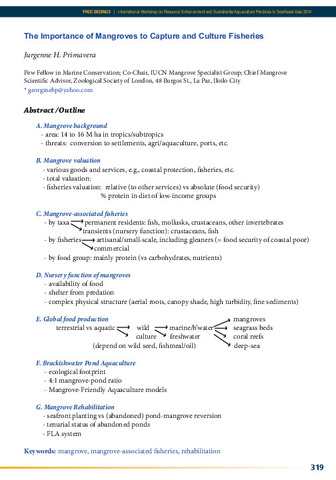
The importance of mangroves to capture and culture fisheries
Primavera, JurgenneAbstract only. (Aquaculture Department, Southeast Asian Fisheries Development Center, 2015)
-
Good aquaculture practices (GAqP): setting directions for harmonized regional standards - the Philippine experience
(Aquaculture Department, Southeast Asian Fisheries Development Center, 2015)A milestone process on how Good Aquaculture Practices (GAqP) emanates in Philippine aquaculture and its integration to the ASEAN harmonized standardization efforts is discussed in the paper. The management model, value chain and draft Philippine National Standard of the GAqP code are presented and evaluated as to its impact to trade and marketing, socioeconomic considerations, food safety and technology. -
Potential genetic impacts of hatchery-based resource enhancement
(Aquaculture Department, Southeast Asian Fisheries Development Center, 2015)The global population according to the United States Census Bureau has reached 7 billion as of October 2013. The continuous growth in human population will continue to put tremendous pressure on food production. The demand for fish as source of good protein is no exception. In 2011 total capture fisheries supplied 90.4 million tons of food and total aquaculture provided 63.6 million tons. While aquaculture production has increased dramatically, more than 50% of fishery production still depends on capture fisheries. Overexploitation of wild fish stocks has become one of the biggest problems in global fisheries. Stock enhancement has become a potential viable strategy for marine fisheries in danger of collapse. With the tremendous progress made in the breeding and larval rearing techniques of marine species, hatchery-based stock enhancement is now operated in many stock enhancement programs. However, many questions are raised in the use of hatchery-reared fish in stock enhancement. This paper will discuss genetic considerations in stock enhancement in developing countries. -
Seed production of the blue swimming crab (Portunus pelagicus)
(Aquaculture Department, Southeast Asian Fisheries Development Center, 2015)The blue swimming crab, Portunus pelagicus, is becoming a commercially important species in the Philippines. The expanding export market for crabs has led to intensified collection and has threatened the wild stocks. This decline has prompted the need for proper management of the remaining resources, and interest in the establishment of hatchery facilities to produce crablets for reseeding and aquaculture. This paper presents the production method for P. pelagicus seedstock at the Guiuan Marine Fisheries Development Center. Experiments to improve larval rearing were conducted as well. For seed production, larvae at the zoeal stage were taken from wild-caught berried crabs hatched in 100-L circular drums filled with sand-filtered seawater (32-34 ppt, 28-30°C). Zoeae were stocked at 100 zoea L-1 in rectangular tanks and fed rotifers at 30 ind ml-1 for the first 4 days. Newlyhatched Artemia were given at 1-2 ind ml-1 at zoea 3, and increased to 5 ind ml-1 at zoea 4 to the megalopa stage. Chlorella sp. was maintained in the rearing tanks at 50,000 cells ml-1 as food for rotifers and for water conditioning. Water exchange was done daily at 30-50%, except for the first 5 days of rearing. The development from zoea 1 to megalopa and megalopa to the first crab instar took 10-12 and 4-6 days, respectively. Longer larval development was observed at lower temperature (<26°C). Cannibalism and deteriorating water quality were identified as major causes of mortality. Survival of zoea 1 to megalopa was higher in chlorinated seawater (7.5+2.58%) compared to UV-treated (6.5+1.73%) and sand-filtered (4.0+2.58%) seawater. Trials involving the use of different tank background colors showed that the survival of larvae was highest in black tanks (9.0+1.00%) as compared to those white tanks (1.5+0.58%). In nursery rearing, megalopae were stocked at 1-2 ind ml-1 in wide tanks or concrete pond. Strategies to reduce cannibalism were done by providing shelters and sand substrate (>10 cm). As soon as the megalopa molted to crab instars, they were given minced fish, shell meat, Acetes and formulated crab feeds twice daily, ad libitum. After 21 days, crablets were collected manually after partially draining the water in concrete pond. The crablets produced were released in identified fish sanctuaries and marine protected areas region-wide for resource enhancement and for aquaculture research purposes. -
Induced breeding of giant trevally, maliputo (Caranx ignobilis)
(Aquaculture Department, Southeast Asian Fisheries Development Center, 2015)The giant trevally, maliputo (Caranx ignobilis), a highly prized and most popular indigenous migratory fish in Taal Lake, Batangas, Philippines, was induced to spawn using various hormones (to assess hormone efficacy on spawning performance). Different feeding regimes used in the larval rearing of this species were also evaluated. Sexually mature breeders, 5 to 7 years old with at least 0.5 mm oocyte diameter and 60% of ova at GVM stage were injected intramuscularly, in two doses, with: (a) 1,000 IU/kg BW human chorionic gonadotropin (HCG); (b) 100 µg/kg BW luteinizing hormone releasing hormone analogue (LHRHa); and (c) 5 mg/kg BW carp pituitary extract (CPE), at five breeders per hormone treatment. Uninjected fish served as the control. Treated fish were released and allowed to spawn spontaneously in 40-ton (5m diameter) circular tanks. Successful spawning was achieved during the months of March to July (28-30 ppt salinity; 27.6-29.25°C). Maliputo eggs are pelagic, clear and spherical, with a single oil globule and mean diameter of 0.8 mm. Ovulation period was 24-36.5 hours after 2nd injection in HCG-treated fish and 25-52 hours for LHRHa-injected fish. Only one of the CPE-treated fish spawned after 27 hours but eggs were not fertilized. Uninjected control fish did not spawn. Eggs were hatched in 11-13 hours in HCG treatment and 11-17 hours in LHRHa. Mean number of spawned eggs (3,500-4,000 eggs•gram-1) was higher in HCG treatment (223,068 eggs•kg-1 breeder at 58.27g•kg-1 breeder) than LHRHa (176,524 eggs•kg-1 breeder at 50.44 g•kg-1 breeder). Fertilization and hatching rates were both higher in LHRHa (60.88% and 71.07%, respectively), than HCG treatment (30.53% and 43.06%). Mean number of produced larvae was higher in LHRHa treatment (56,040 larvae•kg-1 breeder) compared to HCG-treated fish (41,547 larvae•kg-1 breeder). Hatched larvae (1.6 mm mean length) reared for 30 days in 3m x 3m concrete tanks using the standard protocol for marine finfish hatchery attained a maximum survival of 4.47%. Complete metamorphosis was observed after 26-28 days (8.1 mm mean length). Successful larval rearing was attained using greenwater (Nannochloropsis sp.) technology fed with live food (Brachionus sp. and Artemia salina). Critical periods were days 1-7 and days 19-22 when heavy mortalities were observed. Being the first recorded spawning in captivity of Caranx ignobilis in the Philippines, the results of this study provides an important baseline data and is a major step towards the development of a hatchery technology for maliputo in the country as well as for seed enhancement of its natural habitat. The project has provided 400,000 maliputo larvae to private hatcheries for larval rearing trials while 100,000 larvae were seeded in Balayan Bay and 5,000 fingerlings released in Taal Lake. -
Post-larval rearing strategies in sandish (Holothuria scabra) culture
; Sibonga, Rema; (Aquaculture Department, Southeast Asian Fisheries Development Center, 2015)
Various post-larval rearing methods were compared to determine which scheme would give the most yield of newly settled (visible) juvenile stage (> 1mm body length). Five types of postlarval rearing methods were tested: T1- planktonic diatom only (Chaetoceros calcitrans, Cc), T2-benthic diatom Navicula (Nsp) as biofilm and concentrate, T3- Navicula as biofilm + Cc, T4Spirulina as paste on settling plate + Cc, and T5- Spirulina (Sp) as paste on settling plates + Nsp concentrate. An experiment was conducted in small (3-li) aquaria using a cohort of Day 14 (postfertilization) sandfish larvae. Simultaneously, three of the 5 post-larval rearing methods (i.e. T2, T3 and T4) were done in medium scale (30-li) aquaria to determine how a conventional method (T2) employed in a pilot sea cucumber hatchery in Central Philippines compared with method observed in Viet Nam (T3) or with a hybrid method (T4). Visible post-settled juveniles were counted weekly for the next three weeks and expressed as percentage yield. After three days of rearing, transparent but visible early settled juveniles were observed. Mean percentage (%) juvenile yield in week 1 was highest in T1 (Cc only)(17% + 1.3) followed by T3 (Sp + Cc) (14% + 1.6) in a 3 li scale. Yield increased and peaked in week 2 especially for rearing methods with Nsp while those without (e.g T1 and T2) declined dramatically by week 3. In the 30-li scale, the highest mean yield was consistent with T5 (Nsp + Cc) until Week 3 (12% + 11.2). The mean juvenile yield on the 2nd and 3rd week were better than the 2% average for this stage or the 2.5% benchmark based on experiences in the Philippines and Viet Nam as indicated in published references. -
Estimation of energy budget of sea cucumber, Holothuria scabra, in integrated multi-trophic aquaculture
; ; ; ; ; Lebata-Ramos, Ma. Junemie Hazel (Aquaculture Department, Southeast Asian Fisheries Development Center, 2015)
Continuous intensification of aquaculture production has brought about environmental issues associated with eutrophication worldwide. Environmental deterioration such as hypoxia and sulfide production due to water and sediment eutrophication originating from aquaculture effluents have been problematic, resulting to sporadic disease outbreaks and fish kills in the Philippines. Integrated multi-trophic aquaculture (IMTA) is one of the promising methods for sustainable aquaculture as it also provides a supplementary source of income to the fish farmers. IMTA is a polyculture system that integrates culturing of fed species (e.g. finfish) the main commodity, organic extractive species (e.g. deposit and filter feeding benthos) and inorganic extractive species (e.g. seaweed). In this study, IMTA techniques were established for small-scale coastal fish farmers in the Philippines, with sea cucumber (Holothuria scabra, commonly known as sandfish), as the key species. Sandfish commands the highest price in tropical sea cucumber species. Nitrogen (N) budget of sandfish in polyculture with milkfish (Chanos chanos) and Elkhorn sea moss (Kappaphycus alvarezii), both of which are commonly cultured in the Philippines, was estimated using a simple closed box model. Information on stocking density, stocking size, mortality, growth, feed ration, feed assimilation, NH4-N production and NH4-N absorption of these species was obtained from a series of experiments and existing literature. Culture conditions were as follows: 26 g milkfish were cultured in a 5 x 5 x 4 m cage at an average stocking density of 36.7 ind/m3 (i.e. usual practice in the Philippines) with an initial feeding ration of 10% of body weight which was gradually decreased to 4% over time; 10 g sandfish were cultured in a 5 x 5 x 0.3 m cage hung under the milkfish cage to trap particulate N waste (i.e. feces and leftover feed) from milkfish culture at a stocking density of 35 ind/m2; the stocking weight of Elkhorn sea moss line culture was 10 kg. The culture period was 200 days. It was estimated that milkfish culture under the above-mentioned schemes cumulatively produced 145 kg of particulate N, and milkfish and sandfish together excreted 60 kg of NH4-N in 200 days of culture. Daily assimilation rate of the particulate N by sandfish ranged from 3.4 to 12.4%, and 6.4% of the particulate N was estimated to be removed by sandfish during the entire 200 days of culture. Daily absorption rate of NH4-N by Elkhorn sea moss increased exponentially with time and reached 100% at 125 days of culture. Cumulative NH4-N from milkfish and sandfish excretion was estimated to be depleted by 162 days of culture. For complete utilization of particulate N by sandfish by the end of milkfish culture period (i.e. zero emission), sandfish stocking density should be 805 ind/m2, which is 200 times as high as that in existing sandfish aquaculture operations in countries such as Viet Nam and New Caledonia. The purpose of sandfish culture in IMTA should be emphasized in terms of its economic advantages and not very much on environmental integrity. Cages for sandfish culture should be designed in such a way where only a small fraction of organic matter from milkfish culture (i.e. about 6% in this culture scheme) enters it to avoid sediment quality deterioration and possible death of sandfish. Elkhorn sea moss on the other hand seems very efficient in bioremediation capability.