Conference Proceedings: Recent submissions
381-400 / 767
-
Use of Chemicals in Aquaculture in Asia: Proceedings of the Meeting on the Use of Chemicals in Aquaculture in Asia, 20-22 May 1996, Tigbauan, Iloilo, Philippines
(Aquaculture Department, Southeast Asian Fisheries Development Center, 2000)The use of chemicals is common in various aquaculture systems, as it is in many agricultural practices. However, with growing worldwide awareness of the need for responsible practices in aquaculture, governments and aquaculturists are increasingly concerned with the effects of the use of chemicals in aquaculture, especially those which appear likely to be hazardous to man, cultured stock and/or the environment. The need to synthesize and disseminate information on the use and management of double prime aquachemicals double prime was recognized by the Fishery Resources Division of the Food and Agriculture Organization of the United Nations (FAO) and the Southeast Asian Fisheries Development Center (SEAFDEC) Aquaculture Department, who convened double prime The Expert Meeting on the Use of Chemicals in Aquaculture in Asia, double prime which was held 20-22 May 1996 at the SEAFDEC facilities in Tigbauan, Iloilo, the Philippines. Support was provided by FAO, SEAFDEC and the Canadian International Development Agency s (CIDA) ASEAN Fund. The World Health Organization (WHO) supported the participation of a human health expert. The meeting was attended by 27 participants and more than 70 observers from the public and private sectors of 20 countries. Among the attendees were representatives from the Network of Aquaculture Centres in Asia-Pacific (NACA), the Fish Health Section of the Asian Fisheries Society (FHS/AFS), the Japan International Research Center for Agricultural Sciences (JIRCAS), the GESAMP Working Group on Environmental Impacts of Coastal Aquaculture, and the ICES Working Group on Environmental Interactions of Mariculture. The results of this expert workshop are presented in this volume. They include the texts of presentations on a wide range of topics (thematic reviews) related to the use of chemicals in aquaculture, with emphasis on the Asian Region, as well as country overview papers summarizing the use of aquachemicals in Asian countries. The contributions of the selected participants during the meeting are contained in this volume. -
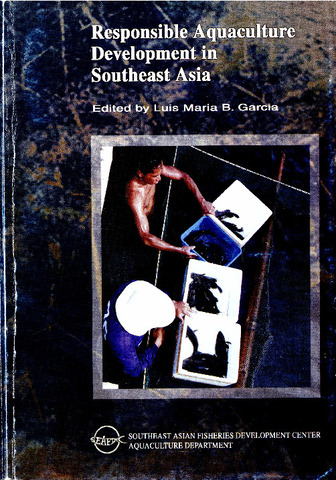
Responsible aquaculture development in Southeast Asia: Proceedings of the seminar-workshop on aquaculture development in Southeast Asia
(Aquaculture Department, Southeast Asian Fisheries Development Center, 2001)This publication documents the proceedings and outputs of the tri-annual seminar-workshop on Aquaculture Development in Southeast Asia (ADSEA). This seminar, ADSEA 99, reviewed the recent developments in aquaculture and provided a forum to discuss strategies to ensure further development of responsible aquaculture in the region. It specifically covered the following: 1) assessment of the progress and development of aquaculture technologies in the region, and research and development in the Department since 1995; 2) review of recent advances in sustainable and responsible aquaculture elsewhere in the world; and, 3) identification of strategies for sustainable and responsible aquaculture in the region. The contributions of selected participants during ADSEA '99 appear in this present volume. -
Environmental impacts of marine fish farming and their mitigation
(Aquaculture Department, Southeast Asian Fisheries Development Center, 2001)The environmental impact of marine fish farming depends on species cultured, culture method, stocking density, feed type, hydrography of the site, and husbandry practices. In all cultured systems, however, a very large percentage of organic carbon and nutrient input into a marine fish culture system as feed may be lost into the environment through feed wastage, fish excretion, faeces production, and respiration. The high pollution loading have caused considerable environmental concern in many countries, especially in water with limited carrying capacity. Furthermore, the use of chemicals (therapeutants, vitamins, pigments, and antifoulants) and the introduction of pathogens and new genetic strains have also raised environmental concerns. Despite the high pollution loadings, results from various studies show that some 23% of C, 21% of N and 53% of P of feed input into the culture system is being accumulated in the bottom sediments and the significant impact is normally confined to within 1 to 1.5 km of the farm. The major impact is on the sea bottom, where high sediment oxygen demand, anoxic sediments, production of toxic gases, and a decrease in benthic diversity may result. Decreases in dissolved oxygen and increases in nutrient levels in the water are normally confined to localized areas, and it is unlikely that fish farming activities will cause eutrophication over large areas. There is also no good evidence to support the suggestion that fish farming would increase the incidences of harmful algal blooms, nor that the present use of therapeutants, vitamins and antibiotics, and the introduction of pathogens and new genetics strains would pose a significant threat to the environment. Practical ways to mitigate environmental impact of fish farming include keeping stocking density (and hence, pollution loadings) well below the carrying capacity of the water body. Computer simulation and hydraulic models have been applied to estimate maximum stocking density in which water quality could be maintained in a sustainable manner. Pollution loading and environmental effects can also be significantly reduced by improved feed formulation and integrated culture (using macroalgae, filter-feeders and deposit-feeders). -
Biological hazard possibly produced by aquaculture and its control
(Aquaculture Department, Southeast Asian Fisheries Development Center, 2001)Blooms of Neterocapsa circularisquama, a novel dinoflagellate, have been causing mass mortality of both wild and cultured shellfish in embayments at the western part of Japan since 1988. Physiological and epidemiological studies suggest that the alga has been partly dispersed with the movement of shellfish in aquaculture activities. A recent outbreak of an epizootic iridovirus in red sea bream (Pagrus major) has caused extensive damage to marine fish culture in Japan. A research group at the National Research Institute of Aquaculture (NRIA), collaborating with prefectural fisheries research laboratories and an R&D company, clarified the etiology and developed a diagnostic method and a commercial vaccine. Penaeid acute viremia (PAV), a synonym of white spot syndrome, caused catastrophic loses in kuruma shrimp (Penaeus japonicus) culture in Japan. An epidemiological study of the research group at NRIA and the prefectural fisheries research laboratories strongly suggests that the causative virus was newly introduced to Japan from imported shrimp seeds for aquaculture. The group clarified the etiology and established diagnostic methods. Based on their studies, NRIA proposed a protocol to check the virus during larval culture and before seedlings are shipped. -
Community-based coral farming for reef rehabilitation, biodiversity conservation and as a livelihood option for fisherfolk
(Aquaculture Department, Southeast Asian Fisheries Development Center, 2001)The present condition of marine resources in the Philippines is critical and a majority of coastal communities live below the poverty line. If it continues, the progressive degradation of coral reefs and overexploitation poses a dangerous trend. Coastal resource management strategies are facing a new challenge: the integration of social, economic and natural sciences in future concepts to reverse the current status of ecosystem destruction and improvement of the people s living conditions. Hence, the primary objective of the coral farm is to provide alternative livelihood to fisher families from their resources on a sustained basis. The second objective is the rehabilitation of degraded reefs. Currently coral colonies of 64 species are taken through fragmentation from the wild. After 6-12 weeks (depending on the species) of grow-out in the farm, the fragments were deployed at the rehabilitation site at an average of 2 fragments per square meter (=12.5% cover). The survival of fragments is high at 84%, despite the fact that some coral colonies were placed in unsuitable substrates by the fisherfolk. More trainings have to be conducted improve their knowledge of coral biology and community structure. The net cost of rehabilitating a one-hectare reef is U$2,100 for 12.5% cover. Additional profit from coral marketing is used for community projects identified by the folk. In this case, coral farming may be an option for livelihood and a cost-effective tool for reef rehabilitation. -
Markets and marketing trends for aquaculture products in Southeast Asia
(Aquaculture Department, Southeast Asian Fisheries Development Center, 2001)Despite the fact that Southeast Asian countries are among the main producers and exporters of fish and fishery products in the world, the region has also increasingly become an important market. According to the Food and Agriculture Organization (FAO), imports of fish and fishery products into countries comprising the Association of Southeast Asian Nations (ASEAN) increased from only US$471 million in 1984 to more than US$2 billion in 1997. High per capita fish consumption, huge market size (population), increasingly strong purchasing power, coupled with relatively liberal trade policies are among the factors behind this trend. Even though the economic crisis in the region has scaled down the degree of market expansion for the last two years, it has, on the other hand, provided trade opportunities among the regional countries for fishery products, including those from aquaculture. Ten species are being cultured commercialIy in the region, but only a few are important in the intra-regional trade. Shrimp, particularly black tiger shrimp (Penaeus monodon), is the most important species being cultured and traded in the region, both in terms of volume and value. The other major species are carps, tilapia, and milkfish, but these are mostly consumed locally and only a limited quantity is traded between countries in the region. Meanwhile, cultured Asian sea bass, grouper, snappers and mud crab are relatively small in production, but these are important species in the intraregional trade. This paper reviews the current trends in Southeast/Far East Asian markets for major aquaculture products, including marketing issues on demand and product trends, safety and quaIity issues as well as marketing access in major Asian markets. -
Health management for sustainable aquaculture
(Aquaculture Department, Southeast Asian Fisheries Development Center, 2001)Aquaculture is a dynamic activity. To be successful and sustainable in this business, new techniques have to be continually developed, and adopted by farmers. Over the last decade, sustainability has become a key word for many different activities, including aquaculture. Many factors are involved in aquaculture sustainability, and health management has an important role among these. In order for aquatic animal health management at the farm level to aid the achievement of optimum yields, the following issues should be considered: suitable site selection, quality of broodstock and seed, reasonable stocking density, feed and feeding programme, water management, prophylactic and therapeutic treatment, and information dissemination. The sustainability of aquaculture at the national and regional levels requires different considerations among which are national policy, assistance priorities for farmers, legislation needs, technology development, and information needs. -
Socioeconomics of responsible aquaculture in Asia
(Aquaculture Department, Southeast Asian Fisheries Development Center, 2001)Aquaculture provided 20% of global fisheries production and 29% of food fish in 1996. Much of the production was from low income food-deficit countries (LIFDCs). Between 1990 and 1996, the average expansion rate of aquaculture in LIFDCs was nearly six times than in non-LIFDCs. The expansion in production is not free of problems, however. Environmental, biological diversity, socioeconomic, and consumer safety issues have been linked to intensive aquaculture. These problems are seen in the context of a need for good governance of aquaculture development. The socioeconomics of responsible aquaculture and approaches of good governance of aquaculture is examined in this paper. -
Developments in integrated aquaculture in Southeast Asia
(Aquaculture Department, Southeast Asian Fisheries Development Center, 2001)Integrated aquaculture is inclusive of interactive utilization of resources and ecosystems in the artificial rearing of aquatic animals and plants. By the nature, purpose and scale of the operation, integrated fish culture can be categorized into five major modes. One is the traditional small-scale subsistence farming where fish are produced by recycling on-farm wastes in ponds or rice field, two is recycling of human excreta, three is the industrialized commercial operation by integrating medium and large-scale poultry or livestock farms with ponds for fish production, four is integration of aquaculture with natural ecosystems, e.g., shrimp culture with mangroves, cage and pen culture in lakes, cove culture in reservoirs. The fifth is environmental-oriented integration, where waste effluents from intensive aquaculture ponds are recycled to improve water quality and to grow filter feeder/ herbivores or macrophytes as secondary crops. This paper presents concepts and practical examples for some of these systems. -
Developments in freshwater fish culture in Southeast Asia
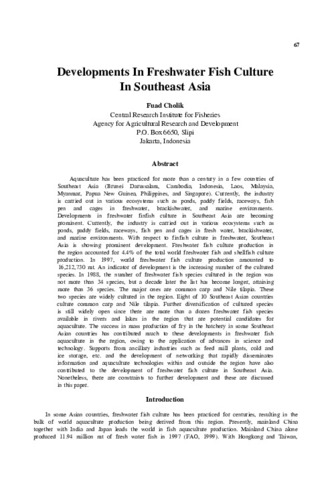
(Aquaculture Department, Southeast Asian Fisheries Development Center, 2001)Aquaculture has been practiced for more than a century in a few countries of Southeast Asia (Brunei Darussalam, Cambodia, Indonesia, Laos, Malaysia, Myanmar, Papua New Guinea, Philippines, and Singapore). Currently, the industry is carried out in various ecosystems such as ponds, paddy fields, raceways, fish pen and cages in freshwater, brackishwater, and marine environments. Developments in freshwater finfish culture in Southeast Asia are becoming prominent. With respect to finfish culture in freshwater, Southeast Asia is showing prominent development. Freshwater fish culture production in the region accounted for 4.4% of the total world freshwater fish and shellfish culture production. In 1997, world freshwater fish culture production amounted to 16,212,730 mt. An indicator of development is the increasing number of the cultured species. In 1988, the number of freshwater fish species cultured in the region was not more than 34 species, but a decade later the list has become longer, attaining more than 36 species. The major ones are common carp and Nile tilapia. These two species are widely cultured in the region. Eight of 10 Southeast Asian countries culture common carp and Nile tilapia. Further diversification of cultured species is still widely open since there are more than a dozen freshwater fish species available in rivers and lakes in the region that are potential candidates for aquaculture. The success in mass production of fry in the hatchery in some Southeast Asian countries has contributed much to these developments in freshwater fish aquaculture in the region, owing to the application of advances in science and technology. Supports from ancillary industries such as feed mill plants, cold and ice storage, etc. and the development of networking that rapidly disseminates information and aquaculture technologies within and outside the region have also contributed to the development of freshwater fish culture in Southeast Asia. Nonetheless, there are constraints to further development and these are discussed in this paper. -
Developments in marine and brackishwater fish culture in Southeast Asia
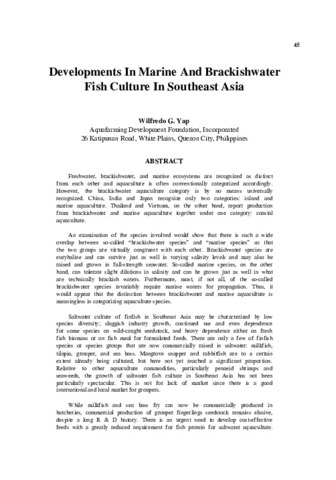
(Aquaculture Department, Southeast Asian Fisheries Development Center, 2001)Freshwater, brackishwater, and marine ecosystems are recognized as distinct from each other and aquaculture is often conventionally categorized accordingly. However, the brackishwater aquaculture category is by no means universally recognized. China, India and Japan recognize only two categories: inland and marine aquaculture. Thailand and Vietnam, on the other hand, report production from brackishwater and marine aquaculture together under one category: coastal aquaculture. An examination of the species involved would show that there is such a wide overlap between so-called "brackishwater species" and "marine species" so that the two groups are virtually congruent with each other. Brackishwater species are euryhaline and can survive just as well in varying salinity levels and may also be raised and grown in full-strength seawater. So-called marine species, on the other hand, can tolerate slight dilutions in salinity and can be grown just as well in what are technically brackish waters. Furthermore, most, if not all, of the so-called brackishwater species invariably require marine waters for propagation. Thus, it would appear that the distinction between brackishwater and marine aquaculture is meaningless in categorizing aquaculture species. Saltwater culture of finfish in Southeast Asia may be characterized by low species diversity; sluggish industry growth, continued use and even dependence for some species on wild-caught seedstock, and heavy dependence either on fresh fish biomass or on fish meal for formulated feeds. There are only a few of finfish species or species groups that are now commercially raised in saltwater: milkfish, tilapia, grouper, and sea bass. Mangrove snapper and rabbitfish are to a certain extent aIready being cultured, but have not yet reached a significant proportion. Relative to other aquaculture commodities, particularly penaeid shrimps and seaweeds, the growth of saltwater fish culture in Southeast Asia has not been particularly spectacular. This is not for lack of market since there is a good intemational and local market for groupers. While milkfish and sea bass fry can now be commercially produced in hatcheries, commercial production of grouper fingerlings seedstock remains elusive, despite a long R & D history. There is an urgent need to develop cost-effective feeds with a greatly reduced requirement for fish protein for saltwater aquaculture. -
Developments in sustainable shrimp farming in Southeast Asia
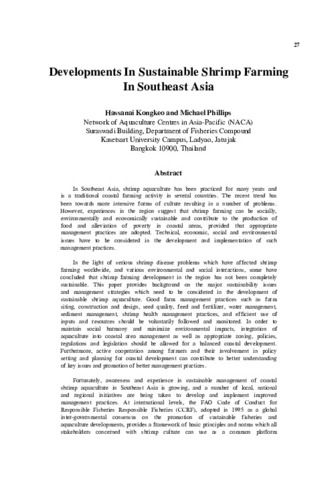
(Aquaculture Department, Southeast Asian Fisheries Development Center, 2001)In Southeast Asia, shrimp aquaculture has been practiced for many years and is a traditional coastal farming activity in several countries. The recent trend has been towards more intensive forms of culture resulting in a number of problems. However, experiences in the region suggest that shrimp farming can be socially, environmentally and economically sustainable and contribute to the production of food and alleviation of poverty in coastal areas, provided that appropriate management practices are adopted. Technical, economic, social and environmental issues have to be considered in the development and implementation of such management practices. In the light of serious shrimp disease problems which have affected shrimp farming worldwide, and various environmental and social interactions, some have concluded that shrimp farming development in the region has not been completely sustainable. This paper provides background on the major sustainability issues and management strategies which need to be considered in the development of sustainable shrimp aquaculture. Good farm management practices such as farm siting, construction and design, seed quality, feed and fertilizer, water management, sediment management, shrimp health management practices, and efficient use of inputs and resources should be voluntarily followed and monitored. In order to maintain social harmony and minimize environmental impacts, integration of aquaculture into coastal area management as well as appropriate zoning, policies, regulations and legislation should be allowed for a balanced coastal development. Furthermore, active cooperation among farmers and their involvement in policy setting and planning for coastal development can contribute to better understanding of key issues and promotion of better management practices. Fortunately, awareness and experience in sustainable management of coastal shrimp aquaculture in Southeast Asia is growing, and a number of local, national and regional initiatives are being taken to develop and implement improved management practices. At international levels, the FAO Code of Conduct for Responsible Fisheries Responsible Fisheries (CCRF), adopted in 1995 as a global inter-governmental consensus on the promotion of sustainable fisheries and aquaculture developments, provides a framework of basic principles and norms which all stakeholders concerned with shrimp culture can use as a common platform for better understanding, consultation and collaboration. Examples of recent efforts by NACA, in cooperation with FAO and other interested partners, in the implementation of the CCRF are given, and suggestions are provided to further promote the sustainable development of shrimp culture. A number of researchable issues on sustainable shrimp aquaculture are also reiterated for discussion in this seminar-workshop. -
Responsible aquaculture development for the next millennium
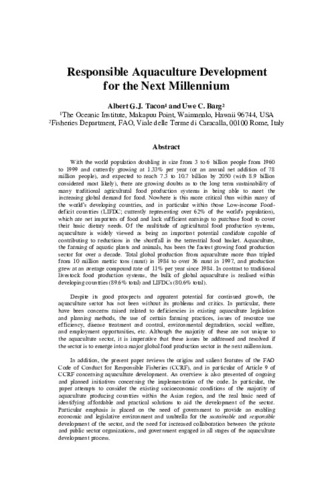
(Aquaculture Department, Southeast Asian Fisheries Development Center, 2001)With the world population doubling in size from 3 to 6 billion people from 1960 to 1999 and currently growing at 1.33% per year (or an annual net addition of 78 million people), and expected to reach 7.3 to 10.7 billion by 2050 (with 8.9 billion considered most likely), there are growing doubts as to the long term sustainability of many traditional agricultural food production systems in being able to meet the increasing global demand for food. Nowhere is this more critical than within many of the world s developing countries, and in particular within those Low-income Food-deficit countries (LIFDC ; currently representing over 62% of the world s population), which are net importers of food and lack sufficient earnings to purchase food to cover their basic dietary needs. Of the multitude of agricultural food production systems, aquaculture is widely viewed as being an important potential candidate capable of contributing to reductions in the shortfall in the terrestrial food basket. Aquaculture, the farming of aquatic plants and animals, has been the fastest growing food production sector for over a decade. Total global production from aquaculture more than tripled from 10 million metric tons (mmt) in 1984 to over 36 mmt in 1997, and production grew at an average compound rate of 1 l% per year since 1984. In contrast to traditional livestock food production systems, the bulk of global aquaculture is realised within developing countries (89.6% total) and LIFDCs (80.6% total). Despite its good prospects and apparent potential for continued growth, the aquaculture sector has not been without its problems and critics. In particular, there have been concerns raised related to deficiencies in existing aquaculture legislation and planning methods, the use of certain farming practices, issues of resource use efficiency, disease treatment and control, environmental degradation, social welfare, and employment opportunities, etc. Although the majority of these are not unique to the aquaculture sector, it is imperative that these issues be addressed and resolved if the sector is to emerge into a major global food production sector in the next millennium. In addition, the present paper reviews the origins and salient features of the FAO Code of Conduct for Responsible Fisheries (CCRF), and in particular of Article 9 of CCRF concerning aquaculture development. An overview is also presented of ongoing and planned initiatives concerning the implementation of the code. In particular, the paper attempts to consider the existing socioeconomic conditions of the majority of aquaculture producing countries within the Asian region, and the real basic need of identifying affordable and practical solutions to aid the development of the sector. Particular emphasis is placed on the need of government to provide an enabling economic and legislative environment and umbrella for the sustainable and responsible development of the sector, and the need for increased collaboration between the private and public sector organizations, and government engaged in all stages of the aquaculture development process. -
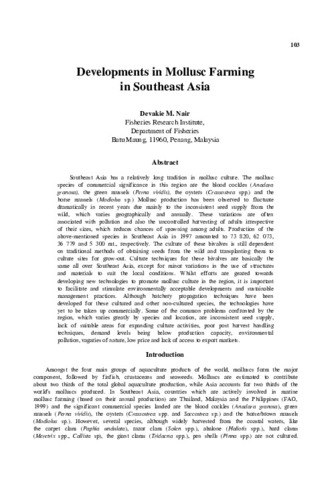
Developments in mollusc farming in Southeast Asia
(Aquaculture Department, Southeast Asian Fisheries Development Center, 2001)Southeast Asia has a relatively long tradition in mollusc culture. The mollusc species of commercial significance in this region are the blood cockles (Anadara granosa), the green mussels (Perna viridis), the oysters (Crassostrea spp.) and the horse mussels (Modiolus sp.). Mollusc production has been observed to fluctuate dramatically in recent years due mainly to the inconsistent seed supply from the wild, which varies geographically and annually. These variations are often associated with pollution and also the uncontrolled harvesting of adults irrespective of their sizes, which reduces chances of spawning among adults. Production of the above-mentioned species in Southeast Asia in 1997 amounted to 73 820, 62 073, 36 779 and 5 300 mt., respectively. The culture of these bivalves is still dependent on traditional methods of obtaining seeds from the wild and transplanting them to culture sites for grow-out. Culture techniques for these bivalves are basically the same all over Southeast Asia, except for minor variations in the use of structures and materials to suit the local conditions. Whilst efforts are geared towards developing new technologies to promote mollusc culture in the region, it is important to facilitate and stimulate environmentally acceptable developments and sustainable management practices. Although hatchery propagation techniques have been developed for these cultured and other non-cultured species, the technologies have yet to be taken up commercially. Some of the common problems confronted by the region, which varies greatly by species and location, are inconsistent seed supply, lack of suitable areas for expanding culture activities, poor post harvest handling techniques, demand levels being below production capacity, environmental pollution, vagaries of nature, low price and lack of access to export markets. -
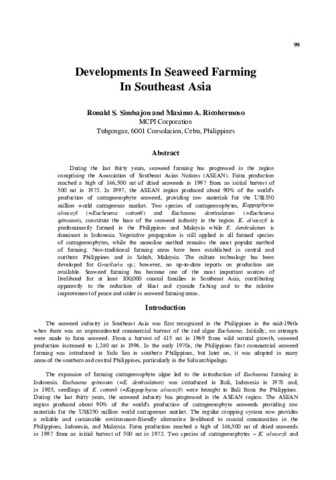
Developments in seaweed farming in Southeast Asia
(Aquaculture Department, Southeast Asian Fisheries Development Center, 2001)During the last thirty years, seaweed farming has progressed in the region comprising the Association of Southeast Asian Nations (ASEAN). Farm production reached a high of 146,500 mt of dried seaweeds in 1997 from an initial harvest of 500 mt in 1973. In 1997, the ASEAN region produced about 90% of the world s production of carrageenophyte seaweed, providing raw materials for the US$35O million world carrageenan market. Two species of carrageenophytes, Kappaphycus alvarezii (=Eucheuma cottonii) and Eucheuma denticulatum (=Eucheuma spinosum), constitute the base of the seaweed industry in the region. K. alvarezii is predominantly farmed in the Philippines and Malaysia while E. denticulatum is dominant in Indonesia. Vegetative propagation is still applied in all farmed species of carrageenophytes, while the monoline method remains the most popular method of farming. Non-traditional farming areas have been established in central and northern Philippines and in Sabah, Malaysia. The culture technology has been developed for Gracilaria sp.; however, no up-to-date reports on production are available. Seaweed farming has become one of the most important sources of livelihood for at least 100,000 coastal families in Southeast Asia, contributing apparently to the reduction of blast and cyanide fishing and to the relative improvement of peace and order in seaweed farming areas. -
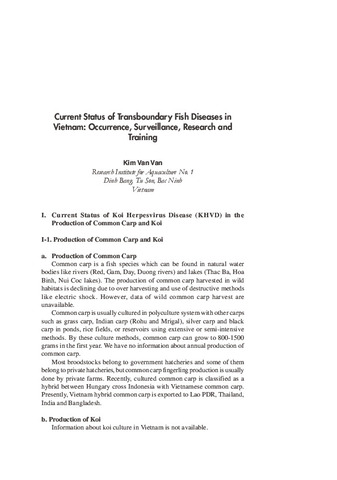
Current status of transboundary fish diseases in Vietnam: Occurrence, surveillance, research and training
(Aquaculture Department, Southeast Asian Fisheries Development Center, 2004)The paper discussed the current status of transboundary fish diseases in Vietnam. The following were given focus in the paper: status of Koi Herpesvirus in the production of common carp and koi and the status of viral diseases in the production of shrimps and prawn. Surveillance, monitoring and diagnosis of diseases of aquatic animals and the quarantine services to prevent entry of diseases of aquatic animals were also discussed. -
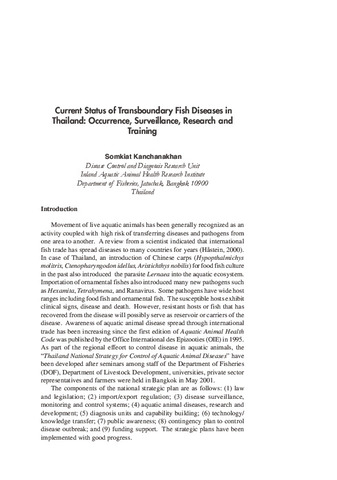
Current status of transboundary fish diseases in Thailand: Occurrence, surveillance, research and training
(Aquaculture Department, Southeast Asian Fisheries Development Center, 2004)The paper discussed the current status of transboundary fish diseases in Thailand. The following were given focus in the paper: status of Koi Herpesvirus in the production of common carp and koi and the status of viral diseases in the production of shrimps and prawn. Surveillance, monitoring and diagnosis of diseases of aquatic animals and the quarantine services to prevent entry of diseases of aquatic animals were also discussed. -
Current status of transboundary fish diseases in Singapore: Occurrence, surveillance, research and training
(Aquaculture Department, Southeast Asian Fisheries Development Center, 2004)The paper discussed the current status of transboundary fish diseases in Singapore. The following were given focus in the paper: status of Koi Herpesvirus in the production of common carp and koi and the status of viral diseases in the production of shrimps and prawn. Surveillance, monitoring and diagnosis of diseases of aquatic animals and the quarantine services to prevent entry of diseases of aquatic animals were also discussed. -
Current status of transboundary fish diseases in the Philippines: Occurrence, surveillance, research and training
(Aquaculture Department, Southeast Asian Fisheries Development Center, 2004)The paper discussed the current status of transboundary fish diseases in Philippines. The following were given focus in the paper: status of Koi Herpesvirus in the production of common carp and koi and the status of viral diseases in the production of shrimps and prawn. Surveillance, monitoring and diagnosis of diseases of aquatic animals and the quarantine services to prevent entry of diseases of aquatic animals were also discussed. -
Current status of transboundary fish diseases in Myanmar: Occurrence, surveillance, research and training
(Aquaculture Department, Southeast Asian Fisheries Development Center, 2004)The paper discussed the current status of transboundary fish diseases in Myanmar. The following were given focus in the paper: status of Koi Herpesvirus in the production of common carp and koi and the status of viral diseases in the production of shrimps and prawn. Surveillance, monitoring and diagnosis of diseases of aquatic animals and the quarantine services to prevent entry of diseases of aquatic animals were also discussed.