Conference Proceedings: Recent submissions
441-460 / 767
-
Characterization of ovarian maturation stages in wild unablated Penaeus monodon
(Aquaculture Department, Southeast Asian Fisheries Development Center, 1985)At least five wild-caught Penaeus monodon from various maturation stages (initially classified in vivo as 0, I, II, III, IV, V) were measured, weighed and dissected for histological and histochemical studies. The anterior and posterior parts of the thoracic and abdominal regions of the ovary were sampled and stained with Mallory trichrome, alcian blue-periodic acid-Schiff (AB-PAS) and Sudan black. Results showed that the ovary is composed of the ovarian wall and its extensions, zone of proliferation, follicle cell layer and oocytes. The proliferating cells are less than 10 µm, have thin rims of cytoplasm, and increase in size as maturation proceeds. Based on histology, the stages were finally classified into groups (1) previtellogenic (stage 0), (2) vitellogenic (stages I and II), (3) cortical rod (stages III and IV), and (4) spent (stage V). The previtellogenic group consists only of perinucleolar oocytes (46-72 µm) which are stained negatively with AB-PAS and Sudan black. Oocytes bigger than 55 µm are enveloped by a single layer of follicle cells. The vitellogenic group is composed mostly of yolky oocytes (121-211 µm) with the following cytoplasmic inclusions: small granules of glycoproteins, medium-size globules of lipoglycoproteins, and few large lipid droplets. The cortical rod group consists mostly of yolky oocytes (288-408 µm) with additional rod-like bodies which contain acid and basic mucopolysaccharides but no lipid. The presence of cortical rods is a characteristic feature of mature penaeid ovaries. The spent group is similar to the previtellogenic group but contains some yolky oocytes, thicker follicle cell layers, or irregularly shaped perinucleolar oocytes. Th GSI ranges of the four groups are 0.899-1.937, 3.099-7.598, 5.631-12.000 and 1.848-2.919, respectively. -
Growth and survival of Penaeus monodon postlarvae with different feeding regimes and stocking densities in earthen brackishwater nursery ponds
(Aquaculture Department, Southeast Asian Fisheries Development Center, 1985)The effect of different stocking densities (50, 100 and 150/m2) and two feeding regimes (natural food, consisting mainly of lablab, and natural food plus artificial diet) on the growth and survival of Penaeus monodon postlarvae (PL4 to PL5) were evaluated in eighteen 40 m2 earthen brackishwater nursery ponds using tidal water exchange for a period of 45 days. Results of the experiment indicated that the effect of different stocking densities was highly significant (P<0.01) on growth but not on survival for the two feeding regimes. Likewise, no interaction effect was discerned. Shrimps given artificial feed (Treatments II, IV and VI) obtained higher mean weight gains of 1.55, 1.17 and 1.05 g, respectively, than those that were not given artificial feed (I-1.44 g, III-0.92 g, and V-0.66 g). Similarly, those reared with artificial feed attained better survival of 41.62% (II), 67.44% (V) and 52.14% (VI) compared to shrimp that were not given artificial feed (I-42.53%, III-54.61% and V-46.90%). An exploratory economic study showed that the nursery operation gave promising results in all treatments. High rate of investment (ROI) was obtained to give a safe margin for the risk involved in this kind of business. Among all treatments, treatment V had the highest ROI of 693% and shortest payback period of 0.19 years. -
Hepatopancreas cells as monitor cells for the nutritional value of prawn diets in aquaculture
; ; Quinitio, Emilia T. (Aquaculture Department, Southeast Asian Fisheries Development Center, 1985)
The hepatopancreas is considered to be the central organ of metabolism in decapod Crustacea. It is a system of blind tubules consisting of four cell types. The E-cells at the summits of the tubules develop into R-cells (for resorption of nutrients), F-cells (for production of digestive enzymes) and B-cells (function unknown). The ultrastructure of Penaeus monodon R-cells changes largely after starvation and feeding different diets. B-cells show slight reactions, while F- and E-cells are rather constant. Thirteen day-starvation results in a large decrease of the cell size and in a significant reduction of all cell organelles. After seven days starvation and four days refeeding with various extreme diets, the R-cells develop completely different food-specific ultrastructures. A distinct proliferation of the endoplasmic reticulum is characteristic of protein diets. Large fat drops are the main feature after refeeding with cod liver oil. Sucrose feeding results in "empty" cells with only few organelles. The most diversified ultrastructure with fat droplets and a high amount of all cell organelles is obtained by feeding a mixed diet. The study indicates that R-cells are very sensitive to the application of different diets. They could be used as monitor cells for the nutritional value and the availability of a diet for prawns. Particularly poor or badly formulated feed could be detected early by electron microscopy. This method may be very helpful for the development of artificial prawn diets in aquaculture, especially if natural sources will be used as food components.
(Aquaculture Department, Southeast Asian Fisheries Development Center, 1985)
The hepatopancreas is considered to be the central organ of metabolism in decapod Crustacea. It is a system of blind tubules consisting of four cell types. The E-cells at the summits of the tubules develop into R-cells (for resorption of nutrients), F-cells (for production of digestive enzymes) and B-cells (function unknown). The ultrastructure of Penaeus monodon R-cells changes largely after starvation and feeding different diets. B-cells show slight reactions, while F- and E-cells are rather constant. Thirteen day-starvation results in a large decrease of the cell size and in a significant reduction of all cell organelles. After seven days starvation and four days refeeding with various extreme diets, the R-cells develop completely different food-specific ultrastructures. A distinct proliferation of the endoplasmic reticulum is characteristic of protein diets. Large fat drops are the main feature after refeeding with cod liver oil. Sucrose feeding results in "empty" cells with only few organelles. The most diversified ultrastructure with fat droplets and a high amount of all cell organelles is obtained by feeding a mixed diet. The study indicates that R-cells are very sensitive to the application of different diets. They could be used as monitor cells for the nutritional value and the availability of a diet for prawns. Particularly poor or badly formulated feed could be detected early by electron microscopy. This method may be very helpful for the development of artificial prawn diets in aquaculture, especially if natural sources will be used as food components. -
Seasonal abundance of Penaeid prawn seed in the Ennore estuary, Madras in relation to hydrography and lunar phase
(Aquaculture Department, Southeast Asian Fisheries Development Center, 1985)An estimate of seed resources in the coastline, estuarine, and backwater bodies is an important prerequisite for developing prawn farming. A one-year (1983) survey on penaeid seed, based on tide and lunar periodicity, indicates the following species: Metapenaeus dobsoni, Penaeus indicus, P. japonicus, M. monoceros, P. semisulcatus and P. monodon in order of their abundance. P. indicus and P. japonicus are predominant in February and March (77.5 and 82.06% of total seed, respectively) when the average salinity ranges from 33.6 to 35.1 ppt followed by M. dobsoni. A second peak of P. indicus is observed in June when M. dobsoni showed its highest peak (47.35%) with continued abundance up to December. During the northeast monsoon, when the average salinity fell to a lower range of 19.9 to 24.6 ppt, P. monodon and M. monoceros showed moderate abundance. As the site chosen is very near the bar mouth, most of the seed collected were postlarvae. In Penaeus and Metapenaeus genera, total size range is 7-15 mm and 3-4 mm, respectively. Afternoon collections showed greater abundance followed by forenoon and night collections. Low tide and Full Moon collections showed greater abundance than those made during high tide and New Moon. Differences in seasonality may reflect breeding intensity of the respective prawn species in the sea. Variations in hydrographic features may also significantly contribute to seasonal abundance. A strong correlation between salinity and seed abundance is seen. The seed potential of these prawns in Ennore estuary is discussed. -
Effect of carrageenan micro-binded diet on the larval stages of Penaeus indicus
(Aquaculture Department, Southeast Asian Fisheries Development Center, 1985)At present, most hatcheries depend on live food like diatoms, Chlorella, rotifer and brine shrimp to rear the larval stages of various penaeid species. Mass production of live feed requires much space (tanks) and labor, and is often affected by environmental conditions. The possibility of substituting live food with artificial diet for Penaeus indicus larvae was evaluated. Carrageenan micro-binded diet (C-MBD) was selected as test diet and its composition was modified from C-MBD designed for P. japonicus (about 45% protein). Larvae stocked at 100/ℓ and fed five times/day at 0.8 mg/larva/day had an average survival rate of 45% from Z1 to M1. Water temperature was 26.5-30.5°C and salinity 32-33 ppt. An average survival rate of 70.2% from M1 to PL1 was attained when the stocking density was 30/ℓ and feeding was three times/day at 0.3 mg/larva/day (water temperature 25.5-28.5°C, salinity 27-32 ppt). From PL1 to PL5 at stocking density of 20/ℓ with feeding rate of 0.3 mg/larva/day (fed 3 times a day), the average survival rate was 64.9% (water temperature 25.5-28.5% C, salinity 28-32 ppt). The results show that the present composition of C-MBD is highly effective for myses up to the early postlarval stages of P. indicus. -
Staggered harvesting as a method of increasing prawn production with supplemental feeding
(Aquaculture Department, Southeast Asian Fisheries Development Center, 1985)Prawns, like any other animals, exhibit dissimilarities in growth rates. As they grow, a wide range of body weight distribution from the same population is observed. Staggered harvesting method is commonly practised in cultured animals having this characteristic. Selective or partial harvesting is especially useful in this type of management system. In this case, the larger shrimps are caught earlier than the small ones thus giving chance for the smaller ones to grow bigger. The study was conducted in four one-ha ponds. Recommended pond preparation was followed. Partial harvesting was employed in experimental ponds by using 2-4 units of 8 knots selective pound nets once a week commencing after three months culture until final harvest. Control ponds were harvested only once at the end of the culture period. The results show a mean production value of 506 kg from control ponds and 639 kg from experimental ponds. Average survival rate for experimental ponds was higher (92.90%) than for control (77.65%). Final average body weight was higher for experimental ponds (21.8 g) than for control (20.5 g). Size-wise, production of big size group (30-35 g) is 578.0 kg compared to 434.6 kg for small size group (13.1-13.4 g) from both control ponds with over-all production of 1,012.6 kg. On the other hand, production from the two experimental ponds for big and small size groups is 872.2 and 405.8 kg, respectively. The means of the total weights of marketable size Penaeus monodon from control and experimental ponds are 289.0 and 436.1 kg, respectively. That is, 43.5% of the stock reached marketable size in ponds with staggered/partial harvest method compared to only 27.5% from control ponds. -
Evaluation of artificial feeds for shrimp (Penaeus monodon) production in brackishwater ponds
(Aquaculture Department, Southeast Asian Fisheries Development Center, 1985)The experiment was conducted in fifteen 500-m2 brackishwater ponds to determine the response of Penaeus monodon juveniles fed with various artificial diets. Five treatments with three replicates each were: two commercial feeds containing 45% and 40% crude protein (treatments I and II), two experimental diets formulated to contain 35% crude protein (treatments III and IV) and control, without feeding (treatment V). Shrimp were fed twice daily at feeding rates based on shrimp consumption. Highest mean harvest weight was attained in treatment I (23.47 g) > III (19.25 g) > II (18.86 g) > IV (11.29 g) > V (9.27 g). Statistical analysis showed that differences in growth were significant at 5% probability level. However, growth in treatments I, II and III are comparable, also growth in treatments II, III and IV. Growth in treatments I, II, III and IV was significantly different from treatment V. Highest mean survival was attained in treatment III (91.82%) > I (88.93%) > II (86.95%) > IV (83.62%) V (82.62%). Statistical analysis showed no significant differences among treatments at 5% probability level. Projecting on a hectare basis, mean yield for each treatment was: I (628.37 kg) > II (496.35 kg) per crop in 120 days culture. Good yield was attributed to provision of formulated feeds, use of pumps in addition to tidal change for water exchange and control of predators, and pest eradication through proper pond preparation. -
Growth and productivity of juvenile banana prawns, Penaeus merguiensis in natural and laboratory systems
(Aquaculture Department, Southeast Asian Fisheries Development Center, 1985)Growth and survival of Penaeus merguiensis juveniles were measured over four years in the Norman River estuary, south-eastern Gulf of Carpentaria. Growth in carapace length for the first 8-9 weeks after settlement was essentially linear and averaged 1.2 mm/week in summer at 29.5°C and 0.45 mm/week in winter at 19.5°C. A comparison of different cohorts under varying temperatures and salinities indicated that growth was temperature- but not salinity-dependent. Survival of newly settled postlarvae varied seasonally and was highest in spring (October-November). In the laboratory, a study of moulting rate and moult increment at 15, 20, 25, 30 and 35°C demonstrated that the optimal temperature for growth was 25-30°C. Survival of juveniles was also highest at intermediate temperatures. Effects of salinity and food ration amounts are discussed. -
Effect of various levels of squid protein on growth and some biochemical parameters of Penaeus japonicus juveniles
(Aquaculture Department, Southeast Asian Fisheries Development Center, 1985)An unknown growth factor previously suspected in squid meal was found in the protein fraction of squid (Loligo vulgaris). It is clearly different from hydro-alcohol-soluble feed attractants that are also present in squid meal. This squid protein fraction (SPF) improves the growth of Penaeus japonicus juveniles when added either in a semi-purified or in a more complex mixed diet. This growth-promoting effect does not seem to be related to the amino acid composition of SPF. In order to obtain more information on its action, several levels (1.5 to 16.0%) of SPF were added to a mixed diet. The diets were isoproteic (59% D.M.), isolipidic (8.5% D.M.), supplemented with vitamins, cholesterol, glucosamine, etc. They were fed as wet pellets to 3 replicates of 15 shrimp; blue mussel was used as the control. The growth of shrimp increased with the SPF level and attained a plateau above 6%. Body weight was significantly higher than that of the control group at this level. RNA content and RNA:DNA ratio increased with the SPF level indicating that growth was improved more by hypertrophy than by hyperplasy of the cells. The hepatosomatic ratio remained unchanged. The assay of two digestive enzymes, proteases and amylases, showed no clear effect of SPF on protease or amylase activities. More experiments are needed to explain the effect of the unknown growth factor of SPF. -
The integrated use of artemia in shrimp farming
(Aquaculture Department, Southeast Asian Fisheries Development Center, 1985)The use of freshly hatched Artemia nauplii in penaeid hatcheries is a common practice, although a broader application of Artemia in shrimp farming is gaining more and more interest. In this regard, an integrated use of Artemia in shrimp culture is presented in this paper. Artemia booster in combination with Fleischmann yeast has been proven to be a suitable algal substitute and the early feeding of decapsulated Artemia cysts at protozoea I to II stages has been shown to improve larval growth. Freshly hatched Artemia nauplii may be introduced at protozoea II to III and the use of enriched nauplii from mysis stage on clearly improves postlarval production. Enriched nauplii, pre-adult and adult Artemia can be successfully used in a nursery phase in order to improve weaning success and performance in grow-out ponds. Furthermore, the use of adult Artemia in broodstock feeding has been shown to be effective for inducing maturation. All Artemia products mentioned can be purchased from commercial dealers but can be produced as well on the spot in most cases. Artemia cysts may be harvested from natural or inoculated populations occurring in adjacent salt works while decapsulation of the cysts can be done in the hatchery. Enrichment of Artemia nauplii can be done routinely using enriched formulated diets during hatching of the cysts or after separation of the nauplii. Pre-adult and adult Artemia can be produced either extensively in nearby salt ponds or intensively in flowthrough raceway systems using nutrient-rich effluent water from the hatchery. In this regard, an integrated use of Artemia in shrimp farming will not only increase postlarval production but will decrease costs as well by production on the spot of the most expensive and valuable live food: Artemia. -
Heterotrophic bacteria associated with eggs and larvae of Penaeus indicus in a hatchery system
(Aquaculture Department, Southeast Asian Fisheries Development Center, 1985)Total viable aerobic heterotrophic bacteria (THB) associated with egg, nauplius, zoea, mysis and postlarva of Penaeus indicus and seawater in a hatchery system were estimated for three years from 1981 to 1984. The bacterial population varied from 1.3 × 10⁴ to 8.72 × l07/g in egg, 1.5 × 10⁴ to 6.17 × 10⁷/g in nauplius, 4 × 10³ to 3.14 × 10⁷/g in zoea, 1.35 × 10⁶ to 1.25 × 10⁸/g in mysis, 1.6 × 10⁵ to 8.44 × 10⁶/g in postlarva. Water contained a THB population of 1.2 X 10⁵ to 2.8 × 10⁸/100 ml. Species of Vibrio, Pseudomonas, Aeromonas, Acineto-bacter, Moraxella, members of the family Enterobac-teriaceae, Micrococcus, Bacillus, and Coryneform group were encountered. Gram-negative bacteria were found to be dominant in all stages and showed an increase from egg (81.3%) to postlarva (92.7%). However such an increase was not recorded in the respective water samples even though gram-negative bacteria were found to be dominant. Vibrio spp. were found in high numbers in postlarvae and it was to be increasing from egg (10.4%) to postlarva (80%). The number of larvae in culture pools gradually declined as the nauplii metamorphosed to postlarvae through zoea and mysis. In general, coincidence of higher percentage of Vibrio spp. and larval mortality was recorded. Physico-chemical factors such as salinity, temperature, pH, oxygen, inorganic phosphorus, organic phosphorus, inorganic nitrogen and organic nitrogen of water did not show much variation in the same set of pools. Relationship between the physico-chemical parameters, bacterial population and the number of larvae is discussed. -
Imperatives for the future development of prawn culture in the Cochin backwater system (Kerala, India)
(Aquaculture Department, Southeast Asian Fisheries Development Center, 1985)A traditional system of prawn culture practised in the Cochin Backwater System, the largest backwater system in Kerala State, has an estimated yield of 4,000 tons from about 4,500 ha. Governmental investments to encourage prawn production on a scientific basis continue to grow with the dual objective of improving the socio-economic conditions of fisherfolks and augmenting prawn exports. A geographic study of land and water uses and an assessment of environmental impact of these uses point to basic incompatibilities of city expansion and semi-intensive prawn culture. Population growth, urban expansion and industrial development projections for Cochin City and its surrounding areas support the view that water quality will deteriorate further making culture of prawns for export a difficult proposition. Functioning horizontal-communications between city and fisheries planning units are essential as are improvements in environmental protection than presently evident. Attention is directed towards examining other options for improving socio-economic conditions of fisherfolks and increasing prawn production and developing public policy for protecting prawn culture areas elsewhere. -
Study on the larval rearing of Penaeus merguiensis
(Aquaculture Department, Southeast Asian Fisheries Development Center, 1985)Nursing postlarvae of Penaeus merguiensis in the same tank as rearing always results in low survival rates, around 30%. One reason is that stocking density for P1 is too high for postlarvae grown to P20 size. Another reason may be that it is impossible to sufficiently clean a tank containing culture stock. In order to overcome the first constraint and to test whether the second is valid, rearing of nauplii to early postlarval stage was done in one tank, then early postlarvae were moved to another tank for nursing to P20. Rearing was done in rectangular, concrete tanks (5 m × 5 m × 2m) of 50 ton capacity, with an initial stocking density of 20-40 nauplii/ℓ. Chaetoceros sp. at a density of 3-4 × 10⁴ cell/ml, or Tetraselmis sp. at 1-3 × 10⁴ cell/ml were fed to zoea stage, then rotifer was given when the larvae metamorphosed to mysis stage. Within 8-10 days, when all of the larvae metamorphosed to postlarval stage, they were transferred to the nursing tank. Postlarval nursing was done in rectangular, concrete tanks with a capacity of 12 or 30 tons. The stocking rate was 12 postlarvae/ℓ in the 12-ton tanks and 8 postlarvae/ℓ in the 30-ton tanks. The early postlarvae were fed constantly with brine shrimp, and the older postlarvae were fed 4-5 times daily with squid meat. Fifty to seventy percent of seawater was exchanged, and siphoning of food remnants was done daily. The postlarvae grew to an intermediate size (1.0-2.5 cm total length) for stocking in grow-out ponds within 12 to 20 days. The results of rearing in 50-ton tanks with an initial stocking density of 20-25 postlarvae/ℓ, 25-30 postlarvae/ℓ and 30-40 postlarvae/ℓ produced survival rates of 74.3%, 63.6% and 47.6%, respectively. The survival rate for nursing in 12-ton tanks, with stocking density of 12 postlarvae/ℓ was 85.0% and for 30-ton tanks with stocking density of 8 postlarvae/ℓ was 61.7%. These results seem to indicate that the rearing and nursing of shrimp would be more efficient if carried out in separate tanks. -
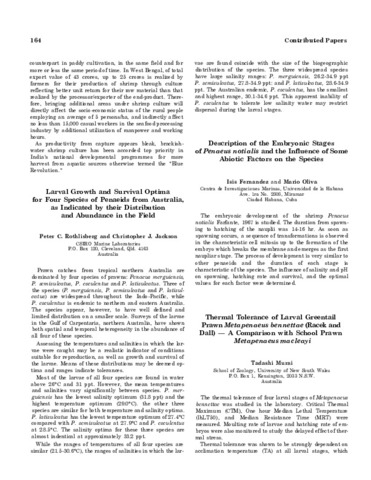
Larval growth and survival optima for four species of penaeids from Australia, as indicated by their distribution and abundance in the field
(Aquaculture Department, Southeast Asian Fisheries Development Center, 1985)Prawn catches from tropical northern Australia are dominated by four species of prawns: Penaeus merguiensis, P. semisulcatus, P. esculentus and P. latisulcatus. Three of the species (P. merguiensis, P. semisulcatus and P. latisulcatus) are widespread throughout the Indo-Pacific, while P. esculentus is endemic to northern and eastern Australia. The species appear, however, to have well defined and limited distribution on a smaller scale. Surveys of the larvae in the Gulf of Carpentaria, northern Australia, have shown both spatial and temporal heterogeneity in the abundance of all four of these species. Assessing the temperatures and salinities in which the larvae were caught may be a realistic indicator of conditions suitable for reproduction, as well as growth and survival of the larvae. Means of these distributions may be deemed optima and ranges indicate tolerances. Most of the larvae of all four species are found in water above 26°C and 31 ppt. However, the mean temperatures and salinities vary significantly between species. P. merguiensis has the lowest salinity optimum (31.8 ppt) and the highest temperature optimum (29.0°C). the other three species are similar for both temperature and salinity optima. P. latisulcatus has the lowest temperature optimum of 27.4°C compared with P. semisulcatus at 27.9°C and P. esculentus at 28.5°C. The salinity optima for these three species are almost indentical at approximately 33.2 ppt. While the ranges of temperatures of all four species are similar (21.5-30.6°C), the ranges of salinities in which the lar-vae are found coincide with the size of the biogeographic distribution of the species. The three widespread species have large salinity ranges: P. merguiensis, 26.2-34.9 ppt P. semisulcatus, 27.8-34.9 ppt: and P. latisulcatus, 28.6-34.9 ppt. The Australian endemic, P. esculentus, has the smallest and highest range, 30.1-34.6 ppt. This apparent inability of P. esculentus to tolerate low salinity water may restrict dispersal during the larval stages. -
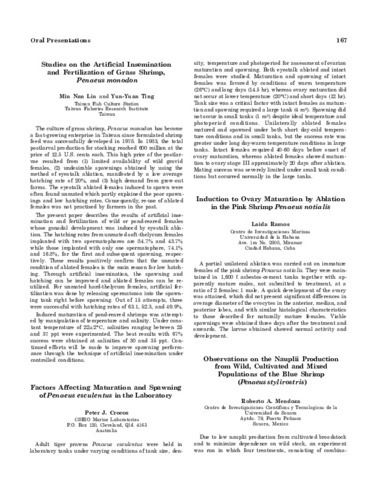
Induction to ovary maturation by ablation in the pink shrimp Penaeus notialis
(Aquaculture Department, Southeast Asian Fisheries Development Center, 1985)A partial unilateral ablation was carried out on immature females of the pink shrimp Penaeus notialis. They were maintained in 1,600 ℓ asbestos-cement tanks together with apparently mature males, not submitted to treatment, at a ratio of 2 females: 1 male. A quick development of the ovary was attained, which did not present significant differences in average diameter of the ovocytes in the anterior, median, and posterior lobes, and with similar histological characteristics to those described for naturally mature females. Viable spawnings were obtained three days after the treatment and onwards. The larvae obtained showed normal activity and development. -
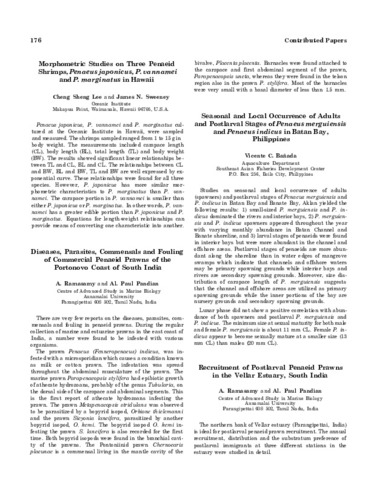
Recruitment of postlarval penaeid prawns in the Vellar estuary, South India
(Aquaculture Department, Southeast Asian Fisheries Development Center, 1985)The northern bank of Vellar estuary (Parangipettai, India) is ideal for postlarval penaeid prawn recruitment. The annual recruitment, distribution and the substratum preference of postlarval immigrants at three different stations in the estuary were studied in detail. Among the postlarvae of Penaeus, P. (Fenneropenaeus) indicus was dominant followed by P. (Penaeus) monodon, P. (P.) semisulcatus, P. (F.) merguiensis and P. (Melicertus) latisulcatus. In Metapenaeus, postlarvae of M. monoceros were abundant followed by M. dobsoni, M. affinis, M. bre-vicornis and M. lysianassa. Two peaks were observed in the postlarval penaeid prawn population. In P (F.) indicus and P. (P.) monodon, the primary peak occurred from January to April and the secondary peak from July to September. In M. monoceros and M. dobsoni, the primary peak was from March to May and the secondary peak from August to September. The postlarvae of P. (F.) indicus, P. (P.) monodon, M. monoceros and M. dobsoni were available throughout the year while the others were seasonal. The distribution of postlarvae in the estuary is related to the type of substratum, salinity and temperature. The postlarval population declined during the northeast monsoon (November-December) and in peak summer (May-June). Their abundance decreased in the lower salinity areas of the upper reaches of the estuary. -
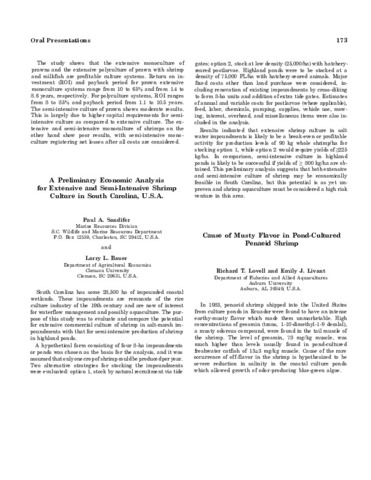
A preliminary economic analysis for extensive and semi-intensive shrimp culture in South Carolina, U.S.A.
(Aquaculture Department, Southeast Asian Fisheries Development Center, 1985)South Carolina has some 28,500 ha of impounded coastal wetlands. These impoundments are remnants of the rice culture industry of the 19th century and are now of interest for waterflow management and possibly aquaculture. The purpose of this study was to evaluate and compare the potential for extensive commercial culture of shrimp in salt-marsh impoundments with that for semi-intensive production of shrimp in highland ponds. A hypothetical farm consisting of four 8-ha impoundments or ponds was chosen as the basis for the analysis, and it was assumed that only one crop of shrimp could be produced per year. Two alternative strategies for stocking the impoundments were evaluated: option 1, stock by natural recruitment via tide gates; option 2, stock at low density (25,000/ha) with hatchery-reared postlarvae. Highland ponds were to be stocked at a density of 75,000 PL/ha with hatchery-reared animals. Major fixed costs other than land purchase were considered, including renovation of existing impoundments by cross-diking to form 8-ha units and addition of extra tide gates. Estimates of annual and variable costs for postlarvae (where applicable), feed, labor, chemicals, pumping, supplies, vehicle use, mowing, interest, overhead, and miscellaneous items were also included in the analysis. Results indicated that extensive shrimp culture in salt water impoundments is likely to be a break-even or profitable activity for production levels of 90 kg whole shrimp/ha for stocking option 1, while option 2 would require yields of ≥225 kg/ha. In comparison, semi-intensive culture in highland ponds is likely to be successful if yields of ≥ 800 kg/ha are obtained. This preliminary analysis suggests that both extensive and semi-intensive culture of shrimp may be economically feasible in South Carolina, but this potential is as yet un-proven and shrimp aquaculture must be considered a high risk venture in this area. -
Culture of blue shrimp, Penaeus stylirostris in Sonora, Mexico
(Aquaculture Department, Southeast Asian Fisheries Development Center, 1985)The Centro de Investigaciones Cientificas y Tecnologicas de la Universidad de Sonora has been conducting research on the culture of the blue shrimp Penaeus stylirostris since 1972. Most of the programs carried out are related to intensive culture in the Puerto Peñasco facilities. However, some experiments on semi-intensive and extensive culture have been conducted since 1975. This paper describes the principal aspects of the technology developed; spawners, larval culture, nursery, growth, feed, environmental parameters, water supply and others. While in intensive culture it is possible to attain over 5 kg shrimp/m2, in semi-intensive systems about 1 kg/m2 is obtained. The intensive system uses raceways for the grow-out of shrimp, the semi-intensive and extensive systems use ponds. -
Effect of temperature and salinity on the hatching of eggs and larval development of sugpo, Penaeus monodon
(Aquaculture Department, Southeast Asian Fisheries Development Center, 1985)Incubation of Penaeus monodon eggs and rearing of different larval stages were undertaken at nine temperature-salinity combinations. The eggs, nauplii, zoea and mysis from one spawner kept as stock culture at ambient temperatures of 26-30°C and salinity of 32-33 ppt were exposed to temperature levels of 23, 28 and 33°C and salinity levels of 23, 28 and 33 ppt. Eggs and nauplii survived the sudden change of temperature and salinity (from ambient to experimental) but the zoea and mysis did not. However, salinities of 23 and 28 ppt in combination with any of the temperature levels produced weak larvae. Highest mean hatching rate was obtained at the temperature-salinity combination of 23°C-33 ppt, followed by 28°C-33 ppt and 33°C-33 ppt. Incubation periods for these treatments were 22, 16 and 14 hr, respectively. Survival rate of nauplius (taken from stock cultures) to first zoeal stage was highest at 28°C-33 ppt, followed by 33°C-33 ppt and 23°C-33 ppt with molting time of 50, 45 and 75 hr, respectively. The nauplii exposed to 33°C-33 ppt molted to zoea stage within 38 to 40 hr but later died. Those exposed to 23°C-33 ppt and 28°C-33 ppt reached zoea stage within 57 to 60 hr and 48 to 50 hr, respectively. Similarly, the nauplii taken from the stock cultures and reared until postlarval stage (P1) under experimental conditions completed the zoea and mysis stages in 9 to 11 days at 28°C C-33 ppt, 7 to 9 days at 33°C-33 ppt, and 13 to 15 days at 23°C-33 ppt. Statistical analysis showed that salinity had highly significant effect on rates of hatching of eggs and survival from nauplius to first zoeal stage but not temperature although the latter had an apparent effect. However, both factors affected time of hatching of eggs and time of molting from nauplius to zoea. Interaction effect was significant only on rate and time of hatching. Different sources (spawners) of eggs and nauplii did not have significant effect on time of hatching and molting from nauplius to zoea, but significantly affected the hatching rate of eggs and survival rate of nauplii to zoea stage. -
Induced ovarian maturation and rematuration by eyestalk ablation of Penaeus monodon collected from Indian ocean (Phuket province) and Songkhla lake
(Aquaculture Department, Southeast Asian Fisheries Development Center, 1985)Because of the difficulty involved in maintaining a supply of sexually mature female shrimp for larval production in hatcheries, experiments on induced ovarian maturation in tiger shrimp, Penaeus monodon by eyestalk ablation were carried out from March to August, 1983. These shrimps were collected from two areas of Thailand: Phuket on the Indian Ocean and Songkhla Lake with entry to the Gulf of Thailand. Every female had one eyestalk pinched before being stocked together with males in various female-male ratios in 50-ton cement tanks with continuous water flow. The shrimp were fed 10% of their body weight daily with a diet of 90% green mussel (Mytilus edulis) and 10% cow liver. Results show that of those female shrimps collected in the Phuket area which is a natural spawning ground, 51% became gravid.However, of those collected in Songkhla Lake which is not a spawning area, only 19.51% became gravid. There was also a large difference in the number of days between eyestalk ablation and first spawning: 4-5 days for the Phuket samples and 20-30 days for those from Songkhla Lake. The survival rate of the larvae until P20 averaged 8.5% (total 732, 259) for the Phuket samples and 4.0% (total 300,000) for the Songkhla Lake samples. Results show mass mortality during the nauplius and mysis stages of shrimp from both locations which may indicate a greater susceptibility to bacterial and fungal infections in larvae produced from artificially matured females. Further studies should be undertaken to determine the proper nutritional diet for maximum production of gravid females, and to discover methods to increase sperm production in males from areas other than natural spawning grounds.