SEAFDEC/AQD Institutional Repository: Recent submissions
Now showing items 3741-3760 of 4221
-
The commercial production of green grouper fingerlings, Epinephelus suillus, from wild caught fry - an industry experience
(Aquaculture Department, Southeast Asian Fisheries Development Center, 1996)Wild-caught fry of the green groupers, Epinephelus malabaricus and E. suillus ranging in standard lengths (SL) from 1.5 to 3.0 cm were bought from different fry dealers all over the Philippines. These were reared from 1.0 to 2.5 months in 10 to 40 m3 (small) concrete tanks, in 240 m3 (large) concrete nursery tanks with sandy bottom, in 10 m3 hapa nets installed either in large nursery concrete tanks with sandy bottom or in 0.8 to 1.0 ha earthen ponds. The initial stocking density was 33-150/m3. When the fingerlings reached 5 to 7 cm SL, these were harvested and stocked in cages. The wild fry were fed adult brine shrimps for the first few days and later, trash fish. Rearing water in small concrete tanks was changed daily while that in large nursery tanks and hapas was changed only when dissolved oxygen level was about 4 ppt or lower. Survival rates ranged from 3% to 64%. Although survival rates varied, rearing grouper fry in hapa nets installed in earthen ponds were found to be the most suitable for the commercial production of grouper fingerlings to a size suitable for stocking in cages. The large variation in survival rates is attributed mainly to the quality of wild fry bought from different fry dealers all over the country and the occurrence of diseases during the culture period. The problems encountered in the commercial production of fingerlings are discussed. -
Influence of LHRHa and methyltestosterone on milt production of sea bass Lates calcarifer (Bloch)
(Aquaculture Department, Southeast Asian Fisheries Development Center, 1996)Milt volume, sperm density, and number of spermatozoa were determined to quantify milt production of mature sea bass after a single injection of LHRHa [(D-Ala6,Pro9-N-ethylamiide)LHRH] in saline solution and 17α-methyltestosterone in corn oil (MT). Two measures of sperm density, sperm count and spermatocrit, were highly correlated (r=0.85). Compared with control, milt volume and the number of spermatozoa collected increased but sperm count decreased (24% at 24 h) after a LHRHa (20 µg/kg body weight treatment, suggesting a stimulation of spermatozoa production and not merely milt dilution. Further milt dilution (44%) was induced by 80 µg/kg LHRHa (LHRHa80) at 12 h post-treatment but not by 200 µg/kg MT (MT200) alone. A milt dilution of only 27% at 12 h after simultaneous injections of LHRHa80 and MT200 may indicate some inhibitory effect of MT on the efficiency of LHRHa. These results demonstrate that the stimulation of milt production by LHRHa involves testicular hydration resulting in milt dilution. -
Nickel-induced pathohistologic alterations in Oreochromis mossambicus
(Aquaculture Department, Southeast Asian Fisheries Development Center, 1996)A pathohistologic study was conducted to determine the effects of nickel on the testes of maturing Mozambique tilapia, Oreochromis mossambicus. The fish were treated with 0.5 mg/L and 1.0 mg/L sublethal dose of nickel sulphate for four weeks. A week reduction in spermatogenic activity together with the disintegration of seminiferous tubules and spermatocytes are commonly observed in the 0.5 mg/L-treated fish. This results in the scattering of germ cells and the occurrence of spaces within the spermatocysts. Pyknotic nuclei are also seen in some specimens. Connective tissues and blood cells invade the damaged regions of the organ. Enlargement of Sertoli cells and interstitial cells are also observed. These effects are more pronounced in the 1.0 mg/L-treated testes. Relatively low levels of nickel in aquatic ecosystems impose a great danger to the reproduction and survival of Mozambique tilapia. -
Impact of nickel poisoning on the histology of the ovaries of Oreochromis mossambicus
(Aquaculture Department, Southeast Asian Fisheries Development Center, 1996)Ovaries of Oreochromis mossambicus exposed to sublethal concentrations of nickel sulphate (0.5 mg/1 and 1.0 mg/1) were histologically analyzed. Changes following exposure to 0.5 mg/1 nickel sulphate include irregularities in the shape of egg follicles, subcellular oocyte damage, lifting off of the theca layer and proliferation of connective tissues. In the ovaries exposed to 1.0 mg/1 nickel sulphate, degenerative changes are worse. Invasion by connective tissues is extensive, oocytes have bizarre shapes, yolk granules are scattered in the interfollicular spaces, abnormal growths are evident and previttelogenic oocytes abound. Nickel is a toxicant in Oreochromis mossambicus ovaries. -
Changes in lipid and fatty acid content during early larval development of milkfish (Chanos chanos): influence of broodstock diet
(Aquaculture Department, Southeast Asian Fisheries Development Center, 1996)The influence of amount and type of lipid given to milkfish broodstock by developing larvae was investigated by feeding broodstock commercial diets that differed in lipid content and composition. The two commercial feeds used had the following proximate composition: RFP - 28.16% crude protein, 2.40% crude fat, 7.58% crude fiber, 53.94% N-free extract; RCP - 43.28% crude protein, 4.58% crude fat, 6.18% crude fiber, 37.0% N-free extract. The lipid content and fatty acid composition of spawned milkfish eggs reflected that of the broodstock feed. Percent lipid in egg from broodstock fed RFP and RCP dropped by 22.5% and 26.9% in newly-hatched larvae and by 53.0% and 65.0% in day 2 larvae (>90% yolk resorbed), respectively. Decreases in total PUFA and increase in monoenoic fatty acids during yolk resorption indicate that milkfish as in other marine fishes utilize PUFA during early larval development. While differences in rate of utilization of individual n-3 and n-6 FA in two groups of larvae seem to be influenced by levels of the fatty acids in eggs, the influence of other nutrients on fatty acid utilization need to be investigated. -
LHRHa and pimozide-induced breeding in the catfish, Clarias macrocephalus (Gunther)
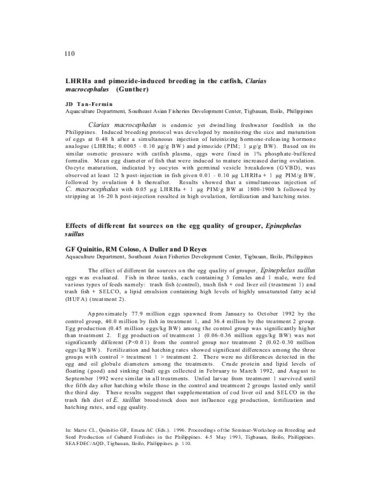
(Aquaculture Department, Southeast Asian Fisheries Development Center, 1996)Clarias macrocephalus is endemic yet dwindling freshwater foodfish in the Philippines. Induced breeding protocol was developed by monitoring the size and maturation of eggs at 0-48 h after a simultaneous injection of luteinizing hormone-releasing hormone analogue (LHRHa; 0.0005 - 0.10 µg/g BW) and pimozide (PIM; 1 µg/g BW). Based on its similar osmotic pressure with catfish plasma, eggs were fixed in 1% phosphate-buffered formalin. Mean egg diameter of fish that were induced to mature increased during ovulation. Oocyte maturation, indicated by oocytes with germinal vesicle breakdown (GVBD), was observed at least 12 h post-injection in fish given 0.01 - 0.10 µg LHRHa + 1 µg PIM/g BW, followed by ovulation 4 h thereafter. Results showed that a simultaneous injection of C. macrocephalus with 0.05 µg LHRHa + 1 µg PIM/g BW at 1800-1900 h followed by stripping at 16-20 h post-injection resulted in high ovulation, fertilization and hatching rates. -
Control of gonad growth, maturation and spawning in teleost fish: A review
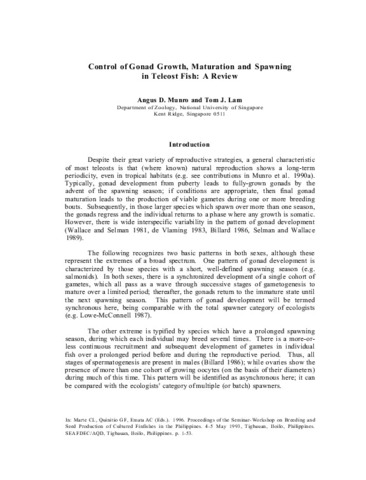
(Aquaculture Department, Southeast Asian Fisheries Development Center, 1996)Despite their great variety of reproductive strategies, a general characteristic of most teleosts is that (where known) natural reproduction shows a long-term periodicity, even in tropical habitats (e.g. see contributions in Munro et al. 1990a). Typically, gonad development from puberty leads to fully-grown gonads by the advent of the spawning season; if conditions are appropriate, then final gonad maturation leads to the production of viable gametes during one or more breeding bouts. Subsequently, in those larger species which spawn over more than one season, the gonads regress and the individual returns to a phase where any growth is somatic. However, there is wide interspecific variability in the pattern of gonad development (Wallace and Selman 1981, de Vlaming 1983, Billard 1986, Selman and Wallace 1989). -
Series: Technical report / SEAFDEC Aquaculture Department; 5
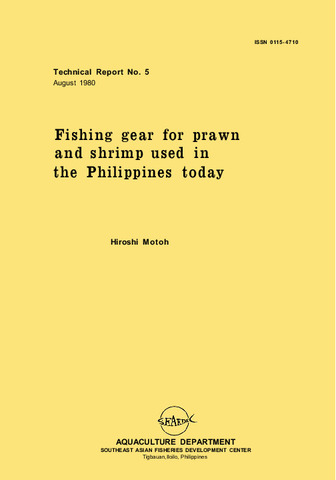
Fishing gear for prawn and shrimp used in the Philippines today
(Aquaculture Department, Southeast Asian Fisheries Development Center, 1980)This paper describes various types of shrimping and prawning gear and devices, most of which have been traditionally used in the Philippines, with some ecological notes. This study provides basic information on prawn culture and fry collection, which will be useful for private fishpond operators and workers. -
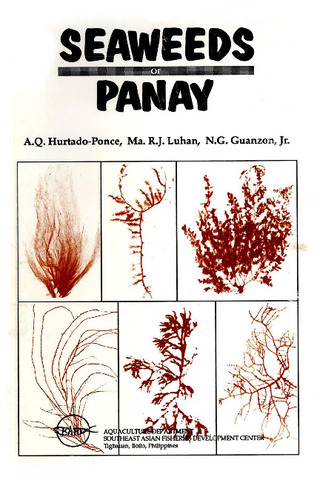
Seaweeds of Panay
(Aquaculture Department, Southeast Asian Fisheries Development Center, 1992)This practical book on the seaweeds of Panay, Philippines, acquaints and provides information to members of the academe and research institutions, policy makers, fishermen and businessmen regarding the taxonomy, distribution, ecology and economic importance of these resources. It consists of 4 major parts: (1) Introduction, which reviews the literature, habitat, distribution, morphological structure and reproduction; 2) Classification, which describes the classes to which the seaweeds generally belong; 3) Collection and preservation, which explains the procedure used in treatment of specimens; and, 4) Taxonomic list. A glossary is included, covering technical terms used. All species listed and described in this book are macrobenthic and were collected in Panay and Guimaras Islands. -
Feed quality problems and management strategies
(Aquaculture Department, Southeast Asian Fisheries Development Center, 1996)Feed is the single most important input in increasing aquaculture production and profits. Success or failure in augmenting yield with feeding depends, to a large extent, on the quality of the diet. Feed quality, generally perceived as the responsibility of the feed manufacturer, is affected by factors outside of the plant such as handling, storage, and use. Thus, the maintenance of feed quality becomes partly the responsibility of the farmer. Every fish farmer must be familiar with the nature and occurrence of major feed quality problems and able to prevent and control them. This paper is based on a farmer's viewpoint. Valuable insights are provided for the feed manufacturer. -
Farming of all-male java tilapia (Oreochromis mossambicus) at two stocking densities in cages in a brackishwater pond
(Aquaculture Department, Southeast Asian Fisheries Development Center, 1996)A study was conducted to determine the growth, survival, and yield of allmale Oreochromis mossambicus in cages at two stocking densities: 50 fish/m2 (Treatment I) and 100 fish/m2 (Treatment II) in a brackishwater pond. The artificial diet contained 70% fine rice bran and 30% Peruvian fish meal. The 25% crude protein diet was fed in pellet form at 5% of fish biomass per day for the first two months and in mashed, moist form at 3% of fish biomass per day for the last month of culture. Results showed that fish in Treatment I gave higher mean weight gain (59.75 g) than in Treatment II (45.10 g). Similarly, higher daily growth rate was observed in Treatment I (0.56g/day) than in Treatment II (0.42 g/day). Feed conversion ratios of 2.42 and 2.85 were obtained for Treatment I and Treatment II, respectively. Fish in treatment I had higher percent survival (87.3%) than those in Treatment II(72.0%). Moreover, higher net income per cage was obtained in Treatment I than in Treatment II. Statistical analysis, however, showed no significant differences between the two treatments. -
Reproductive performance of captive Penaeus monodon fed various sources of carotenoids
Quinitio, Emilia T. ; ; ; (Aquaculture Department, Southeast Asian Fisheries Development Center, 1996)
Three groups of pond-reared Penaeus monodon broodstock were fed formulated diet in combination with carotenoid-containing natural food: mussel + shrimp broodstock pellet (MBP), crab + BP (CBP), and Artemia + BP (ABP). After four months, maturation and spawning rates did not differ significantly among treatments. After eyestalk ablation, MBP-fed shrimps Initially spawned 20 days; 34 days for CBP-fed; 50 days for ABP-fed shrimps. The number of eggs per g body weight of spawner (1616-2359 eggs /g BW) did not differ significantly among all groups. Only nauplii from MBP-fed broodstock reached postlarval stage. Rematuration was observed only in MBP- and CBP fed shrimps. Sperm count was highest in MBP- and lowest in ABP-fed shrimps at the final phase of the test.
; ; ; (Aquaculture Department, Southeast Asian Fisheries Development Center, 1996)
Three groups of pond-reared Penaeus monodon broodstock were fed formulated diet in combination with carotenoid-containing natural food: mussel + shrimp broodstock pellet (MBP), crab + BP (CBP), and Artemia + BP (ABP). After four months, maturation and spawning rates did not differ significantly among treatments. After eyestalk ablation, MBP-fed shrimps Initially spawned 20 days; 34 days for CBP-fed; 50 days for ABP-fed shrimps. The number of eggs per g body weight of spawner (1616-2359 eggs /g BW) did not differ significantly among all groups. Only nauplii from MBP-fed broodstock reached postlarval stage. Rematuration was observed only in MBP- and CBP fed shrimps. Sperm count was highest in MBP- and lowest in ABP-fed shrimps at the final phase of the test. -
Weaning of the Asian catfish, Clarias macrocephalus Gunther, larvae to formulated dry diet
(Aquaculture Department, Southeast Asian Fisheries Development Center, 1996)Two feeding trials lasting 10 days each were conducted to determine the weaning time in the Asian catfish, Clarias macrocephalus, larvae to dry diet feeding. Three-day-old catfish larvae were fed newly-hatched Artemia nauplii for 2,4, and 6 days after which ad libitum feeding with a commercial feed (trial 1) or a formulated diet (trial 2) was started. Fish fed exclusively dry diet (0-day Artemia feeding) or those fed only Artemia for 10 days served as the controls. In trial 1, fish fed Artemia at different durations had significantly higher growth and survival than those reared exclusively on dry diet. In trial 2, percent survival was not significantly different among fish with or without Artemia pre-feeding. However, fish had significantly higher final body weight and SGR when reared initially on Artemia prior to dry diet than those fed exclusively dry diet. Based on the results, catfish larvae can be successfully weaned to dry diet after feeding Artemia for a maximum period of four days (ave. BW=12.25 mg). -
In vitro digestibility of locally available feedstuffs for white shrimp Penaeus indicus
(Aquaculture Department, Southeast Asian Fisheries Development Center, 1996)An in vitro method of determining protein digestibility was modified for application in white shrimps. The protein digestibility of 21 locally available feedstuffs were determined. Vitamin-free casein was used as reference protein. To verify in vitro results, a feeding experiment was conducted using 300 shrimps with average initial weight of 0.075 g. The shrimps were fed isonitrogenous and isocaloric diets containing test ingredients with high (27.6% -33.7%) and low (4.0%-10.5%) digestibility for 61 days. Seawater temperature ranged from 26 to 29°C and salinity from 30 to 33 ppt. Defatted soybean meal (27.2% digestibility) was used as control. Growth and survival were determined. Animal proteins (40.9%-90.9%) were more digestible than plant proteins (0.0%-33.7%), although digestibility of papaya leaf meal (33.7%) was comparable with those of shrimp head meal (40.9%) and Peruvian fish meal (40.7%). Green mungbean meal was most digestible (27.6%) among the legumes. Protein digestibility of defatted soybean meal (27.2%) was significantly higher than that of unprocessed soybean meal (9.4%). Black cowpea meal and ricebean meal were not digestible. Results also showed that white shrimps given a diet containing cassava leaves performed best with weight gain, specific growth rate, and survival (706.4%, 3.44 and 49%) comparable with white cowpea meal (701.3%, 3.35 and 40%) and defatted soybean meal (726.8%,3.50 and 33%), followed by papaya leaf meal (505%, 3.02 and 38%). Shrimps fed a diet containing green mungbean meal showed the poorest response (344.2%, 2.46 and 18%). These results indicate that in vitro protein digestibility is not correlated with growth and survival. The amino acid pattern, anti-nutritional factors, and palatibility of the diets are other important factors that may influence the growth of P. indicus. -
Feed formulation and evaluation for semi-intensive culture of fishes and shrimps in the tropics
(Aquaculture Department, Southeast Asian Fisheries Development Center, 1996)Semi-intensive farming systems account for about 70% of fish and crustacean aquaculture production in the tropics, employing semi-intensive feeding methods ranging from the use of low-cost pond fertilization techniques to high-cost complete diet feeding strategies. The paper reviews the major feeding methods employed within semi-intensive farming systems, and emphasizes the importance of natural food organisms in the nutritional budget of pond-raised fish and shrimp. It also discusses the need of the aquaculture sector to reduce farm production costs through the use of improved feed formulation and on-farm feeds and new methodological approaches towards fish and crustacean nutrition research within semiintensive pond farming systems. -
Kappaphycus and Gracilariopsis meal as binders for diets of tiger shrimp
(Aquaculture Department, Southeast Asian Fisheries Development Center, 1996)Two locally grown seaweeds, Kappaphycus alvarezii and Gracilaria heteroclada, were tested as binders in diets for shrimp juveniles to minimize the use of wheat flour, a common binder. The seaweeds were washed, dried, ground, and made into paste. Seaweed meals were added to an isonitrogenous diet containing 5% flour at 5, 10 and 15%. The control diet contained 15% flour (no seaweed meal). The diets were fed to juvenile Penaeus monodon for 56 days to assess the acceptability of the seaweed meals in terms of shrimp growth, survival and feed conversion ratio (FCR). Seven dietary treatments, each with three replicates, were arranged in a completely randomized design. Treatment means were compared by analysis of variance and Duncan's multiple range test.Growth of shrimp fed diets with 5% and 10% G. heteroclada, and 10% K. alvarezii did not differ significantly but was higher than the rest of the treatments. Only those fed 10% G. heteroclada had growth similar to those fed the control diet. Diets with 5% and 10% K. alvareziii and 10% G. heteroclada had the best FCR. Shrimp survival decreased as the level of G. heteroclada increased. Survival was not affected by the level of K. alvarezii in the diet.Water stability of the diets was assessed in 4 h. High water stability was observed in the diet with 10% G. heteroclada (91%), 5% G. heteroclada (90%) and the control (90%). The rest of the diets were 87-89% stable. Thus, 10% G. heteroclada or 10% K. alvarezii could be used to supplement 5% flour as binders in shrimp diets with no adverse effect on growth and survival. -
Nutritional requirements of commercially important shrimps in the tropics
(Aquaculture Department, Southeast Asian Fisheries Development Center, 1996)The culture of tropical shrimps has gained greater economic importance particularly among Southeast Asian countries. As shrimp fanning moves from low-input, low-technology operation to the intensive and even highly intensive scales of operation, farmers are increasingly seeking ways to achieve more efficient means of production. Feed takes up the major portion of the cost of production. It also has a significant effect on the health of cultured species. Therefore, nutritional adequacy and cost-effectiveness of feeds are critical to the growth of the aquaculture industry. This paper discusses the nutritional requirements for growth as well as for health of some commercially important shrimp species in the tropics with emphasis on P. monodon. -
Screening of inexpensive and indigeneous ingredients for use in practical feed for juvile sea bass (Lates calcarifer Bloch)
(Aquaculture Department, Southeast Asian Fisheries Development Center, 1996)An eight-week feeding experiment with juvenile sea bass (about 15 g) was conducted in 500-1 fiberglass tanks to screen the most cost-effective practical diet for use in ponds and floating cages. Eleven formulations and one control feed were tested. Protein sources used were locally available ingredients such as fish meal, shrimp head meal, scrap squid meal, cow's blood meal, poultry feather meal, leaf meals, soybean meal, and mung bean meal. The diets contained a combination of animal and vegetable protein sources such that the essential amino acid composition was close to the requirement or tissue levels. Crude protein and fat levels were about 42% and 8.3%, respectively. Fish were fed ad libitum twice a day at 0800 and 1600 h. Best weight gain (189%) and feed conversion ratio (FCR, 1.7) were observed in fish given a combination of fish meal, shrimp head meal, scrap squid meal, soybean bean meal, and kangkong leaf meal as protein sources. This was followed by those given a combination of fish meal, shrimp head meal, scrap squid meal, soybean meal, and ipil-ipil leaf meal (139% weight gain, FCR of 2.2). Worst growth (22%) and FCR were observed in fish given a combination of fish meal, cow's blood meal, scrap squid meal, soybean meal, and mulberry leaf meal. Control fish given a combination of fish meal, shrimp meal, and soybean meal showed weight gain of 195% and FCR of 1.8. Survival was high (83-100%) in all treatments. The two diets which gave the best growth rates, survival, and FCR in the screening phase can be tried in ponds and floating net cages. -
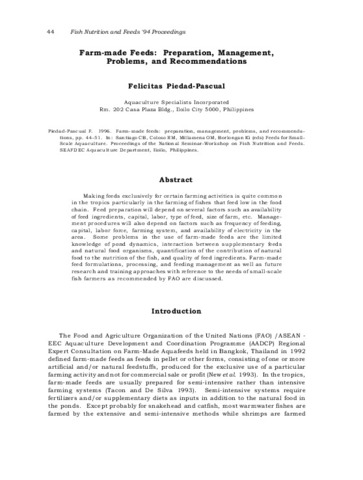
Farm-made feeds: preparation, management, problems, and recommendations
(Aquaculture Department, Southeast Asian Fisheries Development Center, 1996)Making feeds exclusively for certain farming activities is quite common in the tropics particularly in the farming of fishes that feed low in the food chain. Feed preparation will depend on several factors such as availability of feed ingredients, capital, labor, type of feed, size of farm, etc. Management procedures will also depend on factors such as frequency of feeding, capital, labor force, farming system, and availability of electricity in the area. Some problems in the use of farm-made feeds are the limited knowledge of pond dynamics, interaction between supplementary feeds and natural food organisms, quantification of the contribution of natural food to the nutrition of the fish, and quality of feed ingredients. Farm-made feed formulations, processing, and feeding management as well as future research and training approaches with reference to the needs of small-scale fish farmers as recommended by FAO are discussed. -
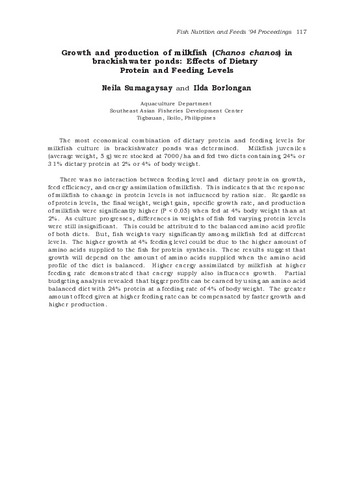
Growth and production of milkfish (Chanos chanos) in brackishwater ponds: effects of dietary protein and feeding levels
(Aquaculture Department, Southeast Asian Fisheries Development Center, 1996)The most economical combination of dietary protein and feeding levels for milkfish culture in brackishwater ponds was determined. Milkfish juveniles (average weight, 5 g) were stocked at 7000/ha and fed two diets containing 24% or 31% dietary protein at 2% or 4% of body weight.There was no interaction between feeding level and dietary protein on growth, feed efficiency, and energy assimilation of milkfish. This indicates that the response of milkfish to change in protein levels is not influenced by ration size. Regardless of protein levels, the final weight, weight gain, specific growth rate, and production of milkfish were significantly higher (P < 0.05) when fed at 4% body weight than at 2%. As culture progresses, differences in weights of fish fed varying protein levels were still insignificant. This could be attributed to the balanced amino acid profile of both diets. But, fish weights vary significantly among milkfish fed at different levels. The higher growth at 4% feeding level could be due to the higher amount of amino acids supplied to the fish for protein synthesis. These results suggest that growth will depend on the amount of amino acids supplied when the amino acid profile of the diet is balanced. Higher energy assimilated by milkfish at higher feeding rate demonstrated that energy supply also influences growth. Partial budgeting analysis revealed that bigger profits can be earned by using an amino acid balanced diet with 24% protein at a feeding rate of 4% of body weight. The greater amount of feed given at higher feeding rate can be compensated by faster growth and higher production.