Mencari Nutrition in tropical aquaculture : essentials of fish nutrition, feeds, and feeding of tropical aquatic species berdasarkan Judul
Now showing items 1-14 of 14
-
Economics of feeding
(Aquaculture Department, Southeast Asian Fisheries Development Center, 2002)This chapter aims to introduce concepts and methods in doing economic analysis applicable in aquaculture in general with emphasis in feed production and feeding in aquaculture farms. This chapter discusses the following topics: cost of producing feeds; simple single-input (feeds) and single output (fish) production function; indices for measuring economic efficiency of feeds; the least-cost combination; and linear programming as used in the allocation of limited resources such as feed ingredients that will meet the nutritional requirements of the fish. -
The essential nutrients: Carbohydrates
(Aquaculture Department, Southeast Asian Fisheries Development Center, 2002)This section discusses the difference among the various forms of carbohydrate and their significance in fish nutrition; distinguish between utilization of carbohydrates by warmwater and coldwater fishes and know how dietary carbohydrates are made available to fish. -
The essential nutrients: Energy
(Aquaculture Department, Southeast Asian Fisheries Development Center, 2002)After studying this section, the reader should be able to differentiate the forms of energy and their measurement. Understand dietary energy metabolism, the energy balance equation and factors that influence dietary energy requirement of fish; and understand the significance of optimal protein to non-protein energy in fish diets. -
The essential nutrients: Lipids and fatty acids
(Aquaculture Department, Southeast Asian Fisheries Development Center, 2002)The objective of this section is to acquaint the reader about common fatty acids, their nomenclature and formulas, and differentiate between saturated and unsaturated fatty acids; to know how environmental factors (temperature, salinity, diet) influence the fatty acid composition of fish; the mechanisms of fatty acid biosynthesis and oxidation, and factors that favor fatty acid biosynthesis and oxidation; the effects of lipid peroxidation and the function of antioxidants; and to understand the importance of fatty acid profiles in fish nutrition, and differences in the essential fatty acid requirements of warmwater and coldwater fishes. -
The essential nutrients: Minerals
(Aquaculture Department, Southeast Asian Fisheries Development Center, 2002)This section discusses the macro, micro, and trace minerals; their physiologic functions; and deficiency signs and symptoms. It also gives a summary of the mineral functions and mineral requirements of fishes and shrimp. -
The essential nutrients: Proteins and amino acids
(Aquaculture Department, Southeast Asian Fisheries Development Center, 2002)This section aims to teach the reader the ten essential amino acids required by fish and their chemical structures, distinguish between essential and non-essential amino acids; the fate of absorbed amino acids in fish; effects of deficiencies and excesses of dietary amino acids in fish diets; the procedure on how to determine the qualitative and quantitative amino acid requirements of fish; methods of evaluating protein quality; and how to determine protein requirements of some aquaculture species. -
The essential nutrients: Vitamins
(Aquaculture Department, Southeast Asian Fisheries Development Center, 2002)This section describes the various lipid-soluble and water-soluble vitamins, their differences, physiological functions, and the symptoms of vitamin deficiencies in fish. It also shows a summary of nutritional deficiency signs and the requirements of various fish species for vitamins. -
Evaluation of feedstuffs and aquafeeds
(Aquaculture Department, Southeast Asian Fisheries Development Center, 2002)This chapter discusses how to evaluate feedstuffs and feeds. The results of feed evaluation will be used to ensure the production of high quality feeds for fish, crustaceans, and shellfish. -
Feeding habits and digestive physiology of fishes
(Aquaculture Department, Southeast Asian Fisheries Development Center, 2002)This chapter provides basic information on the feeding habits and behavior, and physiology of fishes and crustaceans. The mechanisms that control the movement and digestion of food, methods of assessing digestibility of feed, factors affecting digestion and absorption of food nutrients, and feeding processes in fish are discussed. An understanding of the feeding habits, feeding mechanisms, and the digestion and absorption processes can help fish farmers and nutritionists maximize the use of feed. The rate at which fish digest their food is of primary importance in determining feeding rates, frequency, and ration size. Knowledge of the digestive physiology of fish is also necessary for an effective feed formulation and in choosing a proper feeding regime. This chapter aims to teach the reader: the feeding habits and behavior of fishes and crustaceans; the structural adaptation in the anatomy of the digestive tract; the various organs of the digestive systems of fishes and crustaceans and their functions; nutrient digestion and absorption by fishes and the fate of digested and undigested food; the factors that affect the rate of digestion and absorption; and the feeding process in fish. -
Formulation of aquafeeds
(Aquaculture Department, Southeast Asian Fisheries Development Center, 2002)The development of a feed that is both effective and economical for an aquaculture species in all its life stages is a continuous effort. Aquafeed development started when natural food sources in culture systems became inadequate and had to be supplemented with prepared feed. As fish stocking densities in culture increase, supplemental feeding is no longer sufficient. A complete feed that contains all the necessary nutrients in sufficient amounts to bring about good growth, survival, and reproduction is needed. Feed ingredients generally come from animal or plant sources and some are by-products of the food industry. There is no single feed ingredient or feedstuff that contains all the nutrients in adequate amounts. Thus, different feed ingredients are combined to make a feed that has the desired composition and nutrient levels. In combining various feed ingredients, it is important to know how much of each feed ingredient should be used to produce a cost-effective aquafeed. With the growth and expansion of aquaculture into a major industry, several fish species are being cultured; thus, the development of more efficient aquafeed formulations should continue. In developing cost-effective formulated diets, many important factors have to be considered. This chapter discusses these factors and the mathematical calculations in formulating a feed. It aims to enable students to formulate diets using purified and practical feed ingredients, and also to formulate effective supplemental and complete diets for aquaculture species. -
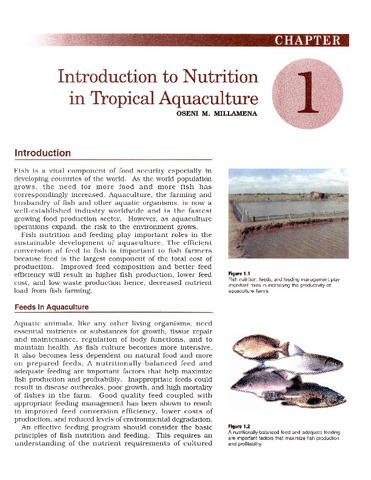
Introduction to nutrition in tropical aquaculture
(Aquaculture Department, Southeast Asian Fisheries Development Center, 2002)Fish is a vital component of food security especially in developing countries of the world. As the world population grows, the need for more food and more fish has correspondingly increased. Aquaculture, the farming and husbandry of fish and other aquatic organisms, is now a well-established industry worldwide and is the fastest growing food production sector. However, as aquaculture operations expand, the risk to the environment grows. Fish nutrition and feeding play important roles in the sustainable development of aquaculture. The efficient conversion of feed to fish is important to fish farmers because feed is the largest component of the total cost of production. Improved feed composition and better feed efficiency will result in higher fish production, lower feed cost, and low waste production hence, decreased nutrient load from fish farming. -
Management of feeding aquaculture species
(Aquaculture Department, Southeast Asian Fisheries Development Center, 2002)This chapter teaches the reader to: differentiate the different feeding strategies in pond culture; learn feeding management methods such as stock sampling and record keeping, calculating daily feed ration, choosing appropriate feed size, and methods of applying feeds; understand the impact of feeding management on water quality and environment and on the cultured animal’s growth, survival, and feed conversion ratio; and describe the different feeding schemes used to culture fishes (milkfish, tilapia, rabbitfish, bighead carp, native catfish, sea bass, orange-spotted grouper, and mangrove red snapper; and crustaceans (tiger shrimp and mud crab). Other species for aquaculture stock enhancement (donkey’s ear abalone, seahorses, window-pane oyster) are also discussed. -
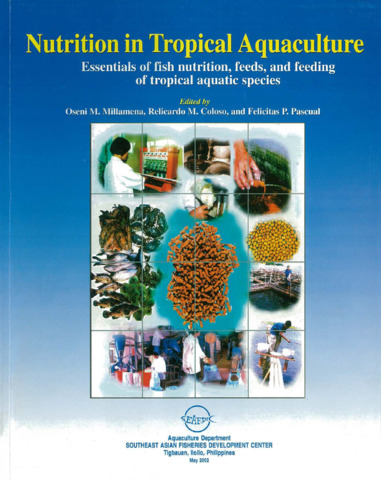
Nutrition in tropical aquaculture: Essentials of fish nutrition, feeds, and feeding of tropical aquatic species
(Aquaculture Department, Southeast Asian Fisheries Development Center, 2002)This book is intended to teach undergraduate students the essentials of aquaculture nutrition, feed formulation, and feeding management. It serves as a reference book for researchers in aquaculture, aquaculturists, fish farmers, and aquaculture nutritionists. For the basic understanding of the materials presented, it is essential that the students, teachers, and researchers have a good background in chemistry, fish biology, or fisheries. The book covers the subject areas of known nutrient requirements, effects of nutrient deficiencies on various aquatic species, nutrient sources, digestibility, and digestive physiology. Feed formulation, processing and storage, evaluation and quality control, feeding management, as well as the economics of feeding are included. Aspects on feeds and feeding related to the conservation of the aquatic environment are also dealt with. Each chapter of this book has common features such as an introduction, basic concepts, and a summary. Both the basic and practical aspects of fish nutrition are included to give the students and allow the readers who are unfamiliar with the topics a clear understanding and knowledge of these concepts. Study questions at the end of each chapter serve as a guide to summarize and impress on the students the salient points of the subject matter in each chapter. To easily comprehend the subject matter, there is an appendix containing the analytical methods and a glossary of technical terms. The users particularly the students are encouraged to broaden their knowledge by referring to the list of references and suggested readings at the end of each chapter. -
Processing of feedstuffs and aquafeeds
(Aquaculture Department, Southeast Asian Fisheries Development Center, 2002)This chapter will help the reader understand and appreciate the basic principles of processing, preparation, storage, and quality control in the preparation of aquafeeds. The material in this section is presented in sequence beginning with the processing of basic ingredients to remove antinutritional factors, followed by steps in feed preparation, from the easiest to the more complex processes, and storage. This chapter presents methods and equipment that are useful not only for feed millers, but also for extension workers and fish farmers.