
Meeting Reports
Browse by
คอลเล็กชันในชุมชนนี้
-
Recent Developments in the Genetic Improvement of the Giant Freshwater Prawn (Macrobrachium sp.) [14]
A compendium of results from the Collaborative Prawn Genetic Improvement and Seed Production Research Project under the Promotion of Sustainable Aquaculture in the ASEAN Region (2002 - 2007) -
Technologies in Mangrove-Friendly Aquaculture [16]
Final Report of and Papers Presented to the On-Site Training on Mangrove-Friendly Aquaculture, Hai Phong City, Socialist Republic of Vietnam 19-30 April 1999
การส่งล่าสุด
-
Technologies in Mangrove-Friendly Aquaculture. Final Report of and Papers Presented to the On-Site Training on Mangrove-Friendly Aquaculture, Hai Phong City, Socialist Republic of Vietnam, 19-30 April 1999
(Aquaculture Department, Southeast Asian Fisheries Development Center, 2000)This document contains the final report of and papers presented as lecture materials, to the On-Site Training on Mangrove-Friendly Aquaculture held in Hai Phong City, Socialist Republic of Vietnam from 19 to 30 April 1999. This document replaces the Advance Copy of the Report issued in May 1999. Fourteen experts on mangroves and aquaculture served as lecturers and resource persons. Technologies in Mangrove-Friendly Aquaculture, in general were introduced, taking into consideration the results of the Workshop on Mangrove-Friendly Aquaculture, 11-15 January 1999, Iloilo City, Philippines. The On-Site Training was participated in by 25 participants; 20 from Vietnam and 5 from Cambodia. The conduct of the On-Site draining was an offshoot of the Project SD/AQ99-CM01 with the SEAFDEC Secretariat which also allocated the necessary funds from the Japanese Trust Fund. The Canada-ASEAN Centre based in Singapore provided funds for the participation of the trainees from the Kingdom of Cambodia. -
Mangrove-aquaculture technology: Philippine experience
(Aquaculture Department, Southeast Asian Fisheries Development Center, 2000)This paper presents the history of one of the earliest mangrove-aquaculture projects in the Philippines which started in 1986. The site is part of the Bureau of Fisheries and Aquatic Resources (BFAR) Fish Farm for milkfish production in Son-oc, Poblacion, Ubay, Bohol, central Philippines. Mangrove seedlings were planted in an area at a ratio of 80%-20%. mangrove to fish culture area. The project proved that mangroves and fish could live and grow in a harmonious relationship. The project area now serves as a free entry for wild fishes so that fish production of no less than one-half ton yearly has been recorded in an area of over 2.0 ha. Fishes caught are usually grouper, snapper, tarpons, barracuda, siganids, tilapia, mullets, caravalle, slipmouth, whiting, scats, goby, sea bass, shrimps and blue crabs. The mangrove-aquaculture project in Ubay, Bohol which has been successful, could be easily adapted by the fisherfolk living in coastal areas where mangroves can be grown. The forest products and fishery resources obtained from such activity could contribute to the sustenance of coastal communities. -
Culture technologies for some economically important seaweeds
(Aquaculture Department, Southeast Asian Fisheries Development Center, 2000) -
Aquaculture of shellfish in Vietnam
(Aquaculture Department, Southeast Asian Fisheries Development Center, 2000) -
Wise use of important mollusc species in mangrove areas: Malaysia
(Aquaculture Department, Southeast Asian Fisheries Development Center, 2000)For centuries, several edible mollusc species are being collected for food by coastal communities from these mangrove ecosystems. The most common molluscs collected are cockles, various species of oysters, clams and cerithids. This paper attempts to discuss the most practical culture technologies that have been developed for some of the more important mollusc species that are cultured in Malaysia. In order of priority, these are Anadara granosa (blood cockle), Crassostrea iredalei (brackishwater slipper oyster), Crassostrea belcheri (mangrove oyster), and Cerithidia obtusa (horn shells). -
The role of mangrove ecosystems and coastal aquaculture in the life of people in coastal mangrove areas
(Aquaculture Department, Southeast Asian Fisheries Development Center, 2000)In discussing the benefits from forests, usually only the direct products such as timber or other forestry products are counted. Little attention is made on indirect benefits such as climate regulation, erosion prevention, flood restriction, etc., which are of great importance because mangrove forests grow at tidal and riverside areas where winds and waves are usually strong. In this paper, the direct products and indirect benefits from mangrove forests are discussed. -
Mangrove-friendly marine shrimp aquaculture technology: Thailand experience
(Aquaculture Department, Southeast Asian Fisheries Development Center, 2000) -
Community-based mangrove-friendly aquaculture: Philippine experience
(Aquaculture Department, Southeast Asian Fisheries Development Center, 2000)This paper discussed two mangrove-friendly aquaculture technologies that will not only protect the coastal and mangrove ecosystem but could also increase the income of the coastal communities not only from the forest products but also from fish, shellfish, and crab production. Moreover, the technologies will not only serve as livelihood but also help in promoting the conservation of biodiversity. -
The Philippine legal framework on silvofisheries
(Aquaculture Department, Southeast Asian Fisheries Development Center, 2000) -
Legal framework for mangrove-friendly aquaculture: Vietnam experience
(Aquaculture Department, Southeast Asian Fisheries Development Center, 2000) -
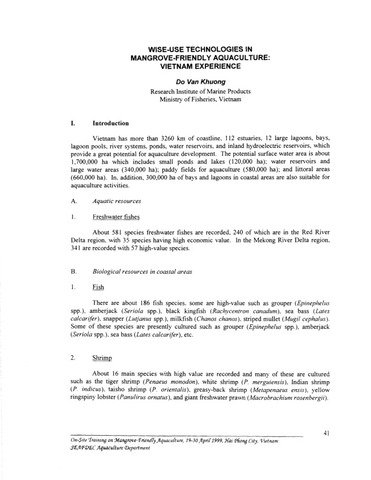
Wise-use technologies in mangrove-friendly aquaculture: Vietnam experience
(Aquaculture Department, Southeast Asian Fisheries Development Center, 2000)This report refers to the status of aquaculture technologies in coastal areas in general. Some mangrove-friendly aquaculture systems in Vietnam are also discussed including several measures to develop aquaculture in mangroves suitably and sustainably. -
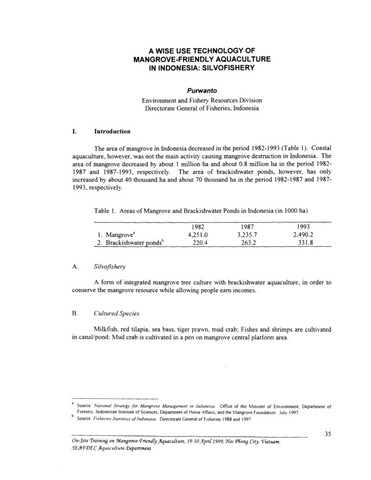
A wise use technology of mangrove-friendly aquaculture in Indonesia: Silvofishery
(Aquaculture Department, Southeast Asian Fisheries Development Center, 2000) -
Report of the planning workshop for the special five-year program on sustainable fisheries for food security in the ASEAN region (aquaculture) 2006-2010: Bangkok, Thailand, 30 November-2 December 2005
(Aquaculture Department, Southeast Asian Fisheries Development Center, 2006-01) -
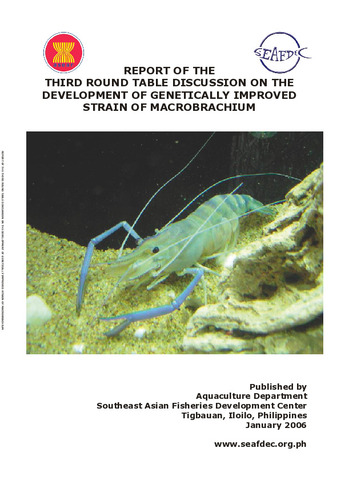
Report of the third round table discussion on the development of genetically improved strain of Macrobrachium, Bangkok, Thailand 3-4 December 2005
(Aquaculture Department, Southeast Asian Fisheries Development Center, 2006-01)In order to continue assessing the progress and status of the activities in the participating countries, the Third Roundtable Discussion was held in Bangkok, Thailand from 3 to 4 December 2005 in order to: 1) assess the ... -
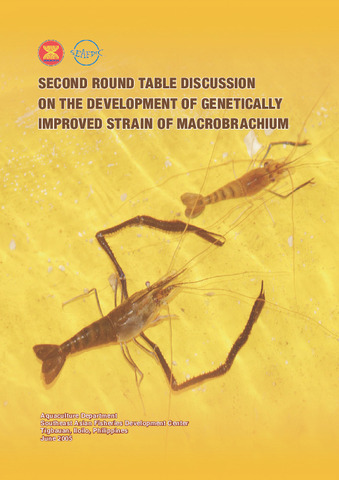
Second round table discussion on the development of genetically improved strain of Macrobrachium: A collaborative research under the Aquaculture Component of the ASEAN-SEAFDEC Special Five-Year Program on Sustainable Fisheries for Food Security in the ASEAN Region
(Aquaculture Department, Southeast Asian Fisheries Development Center, 2005-06)The Second Round Table Discussion on the Development of Genetically Improved Strain of Macrobrachium was held in the Philippines in September 2004 to evaluate the progress of activities of the collaborative research and ... -
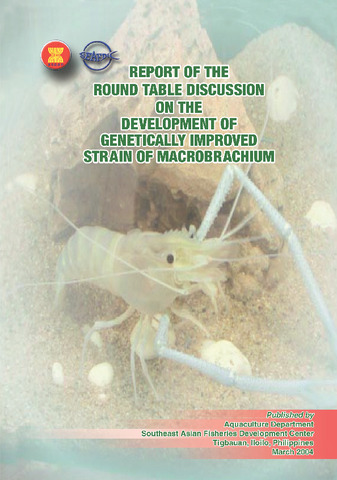
Report of the Round Table Discussion on the Development of Genetically Improved Strain of Macrobrachium: Freshwater Aquaculture Development Center, Sukabumi, West Java, Indonesia, 16-19 November 2003
(Aquaculture Department, Southeast Asian Fisheries Development Center, 2004-03)This publication documents the outcome of the Round Table Discussion including the proposals submitted by the participating countries for implementation under the Collaborative Research. "Part of the Collaborative Research ... -
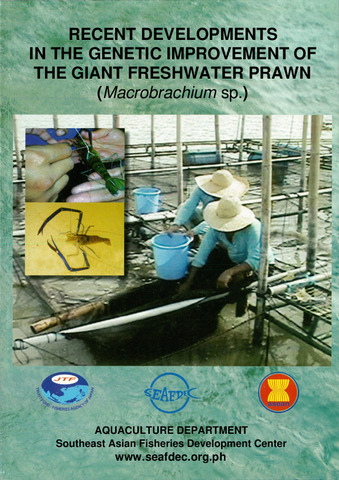
Recent developments in the genetic improvement of the giant freshwater prawn (Macrobrachium sp.)
(Aquaculture Department, Southeast Asian Fisheries Development Center, 2007)This publication contains results from the research project “Development of Genetically Improved Strain of Macrobrachium” covered by the Program on the Promotion of Sustainable Aquaculture in the ASEAN Region (previously known as Integrated Rural Aquaculture Program). It specifically includes activities from the inception of the project in 2002 up to 2005 under the Special Five-year Program on Sustainable Fisheries for Food Security in the ASEAN Region as well as research updates from 2006 to date. Project activities from 2006 to 2010 have been placed under the ASEAN-SEAFDEC Fisheries Consultative Group (FCG) collaborative mechanism with financial support from the Government of Japan Trust Fund. Dr. Koichi Okuzawa, AQD's Deputy Chief from 2005-2007, was project leader at the time the studies started until early 2007. -
Genetic characterization, domestication and improvement of Macrobrachium rosenbergii in the Philippines
Romana-Eguia, Maria Rowena R. ; ; ; ; (Aquaculture Department, Southeast Asian Fisheries Development Center, 2007)
Extensive studies in the Philippines and in adjacent countries revealed that 528 caridean prawn species are found in this region alone (Chan, 1998). Of all the known species, the giant freshwater prawn is considered the most commercially important. Except for the Philippines, culture of the giant freshwater prawn, Macrobrachium rosenbergii, has already made substantial contributions to the local aquaculture production in Southeast Asia, i.e. in Thailand, Malaysia and Indonesia. However, efforts are now being made to improve the aquaculture production of Macrobrachium rosenbergii in the Philippines, thus, optimal methods for the culture and propagation of this high value freshwater aquaculture species are being developed by the Philippine Government fishery agencies as well as other research and academic institutions. The Integrated Rural Aquaculture Program under the ASEAN-SEAFDEC Special Five-Year Program or what is presently known as the Program on the Promotion of Sustainable Aquaculture in the ASEAN Region enabled the Bureau of Fisheries and Aquatic Resources, the Mindanao State University and the Aquaculture Department of SEAFDEC to jointly conduct studies on the genetic characterization, domestication and improvement of Macrobrachium rosenbergii stocks in the Philippines in order to improve the aquaculture production of the giant freshwater prawn. Under the collaborative project which started in late 2004, specific research activities under were conducted, and an update on their results are summarized.
; ; ; ; (Aquaculture Department, Southeast Asian Fisheries Development Center, 2007)
Extensive studies in the Philippines and in adjacent countries revealed that 528 caridean prawn species are found in this region alone (Chan, 1998). Of all the known species, the giant freshwater prawn is considered the most commercially important. Except for the Philippines, culture of the giant freshwater prawn, Macrobrachium rosenbergii, has already made substantial contributions to the local aquaculture production in Southeast Asia, i.e. in Thailand, Malaysia and Indonesia. However, efforts are now being made to improve the aquaculture production of Macrobrachium rosenbergii in the Philippines, thus, optimal methods for the culture and propagation of this high value freshwater aquaculture species are being developed by the Philippine Government fishery agencies as well as other research and academic institutions. The Integrated Rural Aquaculture Program under the ASEAN-SEAFDEC Special Five-Year Program or what is presently known as the Program on the Promotion of Sustainable Aquaculture in the ASEAN Region enabled the Bureau of Fisheries and Aquatic Resources, the Mindanao State University and the Aquaculture Department of SEAFDEC to jointly conduct studies on the genetic characterization, domestication and improvement of Macrobrachium rosenbergii stocks in the Philippines in order to improve the aquaculture production of the giant freshwater prawn. Under the collaborative project which started in late 2004, specific research activities under were conducted, and an update on their results are summarized. -
Hatchery and pond culture of Macrobrachium rosenbergii in northern Mindanao
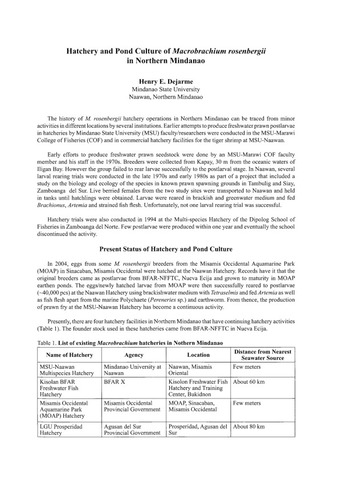
(Aquaculture Department, Southeast Asian Fisheries Development Center, 2007)The history of M. rosenbergii hatchery operations in Northern Mindanao can be traced from minor activities in different locations by several institutions. Earlier attempts to produce freshwater prawn postlarvae in hatcheries by Mindanao State University (MSU) faculty/researchers were conducted in the MSU-Marawi College of Fisheries (COF) and in commercial hatchery facilities for the tiger shrimp at MSU-Naawan. Early efforts to produce freshwater prawn seedstock were done by an MSU-Marawi COF faculty member and his staff in the 1970s. Breeders were collected from Kapay, 30 m from the oceanic waters of Iligan Bay. However the group failed to rear larvae successfully to the postlarval stage. In Naawan, several larval rearing trials were conducted in the late 1970s and early 1980s as part of a project that included a study on the biology and ecology of the species in known prawn spawning grounds in Tambulig and Siay, Zamboanga del Sur. Live berried females from the two study sites were transported to Naawan and held in tanks until hatchlings were obtained. Larvae were reared in brackish and greenwater medium and fed Brachionus, Artemia and strained fish flesh. Unfortunately, not one larval rearing trial was successful. Hatchery trials were also conducted in 1994 at the Multi-species Hatchery of the Dipolog School of Fisheries in Zamboanga del Norte. Few postlarvae were produced within one year and eventually the school discontinued the activity. -
Freshwater prawn research at SEAFDEC/AQD
Romana-Eguia, Maria Rowena R.; ; (Aquaculture Department, Southeast Asian Fisheries Development Center, 2007)
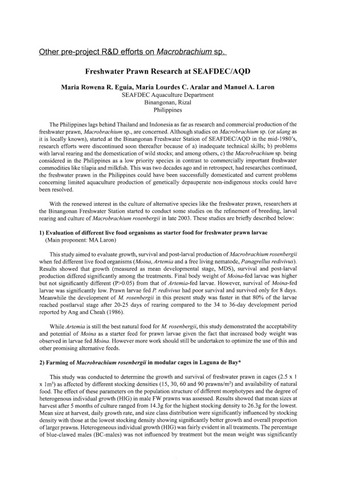
The Philippines lags behind Thailand and Indonesia as far as research and commercial production of the freshwater prawn, Macrobrachium sp., are concerned. Although studies on Macrobrachium sp. (or ulang as it is locally known), started at the Binangonan Freshwater Station of SEAFDEC/AQD in the mid-1980’s, research efforts were discontinued soon thereafter because of a) inadequate technical skills; b) problems with larval rearing and the domestication of wild stocks; and among others, c) the Macrobrachium sp. being considered in the Philippines as a low priority species in contrast to commercially important freshwater commodities like tilapia and milkfish. This was two decades ago and in retrospect, had researches continued, the freshwater prawn in the Philippines could have been successfully domesticated and current problems concerning limited aquaculture production of genetically depauperate non-indigenous stocks could have been resolved. With the renewed interest in the culture of alternative species like the freshwater prawn, researchers at the Binangonan Freshwater Station started to conduct some studies on the refinement of breeding, larval rearing and culture of Macrobrachium rosenbergii in late 2003. These studies are briefly described here.


 RSS 1.0