Conference Proceedings: Recent submissions
741-760 / 767
-
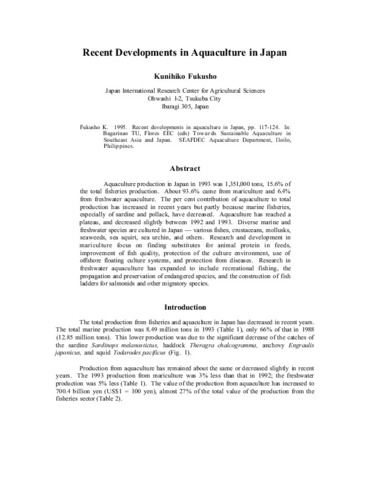
Recent developments in aquaculture in Japan
(Aquaculture Department, Southeast Asian Fisheries Development Center, 1995)Aquaculture production in Japan in 1993 was 1,351,000 tons, 15.6% of the total fisheries production. About 93.6% came from mariculture and 6.4% from freshwater aquaculture. The per cent contribution of aquaculture to total production has increased in recent years but partly because marine fisheries,especially of sardine and pollack, have decreased. Aquaculture has reached a plateau, and decreased slightly between 1992 and 1993. Diverse marine and freshwater species are cultured in Japan — various fishes, crustaceans, mollusks, seaweeds, sea squirt, sea urchin, and others. Research and development in mariculture focus on finding substitutes for animal protein in feeds, improvement of fish quality, protection of the culture environment, use of offshore floating culture systems, and protection from diseases. Research in freshwater aquaculture has expanded to include recreational fishing, the propagation and preservation of endangered species, and the construction of fish ladders for salmonids and other migratory species. -
Coastal aquaculture in Thailand
(Aquaculture Department, Southeast Asian Fisheries Development Center, 1995)Coastal aquaculture in Thailand has expanded rapidly in both area and production in the last decade. The important cultured species are the shrimps (Penaeus monodon and P. merguiensis), sea bass Lates calcarifer, groupers Epinephelus malabaricus and E. tauvina, green mussel Perna viridis, horse mussel Modiolus senhausenii, blood cockles Anadara granosa and A. nodifera and the oysters Crassostrea belcheri, C. lugubris and Saccostrea commercialis. The total production from coastal aquaculture in 1991 was 230,444 tons, consisting of 70.3% shrimp, 28.8% mollusks, and 0.9% fishes. The seaweeds Gracilaria spp., pearl oysters, scallops, and abalones are cultured on a pilot scale in some places. Hatchery technologies have recently been developed for groupers, oysters, scallops, and abalones. Expanded aquaculture has had some adverse effects on the environment and has also suffered from the environmental changes and conflicts due to other sectors using the same water and other resources. -
Aquaculture in the Philippines
(Aquaculture Department, Southeast Asian Fisheries Development Center, 1995)Aquaculture is regarded as the most promising source of protein food in the years ahead. Milkfish and Nile tilapia are the major fishes now produced but groupers, sea bass, rabbitfish, red snappers, carps, and catfishes are grown by some farmers. The tiger shrimp is still the most important cultured crustacean, but white shrimps and mudcrabs also have great potential. Oysters and mussels are produced in considerable amounts. Mariculture of the seaweed Eucheuma is now a well established industry, and the pond culture of Gracilaria for agar extraction is beginning to take off. -
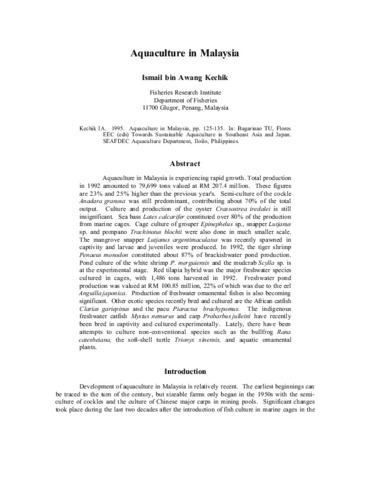
Aquaculture in Malaysia
(Aquaculture Department, Southeast Asian Fisheries Development Center, 1995)Aquaculture in Malaysia is experiencing rapid growth. Total production in 1992 amounted to 79,699 tons valued at RM 207.4 million. These figures are 23% and 25% higher than the previous year's. Semi-culture of the cockle Anadara granosa was still predominant, contributing about 70% of the total output. Culture and production of the oyster Crassostrea iredalei is still insignificant. Sea bass Lates calcarifer constituted over 80% of the production from marine cages. Cage culture of grouper Epinephelus sp., snapper Lutjanus sp. and pompano Trachinotus blochii were also done in much smaller scale. The mangrove snapper Lutjanus argentimaculatus was recently spawned in captivity and larvae and juveniles were produced. In 1992, the tiger shrimp Penaeus monodon constituted about 87% of brackishwater pond production. Pond culture of the white shrimp P. merguiensis and the mudcrab Scylla sp. is at the experimental stage. Red tilapia hybrid was the major freshwater species cultured in cages, with 1,486 tons harvested in 1992. Freshwater pond production was valued at RM 100.85 million, 22% of which was due to the eel Anguilla japonica. Production of freshwater ornamental fishes is also becoming significant. Other exotic species recently bred and cultured are the African catfish Clarias gariepinus and the pacu Piaractus brachypomus. The indigenous freshwater catfish Mystus nemurus and carp Probarbus julleini have recently been bred in captivity and cultured experimentally. Lately, there have been attempts to culture non-conventional species such as the bullfrog Rana catesbeiana, the soft-shell turtle Trionyx sinensis, and aquatic ornamental plants. -
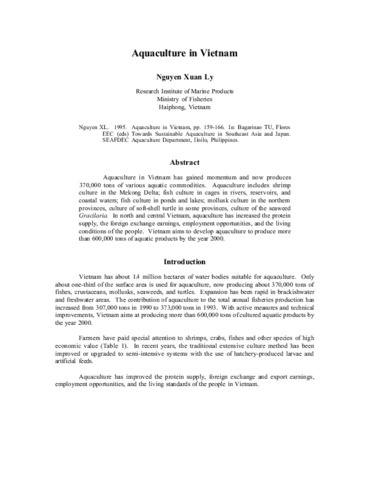
Aquaculture in Vietnam
(Aquaculture Department, Southeast Asian Fisheries Development Center, 1995)Aquaculture in Vietnam has gained momentum and now produces 370,000 tons of various aquatic commodities. Aquaculture includes shrimp culture in the Mekong Delta; fish culture in cages in rivers, reservoirs, and coastal waters; fish culture in ponds and lakes; mollusk culture in the northern provinces, culture of soft-shell turtle in some provinces, culture of the seaweed Gracilaria. In north and central Vietnam, aquaculture has increased the protein supply, the foreign exchange earnings, employment opportunities, and the living conditions of the people. Vietnam aims to develop aquaculture to produce more than 600,000 tons of aquatic products by the year 2000. -
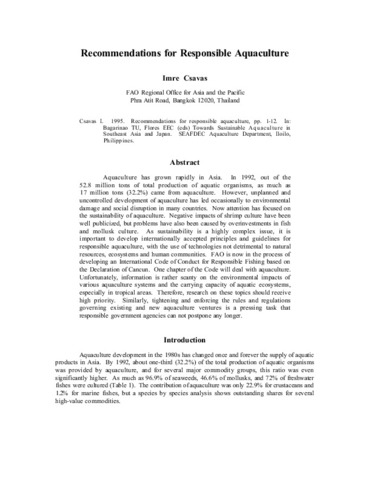
Recommendations for responsible aquaculture
(Aquaculture Department, Southeast Asian Fisheries Development Center, 1995)Aquaculture has grown rapidly in Asia. In 1992, out of the 52.8 million tons of total production of aquatic organisms, as much as 17 million tons (32.2%) came from aquaculture. However, unplanned and uncontrolled development of aquaculture has led occasionally to environmental damage and social disruption in many countries. Now attention has focused on the sustainability of aquaculture. Negative impacts of shrimp culture have been well publicized, but problems have also been caused by overinvestments in fish and mollusk culture. As sustainability is a highly complex issue, it is important to develop internationally accepted principles and guidelines for responsible aquaculture, with the use of technologies not detrimental to natural resources, ecosystems and human communities. FAO is now in the process of developing an International Code of Conduct for Responsible Fishing based on the Declaration of Cancun. One chapter of the Code will deal with aquaculture. Unfortunately, information is rather scanty on the environmental impacts of various aquaculture systems and the carrying capacity of aquatic ecosystems, especially in tropical areas. Therefore, research on these topics should receive high priority. Similarly, tightening and enforcing the rules and regulationsgoverning existing and new aquaculture ventures is a pressing task that responsible government agencies can not postpone any longer. -
Seafarming and searanching in Singapore
(Aquaculture Department, Southeast Asian Fisheries Development Center, 1994)Seafarming in Singapore is described in detail, covering farm design and structure, site selection criteria, current farm practices, farm operation and maintenance, species for culture, and diseases and their control.Searanching has not been done in Singapore. Results of related work on fish stocking is briefly reported. -
Seafarming and searanching in Thailand
(Aquaculture Department, Southeast Asian Fisheries Development Center, 1994)Seafarming is undertaken in the coastal sublittoral zone. Different marine organisms such as molluscs, estuarine fishes, shrimps (pen culture), and seaweeds are cultured along the coast of Thailand. Seafarming, especially for mollusc, is the main activity in Thailand. The important species are blood cockle, oyster, green mussel, and pearl oyster. In 1988, production was approximately 51,000 metric tons in a culture area of 2,252 hectares.Artificial reefs have been constructed in Thailand since 1987 to enhance coastal habitats. Larvae of marine organisms have also been restocked in the artificial reef area. -
Aquaculture developments in the Philippines with emphasis on tilapias and seaweeds
(Aquaculture Department, Southeast Asian Fisheries Development Center, 1994)Significant developments in the culture of tilapias and seaweeds in the Philippines for 1988-1991 are reviewed. The country was the top producer of the Nile tilapia (Oreochromis niloticus) and red seaweed, Eucheuma sp., in the world during the period. Intensification of cage and pond culture of tilapia in freshwater with artificial feeding was prevalent. The National Tilapia Production Program was launched in 1990 and is being implemented in 26 sites of 12 regions in the country. Culture of sex-inversed tilapias (O. niloticus and O. niloticus x O. mossambicus hybrids) in freshwater cages, brackishwater ponds, and sea cages was pilot-tested for the first time. For seaweeds, studies were made on the culture of other economically-important species such as Gracilaria sp. and Porphyra sp. A trial on the integrated searanching of abalones (Haliotis sp.) and giant clams (Tridacna sp.) with Euchema was also conducted. -
Seafarming and searanching development in the Philippines
(Aquaculture Department, Southeast Asian Fisheries Development Center, 1994)The paper reviews developments in Seafarming and searanching in the Philippines. Seafarming activities concentrated on seaweeds and molluscs, technology for which are already widely practiced. In Seafarming of oysters and mussels, technology is mature but only applied in traditional sites. As such, the quality of products and consumption is low due to known pollution of oyster and mussel farming areas. Seafarming of giant clams is just beginning. Hatchery techniques of producing juveniles are being refined for mass production and seeding of reef areas to enhance giant clam population. Seafarming of marine fishes is also practiced but constrained by the lack of seed stock. Sea cage fanning operators mainly depend on wild-caught fry and juveniles although the hatchery technology for sea bass has been developed. There is more research work to be done to mass-produce fry and juveniles for Seafarming of other fish species. Seafarming and searanching appear to be the future major means of supplementing the production of animal protein by year 2000 as arable land continues to dwindle. Declining arable land area would not be sufficient to produce the food needs of the increasing population. There is great potential for Seafarming and searanching to enhance coastal resources and produce more food. However, there is a need to provide stronger legal and institutional support for these activities to sustain development efforts. -
Coastal aquaculture in Thailand
(Aquaculture Department, Southeast Asian Fisheries Development Center, 1994)The coastal area has been explored for aquaculture and coastal aquaculture has expanded quite rapidly in Thailand. The economically important culture species are shrimp (Penaeus monodon), sea bass (Lates calcarifer), and two species of grouper (Epinephelus malabaricus and L. salmoides). The area for marine shrimp culture in 1989 was around 78,209 hectares with a production of 100,000 tons. Approximately 40% of these ponds, by area, is under intensive shrimp cultivation. The average survival rate was reported to be 40-80% with a production of 6 tons per hectare. Sea bass and grouper are mainly cultured in cages. Two cage sizes are used: 10 x 10 x 2 and 5 x 5 x 2 meters. In 1988, the production was about 1,034 and 357 tons for sea bass and grouper, respectively. -
Overview of seafarming and searanching technology in Japan
(Aquaculture Department, Southeast Asian Fisheries Development Center, 1994)In 1989, artificial seed production was attained in 37 species of fishes, 16 species of Crustacea, 25 species of shellfishes, and 9 species of other fishery animals in Japan. Eighty species of fishery animal seed, including natural and artificial production, were released in natural fishery grounds during this year. The total mariculture production was 1.3 million tons. This composed of 18% fish, 35% shellfish, 46% seaweed, and 1% of other fishery animals.In recent years, Japan achieved some success in Seafarming and searanching projects. Among these are searanching of Japanese scallop in northern Japan and acoustic habituation system of red sea bream. Searanching of striped jack using artificial seed is also explained. -
Aquaculture development in Singapore
(Aquaculture Department, Southeast Asian Fisheries Development Center, 1994)Aquaculture production in Singapore is mainly from Seafarming and is about 2% of total fish consumed. At present, there are 79 licensed floating fish farms located in the East and West Johor Straits that culture popular species like sea bass (Lates calcarifer) and estuarine grouper (Epinephelus tauvina). Aquaculture development is geared towards the establishment of highly intensive fish farms such as land-based systems in agrotechnology parks, smaller brackishwater pond systems, and large-scale floating systems in designated sea areas. Research and development on improvement of farming techniques are on-going.Freshwater aquaculture is focused on ornamental fish production. This is a high value trade with yearly growth of 11 % in 1986-1990. Development of intensive farming systems, improvements in water quality management, disease control, and quarantine are considered important. Research concentrates on breeding and genetics. -
Ecological impacts of seafarming and searanching
(Aquaculture Department, Southeast Asian Fisheries Development Center, 1994)Seafarming has ecological effects such as pollution and eutrophication of adjacent areas by excess food or by feces or modification of habitats by physical structures. More subtle effects on the communities result from heavy consumption of plankton or benthos by caged or enclosed farmed organisms and consequent reduction of availability of food to adjacent natural communities. Seapens, in which monocultures are reared, develop a radically different benthos from that in adjacent areas. Seafarms can become focal points from which pathogens and parasites can be spread.Searanching, in which stocks are enhanced by the addition of hatchery-reared recruits, has the potential to cause significant changes in the composition and stability of marine communities. Enhanced recruitment of a species will have negative effects on both its prey and its competitors but will enhance the biomass of its predators.Enhanced recruitment of a stock of apex predators will decrease the biomass of its prey and cause changes in the composition of the community. The effects of searanching are amenable to modelling, and the likely effects of proposed searanching schemes should be examined before these are implemented.The magnitude of the effects of searanching will depend on the degree to which the area is naturally saturated with recruits of that species and on the rate of exploitation. Poor management of the stock, resulting in under- or over-exploitation, will have highly destabilizing effects on the communities.Seafarming or searanching can have negative effects on the gene pools of natural stocks and result in changes in life histories or in behavior. -
Prospects of seafarming through the Fisheries Sector Program (Philippines)
(Aquaculture Department, Southeast Asian Fisheries Development Center, 1994)The status and problems confronting the fisheries sector are discussed. An exploratory discussion of the five-year Fisheries Sector Program addressed on aquatic resources regeneration, conservation, and sustained management of coastal fisheries, production intensification in aquaculture within limits of ecological balance, and commercial fishing away from over-fished areas into the deeper water is made. Seafarming as one of the alternative livelihood for a large number of coastal subsistence fishermen is emphasized particularly in the 12 priority bays under the program to uplift their economic condition. Rapid resources assessment in the 3 priority bays during the first year of the program implementation pinpointed existing aquaculture practices, potential sites for Seafarming and recommended species for culture. The credit, extension services, and training components of the program are envisioned to enhance Seafarming development in the country. -
Economic and social considerations in seafarming and searanching
(Aquaculture Department, Southeast Asian Fisheries Development Center, 1994)Sustainable development of seafarming and searanching calls for careful planning. Investments in seafarming must take into account environmental, biotechnological, and socioeconomic considerations. Investment planning must be carefully examined as well as the physical design of production systems such that its negative impact is minimized and the positive impact is accentuated.Supply from the wild may not be expected to grow much higher than present levels. Many of the major commercially valuable fisheries are now overfished at or close to their respective minimum sustainable yield levels. Seafarming can attract some of the fishermen out of overcrowded fisheries.Production cost of seafarming produce is a major concern which has to be examined closely if these are to compete with and gradually supplant the supply of fish from the wild. Feed is one of the main inhibiting factors, hence, efficient consideration calls for constantly improving feed conversion and productivity per unit input.Existing government policies are not clear nor conducive to seafarming in terms of use rights of coastal waters. To attract potential investors into seafarming, governments are encouraged to review existing policies governing use rights to coastal waters, package the necessary technology consistent with the country's wage and price structure, and develop investment profile for seafarming opportunities using conservative criteria. -
Biotechnological researches at the Prefectural Fisheries Experimental Station in Japan
(Aquaculture Department, Southeast Asian Fisheries Development Center, 1994)Biotechnological studies have been conducted in 46 Prefectural Experimental Stations in Japan in 1991. In 41 of these, research focused on chromosome set manipulation including triploidy for sterilization and gynogenesis for sex control. Practical application of biotechnology for culture of each species is the main interest because each prefecture has its own project for promoting the local fisheries industry. Therefore, the commodities being studied are of commercial importance comprising of about 40 species.The culture production of Japan in 1988 totaled 1,426,000 tons, 95% of which consisted of 10 species. Biotechnology is not widely used since most seeds are not from hatcheries, but from the wild. Recently, however, promising results on the study of sex determination mechanism in the Japanese flounder have been adopted for actual seed production. This has attracted attention as an approach to mass production of all-female seedlings. -
Overview of aquaculture development in Southeast Asia
(Aquaculture Department, Southeast Asian Fisheries Development Center, 1994)The nine countries in Southeast Asia occupy a land area of 1.85% with a population of 7.4% in the world. In 1991, these countries had a total fisheries production of 10.2 million tons or 10.5% of the world total of 96.9 million tons. In aquaculture in 1990, world total production attained 15.3 million tons (15.7% of total world fisheries production) while the Southeast Asian countries produced 1.7 million tons (11 % of total world aquaculture production). The total fisheries production in Southeast Asia which is mainly capture fisheries has continued to increase gradually by about 3.3% from 1986 to 1990 while aquaculture production has been increasing at the rate of over 8.4% during this period.The major areas for aquaculture in Southeast Asia include inland freshwaters, brackishwaters, and marine waters. Various systems exist in the region including ponds, pens and cages, delimited or fenced open water areas, and culture integrated with other production activities. Highest potential is in Seafarming while ranching is a recent innovation. The species being cultured in the region consist of about 50 fishes, 10 crustaceans, 10 molluscs, 5 seaweeds, and 5 miscellaneous aquatic vertebrates.Aquaculture will increasingly supply food and industrial products considering the worldwide levelling off of capture fisheries production. Southeast Asia has the potential to contribute substantially to this need. Support for the industry inspite of this need is inadequate to meet its technical, economic, and management problems. A sound technological base through research and training and extension needs to be pursued vigorously. -
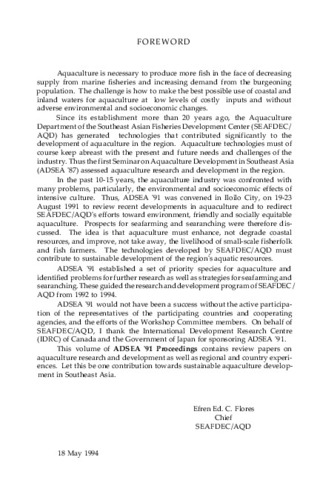
ADSEA '91-Foreword
(Aquaculture Department, Southeast Asian Fisheries Development Center, 1994) -
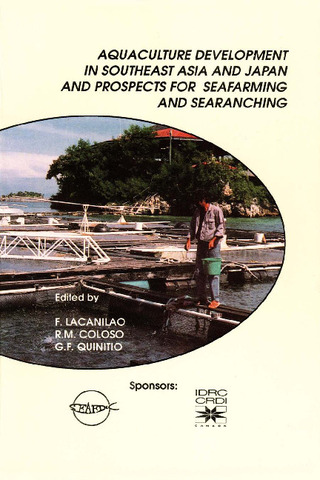
ADSEA '91-Preliminary pages
(Aquaculture Department, Southeast Asian Fisheries Development Center, 1994)Cover page, title page and table of contents