Journal Articles, Conference Papers and Book Chapters by SEAFDEC Staff: Recent submissions
Now showing items 241-260 of 1693
-
Field efficacy evaluation of a formalin-inactivated white spot syndrome virus (WSSV) vaccine for the preventive management of WSSV infection in shrimp grow-out ponds
Amar, Edgar ; Faisan, Joseph P., Jr. ; (Elsevier, 2021)
A shrimp grow-out trial was conducted in four 700 m2 earthen ponds in Dumangas Brackishwater Station of SEAFDEC Aquaculture Department, in Iloilo, Philippines to evaluate the efficacy of a combination of immersion- and orally-administered formalin inactivated vaccine (FIV) as an antiviral strategy against WSSV. Purified virus prepared by sucrose gradient ultracentrifugation was inactivated by overnight incubation in 0.5% buffered formalin. PCR-screened Penaeus monodon postlarvae (PL14) obtained from a commercial hatchery were divided into two groups: 1) immersed in FIV solution for 2 h before stocking in ponds (VAC); and 2) unexposed control (CON). Both groups were stocked at a density of 15 m−2 and grown for 115 d following recommended good practices. Pond water was aerated using two 20-HP electric blowers. Shrimp were given commercial feed following the manufacturer's protocol. They were booster-vaccinated by administering FIV-coated feed every 15 d until the termination of the trial. Shrimp samples were regularly collected to obtain estimates of growth, survival, and feed conversion ratio. In addition, shrimp and extraneous crustacean species were analyzed for the presence of WSSV and IHHNV by PCR. Water quality and bacterial load were monitored regularly. After 115 d of culture (DOC), shrimps grew to 12.93 ± 1.26 g in VAC and 8.54 ± 0.78 g in CON. Likewise, survival and yield was higher in VAC (71.2 ± 3.13% and 1311 ± 70.4 kg ha−1, respectively) compared to CON (52.7 ± 5.05% and 640 ± 3.0 kg ha−1, respectively). PCR analysis showed both shrimp and extraneous crustaceans to be lightly infected with WSSV and IHHNV. A few dead shrimp were noted during routine pond inspection as shrimp biomass increased towards the end of the trial. However, no mass mortalities occurred and shrimp were successfully harvested on 115 DOC. VAC and CON shrimp were also collected on day 70, 90, and 105 and experimentally infected with WSSV in tanks. Significant differences in survival rates (p < 0.05) between the groups were obtained 15 d post-challenge. Further studies in tanks and in ponds on prophylactic oral delivery of antiviral treatments with the use of protein vaccines and vectors/carriers are recommended.
; Faisan, Joseph P., Jr. ; (Elsevier, 2021)
A shrimp grow-out trial was conducted in four 700 m2 earthen ponds in Dumangas Brackishwater Station of SEAFDEC Aquaculture Department, in Iloilo, Philippines to evaluate the efficacy of a combination of immersion- and orally-administered formalin inactivated vaccine (FIV) as an antiviral strategy against WSSV. Purified virus prepared by sucrose gradient ultracentrifugation was inactivated by overnight incubation in 0.5% buffered formalin. PCR-screened Penaeus monodon postlarvae (PL14) obtained from a commercial hatchery were divided into two groups: 1) immersed in FIV solution for 2 h before stocking in ponds (VAC); and 2) unexposed control (CON). Both groups were stocked at a density of 15 m−2 and grown for 115 d following recommended good practices. Pond water was aerated using two 20-HP electric blowers. Shrimp were given commercial feed following the manufacturer's protocol. They were booster-vaccinated by administering FIV-coated feed every 15 d until the termination of the trial. Shrimp samples were regularly collected to obtain estimates of growth, survival, and feed conversion ratio. In addition, shrimp and extraneous crustacean species were analyzed for the presence of WSSV and IHHNV by PCR. Water quality and bacterial load were monitored regularly. After 115 d of culture (DOC), shrimps grew to 12.93 ± 1.26 g in VAC and 8.54 ± 0.78 g in CON. Likewise, survival and yield was higher in VAC (71.2 ± 3.13% and 1311 ± 70.4 kg ha−1, respectively) compared to CON (52.7 ± 5.05% and 640 ± 3.0 kg ha−1, respectively). PCR analysis showed both shrimp and extraneous crustaceans to be lightly infected with WSSV and IHHNV. A few dead shrimp were noted during routine pond inspection as shrimp biomass increased towards the end of the trial. However, no mass mortalities occurred and shrimp were successfully harvested on 115 DOC. VAC and CON shrimp were also collected on day 70, 90, and 105 and experimentally infected with WSSV in tanks. Significant differences in survival rates (p < 0.05) between the groups were obtained 15 d post-challenge. Further studies in tanks and in ponds on prophylactic oral delivery of antiviral treatments with the use of protein vaccines and vectors/carriers are recommended. -
Interaction effect of light intensity and photoperiod on egg hatchability, survival and growth of polychaete Marphysa iloiloensis from larva to juvenile
Mandario, Mary Anne; ; (Elsevier, 2021)
Polychaetes are of high commercial interest as potential feed in aquaculture industry. Despite this, knowledge of polychaete culture is limited. The goal of this study is to develop a protocol that maximizes survival and growth of polychaetes from embryonic to juvenile stages. To determine the effect of light intensity and photoperiod on Marphysa iloiloensis, two experiments were conducted; 1 - hatchability (embryo-larva; 24 h duration) and 2 - survival and growth (larva-juvenile; 29 d duration). Both experiments followed a 3 × 3 factorial design using three light intensities (3.4, 64.4, and 157 μmol m−2 s−1) and three photoperiods (1 L: 23D, 3 L: 21D, and 6 L: 18D) with four replicates each. The best light regime was compared to the control (0 μmol m−2 s−1). Hatching success was significantly lower in treatments exposed to 157 μmol m−2 s−1 regardless of photoperiod (P < 0.05). Survival at juvenile stage was significantly dependent on the interaction between light intensity and photoperiod (P < 0.01). Survival was higher in both 0 μmol m−2 s−1 and 3.4 μmol m−2 s−1 (all photoperiods). Survival decreased significantly in 64.4 μmol m−2 s−1 and 157 μmol m−2 s−1 under both 3 L: 21D and 6 L: 18D photoperiods. Prolonged exposure to higher light intensity compromised the survival of the polychaete from larval to juvenile stage while growth was not affected. These findings suggest that either continuous darkness or a light intensity of 3.4 μmol m−2 s−1 is the best culture condition from embryonic to juvenile stage of mud polychaete M. iloiloensis to optimize production. -
フィリピン・バタン湾におけるウシエビ放流の試み
; ; Primavera, Yasmin; (International Center for Research and Education in Agriculture, 2019-06-06)
Processes and results of stock enhancement of tiger shrimp performed in Batan Bay in Philippines was reported as a trans-disciplinary research for enhancement of area-capability (AC). Causes of decline in catch amount of tiger shrimp were overfishing and degradation of its nursery grounds such as mangrove forest. Five fishers had participated in the intermediate culture throughout the project period. Technical issues for stock enhancement were solved and expectable recapture rate of released shrimp was more than 20%. Economic feasibility of the stock enhancement was also confirmed. Forty-five percent of the people in the area are realizing the increase of catch amount of tiger shrimp. Effectiveness of stock enhancement is obtaining understanding from common people including public administrations. After the project, the stock enhancement was paused and stakeholders want to proceed with the stock enhancement. Aklan State University is planning to support stock enhancement project as its extension activities and expect participations of researchers from foreign countries. Such activities will provide research opportunities for evaluation and theorization of AC. -
Aeromonas load and species composition in tilapia (Oreochromis niloticus) cultured in earthen ponds in the Philippines
Pakingking, Rolando V., Jr.; Palma, Peter ; (Wiley, 2020-04-14)
Aeromonas load and species composition in the rearing water, sediment, gills and intestines of healthy tilapia Oreochromis niloticus collected every 2 weeks from Days 30 to 120 after stocking in six earthen ponds in the Philippines were determined. Presumptive Aeromonas counts (PACs) in the water and sediment ranged from 101–103 c.f.u./ml and 101–103 c.f.u./g while in the gills and intestines, PACs ranged from 104–107 c.f.u./g and 102–105 c.f.u./g, respectively. Presumptive Aeromonas counts in the water, sediment, and gills of tilapia varied among days of culture while in the intestines of tilapia, PACs markedly dropped by approximately 2 logs at Day 75 and either remained in the same level or decreased by another 1 log at Day 120 of grow‐out culture. Aeromonas hydrophila predominantly constituted 94% of all presumptive Aeromonas spp. examined (n = 343), followed by A. sobria (4%) and A. salmonicida (2%). Taken together, current data provide some putative threshold levels of tilapia reared in earthen ponds to Aeromonas spp. The dominance of A. hydrophila together with negligible population of A. salmonicida and A. sobria indicate that Aeromonas are common commensal bacteria in tilapia and their environment which under conditions of stress could instigate disease epizootics. -
Determination of poly‐β‐hydroxybutyrate assimilation by postlarval whiteleg shrimp, Litopenaeus vannamei using stable 13C isotope tracing
Ludevese-Pascual, Gladys; ; ; Amar, Edgar ; Laranja, Joseph Leopoldo ; ; ; ; (Wiley, 2021-02)
A preliminary study was conducted to demonstrate fate of the bacterial storage compound poly-β-hydroxybutyrate (PHB) once ingested and degraded in vivo in crustaceans. The 2% supplementation of 13C-labeled Ralstonia eutropha DSM545 containing 75% PHB on dry weight in postlarval whiteleg shrimp, Litopenaeus vannamei resulted in consistent enrichment of two fatty acids (containing 14–24 carbons [C] in length) pentadecanoic acid (15:0) and palmitic acid (16:0) in all lipid fractions. This could indicate that 13C signal may not only originate from the PHB but partly from the structural components of the bacterial cell. There was a trend of lower 13C enrichment in various lipid fractions of the postlarvae as compared to the diet. These findings may have important implications as to potential of PHB as energy source rather than as building block. There was a rapid transfer of 13C in the postlarvae as seen by the significant 13C enrichment in the tissues 4 hr after feeding with labeled bacterial cells. Overall, the assimilation of PHB in crustacean tissues is demonstrated for the first time. Our results indicate that PHB once ingested is rapidly assimilated in the tissues and could probably act as an energy source rather than as a building block. -
Development of specific enzyme-linked immunosorbent assay for yellowtail kingfish (Seriola lalandi) follicle stimulating hormone using recombinant gonadotropins
; Palma, Peter; ; ; ; (Elsevier, 2019)
We developed a specific competitive enzyme-linked immunosorbent assay (ELISA) for yellowtail kingfish (Seriola lalandi) follicle stimulating hormone (FSH). We previously produced a full-length single chain recombinant yellowtail kingfish FSH using the Pichia pastoris expression system. We used the same method to produce the β subunit of the hormone, against which polyclonal antibodies were raised in rabbits. We first confirmed immunoreactivity of the polyclonal antibodies with the recombinant full length FSH and FSHβ as well as plasma and pituitary FSH of sexually immature and mature yellowtail kingfish by Western blot analysis. We then developed a precise and reproducible ELISA for yellowtail kingfish FSH and validated the assay in plasma and pituitary extracts. The intra- and inter-assay coefficients of variation was <2.2% and 10.2%, respectively. The sensitivity of the assay was 78 pg/ml. For further validation of the assay, we measured the plasma FSH in immature yellowtail kingfish treated with increasing doses (blank, 50, 100 and 150 µg/kg) of kisseptin2-10 peptide from a previous study. The dose response observed in treated females was not significant, however the increased plasma FSH levels coincided with the significantly higher estradiol levels we previously reported in the treated groups. We assessed the applicability of the assay in measuring circulating FSH in other species. We observed parallelism between the linearized FSH standard curve and displacement curves of serially diluted plasma from Atlantic bluefin tuna (Thunnus thynnus) and tilapia (Oreochromis niloticus). We also observed similar parallelism with full length recombinant giant grouper (Epinephelus lanceolatus) FSH. The ELISA we developed for yellowtail kingfish FSH will be useful in understanding the reproductive biology of the species as well as enhancing its aquaculture. -
Aquaculture breeding enhancement: Maturation and spawning in sea cucumbers using a recombinant relaxin-like gonad-stimulating peptide
; ; ; ; ; Palma, Peter; Suwansa-ard, Saowaros ; ; (Frontiers Media, 2019-02-19)
Wild sea cucumber resources have been rapidly exhausted and therefore there is an urgent need to develop approaches that will help restocking. Currently, there is a lack of information regarding the genes involved in sea cucumber reproductive processes. The neurohormone relaxin-like gonad-stimulating peptide (RGP) has been identified as the active gonad-stimulating peptide in sea stars (Asteroidea), which could also be present in other echinoderm groups. In this study, a sea cucumber RGP was identified and confirmed by phylogenetic analysis. A recombinant Holothuria scabra RGP was produced in the yeast Pichia pastoris and confirmed by mass spectrometry. To assess bioactivity, four levels of purification were tested in an in vitro germinal vesicle breakdown (GVBD) bioassay. The most pure form induced 98.56 ± 1.19% GVBD in H. scabra and 89.57 ± 1.19% GVBD in Holothuria leucospilota. Cruder levels of purification still resulted in some GVBD. Upon single injection into female H. scabra, the recombinant RGP induced head waving behavior followed by spawning within 90–170 min. Spawned oocytes were fertilized successfully, larvae settled and developed into juveniles. Our results provide a key finding for the development of a break-through new artificial breeding approach in sea cucumber aquaculture. -
Development of a giant grouper Luteinizing Hormone (LH) Enzyme-Linked Immunosorbent Assay (ELISA) and its use towards understanding sexual development in grouper
; ; Palma, Peter; ; ; (Elsevier, 2020-07-13)
A recombinant giant grouper Luteinizing Hormone (LH) consisting of tethered beta and alpha subunits was produced in a yeast expression system. The giant grouper LH β-subunit was also produced and administered to rabbits for antibody development. The recombinant LH and its antibody were used to develop an Enzyme Linked Immunosorbent Assay (ELISA). This ELISA enabled detection of plasma LH levels in groupers at a sensitivity between 391 pg/ml and 200 ng/ml. Different species of grouper were assayed with this ELISA in conjunction with gonadal histology and body condition data to identify links between circulating LH levels and sexual development. We found that circulating levels of LH decreased when oocytes began to degenerate, and sex-transition gonadal characteristics were apparent when LH levels decreased further. When circulating LH levels were related to body condition (body weight/ body length), transitioning-stage fish had relatively high body condition but low plasma LH levels. This observation was similar across multiple grouper species and indicates that plasma LH levels combined with body condition may be a marker for early male identification in the protogynous hermaphrodite groupers. -
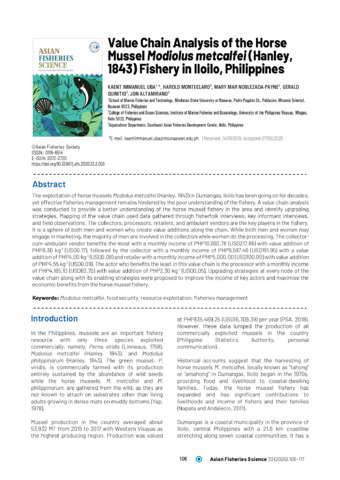
Value chain analysis of the horse mussel Modiolus metcalfei (Hanley, 1843) fishery in Iloilo, Philippines
(Asian Fisheries Society, 2020-06-30)The exploitation of horse mussels Modiolus metcalfei (Hanley, 1843) in Dumangas, Iloilo has been going on for decades, yet effective fisheries management remains hindered by the poor understanding of the fishery. A value chain analysis was conducted to provide a better understanding of the horse mussel fishery in the area and identify upgrading strategies. Mapping of the value chain used data gathered through fisherfolk interviews, key informant interviews, and field observations. The collectors, processors, retailers, and ambulant vendors are the key players in the fishery. It is a sphere of both men and women who create value additions along the chain. While both men and women may engage in marketing, the majority of men are involved in the collection while women do the processing. The collector-cum-ambulant vendor benefits the most with a monthly income of PHP10,892.78 (USD217.86) with value addition of PHP8.30 kg-1 (USD0.17), followed by the collector with a monthly income of PHP9,597.46 (USD191.95) with a value addition of PHP4.00 kg-1 (USD0.08) and retailer with a monthly income of PHP5,000.00 (USD100.00) with value addition of PHP4.55 kg-1 (USD0.09). The actor who benefits the least in this value chain is the processor with a monthly income of PHP4,185.10 (USD83.70) with value addition of PHP2.30 kg-1 (USD0.05). Upgrading strategies at every node of the value chain along with its enabling strategies were proposed to improve the income of key actors and maximise the economic benefits from the horse mussel fishery. -
In-vitro evaluation of some commercial probiotics used in the grow-out culture of the tiger shrimp Penaeus monodon: Effect on bacterial parameters
(Research India Publications, 2007)This study was conducted to evaluate 8 commercial probiotic products being marketed for the grow-out culture of the tiger shrimp Penaeus monodon and the “SEAFDEC Indigenous Probiotic”. Bacterial parameters investigated consisted of: 1) inherent bacterial population, 2) Total Bacterial Count (TBC), 3) effect on Vibrio harveyi, and 4) presumptive Vibrio populations. Results showed that upon activation, the TBCs of Probiotics A, B, C, F, G and H were precisely as claimed in its product brochure at equal or +/- 1 log difference. In contrast, Probiotics D and E yielded TBCs that were 3 and 2 logs lower than stated in their respective product brochures. At 24 h after pond water inoculation, Probiotics A and E caused an almost 2 logs increased TBCs, Probiotic F a one log increase while no apparent differences from the control were observed in the TBCs of the other test probiotics. The “SEAFDEC Indigenous Probiotic”, Probiotics A, G and H induced the inhibition of luminescent Vibrio by 100% for 48 h exposure, 90% in 24 h, 84-63% in 5-6 days and 77-81% in 5-6 days, respectively. However, such inhibitory effect was not sustained on extended periods. In contrast, the other test Probiotics did not inhibit luminescent Vibrio. On the contrary, Probiotics C, E and F even resulted in a 2 and 1 log increase of the V. harveyi population. For the presumptive Vibrio counts, Probiotics B, E and F had 1-2 logs higher numbers of green colonies than controls while Probiotics A and E yielded higher numbers of yellow colonies. This study showed that inoculation of the shrimp pond waters with Probiotics A, C, D, E and F caused at least one log increase in TBCs. The TBCs of the Probiotics in the presence of ammonia, nitrite and phosphate were affected by the presence or absence of aeration. -
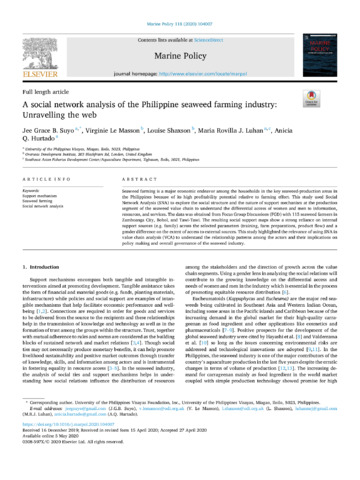
A social network analysis of the Philippine seaweed farming industry: Unravelling the web
(Elsevier, 2020-08)Seaweed farming is a major economic endeavor among the households in the key seaweed-production areas in the Philippines because of its high profitability potential relative to farming effort. This study used Social Network Analysis (SNA) to explore the social structure and the nature of support mechanism at the production segment of the seaweed value chain to understand the differential access of women and men to information, resources, and services. The data was obtained from Focus Group Discussions (FGD) with 115 seaweed farmers in Zamboanga City, Bohol, and Tawi-Tawi. The resulting social support maps show a strong reliance on internal support sources (e.g. family) across the selected parameters (training, farm preparations, product flow) and a gender difference on the extent of access to external sources. This study highlighted the relevance of using SNA in value chain analysis (VCA) to understand the relationship patterns among the actors and their implications on policy making and overall governance of the seaweed industry. -
Nursery culture of sandfish Holothuria scabra in sea-based floating hapa nets: Effects of initial stocking density, size grading and net replacement frequency
(Elsevier, 2020-09)Sea-based culture of early juvenile sandfish Holothuria scabra up to fingerling size (>2 g) using floating hapa nets has been confirmed as a viable nursery system in tropical countries such as the Philippines. However, production can be further optimized through more efficient rearing practices. In this study, we demonstrate the effects of initial stocking density, size grading and net replacement frequency during the culture of early juvenile sandfish in sea-based floating hapa nets (2 × 1 × 1 m). Testing different initial stocking density treatments ranging from 150 to 2000 early juveniles (4–10 mm; 0.02–0.06 g) per hapa net, we confirmed significantly faster growth (0.06–0.08 g d−1) and higher survival (72–97%) in low densities (≤500 hapa−1), compared to high densities (≥700 hapa−1: 0.02–0.04 g d−1; 67–80%). Low density culture can produce 2 g sandfish in about a month, while higher densities will require a 2–3 mo culture period to reach this size. Culture performance following size grading was also compared using three initial size classes (small, 0.05–0.99 g; medium, 1–1.99 g; and large, 2–3 g) and a mixed group (0.05–3.00 g). At 45 d, juveniles in pooled size-graded groups grew significantly faster (0.11–0.13 g d−1) than those in the mixed group (0.01 g d−1). Survival was significantly higher in the medium (85.3%) and large (84.7%) groups, than those in the small (54.4%) and mixed (45.6%) groups. However, size variation was not significantly mitigated by grading during the 45-d culture. Culture performance of sandfish was not significantly enhanced by more frequent net replacement for short-term rearing (30–45 d). Optimal results were gained from an initial stocking density of ≤500 early juveniles (5–10 mm) per floating hapa net which may be cultured in a month, without requiring net replacement and size grading to produce ≥2 g sandfish. However, in cases of high hatchery production, it is also feasible to adopt higher density stocking (e.g. >1000 hapa−1), but will require longer culture duration (60–85 d), monthly net replacement and size-grading to attain the same size. Results of this study can help fine-tune management practices for nursery culture of sandfish in sea-based floating hapa net nurseries in order to boost production of fingerlings needed for aquaculture and restocking. -
Survival, growth and biomass of mud polychaete Marphysa iloiloensis (Annelida: Eunicidae) under different culture techniques
Mandario, Mary Anne (John Wiley & Sons, Ltd, 2020-04-20)
Polychaetes are commercially exploited as fishing bait and supplemental diet to crustacean and finfish broodstock. However, scarcity of supply and biosecurity issues limits its use. Polychaete aquaculture has become the best alternative to wild resources. In this study, two different culture techniques (1‐sediment tank throughout the culture period and 2‐nursery tank with bioflocs for 30 days; thereafter, juveniles were transferred to sediment tank until harvest) using two diets [bioflocs (BF) and feed mill sweepings (FS)] were tested to determine the survival, growth and biomass of polychaete Marphysa iloiloensis (Glasby et al., Zootaxa, 2019, 4674) in the grow‐out. The 180‐day trial was conducted in 16 tanks (0.20 m2) stocked with 5,066 ± 575 M. iloiloensis trochophore larvae/tank which were assigned randomly into four culture treatments with four replicates each. The treatments were labelled as: (a) BFS – fed BF in sediment tank for 180 days; (b) BF + BFS – fed BF in nursery tank for 30 days, juveniles were transferred in sediment tank and fed BF for another 150 days; (c) FSS – fed FS in sediment tank for 180 days; and (d) BF + FSS – fed BF in nursery tank for 30 days, juveniles are transferred in sediment tank and fed FS for another 150 days. Results showed that polychaetes in BF + FSS had significantly higher survival than BFS. Polychaetes in both BF + FSS and FSS had significantly higher body weight than BF + BFS and BFS, while biomass in BF + FSS (175.73 ± 42.25 g/tank) was significantly higher compared to other treatments (p < .05). Polychaetes fed with FS had 61%–64% protein and 12%–13% fat, while those fed with BF exclusively had 66%–70% protein and 3.50%–4.50% fat. The findings indicate that FS whether or not BF is included in the diet can improve both survival and growth of polychaetes but significantly higher biomass can be achieved with the combination of BF and FS. Additionally, polychaetes in BF + FSS contained 64% protein and 13% fat. Therefore, BF can be used as an alternative diet to FS in the early life stages of M. iloiloensis and nursery rearing using BF is imperative to increase its biomass in the grow‐out production. -
Digestibility and effective level of meat and bone meal in formulated diet for milkfish, Chanos chanos Forsskal, grown in fresh and seawater
(Masyarakat Akuakultur Indonesia (MAI), 2015)The efficient level of MBM for good growth and survival of milkfish, Chanos chanos Forsskal, without histological changes in tissues (liver, intestine, muscle, kidney and brain) was determined in both freshwater (FW) and seawater (SW) culture conditions. To determine this level, growth and digestibility experiments were conducted in FW and SW together with observations on histology of tissues. In the growth experiments, fish (wet weight less <5g) in triplicate groups were fed for three months with either of the six test diets formulated to be isonitrogenous at 36% with varying dietary levels of MBM at 0%, 7.5%, 15%, 22.5%, 30% and 37.5%. The apparent digestibility coefficients of crude protein and crude fat in diets were determined using a dietary indicator (Chromic Oxide). Intestinal content of fed fish (wet weight, 85g – 65g) were collected by stripping the last posterior third of the intestine. Milkfish survival was 100% in all treatments in FW. Protein of MBM was more digestible to milkfish in SW (93.64%) than in FW (67.34%). Based on growth efficiencies, survival data, and histology of tissues examined, milkfish was able to utilize dietary level of MBM at 30% in FW and at 22.5% in SW. Assimilation of organic matter in test diets that contained MBM at 7.5% to 30% were high (88% - 93%) in both FW and SW. -
Analysis of biosecurity-related policies governing the seaweed industry of the Philippines
(Springer Verlag, 2020-03-10)The seaweed industry in the Philippines is a significant contributor to aquaculture production, both nationally and internationally. It out-produces the capture fisheries sector and most global producers, with the exception of China and Indonesia. Seaweed species, particularly Kappaphycus and Eucheuma spp., have been farmed throughout the country since the early 1970s. In 2017, the Philippines produced 1.4 million tonnes (fwt) and exported 35,490 tonnes of seaweed and carrageenan with a value of US$174 million. However, a decreasing trend in seaweed production has been observed since the mid-2000s as a result of pest and disease outbreaks, among other factors, which have been exacerbated by climate change. This paper is the first to analyze biosecurity-related national policies and legislation (a.k.a. ‘frameworks’ collectively), which are relevant to the seaweed industry in the Philippines. A total of 12 frameworks were identified, of which a sub-set of seven were compared using defined biosecurity themes, risks, and management measures to evaluate how seaweed biosecurity is incorporated into national policy. The inclusion of biosecurity-related activities in national frameworks was found to be limited to aquatic animal commodities or agricultural crops. Only the Code of Good Aquaculture Practices (GAqP) for seaweed specifically included seaweed cultivation, however, it did not include any biosecurity measures. The results indicated a clear gap in current biosecurity legislation and policy in the Philippines, which if addressed have the potential to reduce the impact of endemic and emergent diseases and pests and support the sustainable growth of this important industry. -
Stock enhancement of abalone, Haliotis asinina, in multi-use buffer zone of Sagay Marine Reserve in the Philippines
(Elsevier, 2020)Donkey's ear abalone (Haliotis asinina) is a gourmet seafood export of the Philippines but its wild stock is at risk due to high fishing pressure. This paper aims to show evidences that abalone seeds produced in hatcheries can be used to rehabilitate its fisheries in multi-use buffer zones of marine reserves. This study released hatchery-reared abalone juveniles in a community-based resource enhancement site located in multi-use reef surrounding Molocaboc. This island is populated by fisherfolks who participated in protecting the 4000 m2 coralline release site. Molocaboc Reef comprise the buffer zone of Sagay Marine Reserve in Negros Occidental province in central Philippines. Data obtained during monthly monitoring of the release site from 2011 to 2016 showed that hatchery-reared abalone established together with its wild counterparts. Baseline wild abalone catch per unit effort (CPUE = 3 divers 1 h fishing) is 0.005/100 m2 in 2011. Mean monthly CPUE after release increased to 53 hatchery-reared and wild individuals combined. The mean shell length, body weight and body mass index of the hatchery-reared individuals (6.4 cm, 70.9 g, 10.5 g/cm) is not significantly different from those of the recovered wild stocks (6.9 cm, 85.0 g, 12.0 g/cm). The stocks recovered in the midst of undisrupted fishing activities in areas immediately outside and beyond the release site. Thus, mass production of seeds of overfished species is advised to repopulate degraded fisheries, improve catch of fisherfolks living within buffer areas of marine reserves and contribute to production and trade of high-value species. -
Point-of-no-return and delayed feeding mortalities in first-feeding larvae of the silver therapon Leiopotherapon plumbeus (Kner) (Teleostei: Terapontidae)
Garcia, Luis Maria; ; Aya, Frolan (Elsevier, 2020-02)
This study examined the incidence of mortalities among first-feeding post-yolk sac silver therapon Leiopotherapon plumbeus (Kner) larvae deprived of live food in the hatchery. Starting after their yolk was consumed at 40 h post-hatch (hph) and every 2 h thereafter until 54 hph, larvae were fed and exposed to live food for an hour only and their performance was observed after initial feeding at 25 °C. Feeding incidence progressively increased until 48 hph as larval mouth gape increased during exogenous feeding, but oil globule volume progressively declined until full exhaustion at 52 hph. All starved larvae fed at 48 hph but feeding incidence progressively declined until larvae ceased to feed at 54 hph to coincide with a significant reduction in survivorship, indicating that larvae have reached their point-of-no-return (PNR) at 50 hph despite the availability of food. Delayed initial feeding of un-fed post-yolk sac larvae starting at 46 hph until 54 hph resulted in significantly higher feeding incidence among 46−48 hph larvae than those fed after 50 hph, which did not survive longer than 10 h after initial feeding. These results demonstrate that silver therapon larvae have a very brief transitional or mixed-feeding period of 12 h after yolk exhaustion so that initial feeding beyond 50 hph when larvae have reached their PNR results in early onset of death. -
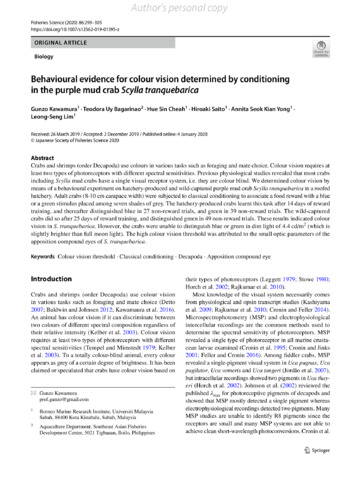
Behavioural evidence for colour vision determined by conditioning in the purple mud crab Scylla tranquebarica
; Bagarinao, Teodora; ; ; ; (Springer Verlag, 2020-01-04)
Crabs and shrimps (order Decapoda) use colours in various tasks such as foraging and mate choice. Colour vision requires at least two types of photoreceptors with different spectral sensitivities. Previous physiological studies revealed that most crabs including Scylla mud crabs have a single visual receptor system, i.e. they are colour blind. We determined colour vision by means of a behavioural experiment on hatchery-produced and wild-captured purple mud crab Scylla tranquebarica in a roofed hatchery. Adult crabs (8-10 cm carapace width) were subjected to classical conditioning to associate a food reward with a blue or a green stimulus placed among seven shades of grey. The hatchery-produced crabs learnt this task after 14 days of reward training, and thereafter distinguished blue in 27 non-reward trials, and green in 39 non-reward trials. The wild-captured crabs did so after 25 days of reward training, and distinguished green in 49 non-reward trials. These results indicated colour vision in S. tranquebarica. However, the crabs were unable to distinguish blue or green in dim light of 4.4 cd/m2 (which is slightly brighter than full moon light). The high colour vision threshold was attributed to the small optic parameters of the apposition compound eyes of S. tranquebarica. -
Morphological descriptions and morphometric discriminant function analysis reveal an additional four groups of Scylla spp
; ; Quinitio, Emilia; ; ; ; ; ; ; (PeerJ, 2020-01-03)
There are four species of mud crabs within the genus Scylla, and most of them live sympatrically in the equatorial region. Apart from a report in Japan about the finding of a natural Scylla hybrid more than a decade ago after the division of genus Scylla into four species by Keenan, Davie & Mann (1998), no subsequent sighting was found. Thus, this study investigates the possible natural occurrence of potential hybridization among Scylla species in the wild. A total of 76,211 individuals from mud crab landing sites around the Malacca Straits, South China Sea and Sulu Sea were screened. In addition to the four-purebred species, four groups (SH 1, n = 2, 627; SH 2, n = 136; SH 3, n = 1; SH 4, n = 2) with intermediate characteristics were found, mostly at Sulu Sea. Discriminant Function Analysis revealed that all Scylla species, including SH 1 - 4, are distinguishable via their morphometric ratios. The most powerful discriminant ratios for each character and the top five discriminant ratios of males and females were suggested. The carapace width of SH 1 males and females were significantly smaller than pure species. Based on the discriminant ratios and the description of morphological characters, we hypothesize that the additional four groups of Scylla with intermediate characteristics could be presumed hybrids. Future work at the molecular level is urgently needed to validate this postulate. -
Biosecurity policy and legislation for the global seaweed aquaculture industry
(Springer Verlag, 2020-08)Each year a significant proportion of global food production is lost to pests and diseases, with concerted efforts by government and industry focussed on application of effective biosecurity policies which attempt to minimise their emergence and spread. In aquaculture the volume of seaweeds produced is second only to farmed fish and red algal carrageenophytes currently represent approximately 42% of global production of all seaweeds. Despite this importance, expansion of the seaweed sector is increasingly limited by the high prevalence of recalcitrant diseases and epiphytic pests with potential to emerge and with the demonstrated propensity to spread, particularly in the absence of effective national and international biosecurity policies. Developing biosecurity policy and legislation to manage biosecurity risk in seaweed aquaculture is urgently required to limit these impacts. To understand current international biosecurity frameworks and their efficacy, existing legislative frameworks were analysed quantitatively for the content of biosecurity measures, applicability to the seaweed industry, and inclusion of risks posed by diseases, pests and non-native species. Deficiencies in existing frameworks included the following: inconsistent terminology for inclusion of cultivated seaweeds, unclear designation of implementation responsibility, insufficient evidence-based information and limited alignment of biosecurity hazards and risks. Given the global importance of the cultivation of various seaweeds in alleviating poverty in low and middle income countries, it is crucial that the relatively low-unit value of the industry (i.e. as compared with other aquatic animal sectors) should not conflate with a perceived low risk of disease or pest transfer, nor the subsequent economic and environmental impact that disease transfer may impact on receiving nations (well beyond their seaweed operations). Developing a clear basis for development of robust international biosecurity policies related to the trade in seaweeds arising from the global aquaculture industry, by first addressing the gaps highlighted in this study, will be crucial in limiting impacts of pests and diseases on this valuable industry and on natural capital in locations where seaweeds are farmed.