Conference Proceedings: Recent submissions
Now showing items 701-720 of 767
-
The milkfish industry in the Philippines
(Aquaculture Department, Southeast Asian Fisheries Development Center; International Development Research Centre; Island Publishing House, Inc., 1984)Milkfish (Chanos chanos ) is the most commercially important fish species in the Philippines. Milkfish production from the marine fisheries and aquaculture sectors has increased at an average rate of 22%. In 1981, production was valued at 1.9 billion Philippine dollars (212,000 t), representing 14% of total fish production value. About 73% of milkfish production came from brackishwater ponds, while the rest was contributed by fishpens (26.3%) and marine fisheries (0.5%). The national yield average was 870 kg/ha per year. Local marketing is handled by brokers, who distribute the fish to wholesalers, cooperatives, retailers, and consumers. Exports experienced a more than 600% increase from 1977 to 1980 and a slight decrease in 1981. Despite inherent problems of the industry include, the potential for further growth of the industry is strong in view of recent research on intensive farming, induced spawning, rearing in controlled conditions, and polyculture techniques. The government is providing support through the establishment of infrastructure facilities, strengthening of extension and training, provision of credit, and development of efficient marketing. -
Milkfish research in the Philippines
(Aquaculture Department, Southeast Asian Fisheries Development Center; International Development Research Centre; Island Publishing House, Inc., 1984)Development and directions in milkfish (Chanos chanos ) research in the Philippines from 1976 to the present are reviewed and analyzed. The problems of milkfish culture are dichotomous: low productivity vis-a-vis seasons of glut and price fluctuations. To intensify fish production extensive research has been conducted on fertilizer management, reclamation of acid sulfate soils, and pond construction and engineering. Research efforts have also been heavily directed toward increasing fry production through artificial propagation, improvement of fry collecting gear, and increasing fry survival through nutrition, control of parasites, and proper handling. Research on improved icing, packaging, and processing techniques along with market analysis are necessary for maximizing economic returns. -
Milkfish aquaculture in Sri Lanka
(Aquaculture Department, Southeast Asian Fisheries Development Center; International Development Research Centre; Island Publishing House, Inc., 1984)Milkfish (Chanos chanos ) fry and fingerlings are abundant in coastal and brackishwater areas in Sri Lanka, yet the industry remains in a stage of underdevelopment. The main seed collection centers are Mannar and Kalpitiya in the northwest and the season is from March to June. The annual fry production potential of the Mannar tidal flats is estimated to be about 4 million. The brackishwater aquaculture potential of Sri Lanka is estimated to be about 120,000 ha. In the past, returns from fry collected from tidal pools and stocked into perennial tanks have been very poor. The recently initiated seed resources survey and investigations into scientific collection, transport, and culture including pen culture should help develop farming of milkfish in Sri Lanka. Polyculture of the species with other fish and shrimp and its culture in salterns are being attempted. -
Gonadal development and induced breeding of captive milkfish in Taiwan
(Aquaculture Department, Southeast Asian Fisheries Development Center; International Development Research Centre; Island Publishing House, Inc., 1984)The induced breeding of milkfish (Chanos chanos ) has been attempted by many institutes in the Philippines, Taiwan, Tahiti, Indonesia, and Hawaii. So far, a few successful trials have been achieved only in the Philippines and Taiwan, although different sources of spawners were used. In Taiwan the spawners used were reared from fry to sexual maturity in ponds and concrete tanks. This paper summarizes the gonadal development of captive milkfish at various stages of sexual maturation investigated from 1975 to 1980 and describes three successful trials of induced breeding in 1979, 1982, and 1983 in Taiwan. Finally, the problems that need further study are discussed. -
Diseases of milkfish
(Aquaculture Department, Southeast Asian Fisheries Development Center; International Development Research Centre; Island Publishing House, Inc., 1984)Although the history of Chanos chanos culture has been quite long, reports of major epizootics have been few. Trained manpower and disease diagnostic services in most milkfish growing areas have not been readily available. Hence, earlier reports of etiologic agents of these epizootics were limited mostly to direct microscopic examination of specimens. Significant disease cases reported were attributed to bacterial, myotic, parasitic, and toxic causes. Bacterial infections, primarily due to Vibrio sp., have been frequently associated with mortality. To a lesser, extent fungal infections have also been reported. Intoxication of stock in freshwater systems by Microcystis toxins has caused massive fish kills in Laguna de Bay, Philippines. In most instances, affected fish were predisposed by environmental stress incurred in handling storage and transport. The fry and fingerling stages seemed severely affected compared with the older stages. Control of these infections must include assessment of fish husbandry practices first, before the use of chemotherapeutic agents like antibiotics is considered. -
Pests/parasites and diseases of milkfish in the Philippines
(Aquaculture Department, Southeast Asian Fisheries Development Center; International Development Research Centre; Island Publishing House, Inc., 1984)This paper presents all known parasites of milkfish (Chanos chanos ) in the Philippines. The major parasitic groups include acanthocephalans, copepods, isopods, and heterophyid flukes. The number of parasitic species found in ponds is small compared with those harbored by the fish in its natural environment. Parasites with a direct life cycle usually survive in ponds as flagellates, ciliates, myxosporidians, coccidia, and parasitic arthropods under improper management. The methods of treatment, prevention and control of these parasites are discussed. -
Milkfish nutrition
(Aquaculture Department, Southeast Asian Fisheries Development Center; International Development Research Centre; Island Publishing House, Inc., 1984)This paper reviews major contributions in the field of milkfish (Chanos chanos ) nutrition since the First International Milkfish Aquaculture Conference in 1976. Substantial progress has been made toward understanding the digestion, foods, and feeding behavior of milkfish, which in its natural habitat apparently feeds on planktonic microorganisms and is most frequently designated as a microphagons planktivore. Vision seems to be the most important sensory mechanism for feeding in fry as well as in juvenilles and larger milkfish. There is very scant information on nutrient requirements and other important aspects of milkfish nutrition. A preliminary study on protein requirement showed that a dietary level of 40% protein was required by fry. Other studies showed that fry responded positively and were easily trained to accept artificial diets. The "deep water method" of growing milkfish practised in Taiwan demonstrated that, with the use of formulated diets, productivity in milkfish aquaculture could be increased three-fold over traditional culture methods, which rely on natural food bases. -
Southeast Asian milkfish culture: Economic status and prospects
(Aquaculture Department, Southeast Asian Fisheries Development Center; International Development Research Centre; Island Publishing House, Inc., 1984)Historically, milkfish (Chanos chanos Forsskal) has been the premier aquaculture product in Indonesia, the Philippines, and Taiwan. However, there are significant differences in the industry's performance among and within these places, especially in terms of yield. These differences can be explained by different factor (land, labor, capital) endowments and by the fact that producers have generally been responsive to these conditions. In Taiwan and the Philippines, milkfish production is becoming less profitable over time. In both places, brackishwater pond producers of milkfish are caught in a cost-price squeeze as input costs have increased more rapidly than market prices. Indonesian producers also face market constraints because high regional transport costs often isolate them from major market centers. In response to declining profitability of milkfish, producers have been changing their production techniques and shifting to the culture of other species such as tilapia that currently have greater domestic or export market potential. Although total milkfish production continues to increase, in the Philippines and Indonesia at least, milkfish's traditional share of total aquaculture production in all these places has declined quite dramatically over the last 10 years, and this trend is likely to continue. -
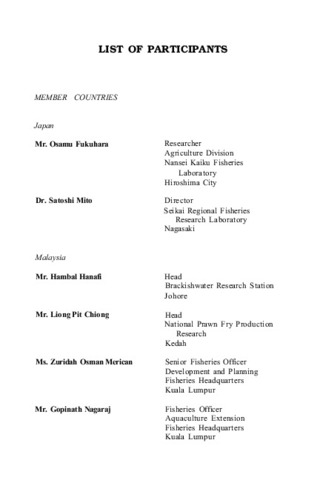
List of participants and guest
(Aquaculture Department, Southeast Asian Fisheries Development Center, 1988) -
Summary of workshop recommendations
(Aquaculture Department, Southeast Asian Fisheries Development Center, 1988)A special workshop among participants was conducted to assess the status of the aquaculture industry in Southeast Asia, particularly in Malaysia, Philippines, Singapore, and Thailand. Although hatchery, nursery, and grow-out culture techniques had already been developed for most of the economically important species cultured in Southeast Asia, the outcome of the workshop showed that there are still major constraints to be able to increase production. Further studies have to be conducted to have greater control of factors that lead to better production. The participants prioritized the economically important species and the research area for each species for the Region. -
Preliminary pages
(Aquaculture Department, Southeast Asian Fisheries Development Center, 1988)Cover page, title page and table of contents. -
Foreword
(Aquaculture Department, Southeast Asian Fisheries Development Center, 1988) -
Broodstock management and seed production of Penaeus monodon (Fabricius)
(Aquaculture Department, Southeast Asian Fisheries Development Center, 1988)Research on the maturation of Penaeus monodon at AQD has focused on three broad areas, namely, reproductive biology and ecology, induced maturation and broodstock management. Studies on reproductive biology provided information on the life cycle, ovarian maturation stages, courtship and mating behavior, minimum size at sexual maturation (sperm occurrence, first spawning), and morphological egg types. Induced maturation has mainly been done through the eyestalk ablation method. Nutritional and environmental parameters were studied to enhance reproductive performance or as an alternative to ablation. Pond-reared and wild broodstock sources and marine pen and land-based tanks as maturation systems were also tested and compared. Size, shape, color, substrate material and other aspects of tank design and construction, sex ratio, stocking density, water management, and other parameters of the management system were also studied and refined. Early techniques in larval and postlarval rearing of P. monodon at AQD were based on the community culture method of growing natural food in larval tanks. However, low and inconsistent survival led to a shift in rearing methods toward pure phytoplankton culture grown in separate tanks as food for the larvae. Henceforth, refinement of rearing methods have been conducted to improve larval survival through effective water management, nutrition, and disease control. Efforts are continuously being geared toward making the technology affordable to Filipino farmers. -
The Philippine aquaculture industry
(Aquaculture Department, Southeast Asian Fisheries Development Center, 1988)The aquaculture sector of the Philippine fishing industry registered the highest growth rate of 12.5% in 1977-1986. The contribution of aquaculture to the total fish production was equivalent to 24% in 1986 compared to only 85 in the early 1970's. In terms of quantity, the mariculture subsector registered the highest growth rate of 10.2% in 1982-1986, whereas in terms of value the brackishwater fishpond subsector showed the highest growth rate of 33%. Meanwhile, freshwater aquaculture production exhibited a negative growth rate due to reduction of activities in Laguna de Bay and the slow expansion in hectarage of the commercial freshwater fishponds. Research by several agencies concentrated heavily on the culture of milkfish (Chanos chanos), tilapia (Oreochromis niloticus), Chinese carps (Aristichthys nobilis and Hypophthalmichthys molitrix), tiger prawn (Penaeus monodon), and sea bass (Lates calcarifer). Innovations in seaweed, oyster, and mussel farming are also discussed. Research directions are presented to assure an ecologically sustainable growth in aquaculture with emphasis on countryside development. -
Aquaculture development in Thailand
(Aquaculture Department, Southeast Asian Fisheries Development Center, 1988)Aquaculture practised in Thailand is in the form of pond culture and cage culture in freshwater, brackishwater and coastal areas. The main species cultured include freshwater prawns, brackishwater shrimp, cockles, mussels, and various freshwater and marine finfishes. There is good potential for increased production from freshwater, brackishwater and marine aquaculture. However, the 1983 production of 145 000 mt represents only about 6% of Thailand's total fish production and production in this subsector has fluctuated widely. It will be several years before aquaculture production will contribute substantially to total production. Nonetheless, the culture of high value species of shrimp and fish could contribute significantly to export earnings during the next 5 to 10 years. Conducted primarily by government agencies, research and development are along the lines of increasing seed supply, establishing new culture techniques or improving older ones. The Department of Fisheries (DOF) together with some private companies have ventured into the development and testing of artificial diets for the various cultured species using a variety of indigenous feed stuffs. It is estimated that with adequate investments and appropriate support, aquaculture production will increase from 145 000 mt in 1983 to 378 000 mt in 1991, showing an annual increase of about 13% over this period. Major increases would come from bivalve mariculture (131 000 mt), brackishwater ponds (36 000 mt) freshwater ponds (46 000 mt) and brackishwater cage culture (20 000 mt). -
Aquaculture development in Singapore
(Aquaculture Department, Southeast Asian Fisheries Development Center, 1988)The trend of fish production in Singapore is towards increasing contribution from marine and brackishwater aquaculture. Aquaculture production in 1986 represented 6.8% of local fish production. It is envisaged that this sector will provide about 37.5% of production by 1995. Freshwater aquaculture will focus mainly on production of ornamental fish. Production from farming of freshwater food fish is not likely to increase significantly. Commonly farmed marine finfishes are groupers (Epinephelus tauvina), sea bass (Lates calcarifer), and golden snapper (Lutjanus johni). Crustaceans include prawns (Penaeus merguiensis), crabs (Scylla serrata) and mussels (Perna viridis). Of the freshwater finfishes, the most commonly cultured are the grass, silver and bighead carps, red tilapia (Oreochromis niloticus hybrid), Lampam jawa (Puntius gonionotus), marble goby (Oxyleotrix marmorata) and the snakehead (Channa sp.). Aquaculture systems use a combination of floating and shorebased techniques. Earthen ponds are utilized for the culture of freshwater carps, floating netcages for marine finfish, ponds and floating netcages for marine crustaceans, and rope culture for mussels. Some research and development studies conducted presently include maturation studies to solve the problem of inconsistent supply of prawn spawners, experiments or use of dry formulated feed to do away with dependency on trash fish as main feed for grow-out marine finfish, and investigations on diseases of prawns under intensive culture. Constraints for large-scale production of finfish seeds lie in the large tank facilities required for producing live feed; for nursery operations, time and manpower required for grading and feeding; for growout systems, disease prevention and control; for prawn production, inconsistent spawner supply; and for mussel production, low consumer demand. The species with the highest potential for fanning in Singapore is the banana prawn, Penaeus merguiensis as its culture can be intensified and high yields can be obtained. -
Broodstock management and seed production of milkfish
(Aquaculture Department, Southeast Asian Fisheries Development Center, 1988)Milkfish (Chanos chanos Forsskal) remains one of the cheapest sources of protein for developing countries in Southeast Asia, particularly in the Philippines. The unpredictable supply of wild fry, the only source of seed for the milkfish farmer, contributed largely to the slow growth of the milkfish industry. Research on the artificial propagation of this fish was, therefore, given emphasis. Major research achievements in milkfish breeding of the SEAFDEC Aquaculture Department in the last decade include: (1) successful induced spawning of wild and captive breeders using gonadotropin preparations and gonadotropin-releasing hormone analogues (GnRHa); (2) spontaneous maturation and spawning of captive breeders; (3) completion of the life cycle of milkfish in captivity; (4) development of a simple egg-collecting method; and (5) development of techniques for mass production of milkfish fry. Information on fry ecology and behavior, larval morphology and physiology were also gathered. These published data constitute the bulk of current knowledge on milkfish biology and natural history. Milkfish breeding technology is currently being pilot-tested in several breeding sites of the Bureau of Fisheries and Aquatic Resources (BFAR). Spontaneous maturation and spawning of milkfish have been verified in four sites which differ in environmental characteristics. The economic feasibility of producing milkfish fry and the socio-economic impact of artificial propagation of milkfish are now being assessed. -
Training programs of SEAFDEC Aquaculture Department
(Aquaculture Department, Southeast Asian Fisheries Development Center, 1988)With training as one of its three mandated functions, the SEAFDEC Aquaculture Department offered its first training course in 1974. Since then it has trained some 6 519 participants in various degree and non-degree programs. The degree courses are MS. Fisheries (Aquaculture) and M. Aquaculture in collaboration with the University of the Philippines in the Visayas. The non-degree programs include regular short-term courses, onsite seminars internship training and practicum for graduating students. The "hands-on" short-term courses cover Prawn Hatchery and Nursery, Marine Finfish Hatchery, Brackishwater Pond Culture, Sanitation and Culture of Bivalves, Freshwater Aquaculture, Aquaculture Management, Aquaculture Engineering, and Aquaculture for Social Scientists. A profile of 637 1982-1986 training participants show 82.3% from Southeast Asia, 79% male and 57.5% from government sector. The paper discusses planning and implementation of training programs, funding support (Japanese Government, International Development Research Centre of Canada, FAO Network of Aquaculture Centres in Asia), and future trends. -
Nursery and grow-out operation and management of Penaeus monodon (Fabricius)
(Aquaculture Department, Southeast Asian Fisheries Development Center, 1988)The results of research on nursery and grow-out rearing of prawn conducted by the SEAFDEC Aquaculture Department for over a decade are reviewed. Different rearing facilities designed to accommodate hatchery-produced prawn fry are presented with corresponding data on growth, survival and production. Studies on stocking density, fertilization/natural food production, water management, feeds and feeding schemes and harvest/post-harvest handling are evaluated and viable technology identified. Diseases, pests and predators and other factors considered as production constraints are also mentioned. The success in hatchery operation for prawn coupled by the gradual emergence of nursery and grow-out rearing technology have triggered off a technology-dependent prawn industry. When SEAFDEC AQD was established in 1973, there were very few commercial prawn monoculture ventures in the country. Prawn pond production was mostly an incidental crop in milkfish culture. At present, various prawn grow-out techniques ranging from extensive, semi-intensive and intensive culture systems are in practice. SEAFDEC AQD focused its research on the extensive and semi-intensive culture systems which are within the reach of most farmers in contrast to the intensive system that is highly capital-intensive. There have been much work done in nursery and grow-out operations, but much remains to be done in research, among which are the development of nutritionally-efficient and low-cost feed, control of diseases, etc. -
Development of aquaculture industry in Southeast Asia: An overview
(Aquaculture Department, Southeast Asian Fisheries Development Center, 1988)Southeast Asia, a Subregion of the Asia-Pacific Region, is composed of countries of diverse socio-economic circumstances. Fisheries production, particularly that of the aquaculture sector, is relatively developed and is important to the economy of this area. Some 80 economic aquatic species are the subject of culture. Many of these species, which include fin fish, crustaceans, molluscs, and seaweeds, are produced in consequential quantities. Total production from the Subregion in 1983 amounted to about 880 000 mt which represented nine percent of total world aquaculture production in said year, and a 100% increase in the area within the decade (1975-1983). Unit production is comparatively low as it is usually done with the use of the extensive level of management developed after long years of experience by fish farmers. Higher rate of production in recent years is a trend especially for high value and exportable species like the penaeid shrimps. Aquaculture production tends to have accelerated growth while capture fisheries production tends to increase very gradually or levels off. Technical and non-technical constraints occur which hinder rapid progress of aquaculture in Southeast Asia. This will require the attention of research institutions and governments. However, bright prospects for future increase in production in this industry are developing in the area. Specific instances to support this forecast are discussed.