Conference Proceedings: Recent submissions
Now showing items 541-560 of 767
-
Status and problems of marine fish seed production in Thailand
(Aquaculture Department, Southeast Asian Fisheries Development Center, 1993)Aquaculture of marine fishes such as sea bass, milkfish, and mullet among others, have been conducted in Thailand for a long time in its provinces along the coast. The fry of these fishes have been collected from natural waters and cultured for the consumption of the family. The traditional method was used in rearing these fishes - flowing seawater into earthen ponds using the bamboo stake trap as the water gate, and culturing trapped fry. Feed was usually the juveniles of other species that come with the water. Needless to say, production was very low. Rearing marine fish in commercial scale is fairly recent, only in the last 30 years. Seed collection, transport, nursery, grow-out culture, and rearing techniques have been experimented by the Department of Fisheries since 1954 at its Prachuab Fisheries Station. The results were then disseminated to fish farmers. The species which are popularly cultured include sea bass (Lates calcarifer), red snapper (Lutjanus argentimaculatus), and grouper (Epinephelus tauvina ). -
The shrimp hatchery industry in the Philippines
(Aquaculture Department, Southeast Asian Fisheries Development Center, 1993)Fifteen years after SEAFDEC Aquaculture Department first offered its training course on Barangay Prawn Hatchery Management, the giant tiger shrimp industry has grown tremendously. Among the private investors in shrimp (Penaeus monodon) hatchery is Jamandre Industries, Inc. But problems (e.g., scarcity of spawners and lack of effective artificial feeds) led the company to explore culture of penaeid shrimps other than tiger shrimp. Although survival of P. stylilostris and P. vannamei were found to be higher than P. monodon in grow-out ponds and in the hatchery, their culture did not take off in the country. For the penaeid shrimps, technology remains largely an art. -
Shrimp seed production in Malaysia
(Aquaculture Department, Southeast Asian Fisheries Development Center, 1993)The giant freshwater prawn, Macrobrachium rosenbergii, and the marine shrimp, Penaeus monodon, are now becoming the most important cultured species in Malaysia. The progress in the aquaculture of these species has led to the development of hatcheries in various parts of the country. To date, a total of 50 hatcheries are now in operation. Fry production technology varies between hatcheries. For M. rosenbergii, clear-water, closed system, and green-water larviculture techniques are common. For P. monodon, the two-tank and one-tank larviculture systems are used. A range of problems such as lack of skilled hatchery personnel, larval diseases, and lack of financial support hampers hatchery operations. In order to ensure the continued operation of the hatcheries, the Department of Fisheries (Malaysia) is providing the necessary support services and technical assistance. -
Shrimp grow-out culture techniques in the Philippines
(Aquaculture Department, Southeast Asian Fisheries Development Center, 1993)The major commercial shrimp species in the Philippines belong to the genus Penaeus and Metapenaeus. The important penaeid shrimps are: P. monodon (giant tiger shrimp or sugpo); P. japonicus and P. semisulcatus (tiger shrimp and bulik or sugpo); and P. merguiensis and P. indicus (white shrimp and Indian white shrimp or putian). The giant tiger shrimp is the major species cultured in ponds while the others are incidental crops. There are 210,000 ha of potential and existing brackishwater ponds in the Philippines (Fig. 1). Because most of these are underdeveloped, present technologies are aimed at improving production or encouraging the development of new areas. Brackishwater fishfarming in the country is primarily centered on milkfish (Chanos chanos) (Table 1). Shrimp used to be merely an incidental crop when postlarvae from the wild enter the milkfish ponds. In the last decade, many traditional milkfish growers recognize the market of shrimps, primarily the giant tiger shrimp. Polyculture of milkfish and shrimp was practiced, and the fishfarmers shifted to shrimp monoculture when price of shrimp in the international market went up. In the mid-70s, SEAFDEC/AQD developed and extended its shrimp hatchery technology, and hatcheries proliferated throughout the country. Seed supply became abundant, encouraging more people to invest in grow-out culture. However, production remained low and inconsistent since the growout technology remains largely an art. When Taiwanese grow-out technology was introduced in the country and research in shrimp was intensified in the Department of Agriculture, University of the Philippines, and SEAFDEC/AQD, new coastal areas were developed particularly in Negros Island where vast tracts of sugarland and rice land were converted to shrimp ponds. Milkfish ponds were also renovated for shrimp culture. There are four shrimp culture levels in the country, namely: traditional, extensive, semi-intensive, and intensive which vary mainly in pond design, stocking density, feeds and feeding, and water management (Table 2). Only the semi-intensive and intensive culture systems are discussed. -
Shrimp hatchery and grow-out operations in Thailand
(Aquaculture Department, Southeast Asian Fisheries Development Center, 1993)Shrimp farming in Thailand has been practiced since more than 50 years ago. This began with the extensive system (traditional method) where shrimp fry are allowed to enter ponds during the high tide, and then harvested after some time. Production then was low and widely fluctuated. After the Department of Fisheries (DOF) successfully spawned and nursed the shrimp (Penaeus, )new techniques were developed and this led to more intensive culture systems. Production of shrimp from aquaculture continuously increased - from 991 t in 1972 to 130,000 t in 1991. The estimated production for 1992 is 150,000 t. The tiger shrimp (Penaeus monodon) is the most desired species due to its rapid growth (commonly grows to 30 g in 4 months in ponds) and its high export value. It is also the major species cultured especially in the intensive system. The other species are banana shrimp (P. merguiensis), white shrimp (P. indicus), and Metapenaeus ensis. These are normally grown in extensive and semi-intensive culture systems. -
Seed production of marine fish in Malaysia
(Aquaculture Department, Southeast Asian Fisheries Development Center, 1993)Aquaculture especially brackishwater fish culture in Malaysia has a very high potential for development. It is also a very important source of protein. The three major species cultured in cages are sea bass, grouper, and snapper. They are very popular, especially sea bass which is a highly esteemed delicacy. Sea bass culture started in the mid-1970. The fry was obtained from the wild or imported from Thailand or Singapore. This industry developed slowly because of inadequate supply of seed. During this period also, the culturist had very little experience in managing the cages. As an answer to the problems of the industry, the Fisheries Research Institute (FRI) of the Department of Fisheries, Ministry of Agriculture, Glugor, Penang, established a unit responsible for research on hatchery propagation, larval feed development, and cage culture of sea bass. The Brackishwater Unit of FRI situated in Gelang Patah, Johor is responsible for research and development of sea bass grow-out in coastal ponds. The Marine Finfish Production and Research Centre (MFPRC) situated in Tanjung Demong, Terengganu was set up in 1982 for marine fish fry mass production. The Extension Branch of the Department of Fisheries in Kuala Lumpur is responsible for all extension services, including promotion of sea bass aquaculture as well as other species. The Extension Branch also operates the MFPRC and organizes training on coastal aquaculture at the Brackishwater Aquaculture Centre in Johor. The Fisheries Development Authority of Malaysia (LKIM), a government statutory body formed in 1971 with the objectives of upgrading the socioeconomic status of fishermen and developing the fisheries industry, is also involved in marine fish culture, especially in setting up commercial culture projects involving local fishermen. In addition to government bodies, some universities in Malaysia also carry out activities related to marine fish culture, especially disease studies. -
Milkfish breeding program in the Philippines
(Aquaculture Department, Southeast Asian Fisheries Development Center, 1993)The National Bangus Breeding Project (NBBP) was established in 1981 in compliance with a presidential directive. Breeding and hatchery techniques for milkfish (Chanos chanos) developed by the Aquaculture Department of the Southeast Asian Fisheries Development Center (SEAFDEC/AQD) are adopted. The project is a joint undertaking of the Bureau of Fisheries and Aquatic Resources (BFAR) of the Department of Agriculture and SEAFDEC/ AQD with the former as the lead implementing agency. -
Research activities and accomplishments of the SEAFDEC Aquaculture Department, 1988-1991
(Aquaculture Department, Southeast Asian Fisheries Development Center, 1993)Research studies conducted from 1988 to 1991 focused on breeding, seed production, and farming of thirteen aquaculture species of regional importance. Studies aimed at developing economical feeds, as well as disease prevention and control were undertaken. Guided by the recommendations of ADSEA I (Seminar-Workshop on Aquaculture Development in Southeast Asia; 8-12 Sept. 1987; Iloilo City, Philippines), workshops to review the previous years' progress and identify specific studies for implementation were held annually since 1989 with the participation of academic institutions, government and private sectors. Some 212 studies were implemented. Majority were on tiger shrimp, milkfish, and sea bass. Studies on other species of fishes, crustaceans, molluscs, and seaweeds, as well as larval food organisms, seafarming and economics of hatchery and grow-out culture systems were also undertaken. As of December 1991, 168 studies were completed. Research results were published in 204 scientific journals, proceedings, and other publications. In addition, 27 papers were in press and 63 manuscripts had been submitted. That research output is gaining recognition in the international scientific community can be gleaned from the number of papers published in refereed journals covered by Current Contents (CC). Of the 142 papers published in scientific journals in 1988-1991, 115 (81%) appeared in CCcovered journals. This has increased from 58.8% (124 of 211) in 1976-1987. The active participation of the research staff in scientific meetings is equally evident from the number of publications in proceedings of scientific meetings from 1988-1991 (63). -
Fish diseases in Thailand: Status and problems
(Aquaculture Department, Southeast Asian Fisheries Development Center, 1993)In Thailand, there are several species cultured and systems of freshwater and marine aquaculture. However, improper management and lack of government control on the area and number of ponds contribute to the deterioration of the environment. One consequence of environmental degradation is the occurrence of diseases. -
Fish diseases in Malaysia: Status and problems
(Aquaculture Department, Southeast Asian Fisheries Development Center, 1993)Aquaculture is still at an early stage of development in Malaysia; however, it has expanded quite rapidly over the past decade or so. Under the National Agriculture Policy, aquaculture development has been given high priority and entrepreneurs are given various incentives and support services. The technologies of various aquaculture systems in Malaysia are already well developed. Many farms adopt intensive culture system and where inadequate fish seed is a constraint, importation from neighboring countries supports culture. It is in the intensive culture system, both in the hatchery and grow-out phases, that diseases often occur. Diseases have resulted in significant economic loss to fish and shrimp farmers. The study of fish parasites has been carried out for sometime but it dealt mainly with taxonomy. The systematic study of fish disease and its documentation are comparatively new. At present, three institutions are involved in fish disease research: Fisheries Research Institute under the Department of Fisheries, Agriculture University of Malaysia, and Science University of Malaysia. -
Fish nutrition in Malaysia: Status and problems
(Aquaculture Department, Southeast Asian Fisheries Development Center, 1993)In aquaculture, nothing is more important than a well-balanced diet and adequate feeding. An undernourished fish is never able to maintain its health and attain its growth potential regardless of the quality of its environment. The production of nutritionally balanced diet for fish requires research, quality control, and biological evaluation. The Department of Fisheries first acknowledged the importance of formulated feed when it established the Feed Section at the Fisheries Research Institute in Glugor in 1976. With the establishment of the research branch, Brackishwater Aquaculture Research Centre (BARC), in Gelang Patah, Johor in 1979 and the National Prawn Fry Production and Research Centre (NAPFRE) in Pulau Sayak, Kedah in 1987, the feed section has been expanded further to cover pond grow-out feeds for fishes and shrimps and the postlarval stage of shrimps. The feed section in Glugor placed greater emphasis on larval and postlarval feed. In the case of freshwater fishes, research and production of feeds began in 1975 at the Freshwater Fish Research Station, Batu Berendam, Melaka. The development of formulated feeds is concentrated on fishes and crustaceans. -
Fish nutrition in Thailand: Status and constraints
(Aquaculture Department, Southeast Asian Fisheries Development Center, 1993)Aquaculture prior to World War II was limited because marine and freshwater fish catches were still abundant. But shortage of fuel and other necessities led to an increase in food prices including fish. The demand for increased fish production in turn increased the number of people involved in fish farming and the number of species cultured to more than 25. The 13 species most commonly cultured include the walking catfish (Clarias batrachus), snakehead (Channa straitus),striped catfish (Pangasius sutchi), gouramy (Trichogaster pectoralis), sand goby (Oxyeleotris marmoratus), grass carp (Ctenopharyngodon idellus), silver carp (Hypopthalmichthys molitrix), bighead carp (Aristichthys nobilis), Nile tilapia (Oreochromis niloticus), freshwater prawn (Macrobrachium rosenbergii), sea bass (Lates calcarifer), grouper (Epinephelus tauvina), and tiger shrimp (Penaeus monodon). Thailand is a major producer of agricultural products in Asia. Large quantities of raw feed materials are produced and consumed each year. Although aquaculture has been in existence as long as land-based agriculture, it has not kept up in terms of feed development. The feeding methods of most cultured fishes are still largely traditional and based on experience using trash fish, rice bran, and broken rice. It was only recently that aquaculture began using feeds to increase production. In 1986, shrimp culture began evolving toward the semi-intensive and intensive systems, and the demand for compound feeds greatly increased. Commercial feed factories expanded to include shrimp feeds, further developing the feed industry. -
Aquaculture development in Malaysia in the 1990s
(Aquaculture Department, Southeast Asian Fisheries Development Center, 1993)Aquaculture is still at an early stage of development in Malaysia. In 1991, for example, Malaysia's total aquaculture production amounted to only 64,344t, while the overall fish production for the year totalled 976,272 t. In recent years, however, there have been significant aquaculture expansion and development in the country. This was fueled not only by the declining catch rates in coastal and inland fisheries but also by the technical advances in aquaculture. There is still considerable potential for further development and production is expected to increase steadily for all the cultured species. With concerted efforts by the public and private sectors, aquaculture could contribute an annual production of more than 200,000 t by year 2000. -
Chemicals in Asian aquaculture: need, usage, issues and challenges
(Aquaculture Department, Southeast Asian Fisheries Development Center, 2000)This paper outlines the opening introductory presentation made at the “Expert Meeting on the Use of Chemicals in Aquaculture in Asia,” which was held 20-22 May 1996 at the SEAFDEC facilities in Tigbauan, Iloilo, the Philippines. Its purpose is to provide a balanced and realistic perspective on the needs, issues and challenges with respect to the use of chemicals in Asian aquaculture. We hope to assist participants in identifying development opportunities and in differentiating real hazards from hypothetical threats to cultured organisms, end-users and the environment as a consequence of chemical use. We do not attempt to provide answers to issues related to chemicals in Asian aquaculture, but rather offer some basic directives and opportunities to the workshop participants to assist them in their discussions and in the compilation of realistic recommendations. -
Antibacterial chemotherapy in aquaculture: review of practice, associated risks and need for action
(Aquaculture Department, Southeast Asian Fisheries Development Center, 2000)This paper briefly reviews the use of chemicals to prevent and treat bacterial diseases in aquaculture, and provides a detailed summary of the current state of knowledge on the development of bacterial resistance to antimicrobial agents in fish and shellfish. The topics covered include mechanisms of resistance, resistance of bacterial fish pathogens, resistance to antibacterial agents associated with use in aquaculture, and factors causing selection of resistant variants. Emphasis is placed on avoiding and solving problems related to bacterial resistance in aquaculture, and recommendations on antibiotic usage in aquaculture are made. -
Ecological effects of the use of chemicals in aquaculture
(Aquaculture Department, Southeast Asian Fisheries Development Center, 2000)Many aquaculture chemicals are, by their very nature, biocidal, and may be released to the surrounding environment at toxic concentrations either through misuse, or in some cases, even by following generally accepted procedures for use. Thus, there is a potential for mortality of nontarget organisms. Illustrations are provided of three classes of aquaculture chemicals and their effects on non-target biota: 1) use of a carbaryl pesticide and mortality of non-target invertebrates; 2) use of an organophosphate parasiticide and suspected effects on nearby biota; and 3) effects of antibacterial residues in aquatic sediments on the associated microbial community. Efforts to assess the risks posed by aquaculture chemicals are often frustrated by a lack of information on environmental fate and effects, and data needs to resolve this situation are identified. -
Transferable drug resistance plasmids in fish-pathogenic bacteria
(Aquaculture Department, Southeast Asian Fisheries Development Center, 2000)Chemotherapeutic agents have been developed for treating bacterial infections and have been widely used for cultured fish for the last 30 years in Japan. The extensive use of chemotherapeutants has resulted in an increase in the occurrence of drug resistance in fish-pathogenic bacteria and also in the bacterial flora of the intestinal tract of cultured fish. The kinds of chemotherapeutants used are correlated with the occurrence of the corresponding drug-resistant genes in fish-pathogenic bacteria. Almost all multiple-drug resistant strains are carried on the transferable R plasmid, although resistance in fish pathogens to nitrofuran derivatives and pyridonecarboxylic acids is associated with a chromosomal gene. The DNA sequences of R plasmids generally differ depending on the species of fish pathogen. Exceptions are the R plasmids of Aeromonas hydrophila and A. salmonicida, which have the same resistance markers as chloramphenicol, streptomycin, and sulfonamides (SA); and the R plasmids of A. hydrophila and Edwardsiella tarda, which have the same resistance markers as SA and tetracycline. The fish pathogens A. hydrophila, A. salmonicida, E. tarda, Enterococcus seriolicida, Pasteurella piscicida, and Vibrio anguillarum are all widely distributed in fish farms in various areas, and within each species the R plasmid has an identical DNA sequence. The chloramphenicol resistance (cat) gene of the R plasmid from Gram-negative bacteria was classified into CAT I, II, III, and IV according to the DNA sequence. The cat gene of P. piscicida was classified as CAT I, those of A. salmonicida and E. tarda were classified as CAT II, and that of V. anguillarum was classified as CAT II or IV, depending on the time the strains were isolated. The tetracycline-resistance determinants (Tet), which occur in six classes (Tet A through Tet G), were class D in the R plasmids obtained from strains of V. anguillarum that were isolated from 1989 to 1991. The Tet for strains of V. anguillarum isolated from 1973 to 1977 was classified as Tet B, while for strains isolated from 1980 to 1983 it was classified as Tet G. -
The use of chemicals in aquafeed
(Aquaculture Department, Southeast Asian Fisheries Development Center, 2000)Various chemicals and additives used in fish and shrimp feeds may have impacts on animal health, product quality and the environment. This paper reviews the use and effects of vitamins (vitamins C and E), essential fatty acids, carotenoids, immunostimulants, hormones and attractants added to feeds for cultured fish and shellfish. -
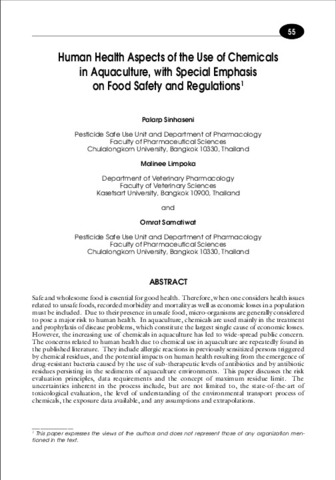
Human health aspects of the use of chemicals in aquaculture, with special emphasis on food safety and regulations
(Aquaculture Department, Southeast Asian Fisheries Development Center, 2000)Safe and wholesome food is essential for good health. Therefore, when one considers health issues related to unsafe foods, recorded morbidity and mortality as well as economic losses in a population must be included. Due to their presence in unsafe food, micro-organisms are generally considered to pose a major risk to human health. In aquaculture, chemicals are used mainly in the treatment and prophylaxis of disease problems, which constitute the largest single cause of economic losses. However, the increasing use of chemicals in aquaculture has led to wide-spread public concern. The concerns related to human health due to chemical use in aquaculture are repeatedly found in the published literature. They include allergic reactions in previously sensitized persons triggered by chemical residues, and the potential impacts on human health resulting from the emergence of drug-resistant bacteria caused by the use of sub-therapeutic levels of antibiotics and by antibiotic residues persisting in the sediments of aquaculture environments. This paper discusses the risk evaluation principles, data requirements and the concept of maximum residue limit. The uncertainties inherent in the process include, but are not limited to, the state-of-the-art of toxicological evaluation, the level of understanding of the environmental transport process of chemicals, the exposure data available, and any assumptions and extrapolations. -
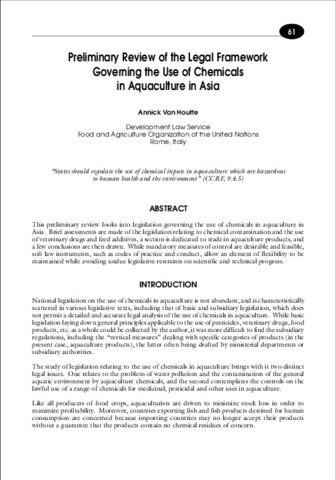
Preliminary review of the legal framework governing the use of chemicals in aquaculture in Asia
(Aquaculture Department, Southeast Asian Fisheries Development Center, 2000)This preliminary review looks into legislation governing the use of chemicals in aquaculture in Asia. Brief assessments are made of the legislation relating to chemical contamination and the use of veterinary drugs and feed additives, a section is dedicated to trade in aquaculture products, and a few conclusions are then drawn. While mandatory measures of control are desirable and feasible, soft law instruments, such as codes of practice and conduct, allow an element of flexibility to be maintained while avoiding undue legislative restraints on scientific and technical progress.