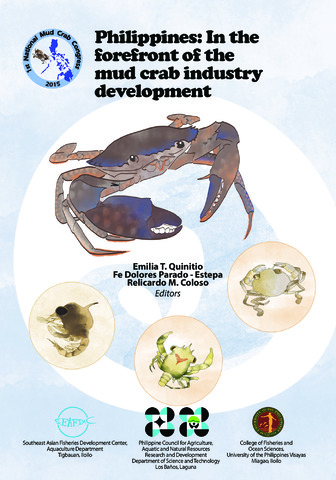
Philippines: In the forefront of the mud crab industry: Proceedings of the 1st National Mud Crab Congress

Date
2017Page views
13,199
AGROVOC keyword
Metadata
Show full item recordShare
Suggested Citation
Quinitio, E. T., Parado-Estepa, F. D., & Coloso, R. M. (Eds.). (2017). Philippines: In the forefront of the mud crab industry: Proceedings of the 1st National Mud Crab Congress. Tigbauan, Iloilo, Philippines: Aquaculture Department, Southeast Asian Fisheries Development Center.
Contents
- FOREWORD
- ACKNOWLEDGEMENTS
- PHOTO OF THE PARTICIPANTS
- A. Technical Papers
- Husbandry
- Recent Developments and Enhancing Transfer of the Nursery Technology for the Mud Crab Scylla serrata - Fe D. Parado-Estepa, Veronica Alava, Esteban Garibay, Churchill Bejemino, Jony Sumile, Jenalyn Silvestre and Emilia T. Quinitio
- Management Strategies for Grow-out Culture of Mud crab - Jerome G. Genodepa
- Development of Protocol for the Production of Hatchery-reared Mud Crab Scylla serrata Juveniles for Soft-shell Crab Farming - Emilia T. Quinitio, Gardel Xyza Libunao and Fe D. Parado-Estepa
- Feeds and Feeding Management
- Breeding and Culture of the Polychaete Marphysa mossambica as Feed for the Mud Crab Scylla serrata Broodstock - Veronica R. Alava, Joseph B. Biñas and Mary Anne E. Mandario
- Nursery Culture of Mud Crab Scylla serrata Using Different Feeding Rates - Veronica R. Alava, Jony D. Sumile and Fe D. Parado-Estepa
- Nursery Culture of Mud crab Scylla serrata Using Different Ratios of Natural Food to Formulated Feed - Veronica R. Alava, Jony D. Sumile and Fe D. Parado-Estepa
- Effect of Feed Binder on Water Stability and Digestibility of Formulated Feed for the Mud Crab Scylla serrata - Mae R. Catacutan
- Biological Evaluation of Existing Feed Formulations for the Grow-out Culture of the Mud Crab, Scylla serrata - Mae R. Catacutan
- Diseases
- Aquasilviculture
- Husbandry
- B. Papers on Industry Practices
- Trading of Juvenile Crabs and Grow-out Culture in Capiz - Graciano Jalemar Panaguiton
- Polyculture of Mud Crab in Region 3 - Maurino Bonifacio
- Mud Crab Fattening Project of KAMAMANA in Del Carmen, Siargao Island - Agapito E. Sulima
- Capacity Building Initiatives of Winrock International on Mud Crab Culture in the Caraga Region - Joselito Nobillos, Daniel Gudahl and Jim Orprecio
- Mud Crab Marketing Practices - Alain G. Decembrana
- Enforcement of the Unified Provincial Fisheries Law in Camarines Norte with Focus on Mud Crab - Edgar A. Estanislao
- Philippine National Standard for Live Mud Crabs: Establishing Food Safety and Quality Requirements - Mark F. Matubang, Teresita S. Palomares, Jose P. Peralta, Emilia T. Quinitio, Rosario J. Ragaza, Julieta V. Alejo, Prescilla B. Regazpi, Cherry E. Romero, Haydee Ann Montoya, Jaypee G. Trinidad and Karen Kristine A. Roscom
- C. Abstracts of Other Presented Papers (Oral and Poster)
- Biology, Genetics and Ecology
- Identification of Mud Crab Species in Coastal Areas of Pangasinan - Rolando B. Cerezo and Mariel C. Tapia
- Genetic Diversity and Stock Delineation of Philippine Populations of the Orange Mud Crab, Scylla olivacea - Faith Jessica M. Paran and Rachel June Ravago-Gotanco
- Population Structure of Scylla serrata from Microsatellite and mtDNA Markers - Chona Camille E. Vince Cruz and Ma. Carmen Ablan-Lagman
- High Throughput RNA Sequencing Reveals Temperature Tolerance Mechanisms in Scylla serrata - Ma. Carmen Ablan-Lagman and Eli Meyer
- Husbandry
- Updates on the Larviculture of Mud Crab at SEAFDEC/AQD - Emilia T. Quinitio, Joana Joy Huervana, Juliette C. Virgula and Fe D. Parado-Estepa
- Mud Crab Scylla serrata Hatchery Operation - Mario Santos and Francisco Santos
- Mud Crab Production Trials at the College of Fisheries and Marine Sciences, Aklan State University, New Washington, Aklan - Yasmin H. Primavera-Tirol, Ronnie de la Cruz and Eduardo B. Pastrana
- Initiatives on Mud Crab Culture at the Palawan Aquaculture Corporation - Elsie Tech, Cheryl Emboltorio, Domingo Galila, Cornelio Ogsimer and Kimberly Lim
- Induction of Molting in Hatchery-reared Mud Crab Scylla serrata Juveniles Through Temperature Manipulation or Autotomy - Joana Joy D.C. Huervana, Valeriano L. Corre Jr. and Emilia T. Quinitio
- Morphological Deformities in Mud Crab Scylla serrata Juveniles Exposed to Antibiotics During the Larval Stage - Gaudioso S. Pates Jr., Emilia T. Quinitio, Gerald F. Quinitio and Fe D. Parado-Estepa
- Nursery Culture of Mud Crab Scylla serrata Fed Diets Supplemented with Tryptophan at Two Stocking Densities - Veronica R. Alava, Marjorie Aijee Lucero, Jony D. Sumile and Fe D. Parado-Estepa
- Adoption of Modified Commercial Scale Mud Crab Hatchery and Nursery Systems in Alaminos, Pangasinan - Rolando B. Cerezo and Jesamine F. Rebugio
- Private Sectors Perspectives: Problems and Constraints of Mud Crab Grow-out Industry - Herbert Renan Hocson
- Feeds and Feeding Management
- Growth, Survival, Proximate and Fatty Acid Composition of Sandworm Perinereis quatrefagesi (Grube, 1878) Fed Variable Feed Types - Joseph B. Biñas, Veronica R.Alava and Wilfredo L. Campos
- Evaluation of the Bioremediation Capacity of the Polychaete, Marphysa mossambica (Peters, 1854) in Pond Sediments - Mary Anne E. Mandario, Veronica R. Alava and Nathaniel C. Anasco
- Nursery and Grow-out Feeding Management Approach of Mud Crab Farmers in the Philippines: Santeh Management - Julius Remar A. Gabiota
- Pilot Scale Production of Pellets Suitable for Mud Crab Scylla serrata - Relicardo M. Coloso, Mae R. Catacutan, Jose P. Peralta, Jerome G. Genodepa, Khrsha Duno and Rosthon Gardoce
- Diseases
- Post harvest
- Aquasilviculture
- Enhancing Mud Crab Population through Mangrove Restoration - Ma. Junemie Hazel Lebata-Ramos, Ellen Flor Doyola-Solis, Rema C. Sibonga, Joseph B. Biñas, Mark Walton and Lewis Le Vay
- Development of Aquasilviculture at BFAR-NBFTC, Pagbilao, Quezon - Romeo E. Dieta and Florida C. Dieta
- Implications of Mud Crab Culture Technology Transfer on Rural Coastal Communities: The Case in Northern Samar, Philippines - Didi B. Baticados, Renato F. Agbayani and Emilia T. Quinitio
- Biology, Genetics and Ecology
- D. Workshop Output
- E. Resolution
- F. Annexes
- 1. List of Participants
- 2. Composition of Committees
Type
Book; Conference publicationISBN
9789719931072Format
[vii], 186 pages : color illustrations.
Collections
Related items
Showing items related by title, author, creator and subject.
-
Mud crab pond and pen culture
(University of the Philippines Aquaculture Society, Inc, 2001) -
Monosex culture of the mud crab Scylla serrata at three stocking densities with Gracilaria as crab shelter
(Australian Centre for International Agricultural Research, 1999)The effects of three levels of stocking density (0.5, 1.5 or 3.0/m2) and monosex culture (male or female) on the growth, survival and production of Scylla serrata were investigated. Juvenile crabs were stocked in 150 m2 enclosures in earthen ponds with Gracilaria as shelter and fed a mixed diet of 75% fresh brown mussel flesh and 25% fish bycatch. There was no interaction between stocking density levels and monosex culture (P<0.05) so the data were pooled for each sex or stocking density treatment. Results showed that highest survival was obtained from a stocking density of 0.5/m2 (P<0.05). Crab growth at different stocking densities was not significantly different (P>0.05). Highest return on investment (ROI) and lowest production costs were attained from 0.5/m2. Partial budgeting analysis showed that no net benefit accrued from stocking beyond 1.5/m2. Male crabs attained significantly better (P<0.05) final weight and specific growth rate than female crabs. Length, width, survival and production between male and female crabs were not significantly different (P>0.05). Male and female monoculture gave high net revenue and ROI of more than 100 but male monoculture is more profitable. Overall the results suggest that the culture of male or female mud crabs at 0.5–1.5/m2 with Gracilaria is economically viable. -
Selection of probiotics for shrimp and crab hatcheries
(Aquaculture Department, Southeast Asian Fisheries Development Center, 2002)A study aimed at obtaining a biological control agent against bacterial diseases, specifically luminescent vibriosis, of hatchery-reared shrimps and crabs was done to find an alternative for chemotherapy as a disease prevention and control method. Bacteria were isolated from crustacean rearing environments where luminescent vibrosis was not observed, from natural food, and from various feed ingredients. From hundreds of purified strains, 80 bacterial isolates were tested in one-on-one mixed cultures in seawater for their ability to suppress the growth of luminescent Vibrio harveyi. Of the 10 isolates exhibiting that capability, two strains were further studied: C1 from chlorella culture and P9 from a commercial probiotic preparation. However, due to the indigenous nature of C1 strain from the unicellular alga Chlorella sp. and the ease in distinguishing it from other bacteria owing to its colony morphology, more tests were done on C1 strain. To determine the suitability of C1, and to some extent P9, as biocontrol bacteria, their pathogenicity against crab larvae and shrimp postlarvae, and their ability to become associated or incorporated into the larvae were determined. Incorporation into the rotifer, Brachionus, was also tested. Due to the positive results obtained in the incorporation experiments, the growth of strain C1 in microbiological media and unrefined media prepared from agricultural by-products was also tested.