
Recent Advances in Diagnosis and Prevention of Fish and Shrimp Diseases in Southeast Asia
Browse by
Fish diseases are one of the major constraints and threats to aquaculture production in Southeast Asia. Numerous infectious diseases have been reported from fish and shrimp cultured in this region. Currently, several emerging diseases are also recognized in the region. These diseases cause large-scale mass mortalities of cultured species, inducing devastating losses to the regional aquaculture production.
Various chemicals including antibiotics, pesticides, disinfectants and others are often used to control fish diseases in the region. There is, however, a need to ensure that aquaculture products are safe for humans, and the presence of chemical residues in aquaculture products have made a serious, negative impact on international trade in exporting countries.
The Aquaculture Department of the Southeast Asian Fisheries Development Center (SEAFDEC) based in Tigbauan, Iloilo, Philippines, has conducted the Regional Fish Disease Project to address fish disease problems and food safety issues in the region with funding from the Government of Japan (GOJ) Trust Fund. Under the title of “Development of Fish Disease Inspection Methodologies for Artificially-Bred Seeds,” the first phase of the project was implemented for five years from 2000 to 2004. During this period, many activities including research, hands-on training, international meetings and extension were conducted.
This volume entitled “Recent Advances in Diagnosis and Prevention of Fish and Shrimp Diseases in Southeast Asia” is a terminal report of the Regional Fish Disease Project on “Development of Fish Disease Inspection Methodologies for Artificially-Bred Seeds” funded by the GOJ Trust Fund. This is a compilation of the outcome of various activities conducted from 2000 to 2004. In addition to this report, a number of scientific papers, manuals, proceedings of international meetings and others have been published to disseminate the outputs of the project (see Chapter 4).
- Foreword
- Message
- Contents
- Introduction
- Acknowledgments
-
Background and Objectives of the Regional Fish Disease Project
- Background
- Objectives and activities of the Regional Fish Disease Project
- Project leaders
-
Chapter 1. Research
-
Part 1. General Information
- Establishment and standardization of diagnostic methods
- Biology and pathogenesis of disease pathogens
- Disease prevention and control
- Establishment of evaluation methods for residual chemicals in aquaculture products
- Epizootiology and prevention of koi herpesvirus disease
-
Part 2. Diagnosis and Prevention of Viral Diseases of Shrimp and Marine Fish
- Standardization of PCR techniques as the detection method for white spot syndrome virus (WSSV) infection in shrimp (Penaeus monodon)
-
Standardization of diagnostic methods for monodon baculovirus (MBV) and hepatopancreatic parvovirus (HPV): Establishment of monoclonal antibodies (MAbs) against MBV and HPV
- Part I. Studies on the experimental transmission model of monodon baculovirus (MBV) and hepatopancreatic parvovirus (HPV) in shrimp (Penaeus monodon)
- Part II. Development of monoclonal antibody (MAb) against monodon baculovirus (MBV) and hepatopancreatic parvovirus (HPV)
- Part III. Production of polyclonal antibodies (PAbs) against monodon baculovirus (MBV) and hepatopancreatic parvovirus (HPV)
- Part IV. Chlorine disinfection against hepatopancreatic parvovirus (HPV) infection in shrimp (Penaeus monodon) larvae
- Development of shrimp (Penaeus monodon) cell culture in vitro
- Detection and identification of viral pathogens in marine finfish cultured in the Philippines
- Detection and identification of viral pathogens of grouper (Epinephelus malabaricus) cultured in Thailand
- Detection and identification of iridoviral pathogens of freshwater fish in Thailand
- Prevalence of economically-important viral diseases in wild shrimp (Penaeus monodon) in the Philippines
- Establishment of preventive measures against viral nervous necrosis (VNN) in finfish hatcheries
-
Part 3. Control of Luminous Vibriosis of Shrimp
- Use of bacteria as biological control agent against microbial diseases in shrimp (Penaeus monodon) and crab (Scylla serata) hatcheries
- Experimental evaluation of probiotics as biocontrol/bioremediation in the rearing of shrimp (Penaeus monodon)
- Antibacterial metabolites in the microbial and phytoplankton flora of the "green water" culture of shrimp (Penaeus monodon)
- Mechanism of control of luminous vibriosis in shrimp-finfish integrated water system
- Screening of Vibrio harveyi bacteriophages for controlling luminous vibriosis in shrimp (Penaeus monodon) hatcheries
- Development of immunological indices for monitoring health status in shrimp (Penaeus monodon)
-
Part 4. Diagnosis and Control of Parasitic Diseases of Marine and Freshwater Fish
- Parasites of commercially-important marine fish cultured in the Philippines
- Parasites of grouper (Epinephelus coioides) cultured in Thailand
- Important parasites of catfish (Clarias macrocephalus) in the Philippines
- Important parasites of freshwater fish in Thailand and neighboring countries
- Biology and pathogenicity of the gill monogenean of grouper (Epinephelus coioides) cultured in the Philippines
- Leech infection in grouper (Epinephelus coioides) in the Philippines
- Establishment and application of prevention and control methods against parasites of fish cultured in the Philippines
- Part 5. Monitoring of Chemical Residues in Aquaculture Products
-
Part 6. Epidemiology and Prevention of Koi Herpesvirus Disease
- Research and other activities of the SEAFDEC Aquaculture Department for koi herpesvirus (KHV)
- Transmission and control of the koi herpesvirus (KHV)
- Standardization of PCR techniques as the detection method for koi herpesvirus (KHV) infection in koi and common carp
- Histopathology of koi herpesvirus (KHV) disease
- Hematology of koi (Cyprinus carpio) infected with koi herpesvirus (KHV)
- In vitro investigation of the anti-koi herpesvirus (KHV) effect of different disinfectants
-
Part 1. General Information
- Chapter 2. Hands-on Trainings
-
Chapter 3. International Meetings, and Annual Progress and Planning Meetings
- SEAFDEC-OIE Seminar/Workshop on Disease Control in Fish and Shrimp Aquaculture in Southeast Asia–Diagnosis and Husbandry Techniques
- International Symposium on Koi Herpesvirus Disease – Strategy for Koi Herpesvirus Disease Control
- Pre-KHVD Symposium Meeting
- Meeting on Current Status of Transboundary Fish Diseases in Southeast Asia: Occurrence, Surveillance, Research and Training
- Annual Progress and Planning Meetings
-
Chapter 4. Dissemination and Publications
- Proceedings
- Books
- Manuals
- Review Papers
- Original Papers
- Papers Presented at International and National Meetings
- Terminal Reports
- Annual Reports
- Hands-on Training Reports
- Pamphlets
- Flyers
- Fish for the People
- SEAFDEC Newsletters
- SEAFDEC Asian Aquaculture
- Annual Reports of SEAFDEC Aquaculture Department
Contents
Recent Submissions
-
Recent advances in diagnosis and prevention of fish and shrimp diseases in Southeast Asia: Terminal report of the regional fish disease project on development of fish disease inspection methodologies for artificially-bred seeds funded by the Government of Japan Trust Fund from 2000 to 2004
(Aquaculture Department, Southeast Asian Fisheries Development Center, 2005-03)Fish diseases are one of the major constraints and threats to aquaculture production in Southeast Asia. Numerous infectious diseases have been reported from fish and shrimp cultured in this region. Currently, several ... -
Second SEAFDEC hands-on training for important viral diseases of shrimp and marine fish
(Aquaculture Department, Southeast Asian Fisheries Development Center, 2005-03)The Second SEAFDEC Hands-on Training for Important Viral Diseases of Shrimp and Marine Fish was conducted at the SEAFDEC Aquaculture Department in Iloilo, Philippines on 5-21 November 2003. The objective of the training course was to train national trainers or core persons in the diagnosis of viral diseases. It was scheduled for two successive years to be participated in by the same set of trainees from the region. The first phase was held on 6-19 November 2002 and focused on the use of molecular tools and other important techniques in the diagnosis of viral diseases of shrimps and marine fish. The second phase was a continuation of the first training course. It was also intended as a venue to thresh out and resolve problems encountered by the participants in the application of these methods in their respective countries or laboratories. -
First SEAFDEC hands-on training for important viral diseases of shrimp and marine fish
(Aquaculture Department, Southeast Asian Fisheries Development Center, 2005-03)The issue on aquatic animal diseases, particularly viral diseases, in shrimp and fish is a priority because of the risks involved with the spread of diseases in aquaculture in Southeast Asia. To support existing activities on aquatic animal health in the region, the SEAFDEC Aquaculture Department and the Office International des Epizooties (OIE) organized a Seminar-Workshop on “Disease Control in Fish and Shrimp Aquaculture in Southeast Asia-Diagnosis and Husbandry Technique” which was held in Iloilo City, Philippines on 4-6 December 2001 with 60 participants from 12 countries. In the Seminar-Workshop, a networking scheme for disease diagnosis and control in the region was discussed. One of the major recommendations of the meeting was implementation of an international training course on diagnosis of viral diseases, which became the basis for the “SEAFDEC Hands-on Training for Important Viral Diseases of Shrimp and Marine Fish.” -
In vitro investigation of the anti-koi herpesvirus (KHV) effect of different disinfectants
Tendencia, Eleonor (Aquaculture Department, Southeast Asian Fisheries Development Center, 2005-03)
One cause of the rapid spread of koi herpesvirus (KHV) is the trade of live ornamental fish. One way of preventing the spread of the disease is through proper hygiene. This study was done to investigate the virucidal effects of some disinfectants on KHV in vitro. Results of the experiment have shown that KHV (TCID50 = 107.5) exposed to different concentrations of iodine (3, 6, 9 %), benzalkonium chloride (3, 6, 9, 12, 15 %), formalin (0.1, 0.5, 1, 1.5, 2.0%) and hydrogen peroxide (3, 6, 9, 12, 15 %) did not produce cytopathic effect (CPE) on KF-1 cell lines after 7 days incubation at 20°C. Syncitia was observed in cell lines inoculated with KHV exposed to 12 and 15% iodine for 30 min.
(Aquaculture Department, Southeast Asian Fisheries Development Center, 2005-03)
One cause of the rapid spread of koi herpesvirus (KHV) is the trade of live ornamental fish. One way of preventing the spread of the disease is through proper hygiene. This study was done to investigate the virucidal effects of some disinfectants on KHV in vitro. Results of the experiment have shown that KHV (TCID50 = 107.5) exposed to different concentrations of iodine (3, 6, 9 %), benzalkonium chloride (3, 6, 9, 12, 15 %), formalin (0.1, 0.5, 1, 1.5, 2.0%) and hydrogen peroxide (3, 6, 9, 12, 15 %) did not produce cytopathic effect (CPE) on KF-1 cell lines after 7 days incubation at 20°C. Syncitia was observed in cell lines inoculated with KHV exposed to 12 and 15% iodine for 30 min. -
Hematology of koi (Cyprinus carpio) infected with koi herpesvirus (KHV)
Amar, Edgar C.; (Aquaculture Department, Southeast Asian Fisheries Development Center, 2005-03)
Koi (Cyprinus carpio, mean body weight=10 g) was experimentally infected with koi herpesvirus (KHV) by intraperitoneal injection with undiluted supernatants from KF-1 cell cultures showing cythopathic effect (CPE) 7 days post-KHV inoculation at a dose of 100 μL per fish and the changes in hematological and plasma chemistry parameters due to the viral infection were measured. Fish were sampled initially and at 1, 3, 6, 9 and 11 days post-infection. Among the plasma chemistry parameters, total protein, hemoglobin and albumin were slightly higher in the control compared to the infected group. However, no clear differences were seen in the hematological parameters between the groups. When values were grouped according to infection stages (incubation period [IP]; onset/peak of mortality [OP]; recovery [R]), hemoglobin and the percentage of neutrophils were higher while platelet count was lower in the control group at IP, whereas no marked differences were observed among plasma chemistry parameters. At OP, most hematological parameters such as hematocrit, hemoglobin and percentage of neutrophils were higher while RBC and platelet count were lower in the infected group compared to the control. Plasma chemistry parameters such as total protein, albumin and Mg were likewise lower in the infected group. The preliminary results indicate that changes in the hematological and plasma chemistry parameters in response to KHV infection could be used to aid the diagnosis of KHV infection in koi. -
Histopathology of koi herpesvirus (KHV) disease
(Aquaculture Department, Southeast Asian Fisheries Development Center, 2005-03)Common carp (Cyprinus carpio) fingerlings (total length=59-165 mm; body weight=32-63 g) were sampled in April 2004 from koi herpesvirus (KHV)-infected farms in Cirata, West Java, Indonesia for histopathological studies. Preliminary results of light microcopy examinations showed that affected fish exhibited severe gill epithelial hyperplasia and necrosis. These are typical signs characteristic to KHV disease. -
Standardization of PCR techniques as the detection method for koi herpesvirus (KHV) infection in koi and common carp
(Aquaculture Department, Southeast Asian Fisheries Development Center, 2005-03)Several runs have been made using the two published PCR protocols in the detection of koi herpesvirus (KHV). The primer pairs designed by individual authors based from the sequence of a cloned fragment of KHV genome successfully detected KHV isolates from several countries with varying sensitivity. The primer sets designed by Gray et al. (2002) and the amplification program modified by Iida et al. (2004) exhibited a better sensitivity and specificity than the primer set of Gilad et al. (2002). The template DNA should be diluted 100-fold before using in the PCR assay. The optimized PCR protocol of Gray et al. (2002) can be used in the rapid, sensitive and specific detection of KHV in koi and common carp (Cyprinus carpio). -
Detection and transmission of the koi herpesvirus (KHV)
(Aquaculture Department, Southeast Asian Fisheries Development Center, 2005-03)The isolations of KHV were conducted on samples collected from Indonesia, Taiwan and Vietnam. No virus was isolated from koi and common carp from the first two countries although PCR tests of samples from Taiwan were positive for KHV. Also, intraperitoneal injection of tissue filtrates to healthy common carp failed to indicate the presence of the virus. Meantime, virus isolation from the Vietnam samples are still ongoing. Meantime, a KHV isolated from fish imported from Malaysia to the United Kingdom was studied. The virus induced CPE in KF-1 cells that distinctly demonstrated vacuolations within the cytoplasm of affected cells. When the cell-propagated KHV were injected intraperitoneally or given by bath to healthy common carp, mortalities were observed. The IP-treated carps with mean body weight [BW]=14 g manifested mortality from day 6 with 100% mortality by day 9. In contrast, carps with mean BW=6 g did not exhibit mortality until day 10 and all test fish died by day 14. However, fish exposed to KHV by bath started to show mortality only on days 16 and 17. Tissue filtrates from moribund and freshly dead experimental fish when extracted and re-injected into healthy carps likewise yielded mortalities. This study demonstrated that the Malaysian strain of KHV isolate was pathogenic to healthy common carp. -
Research and other activities of the SEAFDEC Aquaculture Department for koi herpesvirus (KHV)
(Aquaculture Department, Southeast Asian Fisheries Development Center, 2005-03) -
Monitoring of antimicrobial usage and drug resistant bacteria in shrimp (Penaeus monodon) culture in Thailand
(Aquaculture Department, Southeast Asian Fisheries Development Center, 2005-03)The susceptibility and resistance of Vibrio from shrimp were tested using chemotherapeutants that has been widely used in the past and at present in Thailand. Minimal inhibitory concentration (MIC) of oxolinic acid (OA), oxytetracycline (OTC), erythromycin (E), trimethoprim (TM), norfloxacin (NFX), prefloxacin (PFX), sulfadiazine (SD), sulfadimethoxine (S), chloramphenicol (CP) and furazolidone (FD) to a total of 908 strains isolated from black tiger shrimp (Penaeus monodon) were tested. Interpretative categories which were correlative to the MIC values recommended by the National Committee for Clinical Laboratory Standards were used to detect their resistant abilities. Results of the study showed that OA is presently the most effective drug inhibiting 90% of the strains at a relatively lower concentration. OTC was the next effective drug against shrimp Vibrio. However, OA is more expensive and difficult to use than OTC. The highest percentage of the strains were resistant to E, and next to S, SD and TM. Resistance of Vibrio to PFX and NFX was similar. An average of 93.58% of the strains were found to be multiple drug resistant. Wide ranges of the MIC and high values of inhibitory concentration at 50% (IC50) and 90% (IC90) indicate that the usage of antimicrobial to control the bacterial disease in shrimp may face problems in the near future. The high number of drug resistant strains in our study reveals the spread of resistant bacteria in various shrimp culture areas in the country. The data generated in this study will provide necessary information for the prudent usage of antimicrobials and will assist shrimp quality control to meet food safety standards. -
Development of detection methods of residual oxolinic acid and tetracyclines in aquaculture products
(Aquaculture Department, Southeast Asian Fisheries Development Center, 2005-03)High performance liquid chromatographic (HPLC) methods were developed for the determination of residual oxolinic acid (OXA) and tetracyclines such as oxytetracycline (OTC), tetracycline (TC) and chlortetracycline (CTC) in aquaculture products. The methods were linear between 0.2 and 2.0 ppm of oxolinic acid, and 0.5 and 10.0 ppm of the three individual tetracyclines, with regression coefficient of 0.999 for all the calibration plots. Recovery studies of the oxolinic acid and tetracyclines were performed at 0.4 μg/g and 1 μg/g spiked level, respectively. Average recoveries of oxolinic acid were 88.60% and an average of 78.62%, 79.89% and 68.26% for OTC, TC and CTC, respectively, with coefficients of variation less than 7.04%. The limit of detection and quantification of oxolinic acid were 0.02 μg/g and 0.06 μg/g, respectively. System suitability tests were performed for both methods to verify that the resolution and reproducibility of the system was adequate for the analysis. All criteria for both methods, such as resolution, plate count (efficiency) and tailing factor and precision were met. The methods proved to be accurate and selective for the antibiotic residues tested. -
Detection of pesticide residues in Philippine aquaculture products
(Aquaculture Department, Southeast Asian Fisheries Development Center, 2005-03)Detection and monitoring of pesticide residues in aquaculture-derived products are important considerations for the safety and health of consumers. A study was conducted with the aim of developing, standardizing and validating analytical methods for sampling, extraction, and quantification of pesticide residues in aquaculture products. Another objective of the study was to assess the extent of pesticide contamination in aquaculture products from selected aquaculture sites (seven provinces) in the Philippines. Various extraction techniques and clean-up procedures for some aquaculture products (fatty fish, non-fatty fish, plant material) were standardized. The recovery and efficiency, detection limit and reproducibility of the methods for 28 pesticide residues were established. A total of 10 brackishwater and 8 freshwater aquaculture species (819 samples) from urban, rural/agricultural and rural/non-agricultural sites were sampled during the dry and wet seasons. For the dry season samples, no significant detectable concentration of pesticide residues (28 residues) were detected in the aquaculture products (shrimps, milkfish, grouper, sea bass, rabbitfish, mud crab, catfish, tilapia, silver carp, climbing perch, goby, mussel, oyster and seaweed). For the wet season samples, no significant detectable concentration of the pesticide residues were detected in most of the aquaculture products. However, carbaryl, a carbamate, was detected in catfish (n=3) at 2.3 μg/g. Trace amount (<0.15 μg/g) of endosulfan I was detected in golden apple snails (n=5). Results of the assessment study showed that pesticide residue contamination of aquaculture products in the Philippines is not prevalent. -
Establishment and application of prevention and control methods against parasites of fish cultured in the Philippines
(Aquaculture Department, Southeast Asian Fisheries Development Center, 2005-03)The efficacy of bath treatment methods against the ectoparasites Amyloodinium ocellatum, Pseudorhabdosynochus lantauensis and Zeylanicobdella arugamensis on marine fish was determined under laboratory conditions. The toxicity of formalin and hydrogen peroxide (H2O2) to orange-spotted grouper (Epinephelus coioides) were also investigated. Freshwater or 200 ppm H2O2 bath treatments for 1 hr were effective against the dinoflagellate A. ocellatum on hatchery-reared mangrove red snapper (Lutjanus argentimaculatus). Hydrogen peroxide at 200 ppm for 1 hr was effective in eliminating the gill monogenan P. lantauensis on E. coioides fingerlings. In vitro treatments of the marine leech Z. arugamensis using 250 ppm formalin for 3 hr significantly killed the parasite. Chlorine at 50 ppm for 1 hr can be used to disinfect leech-contaminated facilities. The computed 3 hr and 6 hr LC10 (10% lethal concentration) of formalin to E. coioides fingerlings is 322 ppm and 275 ppm, respectively, at 28°C. The 9 hr LC10 and LC50 (median lethal concentration) of H2O2 to grouper are 255 and 298 ppm at 28°C. -
Leech infection in grouper (Epinephelus coioides) in the Philippines
(Aquaculture Department, Southeast Asian Fisheries Development Center, 2005-03)The effect of infection with the leech Zeylanicobdella arugamensis on the hematological parameters in orange-spotted grouper (Epinephelus coioides) was determined. The hematocrit, hemoglobin and total plasma protein of leech-infected grouper were significantly lower than uninfected fish indicating anemia. The blood, kidney and spleen smears of grouper infected with the leech and smears of the leech’s proboscis, however, did not show any associated blood protozoan. The possible explanations on the absence of blood-parasitic protozoans are discussed. -
Biology and pathogenicity of the gill monogenean of grouper (Epinephelus coioides) cultured in the Philippines
(Aquaculture Department, Southeast Asian Fisheries Development Center, 2005-03)The diplectanid monogenean Pseudorhabdosynochus lantauensis was the most abundant parasite recovered from the gills of cultured orange-spotted grouper (Epinephelus coioides) in the Philippines. The morphology of P. lantauensis is described. Morphometric analysis showed this species has smaller measurements when compared with other related species previously reported from Hong Kong, Malaysia and Indonesia. This species is characterized by having an overlapping dorsal bar and a short copulatory organ. The life cycle of this gill monogenean is also described. One mature parasite lays at least 10-22 eggs/day. Eggs are oval in shape (0.021-0.120 mm) with a spiral filament attached to one end. Eggs hatch into free-swimming larvae (oncomiracidia) within 2-6 days at 30°C and 30 ppt. The rate of development of various eggs of one hatch is not uniform, that is, some hatch in 2 days while others take 6 days. The oncomiracidium can attach to the grouper host within 2 hr. Upon attachment, the oncomiracidium metamorphoses to an adult parasite in 4-7 days. The parasite becomes fully mature and lays eggs in 7 days. Without a host, the oncomiracidium dies in 4-8 hr. The life cycle is completed in 13-20 days (egg to oncomiracidium in 2-6 days; oncomiracidium to adult parasite in 4-7 days; and adult to fully mature and egg laying parasite in 7 days). The effects of salinity and temperature on the hatching rate of eggs were investigated to estimate biological characteristics of the gill monogenean. Results showed that at 30°C the rate of egg hatching was 85% at 10 ppt, 92% at 20 ppt and 98% at 30 ppt. No hatching was observed at 0 and 60 ppt. Egg hatching was 75% at 25°C, 86% at 30°C and 67% at 35°C in seawater (30 ppt). The pathogenicity of the gill monogenean on healthy grouper juveniles was studied. Results showed that a level of 5,000 parasite eggs placed in aquarium with 20 fish resulted in 85% mortality of the fish, 2,000 eggs/20 fish caused 60% mortality, 1,000 eggs/20 fish resulted in 50% mortality and 500 eggs/20 fish resulted in 35% mortality. No mortality was observed at the control (0 egg/20 fish) group. The hematocrit level of the highest infection group (5,000 eggs/20 fish) was lower than those of the other treatment groups. Histopathological analysis revealed that the gills filaments of infected grouper challenged with 5,000 eggs/20 fish showed extensive hyperplasia and hypertrophy. -
Important parasites of freshwater fish in Thailand and neighboring countries
(Aquaculture Department, Southeast Asian Fisheries Development Center, 2005-03)Snakehead fish (Chana striata) from Thailand and Cambodia were sampled for parasitological study. The project was carried out from August 2003 to January 2004 twice a month. The results showed that there were 22 genera from 8 parasitic groups found externally and internally. The gill monogenean Trianchoratus pahangensis was found to be a dominant species, with in high degree of prevalence and intensity. Internal parasites from Cambodian fish samples, particularly Pallisentis nagpurensis (Acanthocephala), were observed in considerably greater abundance than those of Thai samples. Some parasite species, however, were common between the two sampling sites. -
Important parasites of catfish (Clarias macrocephalus) in the Philippines
(Aquaculture Department, Southeast Asian Fisheries Development Center, 2005-03)The parasite fauna of broad head catfish (Clarias macrocephalus) was determined through regular examination of cultured and wild-caught fish. Collection areas included hatchery, nursery and grow-out facilities in Iloilo Province, Panay Island, Philippines. The most prevalent parasite recorded was the monogenean Gyrodactylus sp. and the nematode Procamallanus planoratus. The obligate protozoan parasite Ichthyophthirius multifiliis was recorded in hatchery-reared catfish that were maintained in raceways. This finding of I. multifiliis on C. macrocephalus represents a new host record. Other parasites recorded were the protozoan ciliates Trichodina sp. and Vorticella sp., the digenean Gauhatiana sp. and an immature cestode belonging to the order Caryophyllidea. Majority of these parasites are cosmopolitan in nature and its significance will continue to increase with the growth of aquaculture. -
Parasites of grouper (Epinephelus coioides) cultured in Thailand
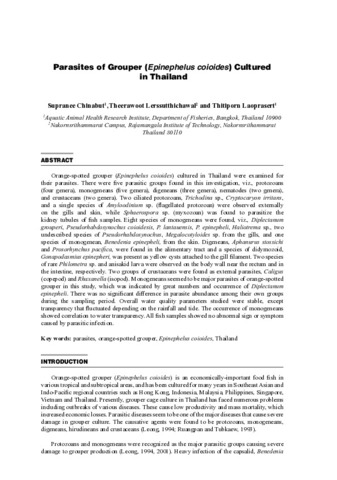
(Aquaculture Department, Southeast Asian Fisheries Development Center, 2005-03)Orange-spotted grouper (Epinephelus coioides) cultured in Thailand were examined for their parasites. There were five parasitic groups found in this investigation, viz., protozoans (four genera), monogeneans (five genera), digeneans (three genera), nematodes (two genera), and crustaceans (two genera). Two ciliated protozoans, Trichodina sp., Cryptocaryon irritans, and a single species of Amyloodinium sp. (flagellated protozoan) were observed externally on the gills and skin, while Sphaerospora sp. (myxozoan) was found to parasitize the kidney tubules of fish samples. Eight species of monogeneans were found, viz., Diplectanum grouperi, Pseudorhabdosynochus coioidesis, P. lantauensis, P. epinepheli, Haliotrema sp., two undescribed species of Pseudorhabdosynochus, Megalocotyloides sp. from the gills, and one species of monogenean, Benedenia epinepheli, from the skin. Digeneans, Aphanurus stossichi and Prosorhynchus pacifica, were found in the alimentary tract and a species of didymozoid, Gonapodasmius epinepheri, was present as yellow cysts attached to the gill filament. Two species of rare Philometra sp. and anisakid larva were observed on the body wall near the rectum and in the intestine, respectively. Two groups of crustaceans were found as external parasites, Caligus (copepod) and Rhaxanella (isopod). Monogeneans seemed to be major parasites of orange-spotted grouper in this study, which was indicated by great numbers and occurrence of Diplectanum epinepheli. There was no significant difference in parasite abundance among their own groups during the sampling period. Overall water quality parameters studied were stable, except transparency that fluctuated depending on the rainfall and tide. The occurrence of monogeneans showed correlation to water transparency. All fish samples showed no abnormal sign or symptom caused by parasitic infection. -
Parasites of commercially-important marine fish cultured in the Philippines
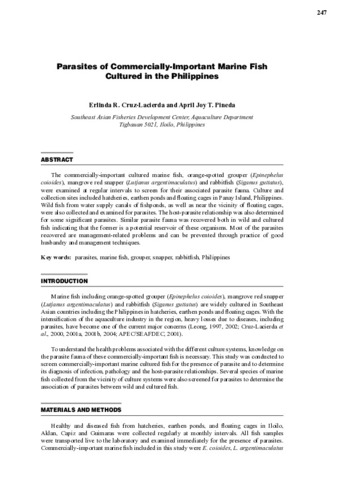
(Aquaculture Department, Southeast Asian Fisheries Development Center, 2005-03)The commercially-important cultured marine fish, orange-spotted grouper (Epinephelus coioides), mangrove red snapper (Lutjanus argentimaculatus) and rabbitfish (Siganus guttatus), were examined at regular intervals to screen for their associated parasite fauna. Culture and collection sites included hatcheries, earthen ponds and floating cages in Panay Island, Philippines. Wild fish from water supply canals of fishponds, as well as near the vicinity of floating cages, were also collected and examined for parasites. The host-parasite relationship was also determined for some significant parasites. Similar parasite fauna was recovered both in wild and cultured fish indicating that the former is a potential reservoir of these organisms. Most of the parasites recovered are management-related problems and can be prevented through practice of good husbandry and management techniques. -
Development of immunological indices for monitoring health status in shrimp (Penaeus monodon)
Amar, Edgar C.; ; (Aquaculture Department, Southeast Asian Fisheries Development Center, 2005-03)
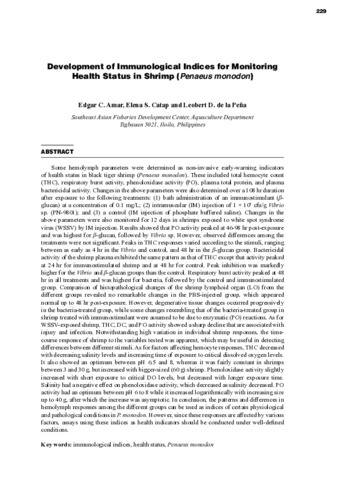
Some hemolymph parameters were determined as non-invasive early-warning indicators of health status in black tiger shrimp (Penaeus monodon). These included total hemocyte count (THC), respiratory burst activity, phenoloxidase activity (PO), plasma total protein, and plasma bactericidal activity. Changes in the above parameters were also determined over a 108 hr duration after exposure to the following treatments: (1) bath administration of an immunostimulant (β-glucan) at a concentration of 0.1 mg/L; (2) intramuscular (IM) injection of 1 × 10⁶ cfu/g Vibrio sp. (PN-9801); and (3) a control (IM injection of phosphate buffered saline). Changes in the above parameters were also monitored for 12 days in shrimps exposed to white spot syndrome virus (WSSV) by IM injection. Results showed that PO activity peaked at 46-98 hr post-exposure and was highest for β-glucan, followed by Vibrio sp. However, observed differences among the treatments were not significant. Peaks in THC responses varied according to the stimuli, ranging between as early as 4 hr in the Vibrio and control, and 48 hr in the β-glucan group. Bactericidal activity of the shrimp plasma exhibited the same pattern as that of THC except that activity peaked at 24 hr for immunostimulated shrimp and at 48 hr for control. Peak inhibition was markedly higher for the Vibrio and β-glucan groups than the control. Respiratory burst activity peaked at 48 hr in all treatments and was highest for bacteria, followed by the control and immunostimulated group. Comparison of histopathological changes of the shrimp lymphoid organ (LO) from the different groups revealed no remarkable changes in the PBS-injected group, which appeared normal up to 48 hr post-exposure. However, degenerative tissue changes occurred progressively in the bacteria-treated group, while some changes resembling that of the bacteria-treated group in shrimp treated with immunostimulant were assumed to be due to enzymatic (PO) reactions. As for WSSV-exposed shrimp, THC, DC, and PO activity showed a sharp decline that are associated with injury and infection. Notwithstanding high variation in individual shrimp responses, the time-course response of shrimp to the variables tested was apparent, which may be useful in detecting differences between different stimuli. As for factors affecting hemocyte responses, THC decreased with decreasing salinity levels and increasing time of exposure to critical dissolved oxygen levels. It also showed an optimum between pH 6.5 and 8, whereas it was fairly constant in shrimps between 3 and 30 g, but increased with bigger-sized (60 g) shrimp. Phenoloxidase activity slightly increased with short exposure to critical DO levels, but decreased with longer exposure time. Salinity had a negative effect on phenoloxidase activity, which decreased as salinity decreased. PO activity had an optimum between pH 6 to 8 while it increased logarithmically with increasing size up to 40 g, after which the increase was asymptotic. In conclusion, the patterns and differences in hemolymph responses among the different groups can be used as indices of certain physiological and pathological conditions in P. monodon. However, since these responses are affected by various factors, assays using these indices as health indicators should be conducted under well-defined conditions.

 RSS 1.0