
DSpace @ SEAFDEC/AQD
Southeast Asian Fisheries Development Center, Aquaculture Department Institutional Repository (SAIR) is the official digital repository of scholarly and research information of the department. This is to enable the effective dissemination of AQD researchers' in-house and external publications for free and online. The repository uses DSpace, an open source software, developed at Massachusetts Institute of Technology (MIT) Libraries. It is an Open Archives Initiative (OAI)-compliant.
Initially, the repository shall contain preprints, full-texts or abstracts of journal articles, books and conference proceedings written by SEAFDEC/AQD scientists and researchers. The aim is to promote these publications especially those published in international peer-reviewed journals and generate higher citation through increased visibility.
It will also provide free access to all in-house publications of SEAFDEC/AQD. Full-text digitized copies of fishfarmer-friendly materials like books, handbooks, policy guidebooks, conference proceedings, extension manuals, institutional reports, annual reports (AQD Highlights), and newsletters (SEAFDEC Asian Aquaculture, Aqua Farm News, AquaDept News and AQD Matters) can be retrieved and downloaded.
In the future, SAIR will expand its collection to include images, presentations, audios, and videos among others.
The objectives of the repository are to: (1) to provide reliable means for SEAFDEC/AQD researchers to store, preserve and share their research outputs and (2) to provide easy access and increase the visibility of SEAFDEC/AQD scientific publications
SAIR also aims to encourage SEAFDEC/AQD researchers for self-archiving and submitting pre-prints from which metadata will be screened and approved by the library staff.
このリポジトリのコミュニティ
ブラウズするコミュニティを選択してください。
-
01 SEAFDEC/AQD Publications [2146]
-
Brochures and flyers [57]
-
Posters [2]
-
-
Podcasts [1]
-
Milkfish Podcasts [1]
A series of podcasts on feeding strategies that can reduce the costs of milkfish culture
-
-
-
Books [142]
-
Handbooks [6]
-
Monographs [34]
-
-
Conference Proceedings [767]
-
Addressing Acute Hepatopancreatic Necrosis Disease (AHPND) and Other Transboundary Diseases for Improved Aquatic Animal Health in Southeast Asia [15]
Proceedings of the ASEAN Regional Technical Consultation on EMS/AHPND and Other Transboundary Diseases for Improved Aquatic Animal Health in Southeast Asia -
ADSEA '87 [20]
Proceedings of the Seminar on Aquaculture Development in Southeast Asia, 8-12 September 1987, Iloilo City, Philippines -
ADSEA '91 [21]
Proceedings of the Seminar-Workshop on Aquaculture Development in Southeast Asia and Prospects for Seafarming and Searanching, 19-23 August 1991, Iloilo City, Philippines -
ADSEA '94 [21]
Proceedings of the Seminar-Workshop on Aquaculture Development in Southeast Asia, Iloilo City, Philippines, 26-28 July, 1994 -
ADSEA '99 [21]
Proceedings of the Seminar-Workshop on Aquaculture Development in Southeast Asia -
Advances in milkfish biology and culture [18]
Proceedings of the second International Milkfish Aquaculture Conference, 4-8 October 1983, Iloilo City, Philippines -
Aquatic Emergency Preparedness and Response Systems for Effective Management of Transboundary Disease Outbreaks in Southeast Asia [20]
Proceedings of ASEAN Regional Technical Consultation, 20-22 August 2018, Centara Grand Central Ladprao, Bangkok, Thailand -
Breeding and Seed Production of Cultured Finfishes in the Philippines [31]
Proceedings of the Seminar-Workshop on Breeding and Seed Production of Cultured Finfishes in the Philippines, 4-5 May 1993, Tigbauan, Iloilo, Philippines -
Culture and use of algae in Southeast Asia [15]
Proceedings of the Symposium on Culture and Utilization of Algae in Southeast Asia, 8-11 December 1981, Tigbauan, Iloilo, Philippines -
Development and Use of Alternative Dietary Ingredients or Fish Meal Substitutes in Aquaculture Feed Formulation [18]
Proceedings of the ASEAN Regional Technical Consultation on Development and Use of Alternative Dietary Ingredients or Fish Meal Substitutes in Aquaculture Feed Formulation -
Disease Control in Fish and Shrimp Aquaculture in Southeast Asia – Diagnosis and Husbandry Techniques [15]
Proceedings of the SEAFDEC-OIE Seminar-Workshop on Disease Control in Fish and Shrimp Aquaculture in Southeast Asia – Diagnosis and Husbandry Techniques, 4-6 December 2001, Iloilo City, Philippines -
Feeds for Small-scale Aquaculture [23]
Proceedings of the National Seminar-Workshop on Fish Nutrition and Feeds, Tigbauan, Iloilo, Philippines, 1 -2 June 1994 -
International Milkfish Workshop Conference [22]
Proceedings of the International Milkfish Workshop Conference, May 19-22, 1976, Tigbauan, Iloilo, Philippines -
International Seminar-Workshop on Mud Crab Aquaculture and Fisheries Management (ISMAF 2013) [15]
Proceedings of the International Seminar-Workshop on Mud Crab Aquaculture and Fisheries Management, 10 - 12 April 2013 -
International Workshop on Pen and Cage Culture of Fish [23]
Proceedings of the International Workshop on Pen Cage Culture of Fish, 11-12 February 1979, Tigbauan, Iloilo, Philippines -
Mangrove Friendly Aquaculture [18]
Proceedings of the Workshop on Mangrove-Friendly Aquaculture organized by the SEAFDEC Aquaculture Department, January 11-15, 1999, Iloilo City, Philippines -
National Bangos Symposium [22]
Proceedings of the National Bangos Symposium, Philippine Village Hotel, Punta Baluarte, July 25-28 1975 -
Philippines : In the forefront of the mud crab industry development [44]
Proceedings of the 1st National Mud Crab Congress -
Prawn Industry Development in the Philippines [11]
Proceedings of the National Prawn Industry Development Workshop, 10-13 April 1984, Iloilo City, Philippines -
Promotion of Sustainable Aquaculture, Aquatic Animal Health, and Resource Enhancement in Southeast Asia (SARSEA) [31]
Proceedings of the International Workshop on the Promotion of Sustainable Aquaculture, Aquatic Animal Health, and Resource Enhancement in Southeast Asia 25–27 June 2019, Iloilo City, Philippines -
Sustainable Aquaculture Development for Food Security in Southeast Asia Towards 2020 [17]
Proceedings of the Regional Technical Consultation on Sustainable Aquaculture Development in Southeast Asia Towards 2020 held from 17 to 19 March 2010 in Bangkok, Thailand -
Technical Consultation on Available Aquaculture Technology in the Philippines [37]
Technical Consultation on Available Aquaculture Technology in the Philippines, February 8-11, 1979 -
Transboundary Fish Diseases in Southeast Asia: Occurence, Surveillance, Research and Training [20]
Proceedings of the Meeting on Current Status of Transboundary Fish Diseases in Southeast Asia: Occurence, Surveillance, Research and Training, Manila, Philippines, 23-24 June 2004 -
Understanding Current Challenges and Future Prospects in Integrated Multi-Trophic Aquaculture (IMTA) Research [12]
Proceedings of the JIRCAS-SEAFDEC/AQD Joint Workshop on IMTA Research held at SEAFDEC/AQD, Tigbauan Main Station, Iloilo, Philippines on 6-8 August 2019 -
Use of Chemicals in Aquaculture in Asia [19]
Proceedings of the Meeting on the Use of Chemicals in Aquaculture in Asia 20-22 May 1996, Tigbauan, Iloilo, Philippines
-
-
-
Institutional Reports [180]
-
Annual Reports [47]
-
Biennial Reports [3]
-
Terminal Reports [1]
-
Terminal Reports [1]
-
-
Meeting Reports [111]
-
Recent Developments in the Genetic Improvement of the Giant Freshwater Prawn (Macrobrachium sp.) [14]
A compendium of results from the Collaborative Prawn Genetic Improvement and Seed Production Research Project under the Promotion of Sustainable Aquaculture in the ASEAN Region (2002 - 2007) -
Technologies in Mangrove-Friendly Aquaculture [16]
Final Report of and Papers Presented to the On-Site Training on Mangrove-Friendly Aquaculture, Hai Phong City, Socialist Republic of Vietnam 19-30 April 1999
-
-
Journals/Magazines [591]
-
Aqua Farm News [286]
-
-
Newsletters [186]
-
AQD Matters [162]
In-house newsletter of the SEAFDEC Aquaculture Department -
Aqua Dep't News [23]
Internal newsletter of the SEAFDEC Aquaculture Department -
FishWorld Matters [1]
Newsletter of SEAFDEC FishWorld, Tigbauan, Iloilo, Philippines
-
-
-
Code of Practice [1]
-
-
-
Technical Reports [13]
-
-
-
-
Fish Health Section [43]
-
Diseases in Asian aquaculture IV [43]
Proceedings of the Fourth Symposium on Diseases in Asian Aquaculture, 22-26 November 1999, Cebu City, Philippines
-
-
-
-
Reports [1]
-
-
-
-
Philippine Council for Agriculture, Aquatic and Natural Resources Research and Development (PCAARRD) [69]
-
Manuals [1]
-
-
LakeCon2011 [30]
2nd National Congress on Philippine Lakes -
Tilapia Farming [9]
Proceedings of the First National Symposium and Workshop on Tilapia Farming, PCARRD, Los Baños, Laguna, November 24-26, 1986
-
-
-
-
-
-
-
-
Disease Control in Fish and Shrimp Aquaculture in Southeast Asia – Diagnosis and Husbandry Techniques [15]
Proceedings of the SEAFDEC-OIE Seminar-Workshop on Disease Control in Fish and Shrimp Aquaculture in Southeast Asia – Diagnosis and Husbandry Techniques, 4-6 December 2001, Iloilo City, Philippines -
Recent Advances in Diagnosis and Prevention of Fish and Shrimp Diseases in Southeast Asia [43]
Terminal Report of the Regional Fish Disease Project on “Development of Fish Disease Inspection Methodologies for Artificially-Bred Seeds” Funded by the Government of Japan Trust Fund from 2000 to 2004 -
Transboundary Fish Diseases in Southeast Asia: Occurence, Surveillance, Research and Training [20]
Proceedings of the Meeting on Current Status of Transboundary Fish Diseases in Southeast Asia: Occurence, Surveillance, Research and Training, Manila, Philippines, 23-24 June 2004
-
-
-
Sustainable Production Systems of Aquatic Animals in Brackish Mangrove Areas [13]
Proceedings of the 2nd Workshop of the JIRCAS International Collaborative Research
-
-
-
International Seminar-Workshop on Mud Crab Aquaculture and Fisheries Management (ISMAF 2013) [15]
Proceedings of the International Seminar-Workshop on Mud Crab Aquaculture and Fisheries Management, 10 - 12 April 2013
-
-
-
SEAFDEC/AQD-Southeast Asian Regional Center for Graduate Study and Research in Agriculture (SEARCA) [49]
-
LakeCon2003 [49]
Proceedings of the First National Congress on Philippine Lakes
-
-
-
-
Milkfish Podcasts [1]
A series of podcasts on feeding strategies that can reduce the costs of milkfish culture
-
-
-
Others [1]
-
-
Books and Book Chapters [123]
-
Conference Proceedings [300]
-
Journal Articles [1267]
These papers were contributed by Department staff to various national and international journals. -
Patents [5]
-
-
-
Fish for the People [41]
These articles were contributed by SEAFDEC/AQD staff to Fish for the People Magazine -
Magazine Articles [20]
-
-
Theses and Dissertations [5]
These are theses and dissertations by SEAFDEC/AQD Researchers that were funded/sponsored by AQD.-
Masters Theses [2]
-
Recently Added
-
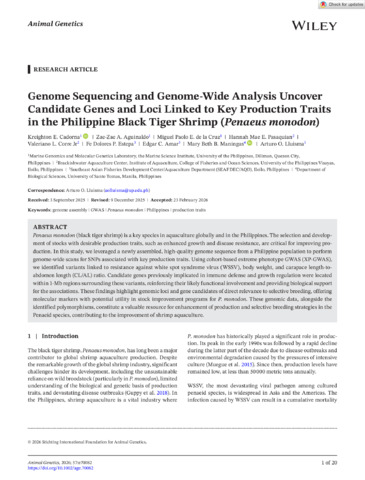
Genome sequencing and genome-wide analysis uncover candidate genes and loci linked to key production traits in the Philippine black tiger shrimp (Penaeus monodon)
Cadorna, Kreighton ; Aguinaldo, Zae-Zae ; ; ; ; Estepa, Fe Dolores ; Amar, Edgar ; ; (Wiley, 2026-03-16)
Penaeus monodon (black tiger shrimp) is a key species in aquaculture globally and in the Philippines. The selection and development of stocks with desirable production traits, such as enhanced growth and disease resistance, are critical for improving production. In this study, we leveraged a newly assembled, high-quality genome sequence from a Philippine population to perform genome-wide scans for SNPs associated with key production traits. Using cohort-based extreme phenotype GWAS (XP-GWAS), we identified variants linked to resistance against white spot syndrome virus (WSSV), body weight, and carapace length-to-abdomen length (CL/AL) ratio. Candidate genes previously implicated in immune defense and growth regulation were located within 1-Mb regions surrounding these variants, reinforcing their likely functional involvement and providing biological support for the associations. These findings highlight genomic loci and gene candidates of direct relevance to selective breeding, offering molecular markers with potential utility in stock improvement programs for P. monodon. These genomic data, alongside the identified polymorphisms, constitute a valuable resource for enhancement of production and selective breeding strategies in the Penaeid species, contributing to the improvement of shrimp aquaculture.
; Aguinaldo, Zae-Zae ; ; ; ; Estepa, Fe Dolores ; Amar, Edgar ; ; (Wiley, 2026-03-16)
Penaeus monodon (black tiger shrimp) is a key species in aquaculture globally and in the Philippines. The selection and development of stocks with desirable production traits, such as enhanced growth and disease resistance, are critical for improving production. In this study, we leveraged a newly assembled, high-quality genome sequence from a Philippine population to perform genome-wide scans for SNPs associated with key production traits. Using cohort-based extreme phenotype GWAS (XP-GWAS), we identified variants linked to resistance against white spot syndrome virus (WSSV), body weight, and carapace length-to-abdomen length (CL/AL) ratio. Candidate genes previously implicated in immune defense and growth regulation were located within 1-Mb regions surrounding these variants, reinforcing their likely functional involvement and providing biological support for the associations. These findings highlight genomic loci and gene candidates of direct relevance to selective breeding, offering molecular markers with potential utility in stock improvement programs for P. monodon. These genomic data, alongside the identified polymorphisms, constitute a valuable resource for enhancement of production and selective breeding strategies in the Penaeid species, contributing to the improvement of shrimp aquaculture. -
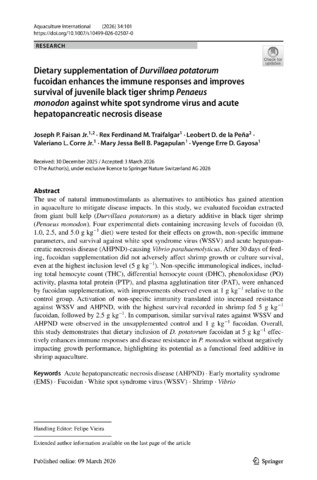
Dietary supplementation of Durvillaea potatorum fucoidan enhances the immune responses and improves survival of juvenile black tiger shrimp Penaeus monodon against white spot syndrome virus and acute hepatopancreatic necrosis disease
Faisan, Joseph P., Jr.; Traifalgar, Rex Ferdinand ; ; ; ; Gayosa, Vyenge Erre (Springer, 2026-03-09)
The use of natural immunostimulants as alternatives to antibiotics has gained attention in aquaculture to mitigate disease impacts. In this study, we evaluated fucoidan extracted from giant bull kelp (Durvillaea potatorum) as a dietary additive in black tiger shrimp (Penaeus monodon). Four experimental diets containing increasing levels of fucoidan (0, 1.0, 2.5, and 5.0 g kg−1 diet) were tested for their effects on growth, non-specific immune parameters, and survival against white spot syndrome virus (WSSV) and acute hepatopancreatic necrosis disease (AHPND)-causing Vibrio parahaemolyticus. After 30 days of feeding, fucoidan supplementation did not adversely affect shrimp growth or culture survival, even at the highest inclusion level (5 g kg−1). Non-specific immunological indices, including total hemocyte count (THC), differential hemocyte count (DHC), phenoloxidase (PO) activity, plasma total protein (PTP), and plasma agglutination titer (PAT), were enhanced by fucoidan supplementation, with improvements observed even at 1 g kg−1 relative to the control group. Activation of non-specific immunity translated into increased resistance against WSSV and AHPND, with the highest survival recorded in shrimp fed 5 g kg−1 fucoidan, followed by 2.5 g kg−1. In comparison, similar survival rates against WSSV and AHPND were observed in the unsupplemented control and 1 g kg−1 fucoidan. Overall, this study demonstrates that dietary inclusion of D. potatorum fucoidan at 5 g kg−1 effectively enhances immune responses and disease resistance in P. monodon without negatively impacting growth performance, highlighting its potential as a functional feed additive in shrimp aquaculture. -
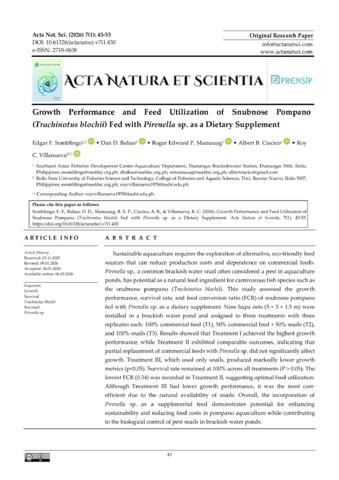
Growth performance and feed utilization of snubnose pompano (Trachinotus blochii) fed with Pirenella sp. as a dietary supplement
Somblingo, Edgar; ; Mamauag, Roger Edward ; Ciacico, Albert ; Villanueva, Roy (Prensip Publishing, 2026-03-06)
Sustainable aquaculture requires the exploration of alternative, eco-friendly feed sources that can reduce production costs and dependence on commercial feeds. Pirenella sp., a common brackish water snail often considered a pest in aquaculture ponds, has potential as a natural feed ingredient for carnivorous fish species such as the snubnose pompano (Trachinotus blochii). This study assessed the growth performance, survival rate, and feed conversion ratio (FCR) of snubnose pompano fed with Pirenella sp. as a dietary supplement. Nine hapa nets (5 × 5 × 1.5 m) were installed in a brackish water pond and assigned to three treatments with three replicates each: 100% commercial feed (T1), 50% commercial feed + 50% snails (T2), and 100% snails (T3). Results showed that Treatment I achieved the highest growth performance, while Treatment II exhibited comparable outcomes, indicating that partial replacement of commercial feeds with Pirenella sp. did not significantly affect growth. Treatment III, which used only snails, produced markedly lower growth metrics (p<0.05). Survival rate remained at 100% across all treatments (P > 0.05). The lowest FCR (0.34) was recorded in Treatment II, suggesting optimal feed utilization. Although Treatment III had lower growth performance, it was the most cost-efficient due to the natural availability of snails. Overall, the incorporation of Pirenella sp. as a supplemental feed demonstrates potential for enhancing sustainability and reducing feed costs in pompano aquaculture while contributing to the biological control of pest snails in brackish water ponds. -
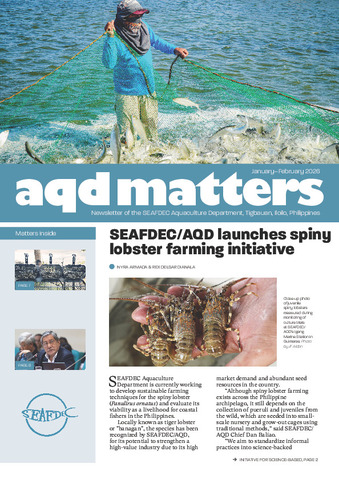
AQD Matters 2026 January - February
(Aquaculture Department, Southeast Asian Fisheries Development Center, 2026-03)In this issue: 1) SEAFDEC/AQD launches spiny lobster farming initiative; 2) Community hatchery supplies prawn postlarvae with SEAFDEC/AQD support; 3) SEAFDEC/AQD joins aquaculture fair in Turkey; 4) Igang Marine Station ... -
SEAFDEC/AQD
(Aquaculture Department, Southeast Asian Fisheries Development Center, 2026-03)The SEAFDEC Aquaculture Department (AQD) is a regional treaty organization established in 1973 in the Philippines with a mandate to promote sustainable tropical aquaculture through research, training, and information ...
 RSS 1.0